The Runner’s Nutrition Manual: How to Eat for Energy, Endurance, and Fat Loss

If you’re serious about running faster, farther, and injury-free, you can’t treat nutrition like an afterthought.

Most runners obsess over mileage and splits — but many ignore the one thing that powers it all: fuel.

Here’s the hard truth: you can’t out-train bad nutrition.

You can nail every workout and follow the perfect plan, but if your body’s running on empty, you’ll never unlock your real potential. Food is what turns miles into fitness. It’s what rebuilds muscle, restocks glycogen, sharpens your focus, and keeps you healthy enough to train tomorrow.

This isn’t about trendy diets or cutting carbs. It’s about giving your body what it needs — every run, every workout, every race. The right fueling strategy doesn’t just make you feel better; it’s the difference between hitting the wall and powering through.

In this guide, you’ll learn exactly how to eat, drink, and recover like a runner. No guesswork. No fads. Just proven, real-world strategies backed by science — and tested on the road, track, and trail.


Table of Contents

  1. Why Nutrition is the Missing Piece Most Runners Skip
  2. Macronutrients for Runners: Carbs, Protein, and Fat
    • Carbs: Your High-Octane Running Fuel
    • Protein: Rebuild and Recover Stronger
    • Healthy Fats: Hormones, Recovery, and Endurance
  3. Electrolytes: The Salty Secret to Stronger Runs
  4. Pre-Run Fueling Strategies
  5. Post-Run Recovery Nutrition
  6. Mid-Run Fueling: How to Avoid the Bonk
  7. Race Day Fueling: Practice, Plan, and Perform

Why Nutrition Is the Missing Piece Most Runners Skip

I hate to sound like a broken record but here’s the deal: You can’t outrun bad fueling.

You can log all the miles, crush the speed workouts, follow the perfect plan — but if you’re skimping on food, you’re basically trying to drive a race car on empty.

So let’s stop glorifying under-fueling and chasing some false “lighter is faster” mindset.

Truth is, fueling is faster.

The runners who eat right recover better, feel stronger, and show up on race day ready to roll.

Every hard run breaks your body down. Food — not just time — is what rebuilds it.

  • Carbs restock glycogen so you don’t bonk.
  • Protein repairs those micro-tears in your muscles.
  • Micronutrients (think iron, B12, electrolytes) keep your system running clean.

Ignore nutrition, and it’ll catch up to you: sluggish runs, flat legs, mood swings, recurring injuries, or just feeling… blah.

So forget fad diets. Forget eating like a bird. This isn’t about starving to get faster — it’s about fueling like an athlete to train and recover like one.

Now let’s dive into the practical stuff.

Macronutrients for Runners:

 Let’s break down the big three macros: Carbs. Protein. Fat. (And yes, electrolytes — but we’ll hit those later.)


Carbohydrates: Your High-Octane Running Fuel

Carbs aren’t optional for runners — they’re non-negotiable.

They’re your body’s #1 fuel source for running — especially when you pick up the pace or go long. Your muscles store carbs as glycogen, and once that tank runs low, you bonk. Hard.

That dead-leg feeling halfway through a long run? That crash during a tempo session? That’s usually a carb problem.

How much do you need?

  • Aim for 5–12 grams of carbs per kg of body weight per day
  • A 70kg runner = 350–700g/day, depending on training load

That’s a lot of carbs. And no, that’s not too much. It’s what your body burns when you train hard — especially at moderate to high intensity.


Everyday Carbs vs. Workout Carbs

Daily meals? Stick with slow-digesting, complex carbs:

  • Oats
  • Sweet potatoes
  • Whole grain bread
  • Brown rice
  • Beans, lentils
  • Fruits & veggies

These give you sustained energy and help with recovery.

Before or during workouts? You want quick, easy-to-digest carbs:

  • Banana
  • White bread with jam
  • Sports gels or drinks
  • Dates or dried fruit
  • Rice cakes

Fast carbs = fast energy. No shame in that. It’s about fueling the run — not your Instagram.


Why Low-Carb + Running = Recipe for Disaster

Low-carb diets may work for desk jobs or light gym goers — but for runners? It’s like cutting the brakes and wondering why you can’t stop.

Studies show that runners on keto or low-carb plans may be able to jog slowly forever — but they can’t hit top gear. Their high-end performance tanks. Why? Because fat can’t fuel fast. Once you’re above 70% of your VO₂max, your body needs carbs to keep pace.

Want to run fast? Climb strong? Push hard in the final miles?
You need carbs. Lots of them.

Don’t get me wrong. I like low carb diet (especially when it comes to weight loss) and have run a marathon last year while on keto. But when it comes to performance, it’s the best diet. 

Protein: Rebuild, Recover, and Run Stronger

Most runners obsess over carbs—and yeah, carbs are king for fuel. But protein? That’s your rebuild-and-repair crew.

Every footstrike causes tiny tears in muscle tissue. Protein is what patches those up—and makes you stronger.

It’s not just for bodybuilders. Runners need it to adapt, recover, and hang onto lean muscle.

It keeps your stride strong and your metabolism firing, especially if you’re training hard or trying to lose weight.


How Much Protein Do You Actually Need?

More than you think. The American College of Sports Medicine recommends 1.2–1.4 g/kg/day for endurance athletes—but newer research shows 1.6–2.0 g/kg/day (or ~0.7–0.9 g per pound of body weight) is even better.

Let’s break it down:

  • If you weigh 132 lbs (60 kg), that’s 95–120+ grams of protein a day.
  • Trying to lose fat while training? Go higher to protect your muscle.

Protein helps reduce soreness, repair damage, and build new mitochondria (your energy factories).

It also plays a huge role in keeping your immune system strong and your hunger in check.


What Does That Look Like in Real Life?

You don’t need to chug shakes or grill chicken five times a day. Just spread it out. Aim for:

  • 20–30g per main meal
  • 10–20g in snacks

That “protein drip” keeps your recovery rolling all day.

Sample Day:

  • Breakfast: Greek yogurt + fruit (~20g)
  • Lunch: Turkey sandwich or tofu bowl (~25g)
  • Post-run: Chocolate milk or protein shake (~20g)
  • Dinner: Quinoa + chicken or tempeh (~30g)
  • Evening snack: Almonds, protein bar, or cottage cheese (~15g)

Easy. Not excessive. Just strategic.


Timing Matters—but Don’t Obsess

You don’t need to slam a shake 5 minutes after your run like a powerlifter. But yeah—getting protein within an hour or so post-run helps. Especially if it’s a tough session.

So what’s ideal? Pair protein + carbs after a run for max recovery:

  • Chocolate milk
  • Smoothie with fruit + protein powder
  • Sandwich
  • Yogurt with granola

The “30-minute anabolic window” isn’t a brick wall—it’s a suggestion. But don’t wait 3 hours, either.


Quality Counts

Your body runs on amino acids—some of which it can’t make on its own. So you need:

  • Complete proteins: Meat, fish, eggs, dairy, soy.
  • Combo sources: Beans + rice, lentils + grains, etc.
  • Plant-based? You’re covered—you just need a little more planning and maybe a protein powder backup. Tempeh, seitan, tofu, quinoa, legumes—stack them smart and you’re golden.

The Hidden Power of Protein

Protein isn’t just about muscles:

  • It fuels enzyme and hormone production
  • Supports immune function
  • Keeps you full and focused
  • And if your carbs are low? Your body taps protein for energy (not ideal, but it happens)—better to eat it than have your body break down its own muscle for fuel

Training hard and not eating enough protein? You’re not just sore—you’re losing ground. Make it part of your plan, not an afterthought.

Fat: Long-Lasting Fuel and Vital Support

Fat’s had a bad rap in the past, but let’s clear that up—runners need fat.

You may not be burning it at race pace, but on long aerobic runs? It’s pulling weight.


Why Fat Matters:

  • It’s your slow-burning fuel on long, easy efforts.
  • It supports hormones like estrogen and testosterone (yes, even for men).
  • It helps you absorb key vitamins—A, D, E, K.
  • And it keeps you from feeling like a zombie between meals.

Even lean runners carry tens of thousands of calories in stored fat. When you train consistently, your body gets better at tapping into that. That’s how you spare glycogen for when you need to hit the gas.


Warning for Low-Fat Eaters

If you’re barely getting any fat—especially female runners—you could run into issues:

  • Hormonal imbalances
  • Menstrual disruption
  • Mood swings
  • Recovery problems
  • Increased injury risk

Low fat = low hormone output = low performance over time.

Don’t fall into that trap.


Smart Fat Sources:

  • Avocados
  • Nuts & seeds
  • Olive oil
  • Fatty fish (salmon, sardines)
  • Nut butters
  • Whole eggs

You don’t need to go keto. Just include moderate healthy fats in your meals, and don’t fear them.

Why You Need Fat

  • Omega-3s (found in salmon, sardines, walnuts, flax, chia seeds) are anti-inflammatory, support joint health, and may even improve oxygen delivery by making red blood cells more flexible. That means smoother blood flow = better performance.
  • Most runners don’t get enough of these, so it’s smart to add fatty fish to your weekly meals or consider a fish oil or algae-based supplement if you’re plant-based.

How Much?

Rough guideline:

  • 20–30% of your calories from fat
  • That’s about 0.8–1.5 grams per kg of bodyweight per day for most runners

Easy Daily Sources:

  • Olive oil on your salad
  • Avocado on toast or in your wrap
  • Nut butter in your oatmeal
  • A small handful of almonds as a snack

Focus on unsaturated fats—olive oil, nuts, seeds, fish. A little saturated fat from meat or dairy is okay, but don’t let that be the bulk.

Just don’t load up on high-fat meals right before a run. Fat digests slowly and can cause stomach issues. Save the bacon cheeseburger for your post-run reward.


Electrolytes: The Salty Secret to Better Runs

Electrolytes don’t get enough attention—but if you’ve ever cramped up mid-run, bonked hard, or felt dizzy after a long sweat fest… you know they matter.

The Big Five:

  • Sodium (most important for runners)
  • Potassium
  • Magnesium
  • Calcium
  • Chloride

These minerals run the show behind the scenes—regulating fluid balance, muscle contractions, nerve signals, and keeping your body cool under stress.

Sodium: Your MVP

You sweat it out in the highest amounts. And if you only replace water and ignore sodium? You risk hyponatremia—that’s low blood sodium. It’s rare, but when it hits, it hits hard (think confusion, weakness, even collapse).

You lose 500–1000 mg of sodium per hour when sweating hard. On hot days? Even more. 

Rule of Thumb:

  • Runs under 1 hour? You’re probably fine without extra electrolytes—just hydrate after.
  • Runs over 1 hour (especially in heat)? Time to add salt:
    • Sports drink
    • Electrolyte tabs or capsules
    • Salty snacks or gels

You don’t need to chug saltwater—but you do need to replace some of what you’re losing.

How Much?

Start with 300–600 mg of sodium per hour and adjust based on how salty you sweat (salt crust on your hat? You’re a heavy salt sweater). Some runners need up to 800+ mg/hr.

Pro tip: Don’t try to replace 100%. You’ll overload your stomach. Aim for 50–80% of what you’re losing.

Other Electrolytes:

  • Potassium & Magnesium usually get replenished through food (fruit, veggies, nuts, whole grains).
  • But if you’re doing multi-hour or back-to-back workouts, low magnesium can sneak up—contributing to cramps and lingering soreness.

A banana, handful of nuts, or leafy greens post-run usually has you covered.


During Training:

  • Try different hydration options on your long runs—don’t wait for race day.
  • Some runners do great with sports drinks. Others prefer salt caps and plain water.
  • Experiment now, not mid-marathon.

Before Race Day:

Start 24–48 hours out. Add a little extra salt to meals.

  • Soup, salted pretzels, soy sauce on rice = easy sodium loading.
  • Pair with water to hold onto hydration better.

What to Eat Before Running (Without Messing Up Your Stomach)

Let’s be real—what you eat before a run can make or break it.

Eat the wrong thing, or eat too close to go-time? You’ll find yourself doubled over with cramps, or scouting every porta-potty in sight.

The goal isn’t to “load up” like it’s race day every time you run.

It’s to top off your tank without making your gut miserable. That means carbs your body can use, small portions, and smart timing.


Timing Is Everything

How much time do you have before your run? That changes the game.

Got 2–3 Hours?

You can go with a solid, balanced meal. Something like:

  • Oatmeal with banana and peanut butter
  • A turkey sandwich and fruit
  • A bagel with jam and a boiled egg

This gives you carbs for fuel, a little protein to hold you over, and enough time to digest it all before you hit the pavement.

Got 60–90 Minutes?

Go smaller. Try:

  • A slice or two of toast with peanut butter and honey
  • A banana with a spoonful of almond butter
  • Yogurt with a bit of granola

You want mostly carbs with a little fat or protein. Not too much. You’re fueling, not feasting.

Only 15–30 Minutes?

Keep it super simple and fast-digesting:

  • Half a banana
  • A few swigs of a sports drink
  • A small rice cake with a dab of honey
  • Half a granola bar (low fat/fiber)

Anything more and it’ll sit like a brick once you start moving. This is just enough to prevent a crash mid-run.


What to Eat: Keep It Simple, Keep It Light

Here’s what works for a lot of runners (and what’s worked for me):

  • Toast with jam or banana – quick carbs, easy on the stomach
  • Banana + nut butter – fast fuel plus a little staying power
  • Oatmeal with honey (2+ hours pre-run only) – great base if you’ve got time
  • Energy bar or half-bar – if you’ve tested it and it doesn’t wreck your gut
  • Rice cake with honey or soy sauce – low fiber, quick energy
  • Yogurt with fruit (low-fat) – works if dairy agrees with you

One rule of thumb: 75% carbs, 15% protein, 10% fat. That’s the rough balance your body will thank you for pre-run. Not a giant greasy meal. Not a high-fiber salad. Definitely not eggs and bacon 10 minutes before heading out.


What to Avoid

  • Big meals too close to your run
  • High-fat, high-protein, or high-fiber foods
  • Spicy stuff (you’ll regret it)
  • Anything totally new—don’t experiment on race morning

If you eat too much or too soon, you’ll feel heavy and slow. If you eat the wrong thing, you might end up making an emergency bathroom stop. You don’t want either.


Practice Makes Comfortable

Long run coming up? Race simulation? Test your food strategy. This is your chance to figure out what sits well, what gives you energy, and what makes you feel like you swallowed a dumbbell.

Everyone’s different. Some folks can run after a full breakfast. Others need a strict 2-hour digestion window or it’s game over.

Anything shorter than a 3-hour window after a heavy meal is a no-go for me.

I always tell runners: Use training to find your pre-run sweet spot. Figure out your “banana and toast” combo. Then on race day? Stick to the plan.

Golden rule: Nothing new on race day. That includes food.

What to Eat After Running: Refuel to Rebuild

Let’s be clear: the run isn’t over when you stop your watch. What you do next — especially what you eat next — is just as important.

Your body’s in recovery mode the second you finish. The tanks are low, the muscles are dinged up, and the repair process is ready to go — but only if you give it the fuel it needs.

Post-run nutrition = faster recovery, better training gains, and fewer days spent waddling around sore and stiff. Here’s how to do it right.


Timing: The 30–90 Minute Sweet Spot

You might’ve heard of the “30-minute anabolic window.” Yes, the sooner you refuel, the better. But don’t freak out if you don’t slam a shake immediately.

Just aim to eat something within the first 30–60 minutes, especially after long runs or hard efforts. After 90 minutes, your body’s still refueling — just not as efficiently.

Big mistake? Waiting 3–4 hours to eat after a run. That’s how you end up ravenous, under-recovered, and face-first in a bag of chips.


The Carb + Protein Combo (The Recovery Power Duo)

After a run, your body needs two things:

  1. Carbs – to refill muscle glycogen (your energy stores)
  2. Protein – to repair and rebuild muscle fibers

The magic ratio? About 3:1 or 4:1 carbs to protein, by grams.

For most runners, that’s about 50–70g carbs and 15–20g protein within an hour of finishing.


Real-World Recovery Food Ideas

Here’s what that looks like on a plate (or in a bottle):

  • Chocolate milk (or soy version): 16 oz = ~50g carbs, 12g protein + hydration
  • Smoothie: banana + berries + Greek yogurt or protein powder = ~60g carbs, 20g protein
  • Greek yogurt parfait: granola + berries + drizzle of honey = ~40g carbs, 20g protein
  • PB&J + milk: classic, effective, tasty
  • Recovery bar + sports drink: for on-the-go fueling
  • Oatmeal + eggs: great breakfast combo
  • Rice or pasta + lean meat: post-evening run dinner fuel

Pro tip: If you’re queasy right after a run (common), sip something first — sports drink, chocolate milk — then eat solid food a bit later. Just don’t wait too long.


Don’t Forget Hydration (It’s Recovery Too)

Sweat a lot? You lost more than water — you lost salt too. So don’t just chug plain water.

A good rule of thumb:

  • For every pound lost post-run, drink 16–24 oz of fluid
  • Include sodium (sports drink, salty snack, or electrolyte tab)

Be careful with overhydrating on water alone — that can dilute your sodium levels (hyponatremia). That’s why a salty snack or electrolyte drink post-run is a smarter move than plain water alone.

Simple rule:

Drink until your pee is pale. Light yellow = hydrated. Dark = keep sipping.


Don’t Skip Recovery Calories (Even If You’re Trying to Lose Weight)

I get it — you just ran and want to “bank” those calories for later. But skipping your recovery meal is the worst move you can make if weight loss is part of the picture.

Why? Because:

  • You’ll feel hungrier later (and probably overeat)
  • You’ll slow down your recovery
  • Your body might respond by holding onto fat or burning muscle

💥 Fueling after a run isn’t “undoing” your workout — it’s completing it. It tells your body,

“Hey, we’re safe. Now get stronger.”

Recovery Nutrition: It’s Not Over Until You Eat

Let’s get this straight — your run isn’t finished when you stop your watch. It’s done when you’ve refueled.

There’s this myth that recovery has to be some fancy shake or $40 supplement blend.

Total BS.

You don’t need a lab-made powder to recover well.

Real food works.

The magic formula? Carbs + protein + fluids. That’s it.

Shake Optional, Not Required

Sure, shakes are convenient. Easy to chug when you’re not in the mood to chew. But they’re not mandatory.

Example:

  • Runner A: Has a whey protein shake and a banana
  • Runner B: Eats a bowl of cereal with milk and berries

Both get the job done. Both rebuild muscles and restock glycogen. You don’t need to blow money on a branded “recovery matrix” — just have a plan and eat something decent soon after you run.


Timing Matters — But Don’t Panic Over Minutes

Yes, there’s a “recovery window.” No, it doesn’t slam shut at exactly 30:00 on the clock.

But the sooner you refuel, the better you’ll feel — later that day, tomorrow, and the next workout.

Ideal? Within 30–60 minutes. But if you’re not hungry, start with something small:

  • Sports drink
  • Banana
  • Pretzels and a protein bar
    Then eat a proper meal a bit later. That’s a solid one-two punch.

Skip the post-run meal altogether? That’s when you start paying the price — heavy legs, energy crash, sore muscles that won’t bounce back. Don’t do that to yourself.

Bottom line: Eat something. Don’t overthink it. Your body’s screaming for nutrients — listen to it.


Real-World Refueling Example (10-Mile Run)

You finish a long run. Here’s what good refueling looks like:

  • Immediately: Bottle of sports drink (~30g carbs), handful of pretzels (~20g carbs + salt), protein bar (~15g protein, 25g carbs)
  • An hour later: Rice bowl with chicken and veggies, plus fruit

That combo gives you carbs to replenish, protein to rebuild, fluids to rehydrate, and salt to help retain it all. That’s how you recover like a pro.


Delayed Refueling = Sluggish Recovery

You skip the snack. You wait until lunch. What happens?

  • You feel drained all day.
  • Your legs feel heavy tomorrow.
  • Your next run feels like dragging a dead body.

Fix it: Prioritize post-run nutrition like you do your gear or your watch. It’s not a “bonus.” It’s the final mile of your training.


Fueling During Runs & Races: What to Eat, When to Eat, and Why It Matters

Let’s get one thing clear: fueling isn’t about being fancy—it’s about staying on your feet and finishing strong.

Whether it’s a long run or race day, your body’s burning through glycogen like firewood in winter. Wait too long to refuel, and you’ll feel it—the fade, the fog, the dreaded bonk.

So here’s how to fuel smart, without making it complicated.


What Counts as Fuel?

Whatever works for you—energy gels, chews, sports drinks, bananas, dates, even boiled potatoes with salt (ultra runners swear by ‘em).

The goal is simple: get carbs in, and make sure it’s easy to digest.

Modern gels and drinks often mix glucose + fructose so your gut can absorb more—up to 90g/hour if trained.

But don’t stress the math—any basic gel or sports drink works fine for most runners. Some go with candy or dried fruit—also fair game as long as it’s low fiber and sits well.

The key is: train with it before race day. Don’t surprise your gut mid-race.


Fueling by Run Duration & Race Type

Runs under 60 minutes

✅ Usually no fuel needed. You’ve got enough stored glycogen to cover it—unless it’s super intense or you skipped breakfast.

Then maybe sip a sports drink or pop a gel halfway. Otherwise, water’s plenty.


Runs 60–90 minutes

 “It depends” zone.

  • Easy 75-min jog? Probably fine with water.
  • Hard 90-min tempo or long 15K race? Bring fuel.
    Try 30g carbs—1 gel or a bottle of sports drink. Many half marathoners use 1–2 gels in races this long.

Long Runs (90+ minutes)

Now we’re talkin’. This is when fueling becomes essential. Start fueling after 45–60 minutes, then every 30–45 min after that.

Example for 2.5-hour long run:

  • Gel at 45 min
  • Another at 1:30
  • Maybe one more at 2:15

Some runners prefer small sips of sports drink or half a gel every 20 min. Doesn’t matter how you break it up—just don’t wait till you feel wiped.

Use a watch timer if needed. Don’t rely on “feel”—by the time you feel it, it’s often too late.


 Speed Work / Intervals
  • Long sessions (2 hours or 3×2-mile workouts): Fuel like a long run.
  • Shorter but intense sessions (~1 hour): No fuel needed mid-run if you ate well beforehand.
     A splash of sports drink halfway or some caffeine pre-run can help for quality.


Fueling Won’t Fix Dumb Pacing (But Bad Fueling Will Break Smart Pacing)

You go out too fast, you’ll blow through glycogen before your body can replace it — even if you’re fueling well.

Pace and fuel should be partners. Even pacing = your gut can actually use the energy you’re giving it.

Suicide pace? You’re draining the tank faster than you can fill it. That’s a one-way ticket to the wall.


“Train Low, Race High” (For Advanced Runners)

Some experienced athletes dabble with “train low” sessions (fasted runs, low-carb workouts) to build fat-burning efficiency. That’s fine — if you use it carefully. Once a week, max. Easy runs only.

But race day = fuel up, don’t hold back. Even low-carb or keto ultra runners take in carbs during races. Why? Because they work.

Hydration for Runners: Don’t Just Drink — Drink Smart

Let’s cut to it: hydration can make or break your run. We’re not just talking comfort — we’re talking performance, recovery, and even safety.

You lose too much? You’re cooked.
You drink too much without salt? You’re also cooked — just a different flavor of disaster.

Here’s what you really need to know to stay sharp, steady, and out of the medical tent.


Why Hydration Matters

Even a 2% drop in body fluid can tank your pace, spike your heart rate, and leave you feeling like a foggy mess.

It’s like trying to run with the emergency brake on.

What happens:

  • Blood volume drops → heart works harder
  • Cooling gets worse → core temp spikes
  • Focus fades → pacing mistakes, poor decisions

✅ Runners who stay on top of fluids run faster, finish stronger, and feel better after.

But here’s the twist: more isn’t always better.

Drink too much plain water? You risk hyponatremia — low sodium levels. It’s rare, but it happens, especially in slower long-distance events when folks overdo fluids and forget salt.

Symptoms? Same as dehydration — fatigue, confusion, nausea. But the fix isn’t more water — it’s electrolyte balance.

 Moral of the story: Find the sweet spot. Don’t overdrink. Don’t underdrink. Drink smart.


Before the Run

You don’t need to guzzle a gallon right before you lace up.

Instead:

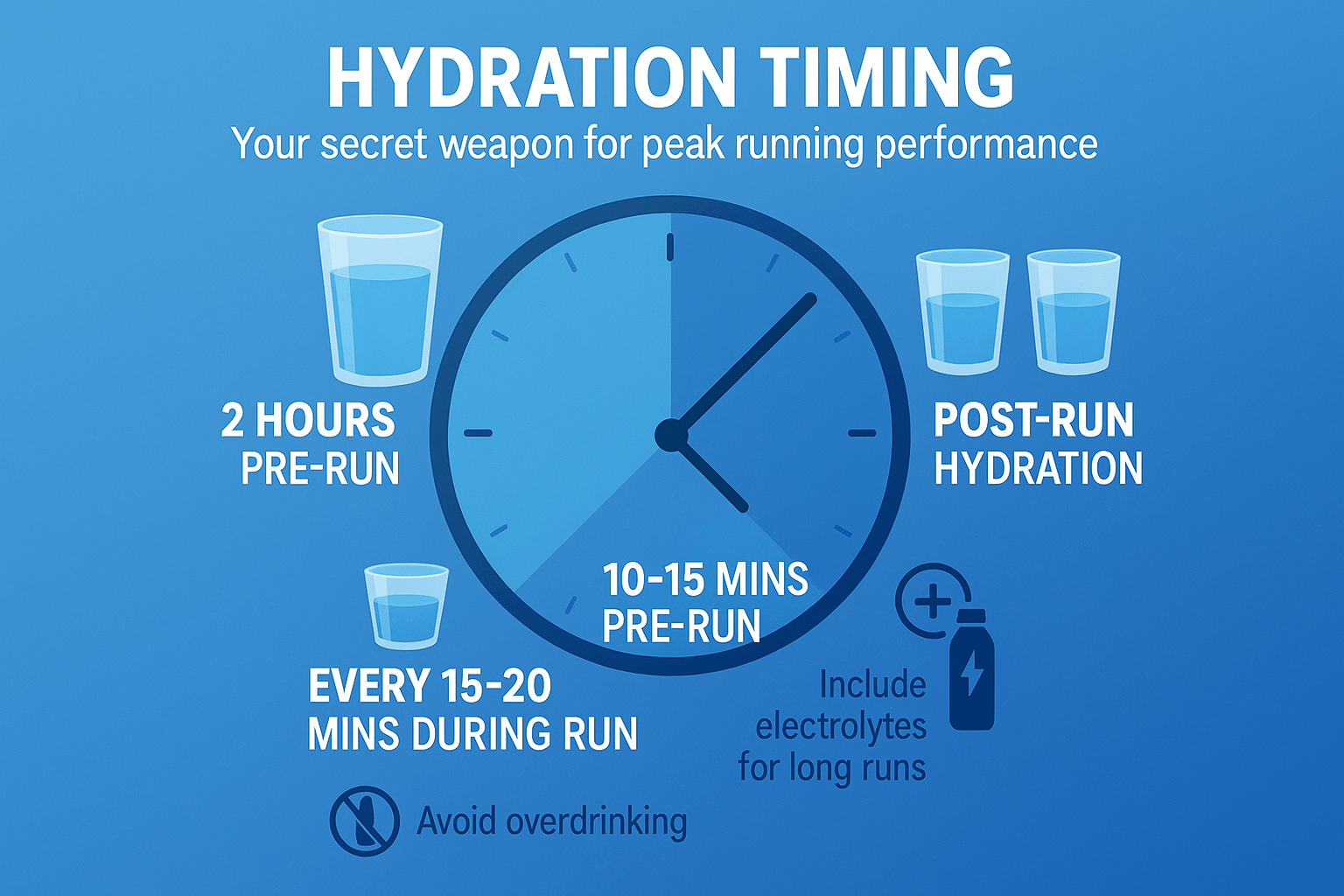
  • In the 2 hours before: Sip ~16–24 oz steadily
  • 10–20 minutes before: Top off with ~8–12 oz if needed
  • Bonus: Add a little sodium — like a salty snack or an electrolyte drink
  • Check your pee: Pale yellow = good. Too dark? Hydrate more. Crystal clear? Might be overdoing it.

Pro tip: Morning runner? Overnight pee is usually darker — that’s normal. Just sip a little water upon waking and you’re good.


During the Run

What you need depends on the day:

  • Cool temps + short run? Maybe nothing.
  • Hot day + long effort? You’ll need a plan.

Ballpark range: 14–27 oz (0.4–0.8 liters) per hour. Roughly 3–6 oz every 15–20 minutes

BUT — and this is big — don’t treat that like gospel. Listen to your thirst. Newer science says it’s actually one of the best tools we’ve got.

On shorter runs (<45–60 minutes): You might not need anything unless it’s scorching out.

On long runs: Have a way to drink. Carry a handheld, wear a vest, stash bottles, or loop by fountains. Aid stations are your friend — just don’t chug like it’s a frat party.


What to Drink

Water or sports drink? Depends how long you’re out there.

  • <60–90 minutes: Water is probably fine
  • 90+ minutes: Bring in the sports drink

A solid endurance drink includes:

  • Sodium: ~200–500 mg per hour
  • Carbs: 4–8% solution (that’s 20–60g per hour)
  • Examples: Gatorade, Skratch, Tailwind, Nuun (with carbs), Maurten

Prefer water + gels? Fine. Just check your gels — do they have sodium? Some do, some don’t. If not, consider adding salt tabs or chews.

 Don’t obsess over potassium or magnesium unless your doctor says to — normal diet covers those.


Electrolyte Balance: The Real MVP

Sodium is the big one. Lose too much and you’re cramping, bonking, or worse.

  • Heavy sweaters? You need more.
  • Light sweaters? You may get enough just by sipping sports drinks.

Cramping? It’s usually a mix of fatigue + low sodium + hydration. Rarely just potassium.


🧠 Drink to Thirst — But Have a Plan

Best practice? Use thirst as your primary cue. Don’t force it, but don’t ignore it.

Some days you’ll need more, some less. Plan hydration points for long runs or races, but don’t chug mindlessly at every water table.

Heavy sweater? Start sipping before you feel parched.

Light sweater on a cool day? Chill out — don’t drink just to check a box.


Different Weather, Different Tactics: How to Hydrate Like a Smart Runner

Let’s get something straight: hydration isn’t just a hot weather problem.

Sure, summer sweatfests get all the attention, but poor hydration can trip you up in any season—hot, cold, humid, or even at altitude. And yeah, dehydration sucks, but so does drinking too much water without salt. Both will wreck your run if you’re not paying attention.

So here’s how to handle hydration like a pro—before, during, and after your runs—no matter the forecast.


Hot Weather

Hot out? Your body’s working overtime to cool you down. That means higher sweat rate, faster fluid loss, and more need for sodium (since you’re sweating it out).

Your tactics:

  • Drink more frequently, but pair it with electrolytes—don’t just guzzle plain water.
  • Use cold drinks when you can. Pour water on your head or neck during races to help with cooling.
  • Rule of thumb: for every 5°C (9°F) hotter than normal, bump fluid intake.
  • Be smart: schedule walk breaks to drink if needed. Heatstroke is not a badge of honor.

Watch for signs like dizziness, chills, or a racing heart—those mean you’re falling behind.


Humid Weather

Humidity’s a sneaky beast. It slows sweat evaporation, which means you keep sweating—but it doesn’t cool you.

Your tactics:

  • You’ll likely sweat a ton, even if you don’t feel it. Drink small sips regularly.
  • Thirst may not kick in as strong—don’t wait for it. Have a plan.
  • Watch your heart rate and energy—if they spike more than usual, dehydration could be the reason.

Cold Weather

Cold doesn’t mean safe. You can still dehydrate fast—it’s just sneakier.

Your tactics:

  • Your thirst reflex drops (up to 40%), so you won’t feel thirsty even when you’re losing fluid.
  • Cold makes you pee more (thanks, kidneys), which adds to the loss.
  • Drink anyway—tea, warm water, or sports drink. It doesn’t have to be icy.

Just because it’s cold doesn’t mean you’re hydrated. Hydrate anyway.


Altitude

Higher up? Dryer air + lower pressure = more water loss through breathing and more frequent urination.

Your tactics:

  • Drink consistently. You’ll need more than usual, even if you’re not sweating buckets.
  • Appetite might drop—thirst usually goes up. Sip water and electrolyte drink alternately.

Know Thyself: Heavy Sweater or Camel?

Every runner’s different. Some of you drip sweat like a busted faucet. Others barely break a sweat and get by on minimal sips.

How to find out:

  • Weigh yourself pre- and post-run. If you’re down more than 2–3% body weight? You probably under-drank.
  • Crusty with salt? Swollen fingers? Feeling lightheaded? That’s a hydration or electrolyte mismatch.

Calibrate your intake through trial and error.

Before / During / After: Your Checklist

Before the Run

  • Drink ~500–600 ml (~17–20 oz) of water or sports drink in the 2 hours before.
  • Optionally sip another 250 ml (~8 oz) in the last 15–30 minutes.
  • Don’t overdrink. Include a little salt or electrolyte if it’s a long run day.
  • Check your pee: light yellow = good to go.

During the Run

  • For runs >1 hour, start sipping every 15–20 min.
  • Aim for 0.4–0.8 L/hour (~13–27 oz) as a baseline.
  • In practice: ~100–200 ml (3–7 oz) every 15 min works well.
  • Include sodium: either via sports drink, salt tabs, or a salty snack.
  • Don’t force it. Drink to thirst, especially if you’ve trained that way.

After the Run

  • Replace ~125–150% of what you lost in sweat.
    • Lost 1kg (2.2 lbs)? Drink 1.25–1.5 liters (~42–50 oz) over a few hours.
Signs of dehydration:
  • Dry mouth
  • Headache
  • Sluggish pace
  • Spiked HR
  • Dark pee
  • Dizziness
Signs of overhydration (hyponatremia):
  • Nausea
  • Confusion
  • Bloating
  • Swelling in fingers/feet
  • Very clear urine (but you feel off)

💡 Balance, not volume, is the goal. Drink enough—but not too much—and include salt if you’re sweating a lot.

Runners and Fat Loss: How to Cut Weight Without Wrecking Your Running

Let’s get honest. A lot of runners think, “If I could just lose 5–10 pounds, I’d be faster.” And yeah — carrying less non-functional weight can help your running economy.

But here’s the trap: chasing weight loss the wrong way can blow up your season faster than a rolled ankle.

Starving yourself? Crash dieting? Slashing calories just because the scale isn’t moving? That stuff kills performance, torpedoes recovery, and opens the door to injuries and burnout.

So if you want to lean out the right way — run better, not just lighter — here’s the smart approach.


Performance First — Not Just Aesthetics

Before you mess with your intake, ask yourself: Why do I want to lose weight?

If the answer is “to get faster and feel stronger on the run,” good.

If the answer is “to look better in a mirror,” pause.

Chasing scale numbers for aesthetic reasons leads runners down dark roads — skipping meals, undereating, obsessing over calories. You might lose a few pounds… but along with it, you lose speed, energy, and joy.

One study showed marathoners who restricted calories to lose weight actually performed worse and had higher injury rates.

“Lighter is not automatically faster — if it costs you strength or fuel.”

Sometimes your true racing weight is 5–10 pounds heavier than your “photo weight” — and that’s okay. You run better when you’re fueled, not flat.


Create a Small Deficit — Not a Starvation Plan

If you’re going to cut weight, do it gradually.

  • Safe target: 200–500 calories/day below maintenance
  • Expected rate: 0.25–0.5 kg (0.5–1 lb) per week

That might sound slow, but it’s sustainable. It lets you keep training, hold onto muscle, and stay mentally sharp. You’re not trying to win The Biggest Loser — you’re trying to run strong.

Experts recommend dropping no more than 0.5% of your bodyweight per week.

So for a 150 lb runner, that’s about 0.4–0.75 lbs/week.

That’s the sweet spot where your body trims fat without freaking out.


RED-S: When Running on Empty Backfires

Underfueling isn’t just unhelpful — it’s dangerous. RED-S (Relative Energy Deficiency in Sport) is real, and it wrecks runners.

Symptoms include:

  • Fatigue
  • Poor recovery
  • Missed periods or low testosterone
  • Bone stress injuries
  • Slowed metabolism
  • Irritability and brain fog

Basically, if you under-eat long enough, your body starts shutting down stuff it thinks you don’t “need.”

You might lose a few pounds fast… but then plateau, get slower, and wonder why your workouts suck.

Here’s the truth:

A well-fueled runner who’s a few pounds heavier will always outrun a lighter, under-fueled one.


Eat Protein, Lift Stuff — Keep Your Muscle

Fat loss is only good if you hold onto muscle. Otherwise, you’re just getting smaller — not stronger.

To protect your lean mass:

  • Protein: Aim for ~1.8–2.0g/kg of body weight
    (Roughly 25–30% of total daily calories)
    • Every meal should have 25+g of protein
    • Snacks? 10g+ minimum
  • Strength Training: Don’t stop lifting just because you’re dieting
    • Bodyweight strength, core, or weights 2–3x/week
    • It tells your body: “Hey, this muscle is still needed — don’t burn it for fuel.”

Some runners think, “I’m not bulking, so why lift?” Because lifting preserves the muscle you’ve built — especially during a calorie deficit.

More muscle = better running economy.

More strength = more power at every stride.


Time Your Cut — Not During Peak Season

Trying to cut weight in the middle of race prep? That’s a rookie move.

The best time to focus on fat loss is:

  • Base phase or early training
  • Lower intensity = better chance to recover while eating slightly less
  • Once you’re 6–8 weeks out from a race? Stop cutting and start fueling

Trying to PR while under-eating? That’s how people get hurt or underperform.

Finish your cut early, stabilize your weight, and then eat to perform. Think of food as fuel for your peak workouts — not the enemy.


Fuel the Training — Don’t Starve It

If your workouts start to suck… if you’re dragging through intervals… if your motivation crashes…

That’s not “mental weakness” — that’s your body asking for fuel.

A smarter approach:

  • Eat more on hard days, maybe slightly less on easy days
  • Don’t try to run fasted all the time
  • Don’t skip carbs — they’re your rocket fuel

You can’t get faster if you’re always running on fumes.

Quality Over Calories – Make Every Bite Count

If you’re in a fat-loss phase or eating at a small deficit, you can’t afford to waste calories on junk.

That doesn’t mean you cut all the joy out of your food—but it does mean your meals need to work for you. Here’s how:

  • Prioritize whole foods – lean protein, fruits, veggies, whole grains, healthy fats.
  • Cut back gently – smaller portions of carb-dense foods (ex: 1.5 cups rice instead of 2), and add more veg to stay full.
  • Dial protein up – aim for about 30% of your calories from protein to hold on to muscle and feel full longer.

Don’t go ultra low-carb. Don’t go fat-free. That’s not how runners operate.

  • Fat = hormones. Drop it too low and you risk tanking your libido, messing with your cycle, or feeling chronically wrecked.
  • Carbs = fuel. Even during a cut, you need enough to power your runs. Spread carbs around your training sessions and ease back slightly on rest days—not all the time.

Rule of thumb: You should still be eating enough to train strong.


Red Flags: Signs You’re Underfueling

You can’t run strong if you’re starving your body. Period.

Watch for these warning signs:

  • Always cold
  • Poor sleep or insomnia
  • Mood swings or depression
  • Low libido (men) or missing periods (women)
  • Frequent injuries or illness
  • Performance falling off a cliff

These are signs you’ve gone too far. Don’t ignore them. Back off the deficit and focus on recovery. Your long-term progress matters more than fast fat loss.

One thing I always tell my athletes:

“The scale can lie. Your workouts don’t.”

If training starts to feel worse and worse while weight drops, something’s off.


Recovery Still Matters During a Cut

Cutting calories doesn’t mean cutting corners.

  • Post-run fuel is still non-negotiable. After key sessions, get in protein + carbs ASAP. You can make the deficit happen later in the day.
  • Don’t go to bed starving. A small protein snack before sleep can help you recover better and sleep deeper.

Recovery is training. It’s when you actually get fitter. Cutting too hard sabotages that.


Be Patient – Real Progress Takes Time

Got 10+ lbs to lose? Don’t try to do it all in one cycle. Split it up:

  • Lose 5–6 lbs during base training
  • Maintain during race season
  • Another cut during the next off-season

Trying to diet all year long? Recipe for burnout.

Also, the leaner you get, the slower the fat loss. That’s normal. You’re not broken—you just need to stay consistent and adjust expectations.


The Holy Grail: Leaner & Faster

Can you lose fat and PR in the same season? Yes—if you do it right.

Here’s what works:

  • Drop ~300 calories/day (modest deficit)
  • Keep protein high
  • Time carbs around training
  • Don’t compromise sleep or post-run fuel
  • Stay consistent

Over 2–3 months, you might lose 5% of your body weight without trashing your workouts. That’s the dream.

But try to force it? Slash calories too hard? You’ll lose weight and fitness—and probably end up injured or fried by race day.


Carb Loading: Do It Right, Don’t Overdo It

You’ve trained smart. You’re tapering. Now let’s fuel the tank.

Carb loading isn’t about stuffing your face the night before the race—it’s about strategically filling your muscles with glycogen so you have fuel to burn over 26.2 miles (or more).

Done right, it can boost performance by 2–3%. That’s 5–10 minutes in a marathon. Totally worth it.


When to Start?

Start 2 days out from race day. If your race is Sunday, ramp up carbs Friday and Saturday. Some runners go for 3 days (Thursday through Saturday), which works if you prefer more moderate volumes over more time.

Minimum: 48 hours

Too early (5+ days out)? Not helpful—can lead to weight gain that doesn’t fuel you

Too late (just Saturday dinner)? Doesn’t give your body time to fully top off

The sweet spot? Start loading by Thursday night and be mostly done by Saturday afternoon.


It’s About Carb Percentage, Not Just Calories

You don’t need to eat 5,000 calories a day. But you do need to shift your plate toward more carbs, less fat/fiber/protein.

  • Target: 8–10 grams of carbs per kg of body weight (e.g., 500–600g/day for a 140 lb runner)
  • Keep meals lower in fat and fiber—you’re not trying to set PRs in digestion
  • Carb loading + water = weight gain (1–3 pounds is normal)
    👉 That’s glycogen + water stored in your muscles. It’s a good thing.

You’re not gaining fat—you’re gaining race fuel.


Don’t Make These Mistakes

1. Stuffing yourself at one dinner

One pasta meal won’t do it. The night-before meal should actually be normal-sized, not a gut bomb. Your last big carb meal should be lunch the day before.

2. High-fiber “healthy” carbs

Good for everyday. Bad before racing. Skip the beans, kale, brown rice, whole-wheat everything. Go with white rice, white bread, peeled potatoes, low-fiber cereals, bananas, juice. You want fuel that digests clean.

3. Forgetting sodium & hydration

Glycogen needs water to store—about 3g of water per gram of carb.
That means:

  • Sip water throughout the day (don’t chug gallons)
  • Include some electrolytes (sports drinks, broth, pretzels)
  • Salt your food more than usual

Sample 2-Day Load (140 lb / 63.5 kg Runner)

Day 1 (Friday) – moderate taper day

  • Breakfast: Oatmeal + banana + honey + OJ (~125g)
  • Snack: Bagel + jam (~50g)
  • Lunch: Turkey sandwich on white bread + pretzels + apple + sports drink (~90g)
  • Snack: Granola bar + grapes (~40g)
  • Dinner: Big plate of pasta + marinara + lean chicken + carrots (~130g)
  • Dessert: Fig bars or sorbet (~40g)

Estimated: ~500g carbs


Day 2 (Saturday – Race Eve) – mostly rest, heavy carb focus

  • Breakfast: Pancakes + syrup + Greek yogurt (~95g)
  • Snack: Sports drink + crackers (~40g)
  • Lunch: Baked potato + cottage cheese or tuna + rolls + applesauce (~120g)
  • Snack: Rice Chex + almond milk + banana (~75g)
  • Dinner (early): White rice + tofu or lean fish + zucchini + roll (~110g)
  • Evening (light): Half bagel with honey or Cheerios (~25g)

Estimated: ~520–580g carbs


Race Morning

Don’t skip breakfast. Aim for 1–1.5g/kg of carbs ~2–3 hours before go time. That’s about 80–100g for this runner.

Example:

  • Bagel with peanut butter + banana + sports drink
  • OR oatmeal with fruit + small glass of juice

Carb Loading: It’s Real, But Only If You Do It Right

Let’s cut to it: carb-loading works—if you do it correctly.

Done right, it can push back the wall by miles. Done wrong, it’s just bloating without the benefit.

What Carb-Loading Actually Looks Like:

If you’re prepping for a race that’s 90+ minutes (like a marathon, hard half marathon, ultra, or triathlon), carb-loading gives you a legit edge. You’re topping off muscle glycogen—your main fuel tank for endurance efforts.

Expect to feel a little “heavy” during taper. That’s normal. You might be up 1–4 pounds, feel tighter in the legs, even look slightly more jacked. That’s just extra water stored with glycogen—and it’s fuel in the bank. Come race day, you’ll burn through it.

One study showed runners went ~20% longer before fatiguing after proper loading. Another saw a 2–3% improvement in race performance. That’s minutes off your marathon time—for free.

 How to Load Right (Not Just Eat More Pasta):

  • Duration: 2–3 days before your race
  • Carbs: 8–12 grams of carbs per kilo of body weight (yes, it’s a lot)
  • Keep fat/fiber low: You want clean-burning fuel, not gut bombs
  • Hydration: Stay on top of fluids—carbs pull water into muscles
  • Cut the feast the night before: Big meals late = bad sleep and heavy stomach. Finish carb-loading by early afternoon the day before.

Think bagels, white rice, toast, potatoes, cereal, sports drinks. Snack all day, don’t binge all at once.

And remember: carb-loading isn’t weight gain—it’s race fuel.

If you’ve trained for months, don’t shortchange yourself now because you’re afraid of feeling “puffy.” That little weight increase? It’s part of the plan.


Race Day Nutrition: What to Eat Based on Distance

General Rule: No Surprises

Race day is not the time to try something new. That new gel from the expo? Save it for a test run next weekend. Today is for execution, not experimentation.


5K & 10K Strategy

Short races, but they still need the right fuel window to feel good and go fast.

Pre-Race:

  • No mid-run fuel needed. Focus on showing up topped off.
  • Night before: Regular high-carb dinner (pasta, rice, potatoes). Nothing special—just don’t skip the carbs.
  • Morning of: Eat what’s worked in training. If you’ve got 2–3 hours, go with toast, a banana, small bowl of oats, or a light energy bar. Only 30–60 minutes? Try a half banana, a rice cake, or a few swigs of a sports drink.
  • Hydrate well leading into the race, but don’t chug water right before.

During Race:

  • You probably won’t need anything.
  • Maybe a sip of water in a 10K if it’s hot or you’re out there over an hour, but many runners don’t drink at all during a 5K.

Optional Boost: Caffeine Preload

  • Big performance kicker, even for short races.
  • 2–3 mg/kg 45–60 minutes pre-race is a common sweet spot (that’s ~150–200mg for a 150 lb runner).
  • You can use coffee, caffeine pills, or a caffeinated gel. Just don’t try it for the first time on race day.
  • Caffeine has been shown to shave 2–4% off your time, even in 5K/10K efforts. That’s a full minute in a 40-min 10K. No joke.

If you’re caffeine sensitive, start lower (like 100mg) and test in training.


Gut Management for Short Races

GI issues at this distance usually come from bad timing or nerves, not fueling mistakes mid-run.

  • Eat at least 60–90 minutes before the race if possible.
  • Avoid high fiber or greasy meals the night before (no spicy takeout, giant salad, or mystery bar from the expo).
  • Stick with plain, simple, tested food: toast, banana, cereal, maybe a little PB or honey if that works for you.
  • Wake up early enough to “take care of business” before the race. Some runners swear by a little coffee to help that along. Just don’t overdo it if you’re not used to it.

Don’t Do This:

  • Eat a giant bacon-and-eggs breakfast 20 minutes before your 5K.
  • Slam a random gel mid-10K when you’ve never used it before.
  • Skip breakfast entirely and wonder why you bonked at mile 4.
  • Pop caffeine pills without testing the dose first.

Fueling for a Half Marathon: How to Run Strong from Start to Mile 13.1

The half marathon isn’t just “half a marathon” — it’s a beast of its own. Long enough that fueling matters, short enough that pacing and gut strategy still make or break your race.

Here’s how to handle the food, fluids, and caffeine so you don’t bonk at mile 10 or wrestle your guts into the port-a-potty mid-run.


Pre-Race Fueling: Top Off the Tank (Without Overdoing It)

For most runners, a half takes 1.5 to 3 hours. That’s long enough that glycogen stores matter. So yes, carbs matter too — but no need for a 3-day pasta binge.

Day Before:
  • Lightly carb-load: ~7–8g of carbs per kg of bodyweight is solid. That means more rice, potatoes, pasta—but keep fiber and fat low, especially at dinner. No giant salads or greasy Alfredo.
Race Morning:
  • Eat 2–3 hours before go time. Something like:
    • Oatmeal + banana
    • Toast with honey + PB + fruit
    • Bagel + jam + a little protein if your stomach handles it
  • Aim for 75–100g carbs, 300–500 calories
  • Drink 16 oz fluids with electrolytes between 2–1 hour pre-race
  • Finish anything heavy 1 hour out, then sip 5–10 oz of sports drink or water in the final hour

Pro tip: Avoid experimenting here. Eat what you’ve practiced with on long runs.


Mid-Race Fueling: Yes, You Need It

If you’re running over 90 minutes (and most people are), you need carbs mid-race. It’s that simple.

The goal:

  • 30–60g of carbs total during the race
  • That could be:
    • 1–2 gels
    • Sips of sports drink
    • Or both

Sample Gel Strategy:

  • Gel #1: ~45 minutes in (mile 5–6)
  • Gel #2: ~1h30 in (mile 10)
    Take with water, not sports drink, to keep your gut happy.

If you’re finishing in 1.5 hours or less? You might just need one gel around the 45-minute mark.

If you’re going closer to 2+ hours? Two to three gels, spaced 40–45 minutes apart, will keep your energy up and delay the crash.


Caffeine: Handle With Care (But Use It Smart)

Caffeine works. It can make mile 11 suck less. But don’t go wild if you haven’t practiced.

Strategy:

  • Take 100–200mg of caffeine about 30–45 minutes before the start (coffee, energy gel, tablet)
  • Optional: top off with a caffeinated gel around mile 8–10 (~30–50mg)

Don’t double your usual coffee dose on race morning. That’s a fast track to port-a-potty town. Practice this combo during long runs first.


Hydration During the Race: Sip Smart

Hydration’s personal. Here’s a guide:

  • Cool weather? 8–12 oz total might be plenty
  • Warm or humid? Hit every other aid station, aim for 4 oz each time (~20–30 oz total)
  • Don’t overdo water. Some sports drink = good (you lose salt in sweat)
  • If you’re drinking gels, use water not sports drink with them

The golden rule: Drink to thirst, not on a fixed schedule.


Sample Race-Day Fuel Plan (2-Hour Half)

  • 5:30 AM (2 hrs before): Toast + honey + banana (~80g carbs), coffee (~100mg caffeine), sip 8–12 oz sports drink
  • 7:15 AM (15 min before gun): Final sip of water (~4 oz), maybe a chew or half-gel (~25mg caffeine, 10g carbs)
  • During the race:
    • Gel #1 at ~45 min (mile 5–6)
    • Gel #2 at ~1h30 (mile 10)
    • Sip sports drink at aid stations (mile 3, 8), water at others as needed

That gives you:

  • 70–80g carbs total
  • ~105mg caffeine
  • Enough fluid and sodium to stay strong

Marathon Fueling: Eat Smart, Run Strong

When it comes to the marathon, fueling can make or break you.

You can have the perfect pacing, perfect training, and still crash and burn if you blow the nutrition plan.

So let’s walk through it — what to eat, when, and how to avoid bonking at mile 20.


The Day Before: Carb-Load Like a Pro (Not Like a Fool)

Here’s the move: Friday and Saturday (for a Sunday race) = carb city. We’re talking 8–10g of carbs per kilogram of body weight. Don’t get lost in the math — just know that means lots of rice, pasta, bagels, oats, bananas, sports drinks, etc. Keep fiber low and fat low. Don’t gorge at 9 p.m. — eat a solid dinner early enough that you’re not stuffed at bedtime.

And hydrate. Sip fluids through the day. Maybe add a little extra salt (unless you’re on a restriction) to help hold water.


Race Morning: Early, Easy, and Familiar

Eat breakfast 3–4 hours before the start. That might mean 5 a.m. if your race is at 9. Sorry, but trust me — it’s worth it.

  • Aim for 1–4g/kg carbs. For most, that’s 75–100g.
  • Easy combos: bagel + jam + banana. Oatmeal + honey + raisins. Pancakes + syrup.
  • Include a little protein (like an egg or milk) if you like, but keep fat low.
  • Drink ~16–20 oz of fluid with breakfast, then ease up and sip smaller amounts closer to the gun.

Optional but effective: A gel ~15 minutes before the start with a few ounces of water. It gives you a hit of carbs (and caffeine if desired) right before go time.


During the Race: Don’t Just Survive — Fuel to Thrive

Here’s the golden rule: 30–60g of carbs per hour. If you’re aiming for a 4-hour finish, that’s at least 120–240g of carbs total.

How to hit that?

  • Gels: One every 30–45 minutes. Most are ~25g of carbs each. That’s 4–5 gels minimum. Take them at Mile 5, 10, 15, 20, maybe 23–24 for the final push.
  • Sports Drink: Add it at aid stations. Those little cups are maybe 3–4 oz, with 6–8g of carbs. Hit a few cups per hour, and it adds up.
  • Combo: Gels + sports drink = best bet. Just make sure you’ve practiced it in training.

Can’t handle a ton of gels? Try chews, carb-rich sports drink, or other options — but practice is key. Don’t just wing it on race day.


Electrolytes: Don’t Forget the Salt

If it’s warm or you’re a heavy sweater, you’ll need sodium too.

  • Gels = ~50–100mg sodium
  • Sports drinks = ~100mg per cup
  • If it’s hot? Maybe a salt tab halfway through (~200–300mg sodium), but don’t overdo it.

Sweaty shirt with salt crusts after long runs? That’s your clue — you might need more electrolytes.


Caffeine: Use It Smart

Caffeine can give you that mental boost, especially late in the race.

  • Race day plan: Coffee with breakfast (~100mg), then a caffeinated gel mid-race (~50mg), maybe another around mile 20.
  • Keep total intake around 200–300mg max to avoid GI issues or jitters.

Example Plan (for a 3:45 marathoner)

Pre-race:
  • Carb-load 2 days before
  • 3 hours pre-race: Bagel + PB + banana + sports drink = ~100g carbs
  • Small coffee (~100mg caffeine)
Start line:
  • 15 min before: 1 gel (20g carbs, 50mg caffeine) + a few sips of water
During race:
  • 5 gels: Take at 45, 90, 135, 180 minutes (and maybe 210 if needed)
  • Sports drink: At most aid stations (~every 2–3 miles), drink ~4 oz each = ~70g carbs total
  • Electrolytes: Gels + drink = ~700mg sodium. If hot, take a salt tab at 2hr (~250mg more)
  • Caffeine: Total ~200mg = solid boost without overdoing it

Total carbs = ~215g = ~57g/hr. Solid.


Don’t Experiment on Race Day

This is the rule: nothing new on race day. No strange gels, no mystery drinks, no orange slices from random spectators unless you’ve trained with them.

You see that homemade cookie at mile 18? It’s not worth a stomach blow-up. Stick with what your gut knows.

If the race offers a different sports drink than you trained with? Bring your own or go with water + your usual gel. You don’t want to guess.


Late-Race Fueling: Where the Wheels Can Fall Off 

Let’s talk about the last 10K of a marathon—because this is where it gets real. You can fake a 10K. You can bluff your way through a half. But the last hour of a marathon? That exposes your fueling plan—or lack of one.

If you’ve paced and fueled right, you’ll be passing people. If not? You’ll be praying for a porta-potty or a bench to sit down.

Here’s how to handle the final stretch so you finish strong, not stumbling.


Mile 20: The Checkpoint, Not the Cliff

This is where everything tightens, your brain says “no more,” and your stomach starts making deals. But if you’ve been taking in carbs every 30–45 minutes like clockwork? You’ve got gas in the tank. This is when caffeine can shine—a caffeinated gel around mile 18–20 can flip the mental switch and push you through the fog.

Flat Coke at mile 20? Some marathoners swear by it. Quick sugar, some caffeine, and it goes down easy if your gut’s still cooperating. Just don’t try it for the first time on race day.


Hydration in the Final Hour

You’ll be slightly dehydrated by now. That’s normal. Just keep sipping what your stomach can handle. Don’t go overboard guzzling water at every aid—especially if you’ve mostly been drinking plain water. Overhydration late in the race can mess with your sodium balance (hyponatremia = bad news).

If you’re suddenly craving salt or Coke? That’s your body whispering what it wants. Some late stations offer salty snacks or soda—grab a small hit only if you’ve practiced with it in training.


Post-Race Refuel: Don’t Skip the Recovery

The banana and protein bar at the finish line aren’t just for the photo op. You need carbs + protein within 30 minutes to start repairing muscle damage and refilling glycogen.

Even if you’re nauseous, try a chocolate milk or a smoothie. And keep sipping water with electrolytes—you’re still in a deficit, even if you drank well on the course.


Ultra Fueling: A Moving Buffet + Mental Battle

Let’s be honest: ultramarathons are part race, part eating contest, and part spiritual journey.

You’re out there for hours—sometimes 20+. Your nutrition plan isn’t just fuel—it’s survival.

During the Race

  • Goal: ~200–300+ calories per hour (about 50–75g carbs)
  • Mix it up: Gels, bars, sports drink, fruit, sandwiches, broth, pretzels, even candy.
  • Real food matters. The gut can only take so many gels before it protests. Salty chips or a PB&J quarter might be what gets you through mile 40.

Climbing a big hill? That’s a good time to chew real food—lower intensity, easier digestion.


Caffeine in Ultras

Used smart, it’s a lifesaver. Most runners take ~100mg every 4–5 hours, or save it for the overnight hours or that soul-crushing final stretch.

Don’t slam caffeine early and often—you’ll crash hard or risk gut trouble. Think of it like a grenade. Time the pull.


Ultra = Gut Training + Mental Fueling

By hour 8, you might not want to eat—but you have to.

Pro tip from the trail:

“If you feel good, eat. If you feel bad, eat more.”

Set a timer, treat your nutrition like a job, and keep going. Eat before you’re starving. Drink before you’re dying of thirst. And if your stomach goes south? Switch to small sips of sports drink or ginger ale, nibble crackers, or walk while eating.


Post-Ultra Recovery

  • Carbs + protein ASAP (within 30–60 min)
  • Simple, bland food is best: rice, broth, bananas, toast
  • Hydrate slow and steady
  • Sleep and rest for days—not hours

You just ran a full-body demolition derby. Respect the rebuild.


Race Fueling: From Week Before to the Finish Line

Let’s zoom out for a second.

 Race Week
  • Carb-load smart (3 days out) for marathons+
  • Hydrate well daily—pale pee = good
  • Cut fiber a bit if GI issues are common
  • Don’t eat anything risky or brand new
Race Morning
  • Eat the exact breakfast you trained with
  • Drink, but don’t overdo fluids
  • Time bathroom stops
  • Caffeine only if it’s part of your tested plan
Mid-Race
  • Stick to your fueling schedule—don’t wing it
  • Set reminders (watch alarms or course landmarks)
  • Take carbs before you feel bonky
  • Don’t experiment with mystery snacks unless you’ve trained with them

The Golden Rule: Nothing New on Race Day

Whether it’s a 5K or 100-miler, your race nutrition should feel familiar. Practiced. Rehearsed.

If it’s not in your training log, don’t put it in your mouth on race day.

Fueling isn’t just part of your race plan—it is your race plan.


📌 Race Fueling by Distance – Quick Recap:

Distance Fuel Needed? Notes
5K Eat pre-race. Optional caffeine.
10K ❌ / Maybe Maybe sip sports drink if >1hr or hot.
Half ✅ Yes 1–2 gels + water or sports drink. Fuel by the clock.
Marathon ✅ Absolutely 30–60g carbs/hr, gels every 30–45 min, plan caffeine.
Ultras ✅ Eat Constantly 200–300 cal/hr. Real food, gels, drink, salt.

Supplements for Runners: What Actually Works  

Let’s cut through the noise: no supplement is a shortcut to fitness, and no pill or powder is going to fix a lousy training plan or junk diet. But — used right — some supplements can give you a small edge or help you recover better.

Here’s the golden rule: Food first, supplements second.

Supplements are exactly that — supplemental. The cherry on top of an already solid routine. And yeah, the industry is messy, so if you’re going to take anything, make sure it’s from a brand that gets third-party tested (like NSF Certified for Sport or Informed-Sport).

Now let’s break down what’s worth your time — and what’s not.


What’s Worth Taking (If You Use It Right)

Caffeine – Cheap, Legal, Effective

If there’s a king of performance supplements, it’s caffeine.

  • What it does: Lowers your perceived effort, helps you burn fat more efficiently, and gives you that mental edge.
  • How to use it: 3–6 mg/kg body weight, ~60 min before your run/race (that’s ~200 mg for a 70kg person).
    Even 100 mg can help without the jitters. Some runners take smaller hits mid-run (via gels, gum, soda) to fight off fatigue.

Great before long runs, races, or key workouts

Don’t go overboard (high doses don’t give more benefit, just more side effects).

Practice with it — caffeine on race day only works if your gut and brain know how to handle it.


Creatine – Not Just for the Gym Bros

Surprised? Creatine has legit benefits for runners — especially if your training includes sprints, hills, intervals, or strength work.

  • What it does: Helps muscles produce quick energy for short bursts (sprints, surges, finishing kicks). Might also improve recovery and cognitive endurance in long races.
  • How to use it: 5g/day of plain ol’ creatine monohydrate.

Yes, you might gain a couple pounds from water retention — but it’s stored in the muscle where you need it.

If your training involves intensity or if you’re a trail runner, miler, or 5K racer? Creatine is worth a look.


Beetroot / Nitrates – More Oxygen Efficiency

Beets (or concentrated nitrate shots) can reduce the oxygen cost of running, which means better efficiency and stamina.

  • What it does: Increases nitric oxide → better blood flow and oxygen delivery.
  • How to use it: Start ~2–3 days before your race, and take one dose (beet shot or 500ml beet juice) about 2–3 hours pre-race.

Works best for moderately trained runners. If you’re elite, the effect might be smaller — but still noticeable.

Don’t use mouthwash — it kills the oral bacteria that convert nitrates.

Pink pee = normal.


Electrolytes – Not Sexy, But Necessary

Sodium’s your MVP here — it helps you stay hydrated and prevents cramps or hyponatremia on long/hot runs.

  • What to take: Salt tabs, electrolyte drink, or just salty food (pretzels, broth).
  • How much: 200–500 mg sodium per hour depending on sweat rate.

This isn’t a performance booster — but it keeps you from falling apart.

Protein Powder – For Recovery, Not Speed

Not magic. Just convenient.

  • If you can’t get a solid 20–25g of protein post-run through food, a scoop of whey or plant protein does the job.
  • Helps with muscle repair and soreness, especially after long runs or hard sessions.

Whey is fast-digesting and high in leucine. Plant-based blends (pea + rice) work fine too. Use what your stomach tolerates.


Iron & Vitamin D – Only If You’re Low

These two are common deficiencies in runners — especially in women or anyone training hard indoors or in winter.

  • Iron: Low ferritin = fatigue and poor endurance
  • Vitamin D: Linked to bone health, recovery, and immune function

Don’t supplement blindly. Get bloodwork. If you’re low, correcting it can make a massive difference. If you’re not, it’s pointless (and in iron’s case, risky).


Beta-Alanine – Niche But Useful (for Track Heads)

This one helps with acid buffering in the muscles — so it’s more for the 800m–5K crowd, not marathoners.

  • Might help during hard VO2max intervals or the final kick of a race.
  • Dose: 3–6g/day over a few weeks.
    ⚠️ Tingles are normal (take in small doses to avoid that skin-crawling buzz).

Useful if you’re a middle-distance specialist. Otherwise? Probably not necessary.


🧴 The Overrated Stuff (Skip It)

  • “Fat burners” – Just no. They don’t work, and they usually come with side effects.
  • BCAAs if you eat enough protein – Extra BCAAs are redundant if your diet has adequate protein.
  • Detox powders, anti-inflammatory pills, or miracle energy boosters – If it sounds like hype, it is.
  • Pre-workouts full of mystery ingredients – Skip anything you don’t recognize on the label.

Supplements That Are Overhyped (or Flat-Out Useless) for Runners

Let’s be honest — the supplement aisle is a circus. Flashy tubs, big promises, and mystery blends that claim to turn joggers into Olympians. But here’s the truth: most of it is hype. If you’re eating well, sleeping, and training smart, you’ve already covered 95% of the performance equation.

Now, let’s break down the ones you can skip (or at least think twice about).


BCAAs – Redundant and Overrated

BCAAs (branched-chain amino acids) used to be all the rage — leucine, isoleucine, valine in a fancy tub. Supposed to stop muscle breakdown and boost recovery.

But if you’re already eating enough protein? You’re covered.

✅ A scoop of whey or a balanced meal gives you all the BCAAs you need — plus the rest of the amino acids needed for muscle repair.

And the so-called “central fatigue” benefit? Meh. Maybe a tiny effect, maybe not. Either way, it’s not worth your money.

Only niche case: If you’re doing fasted runs and want to hedge muscle loss, some runners sip BCAAs. Even then, a bit of protein would do a better job.

Verdict: Save your cash. Get real protein instead.


Pre-Workout Powders – Overkill for Most Runners

These are made for gym rats, not runners. Most are overloaded with caffeine, weird stimulants, and mystery “pump” ingredients.

Yeah, caffeine helps. But do you need 350mg from a glowing watermelon powder that makes your face tingle? Probably not.

Better option:

  • Drink coffee (easy, predictable)
  • Eat a carb snack pre-run
  • Add beta-alanine or caffeine individually if needed for racing

Some of these blends even contain banned or sketchy ingredients — like yohimbine, synephrine, or untested “herbal” stuff.

Verdict: Stick to basic tools. Pre-workouts are built for the weight room, not your long run.


Fat Burners – Big Promises, Big Risks

These pills are usually just a cocktail of caffeine, green tea extract, and a hope and a prayer.

Do they “burn fat”? Barely. Maybe they raise your metabolism a hair, but often at the cost of:

  • Jitters
  • Elevated heart rate
  • Dehydration
  • Messed-up sleep
  • Poor recovery

Worse: many aren’t tested and could contain banned substances. Not worth the risk for performance — or your health.

If you want to burn fat? Run. Eat well. Sleep. Repeat.

Verdict: Hard pass. They’re a marketing gimmick wrapped in a shaker bottle.


Detox Teas & Cleanses – Just… No

Let’s be blunt: your liver and kidneys are your detox system.

No tea, powder, or overpriced cleanse will make you faster or “leaner” in a healthy way. Most just make you poop a lot or drop water weight.

Runners need fuel, not food fear.

Verdict: Don’t fall for the “cleanse = light + fast” trap. That’s not how your body works.


Baking Soda – Works, But Comes at a Price

This one’s actually legit — in lab settings.

Bicarbonate loading can buffer lactic acid and help in all-out efforts like 800m–1500m racing.

But to get the dose (~0.3g/kg), you’d have to chug so much that you’ll likely spend race day hugging a toilet.

Unless you’re a serious track athlete testing this carefully, it’s more trouble than it’s worth.

Verdict: Technically not junk, but practically unusable for most runners.


Glutamine, Arginine, Branched-Chain Keto Acids

  • Glutamine: Doesn’t do much unless you’re deficient — most runners aren’t.
  • Arginine: Hyped for nitric oxide, but oral arginine doesn’t absorb well. Beet juice is better.
  • Keto acids: Expensive, unproven, and covered by normal diet.

 Verdict: Mostly filler supplements. Save your budget.


 Collagen – A Maybe (But Not a Miracle)

Collagen peptides are getting buzz for joint and tendon support — and some early studies suggest a combo of collagen + vitamin C pre-workout may help with tendon rehab.

But it’s not an endurance booster. And it’s not a shortcut to injury-proofing your body.

Verdict: Might help if you’re dealing with tendon issues. But it won’t make you faster.

Special Diet Considerations for Runners

Let’s be real—there’s no one-size-fits-all nutrition plan.

Some runners thrive on steak and eggs. Others are all in on tofu and greens.

Whether you’re vegan, vegetarian, gluten-free, or managing something like IBS or food allergies, you can be a strong, healthy runner—but you’ve got to plan it right.

Here’s how to make your diet work with your running—not against it.


Vegan / Vegetarian Runners: Strong on Plants (With a Plan)

Plenty of badass runners are vegan or vegetarian. But plant-based doesn’t automatically mean performance-optimized. You’ve got to be intentional. Here’s where to focus:


Iron

Plant-based iron (non-heme) doesn’t absorb as well as meat-based (heme) iron. That’s why iron deficiency is a real risk, especially for women.

What to do:

  • Eat iron-rich plant foods: lentils, tofu, spinach, fortified cereal.
  • Pair them with vitamin C (citrus, bell peppers) to boost absorption.
  • Avoid coffee, tea, or calcium with iron-rich meals—they block uptake.
  • Test your ferritin occasionally if you’re feeling extra fatigued.

Pro tip: If you feel run down, pale, or breathless? Don’t guess. Get bloodwork and fix iron before it tanks your training.


B12

B12 is non-negotiable—you won’t get it from plants. It’s crucial for red blood cells and nerve health.

  • Vegan? You need a supplement—either 250 mcg daily or 2,500 mcg once a week.
  • Fortified foods help (nutritional yeast, plant milks), but don’t rely solely on them.
  • Symptoms of low B12 mimic iron issues: fatigue, numbness, sluggish recovery.

This one’s an easy fix—just take the supplement.


Protein

The “vegans can’t get protein” myth is tired. You can hit your numbers—but you’ve got to try.

Tips:

  • Target 1.2–2.0g protein/kg bodyweight (same as meat eaters).
  • Prioritize high-protein plants: beans, lentils, tofu, tempeh, seitan, edamame, nuts/seeds.
  • Combine sources across the day (e.g., rice + beans, PB + toast).
  • Use a plant protein powder post-run if needed—especially during heavy training.
  • Consider bumping intake +10% to cover lower digestibility.

Spread it out: Aim for 20g+ per meal—don’t try to cram it all in at dinner.


Calcium & Vitamin D

No dairy? No problem—as long as you’re proactive.

  • Get calcium from fortified plant milks, leafy greens, almonds, tofu, tahini.
  • Shoot for ~1,000mg/day.
  • Vitamin D is tougher—sun helps, but you may need a supplement (2,000 IU/day common).
  • Low D = injury risk, low immunity, mood drops. Don’t ignore it.

Zinc

Zinc’s important for recovery and immune health—but it’s tougher to absorb from plant sources.

  • Eat more legumes, seeds, oats, pumpkin seeds.
  • Feeling run down all the time? Might be worth checking levels.

Omega-3s

No fish? You still need omega-3s—just take the plant path.

  • Flaxseed, chia, walnuts = good sources of ALA (the plant version).
  • But conversion to EPA/DHA (the active stuff) is low.
  • Algae-based supplements are a solid choice—fish oil benefits without the fish.

Energy Density

This one’s big. Plant-based diets tend to be high-volume but low-calorie.

That’s awesome for general health… but not always for high-mileage runners.

If you’re losing weight unintentionally, dragging through workouts, or always full but still under-fueled:

  • Add more calorie-dense foods: avocado, nuts, dried fruit, olive oil, nut butter, white rice, smoothies.
  • Don’t fear some processed fuel (Clif Bars, bagels, etc.)—real runners need energy, not food perfection.
  • Don’t try to marathon train on salads and oatmeal alone.

Eat enough. Often. And make it work for your volume.

Low-FODMAP (for IBS or “Runner’s Trots”)

If long runs have you sprinting for the nearest bathroom, you’re not alone. GI issues are common, and for some runners, a low-FODMAP approach can be a game changer.

FODMAPs are certain types of carbs that ferment in your gut and cause gas, bloating, or urgent bathroom trips. For those with IBS — or even runners with sensitive stomachs — cutting FODMAPs for a few days before a race or long run can calm things down.

High-FODMAP culprits to avoid pre-race:

  • Beans, lentils
  • Onions, garlic, broccoli
  • Apples, pears, watermelon
  • Milk, soft cheese, yogurt (if lactose intolerant)
  • Sugar alcohols (like sorbitol in sugar-free gum or protein bars)

Instead, eat:

  • Grains: Rice, oats, corn, quinoa
  • Fruits: Bananas, strawberries, oranges, kiwi
  • Veggies: Carrots, spinach, zucchini, bell peppers
  • Protein: Chicken, tofu, eggs, lean meats
  • Dairy: Lactose-free milk, hard cheese, or dairy-free alternatives

A classic low-FODMAP pre-race meal?

Grilled chicken, white rice, carrots.

Breakfast? A plain bagel with peanut butter, banana, water.


Gluten-Free

Some runners ditch gluten because of celiac disease or non-celiac gluten sensitivity. If that’s you — 100% avoid it. It’s a real medical thing.

But if you’re going gluten-free just because it “seems healthier” — be careful.

There’s no performance benefit to going gluten-free unless gluten gives you GI trouble. That said, wheat contains FODMAPs, so some runners feel better without it, especially before big runs.

If you do go GF:

  • Load up on carbs from rice, corn, potatoes, GF oats, quinoa
  • Watch out for nutrient gaps — many GF products lack B vitamins and iron
  • Whole-food carbs like sweet potatoes and brown rice beat processed GF breads and snacks any day

Bottom line: If gluten makes you feel bloated or sluggish, cut it. But don’t treat it like magic. And if you cut it, replace it with quality carbs or you’ll tank your energy.

Dairy-Free

Some cut dairy for lactose intolerance. Others for ethical or personal reasons. Totally fine — but plan around it.

Dairy gives you protein, calcium, iodine, and vitamin D. You’ll need to make that up with:

  • Soy milk, tofu, nuts, seeds
  • Calcium-fortified plant milks
  • Leafy greens
  • Possibly a supplement if you’re low

Some runners skip dairy before runs because it makes their stomach feel heavy — that’s fair. But don’t ditch it entirely unless it’s really causing you problems. Yogurt and chocolate milk, for instance, are killer recovery options.

Intermittent Fasting (IF): Smart or Sabotage?

Fasting is trendy — and some runners are curious about whether it’ll help with fat burning or weight control. But if you’re training hard, you better be careful.

Pros (for the right person):

  • Might help masters runners manage weight or appetite
  • Can help people with sensitive stomachs run more comfortably in the morning
  • Some like the structure of eating within a window

Cons (for most runners):

  • You’re risking underfueling
  • Fasted runs can feel like garbage if the workout is hard
  • Not eating after a PM run? Terrible for recovery
  • Women, especially, are more prone to energy deficiency and hormonal issues with fasting The truth? IF might help you cut calories… but so would just eating mindfully. It’s not magic. And if your workout quality or recovery starts to suffer, that calorie cut isn’t helping you anymore.

Want a middle ground? Try a normal overnight fast (12 hours), but eat before and after workouts, especially the hard ones.


Special Diet Pitfalls – Fuel for Function, Not for Trend

You don’t have to eat like a monk to be a successful runner. But if you’re on a special diet—vegan, gluten-free, low-FODMAP, intermittent fasting—you better know what you’re doing.

Because the #1 issue I see with these diets? Accidental underfueling.

Yeah, you’re eating “healthy,” but are you eating enough? That’s the question. Let’s hit the common pitfalls:


Vegan? Watch Calories & Protein

Going plant-based? Totally doable. Tons of runners thrive that way. But…

  • Don’t eat too clean. Big salads and smoothies are great, but they’re low-cal. If you’re running 30+ miles a week, you need fuel.
  • Protein needs attention. Hit those legumes, tofu, tempeh, nuts/seeds, and consider a vegan protein powder if needed.
  • Supplement B12. Maybe iron and omega-3s too.

Gluten-Free? Replace Those Carbs

Unless you have celiac or a real intolerance, there’s no proven performance boost from ditching gluten.
But if you are GF:

  • Don’t just cut out pasta and bread—replace them with good carbs like rice, potatoes, oats, quinoa.
  • Watch for fiber and B vitamin gaps. Use fortified versions where you can.

Low-FODMAP or IF? Watch Energy Availability

  • Low-FODMAP = fewer gut triggers, which is great… but also fewer carbs. Make sure you’re still getting fuel.
  • IF (intermittent fasting)? You better be able to get your calories in during your window. If you’re dragging on runs, re-evaluate.

Contrarian truth: You don’t need a restrictive diet unless there’s a reason.

A lot of runners go gluten-free, dairy-free, or carb-light thinking it’ll make them “leaner” or faster. But studies (like that 2015 Med Sci Sports Exerc one) show no performance benefit for non-celiac athletes going GF.

If it helps digestion or makes you feel better? Great. But don’t restrict just to restrict.


Nutrition for Female Runners – Fuel Your Strength

Women have the same basic needs as men, but a few extra variables—like hormones, iron losses, and energy demands—mean you’ve gotta be a little more tuned in.


Periods & Fueling

The menstrual cycle can affect your training—and your fueling needs.

  • Follicular phase (period → ovulation): You may feel strong and carb-happy. Great time for tough workouts.
  • Luteal phase (ovulation → period): Hunger goes up, energy burn rises ~100–300 calories/day. You may feel more sluggish and hotter.

Pro tip: Don’t ignore the hunger. Eat more carbs and hydrate well. You might feel like your runs are harder because your body’s working harder.

Add extra iron-rich foods during and after your period—you’re losing blood, so top off the tank.


RED-S: Don’t Miss the Signs

Skipping periods used to be seen as “normal” for athletes. It’s not. It’s a red flag for underfueling.

  • Missed or irregular periods = low energy availability = bad news.
  • Low estrogen = low bone density = high injury risk (hello, stress fractures).

Even if you’re on birth control and can’t track your cycle, watch for other RED-S signs:

  • Chronic fatigue
  • Low mood
  • Low libido
  • Getting sick a lot
  • Poor workout recovery

If that’s happening? Eat more. Rest more. Especially carbs and fats. Your body needs fuel to function and perform.


Iron – Critical for Female Runners

Women need double the iron men do (18 mg/day vs 8 mg), and endurance running hits your iron harder:

  • Blood loss from periods
  • Footstrike hemolysis (yep, smashing red blood cells when your feet hit the ground)
  • Sweat loss
  • Dieting

Low iron = fatigue, slow recovery, and poor VO₂ max. And you might not be anemic yet—low ferritin (iron stores) alone can tank your energy.

Here’s what most experts recommend:

  • Get tested (many coaches recommend at least once a year).
  • If your ferritin is <30 ng/mL and you feel tired? Supplement under guidance.
  • Eat iron-rich foods and pair them with vitamin C (helps absorb), not calcium (hinders it).

Runners who fix low iron often say it’s like night and day. Don’t overlook it.

Perimenopausal & Menopausal Nutrition for Runners: Fueling for Strength, Recovery & Resilience

Let’s talk about something most training plans ignore — but every female runner over 40 needs to hear: as estrogen drops, your nutrition needs to level up.

This isn’t about panic. It’s about strategy. Because if you’re in perimenopause or menopause and wondering why recovery feels slower, runs feel harder, or body comp is shifting — it’s not just in your head.

Hormones matter, and smart fueling can make a huge difference.


Protein: Your New Best Friend

As estrogen declines, muscle loss (sarcopenia) speeds up. That means protein becomes non-negotiable if you want to stay strong and fast.

Aim for:

  • 1.6–2.0g of protein per kg of bodyweight daily
  • Spread evenly across meals — not one massive shake at night
  • Focus on high-quality sources (eggs, poultry, tofu, Greek yogurt, etc.)

And here’s a bonus tip: creatine might help too. Research shows it can improve muscle strength — and even cognitive function — in postmenopausal women. 3–5g/day is a typical dose. Talk to your doc if you’re unsure.


Bone Health: Don’t Wait for a Break to Care

Estrogen helps protect bones. As it dips, you’re at higher risk for bone density loss — especially if you’re underfueling or skipping periods.

Must-haves:

  • Calcium (aim for 1,000–1,200mg/day)
  • Vitamin D (get tested if you’re unsure; many runners are low)
  • Strength training — seriously, it’s not optional

Fuel your bones or risk sidelining yourself long-term. And remember: bone health isn’t just about age — it’s about habits.


“Clean Eating” Isn’t Always Clean Enough

This one’s big.

A lot of female runners eat “clean” — tons of salads, lean protein, minimal sugar — which sounds great. But if you’re training hard and your lunch is a 300-calorie bowl of greens with no carbs or fat?

🚨 You’re probably underfueling — even if it looks healthy.

Underfueling often hides under clean-eating culture. You feel like you’re doing everything “right,” yet you’re:

  • Constantly fatigued
  • Missing periods
  • Getting injured
  • Losing motivation

What’s really happening? Low energy availability. You’re simply not eating enough to support your training and hormonal health.

Reminder: Healthy doesn’t mean minimal. Sometimes you need a bagel, not another spinach bowl.


Fueling With Your Cycle (or Lack of One)

If you’re still cycling, fuel accordingly.

  • Luteal phase (after ovulation) = higher energy burn. Eat more carbs.
  • Follicular phase = prioritize protein, maybe push harder workouts.

No period at all? That’s a red flag. Not a badge of discipline.

A lost or irregular cycle = your body is under stress. Fueling enough — especially around workouts — is how you tell your body it’s safe.


 Practical Tips for Strong, Fueled Female Runners
  • Eat 3 solid meals + snacks every day
  • Always refuel within 30–60 minutes post-run (protein + carbs)
  • Don’t fast before hard runs — cortisol’s already elevated during perimenopause, no need to spike it more
  • Eat fat: avocado, nuts, olive oil — it supports hormone health
  • Consider iron supplements if you’re prone to low iron, especially during your period
  • If you’re gaining weight, don’t panic. Some of that may be protective. Instead of cutting calories, lift weights and up protein to shift composition

Final Word: Fueling Is a Skill

Here’s the truth: fueling is a trainable skill—just like pacing, breathing, or form.

You don’t guess your race pace on race day. So why guess your nutrition?

✅ Test foods in training
✅ Practice your pre-run meals
✅ Try gels, drinks, snacks on long runs
✅ Note what works—and what doesn’t The best runners aren’t lucky. They’ve just logged the reps. Every bonk, cramp, or bathroom emergency taught them something. And they adjusted


Nutrition and Hydration: What Changed as My Sprinting Distance Increased

Let me cut to the chase.

When I got into serious sprint work—especially when I started throwing in 200m repeats and longer intervals—I realized real quick: I couldn’t fuel the same way I did back when I was logging long, slow distance.

My body went from being a hybrid cruising on diesel to a high-revving, gas-guzzling dragster.

What worked for marathon prep just didn’t cut it anymore.

Here’s what had to change.

Protein: From Afterthought to Priority

When you’re sprinting hard and lifting heavy, your muscles get beat up.

I’m talking micro-tears with every session. If you don’t feed them right, recovery drags—and so does progress.

I had to up my protein intake.

Back when I was focused on distance, I barely thought about it—just shoveled carbs and kept moving.

But now? I was shooting for 1.2 to 1.5 grams of protein per kilo of bodyweight daily.

For me, that meant slipping in an extra snack or two loaded with protein.

My staples? Greek yogurt, cottage cheese, lean meats, and post-workout shakes.

Carbs Still Matter—Just Use Them Smarter

Sprint workouts are short, but they hit hard. They burn through glycogen like wildfire. I didn’t ditch carbs—far from it—but I had to time them differently.

Gone were the days of pasta feasts the night before.

Now it was all about having light, clean carbs a couple hours before a workout—stuff that digests fast and doesn’t leave you heavy.

Think: banana with peanut butter, or a bowl of oats in the morning if I was hitting the track in the afternoon.

Sweet potatoes became a go-to for dinner—nutrient-packed and easy to digest. But I had to be careful not to overload.

Too many carbs and I’d feel sluggish. Not enough, and I’d fizzle out by rep three.

Yes, my macros have changed a lot in favor of protein.

Hydration: Just Because It’s Short Doesn’t Mean It’s Easy

I hate to state the obvious but when you go from marathon training to 45-minute sprint sessions, it’s easy to slack on water.

But, living in Bali, I soon found out that sprinting in heat or humidity without proper hydration is a recipe for cramps, sluggish reps, and mental fog.

Now, I always bring my water bottle to the track and sip between reps. On hotter days or harder sessions, I toss in electrolytes.

Sometimes it’s a pinch of salt and lemon; other days it’s a zero-calorie tab. It makes a huge difference.

One time, I skipped the hydration game completely and ended up hobbling off the track with a calf cramp that had me walking funny for days. Not worth it.

Hydration matters—no matter how short the session.

Also, there’s no mid-run fueling in sprinting. You can’t slam a gel at the 60-meter mark—unless you want to choke on it mid-drive phase.

So I had to make sure I was fed and hydrated ahead of time. If I skipped a meal or didn’t drink enough earlier, I paid for it with a flat, sluggish workout.

Here’s the full guide to proper hydration while training.

Pre-Workout Fueling: Light and Precise

Sprinting on a full stomach? Nope. That’s a shortcut to nausea or a brutal side stitch.

I started eating a solid meal 2–3 hours before sprinting—something with a good carb-protein combo like chicken and rice or a turkey sandwich.

Then about 30 minutes before, I’d hit a quick carb—maybe a banana or a few dates—for an extra burst.

High-fiber meals or anything fatty? Not sprint-day friendly. I moved my giant salad bowls to post-workout. Before sprinting, it was all about quick, clean energy.

Supplements: Simple but Strategic

I’m not big on popping pills, but I tried a few things that actually helped.

First up: creatine. It’s one of the most researched supplements out there for explosive power and short-burst performance.

I started taking it regularly and saw small gains—extra reps in the gym, slightly better bounce during sprints. Maybe it even helped recovery.

Yeah, I put on a bit of water weight, but it wasn’t fat. It was that solid kind of weight. Worth it.

Magnesium was another one I added—especially at night. Either through food (nuts, spinach) or a glycinate pill. Helped with muscle function and better sleep, both of which made a difference.

And caffeine? That became my secret weapon. A small cup of coffee about an hour before sprinting gave me that mental and physical jolt I needed to attack the session.

Not too much—just enough to feel sharp without getting jittery.

Fueling Longer Sprint Sessions

Once I ventured into the land of 200m and 300m repeats, things changed. Those sessions are brutal.

After five reps of 200m at near-max effort, I was toast—and starving.

I made it a rule to eat a proper recovery meal within 30–60 minutes post-workout.

Smoothies were my favorite: fruit for carbs, Greek yogurt or whey for protein, and a handful of spinach or some cocoa powder to sneak in extra nutrients.

It helped curb the energy crash and gave my muscles what they needed to rebuild.

Watching Calories Without Obsessing

Here’s a little reality check: sprinting doesn’t burn as many calories as long runs.

So even though the work is intense, I couldn’t go crazy with the post-workout “I deserve a feast” mentality.

I had to eat smarter, not just more.

I kept meals nutrient-dense and paid attention to hunger cues. I probably ate slightly less overall than when I was marathon training, but the quality went up.

And my body responded—I leaned out, added some muscle, and felt fast without feeling heavy.

Final Thoughts

Here’s the bottom line: nutrition for sprinting isn’t the same game as nutrition for distance.

You’ve got to pivot—just like your training. Feed your muscles, hydrate like your workout depends on it (because it does), and time your carbs to hit right when you need them.

I actually started to enjoy dialing in my meals and watching how they translated to better splits and smoother recoveries.

Sprint nutrition became part of the training puzzle—and honestly, it made the whole process more fun.

So if you’re jumping into sprint work, do yourself a favor: eat like a sprinter. Drink like it’s race day. And trust your body—if it’s craving something (other than donuts), it’s probably for a reason.

What about you? How has your diet changed since you started sprinting or training differently?

Got a weird food combo story of your own? Let’s hear it.

The Guide to Pre and Post Run Nutrition – Meal Ideas For Runners

post run nutrition

Let’s get something straight right out of the gate:

Your food is part of your training plan. Not optional. Not “extra.” It’s fuel, recovery, and longevity—all in one.

I’ve been coaching runners for years and I’ve lived it myself: show up under-fueled, and you’ll crash. Skip your post-run recovery meal? You’ll feel like roadkill the next day.

Think of your body like a high-performance machine. You wouldn’t put junk gas in a race car, right? Same goes for you. If you’re serious about getting stronger, faster, and staying in this game long-term, then you’ve gotta start treating your nutrition like it matters.

This isn’t just for elite runners. It’s for all of us—whether you’re training for a marathon or logging a few stress-busting miles after work. Dial in your pre- and post-run meals, and your performance will follow.

Let’s break it down…

Why Pre- and Post-Run Nutrition Matters

Fuel = Performance + Recovery

Food isn’t just calories. It’s power, plain and simple.

If you run on empty, your blood sugar drops, your energy tanks, and you might start seeing stars halfway through the workout. Been there. It’s not fun.

There’s even research to back it up: showing up to a run without food in your system can lead to symptoms like dizziness, weakness, confusion, or even blurred vision—classic low blood sugar. That’s a fast track to bonking.

And after the run? That’s when recovery starts. Your muscles are hungry. Your glycogen stores are drained. If you don’t feed your body the right stuff within an hour, you’re shortchanging your gains.

Here’s the science:

  • Experts recommend eating carbs + protein in a 3:1 or 4:1 ratio within about 30–60 minutes post-run. That’s your glycogen window.
  • Miss it, and your muscle repair slows down.
  • One study found that if you wait just a couple hours? You cut your glycogen recovery in half.

Translation: you’ll be sore, tired, and probably dragging tomorrow.

Underfueling Isn’t Just Sloppy. It’s Risky.

Let me share a couple runner stories that hammer this home:

One woman tried a 7-mile run after having nothing but coffee and water. She finished… but later that day? Fainted in a grocery store. Paramedics said she was fine—except for running on zero fuel. Big lesson learned the hard way.

Another guy went all day on maybe 600 calories, then hit the gym. Nearly passed out mid-squat. His takeaway?

“Yeah, you need to eat something. A banana. Anything.”

These are everyday runners. Just like you and me.
Underfueling can sneak up and flatten you.

So yeah—your nutrition plan is as important as your long run. Period.

What to Eat Before a Run

Now let’s get into the meat of it. Or the oatmeal, in this case.

Why Pre-Run Fuel Matters

Your pre-run meal isn’t about stuffing yourself. It’s about topping off the tank so you’ve got fuel ready to go.

Skip it, and your body taps out early.
Hit it right, and you’ve got steady energy, less fatigue, and a better shot at hitting your paces.

Timing is Everything

Here’s the simple cheat sheet:

  • Big meal? Eat it 3–4 hours before your run.
  • Small meal? Give it 1–2 hours.
  • Quick snack? 30–60 minutes out is usually fine.

Everyone’s gut is different. I’ve seen runners eat a full breakfast and run 45 minutes later with no problem, and others who need hours or they’ll cramp up like crazy.

Test it during training—not race day.

How Much Do You Need?

For a regular training run, you’re looking at 100–300 calories of easy-to-digest carbs. That could be:

  • Half a bagel with peanut butter
  • A banana and a handful of pretzels
  • A small smoothie
  • A sports drink or energy chew if your stomach’s touchy

If you’re heading out for a long run or speed session, aim for the higher end. Or eat a full meal earlier, like I do.

Coach’s Tip

During marathon training, I’d wake up 3–4 hours before long runs, eat something real (usually oatmeal with some fruit and nut butter), then go back to bed. Not glamorous, but it worked.

Your gut is trainable—just like your legs. Teach it to handle fuel early and often, so race day isn’t a disaster.

What If You Run Fasted?

Short, easy runs? Sure, you might get away with it. I do recovery jogs fasted sometimes. But if you’re pushing the pace or going longer than 45 minutes, I’d highly recommend eating something.

A registered dietitian I trust put it this way:

“Even a small snack can reduce injury risk, especially for women. Performance improves when you’re not running on fumes.”

You don’t get a medal for suffering through an empty workout.
Fuel up. Feel better. Train smarter.

Best Pre-Run Foods & Snacks

Fuel smart, run strong. Bonk, and you’ll learn the hard way.

Here’s the deal: what you eat before a run can either fuel you like a champ… or leave you dragging your sorry butt by mile 3. I’ve been there. I’ve tried “fasted runs,” mystery protein bars, even spicy leftovers once (don’t ask). None of those ended well.

If you want steady energy, zero gut drama, and to avoid crashing mid-run, stick with carbs, keep it simple, and eat what your body already knows.

Here’s the no-BS breakdown:

Banana + Nut Butter = Classic Combo That Works

Bananas are basically nature’s energy gel. Fast carbs, potassium (helps fend off cramps), and easy on the stomach. Add a tablespoon of peanut or almond butter if you’ve got an hour to digest. That little fat-protein boost keeps the engine humming.

Real talk: I eat this combo 60 minutes before most of my morning runs. It never fails.
One medium banana has ~27g of carbs and over 400mg of potassium. Fuel + function.

Toast or Bagel with Jam/Honey

This one’s been a go-to for runners forever. Grab a slice of whole grain toast or half a bagel, throw on some jam, honey, or a thin layer of peanut butter. Boom — instant pre-run fuel.

Heads-up: skip the butter or heavy cream cheese. You’re running, not hosting brunch. Keep it light.

Oatmeal with Fruit

Oats = slow-burn carbs. That means steady energy, not sugar spikes. Great for longer runs, just give yourself time to digest. Toss in berries or half a banana. A drizzle of honey? Even better.

Pro tip: If your gut is sensitive, skip the extra fiber bombs like flax or chia before your run. Save that stuff for after.

Greek Yogurt with Honey or Berries

Want a little protein before heading out? A few spoonfuls of Greek yogurt with fruit or honey can do the trick. This one’s better about 1–2 hours pre-run, especially if you’re doing something longer.

Caution: If dairy wrecks you, skip it. Don’t roll the GI dice before your tempo session.

Smoothie (Light & Fast)

Not a big eater in the morning? Go liquid. A banana, some berries, a splash of almond milk, maybe a scoop of protein if you’ve got more time — blend it up. Drinkable energy.

Just don’t overload it. You want fuel, not a full-on milkshake sloshing in your gut by mile 1.

Energy Bar, Chews, or Gels (When You’re in a Pinch)

No time? Grab half a granola bar, a few chews, or a gel 10–15 minutes before the run. These are made to digest fast and keep you going.

One runner I coached swore by applesauce pouches or graham crackers if she was short on time. Do what works — but test it on a training run first. Don’t try new fuel on race day unless you enjoy gambling with your intestines.

Other Real Snacks That Work

  • A small apple + a few walnuts
  • Handful of pretzels
  • Half a cup of dry cereal
  • Granola bar
  • Rice cake with jam
  • Small baked sweet potato
  • English muffin with PB and a splash of OJ
  • Toast and jelly with coffee (⚠️ Caffeine helps performance, but also makes some folks sprint… to the toilet)

Bottom line: Your pre-run food should be familiar, light, mostly carbs, and easy to digest. Never try something new before a big race or a long run. This is one place where playing it safe pays off.

Real Runner Story: “I Don’t Eat Before Long Runs” (Big Mistake)

Had a guy I coached — let’s call him Mike. Swore he didn’t need breakfast before his long runs. Said he felt “fine.” That is, until mile 8 of a 12-miler when he bonked hard and ended up nearly blacking out on the sidewalk. I had to drive out and rescue him.

After that? Banana and toast before every run. His pace improved, his energy held steady, and he hasn’t called me for a mid-run pickup since.

Moral of the story? Being too lazy to eat might save five minutes… but could cost your whole run.

What to Eat After a Run

Recovery starts the second you stop your watch.

Just because the run’s over doesn’t mean your job’s done. Post-run fuel is where you either rebuild stronger — or stay sore and sluggish. That window after your workout? That’s prime time to restock, repair, and hydrate. If you skip it, you’re making your next run harder than it has to be.

Let’s break it down like I explain to my athletes after a tough session.

Why Post-Run Fueling Matters (And Isn’t Just Optional)

Running drains your gas tank — especially the long ones and those high-effort sessions. Your muscles burn through stored carbs (glycogen) and get micro-tears in the process — which is how they grow back stronger… if you feed ‘em right.

So, here’s your 3-part mission every time you finish a run:

  • Refuel with carbs to restock glycogen
  • Repair muscles with protein
  • Rehydrate with fluids and electrolytes

Skip any one of those, and you’re not recovering right.

Coach’s Corner: Science says pairing carbs with protein after endurance workouts boosts muscle repair and restocks energy way better than either one solo. That 3:1 or 4:1 carb-to-protein ratio? That’s not just some Instagram myth — it’s backed by research. Something like 30–40 grams of carbs with 10 grams of protein is money for most runners post-run.

When to Eat: Don’t Wait Too Long

You’ve probably heard about the “anabolic window.” Yeah, your muscles won’t wither away if you don’t eat exactly 32 minutes post-run — but there is truth to timing.

Try to get something in within 30 to 60 minutes of finishing. That’s when your muscles are basically yelling, “Feed me!” Delay more than 2 hours? You can cut glycogen replenishment by nearly 50%. That’s half your recovery left on the table.

And if you can’t stomach solid food? No stress. I’ve had runs where even the thought of chewing felt wrong. In that case, go for a smoothie, juice, chocolate milk — anything liquid that gets sugar and protein in your system fast.

Once the stomach calms down, follow it up with a full meal.

Hydration: The Forgotten Pillar

Post-run nutrition isn’t just about what you eat — it’s also about what you drink. You sweat out a lot more than just water. You lose sodium, potassium, magnesium — and if you don’t replace those, recovery gets rough.

Here’s a simple rule:

Drink 16–24 oz of fluid per pound lost during the run.
(Pro tip: weigh yourself before and after long runs to really dial this in.)

If you were dripping with sweat? Add electrolytes. Sports drink, coconut water, salty snack — even chocolate milk covers both bases.

Remember the 3 Rs After Every Run:

  • Repair (Protein)
  • Replenish (Carbs)
  • Rehydrate (Fluids + Electrolytes)

Here’s how I do it: after intervals, I chug water with a pinch of salt, eat a banana, and down a Greek yogurt or quick protein shake. Doesn’t have to be fancy. Just consistent. Makes a huge difference the next day.

Fast Recovery Snacks for That First Hour

Let’s keep it real — you’re probably not sitting down for a full meal right after a tempo session. That’s where a quick snack comes in. Here are a few tried-and-true recovery options runners actually use (and love):

Chocolate Milk

This one’s legendary for a reason. Roughly a 4:1 carb-to-protein ratio, loaded with potassium, calcium, sodium — and it’s cold and easy on the stomach.

  • One 8-oz glass = ~26–32g carbs, 8–10g protein
  • Bonus: It hydrates and refuels at the same time

One of my athletes swears by it — calls it “liquid gold” after track workouts. She doesn’t miss a single recovery window.

If dairy agrees with you, it’s a slam-dunk post-run drink.

Fruit + Protein Combo

Keep it simple. Grab a banana and a string cheese. An apple with a handful of almonds. A clementine and a jerky stick. You get the idea.

  • Fruit = quick sugar, vitamins, hydration
  • Protein source = muscle repair, satiety

I keep an apple and some almonds in the car when I drive to trailheads. No cooler needed, no mess.

Other combos I’ve seen work:

  • Grapes + cheese stick
  • Dried apricots + walnuts
  • Banana + scoop of peanut butter

If it travels well, doesn’t upset your stomach, and hits the carb-protein mark — it’s a winner.

Eat Like You Mean It – Post-Run Fuel That Actually Works

Look, your body just crushed a run. Whether it was a shakeout jog or a gut-busting long run, what you eat next makes or breaks your recovery. You don’t have to whip out a gourmet cookbook — but you do need to get carbs and protein in your system, sooner than later.

Here’s how to keep it simple, smart, and runner-friendly.

Quick Recovery Snacks (ASAP After Your Run)

This is your “get-something-in-you-now” moment. You’ve got a 30–45 minute window where a quick snack can help kickstart repair and refuel your tank. You’re not making a 5-course meal here — just something to tide you over until your next real one.

1. Yogurt or Cottage Cheese + Fruit

Fast. Tasty. Hits the carb-protein combo like a champ.

  • A cup of Greek yogurt gives you 15–20g of protein.
  • Add some berries, a spoon of honey, or jam = carbs + flavor.
  • Cottage cheese with peaches or pineapple? Old-school classic.

No time? Grab a drinkable yogurt smoothie and go. Recovery doesn’t need a kitchen.

2. Smoothie or Protein Shake

When chewing feels like a chore, drink your nutrients.

My go-to?

  • 1 cup milk (or almond milk)
  • 1 scoop protein powder (20g)
  • 1 banana
  • 1 tbsp cocoa

Tastes like dessert, hits around 30g carbs, 25g protein.

Add spinach, berries, peanut butter — make it yours. Or use a premade recovery shake. Those 4:1 carb-to-protein mixes? Sure, they work. But honestly, regular food gets the job done too.

3. Trail Mix or Energy Bar

Need crunch? Go solid.

  • Trail mix = dried fruit + nuts = carbs + protein + healthy fat.
  • Energy bar? Aim for 10+ grams protein, and some carbs.
  • Heck, even a granola bar + beef jerky works in a pinch.

One runner told me she once skipped her post-run snack, felt woozy, and nearly passed out driving to get food. Now she always keeps a bar in her glove box.

Lesson: Don’t run on empty. Ever.

Pro Tip

If you’re not getting a real meal anytime soon, aim for 200–300 calories in that first snack. A quick sports drink + protein bar can save your legs and brain from going into shutdown.

Sweet Tooth or Salt Craving?

Post-run, some folks want a fruit smoothie. Others want pretzels and turkey. You do you.

  • Sweet? Yogurt, fruit, chocolate milk, or protein pancakes.
  • Savory? PB&J, hummus with pretzels, turkey + orange slices.

Rule of thumb: If it’s got carbs and protein, you’re good.

Best Post-Run Meals (Within 1–2 Hours) 🍳🍲🌮

Once you’ve knocked back your quick snack, it’s time for a proper refuel. This is where you rebuild your energy stores (glycogen), fix up those muscle fibers, and keep your engine humming for tomorrow’s workout.

Here are my tried-and-true meals that keep runners recovered and ready:

Lean Protein + Starchy Carb + Veggies

The classic formula that never fails.

  • Grilled chicken + sweet potato + veggies
  • Salmon + brown rice + broccoli

Sweet potatoes are a runner’s secret weapon — loaded with carbs, potassium, and flavor. Try one topped with Greek yogurt and a pinch of salt — trust me, it’s weirdly good.

Or stir-fry beef or tofu with veggies over quinoa or rice. Bonus points for seasoning with soy sauce and ginger (hello, sodium and anti-inflammatory kick).

Eggs + Toast (aka “Anytime Breakfast”)

Perfect for post-morning runs — or if you’re the kind of runner who loves breakfast all day.

  • Scramble 1–2 eggs with some egg whites
  • Pair with whole-grain toast, maybe some avocado or fruit

Want more flair?
➡️ Make a breakfast burrito with eggs, salsa, potatoes, cheese — all wrapped up and ready to devour.

Pasta + Protein + Veggies

Pasta isn’t evil. Pasta is fuel.

  • Go with whole-grain if it doesn’t wreck your gut. Regular is fine too.
  • Add chicken, turkey, or plant-based meat.
  • Toss with marinara, pesto, or olive oil — keep the cream sauces for date night.

Spinach, peppers, mushrooms — whatever veggies you like, toss ’em in.

Grain Bowls That Hit Every Macro

Easy to prep, easy to love.

  • Start with quinoa, rice, or farro.
  • Add black beans, roasted veggies, diced chicken or tofu.
  • Top with a bit of cheese, avocado, or olive oil.

Feeling extra hungry? Build a burrito bowl — rice, beans, salsa, grilled meat, corn, avocado.
Race day? Just go full burrito. You earned it.

Sandwiches & Wraps

Simple, fast, and super portable.

  • Turkey sandwich on whole-grain bread + piece of fruit = ✔️
  • Chicken wrap with spinach and cheese = ✔️
  • Tuna salad on toast, or egg salad if you’re into that vibe

Vegetarian? Go with PB&Banana on whole wheat. That combo hits the 4:1 recovery ratio better than some overpriced sports drinks.

“Breakfast” Recovery Feasts

Morning runner? Here’s your recovery brunch:

  • Oatmeal topped with banana, nuts, protein scoop = fuel city
  • Cereal with milk + berries = high-carb + protein
  • Protein pancakes with almond butter + jelly? Chef’s kiss

Tip: You can sneak protein powder into the batter. I do it all the time. Feels indulgent, fuels like a champ.

Different Strokes: Real Runner Fueling Stories

Let’s be straight — fueling is personal. What works for your buddy might wreck your stomach. I’ve coached runners who swear by nothing but coffee before a run, and others who need a mini buffet to even lace up their shoes. There’s no one-size-fits-all here, and that’s the point.

Chocolate Milk & Cottage Cheese?

Take Reddit runner CaffeineHangover. Guy doesn’t eat a thing before his early runs — says anything in his stomach turns on him by mile 3. Instead, he crushes his post-run routine: real chocolate milk, some cottage cheese, and then a full breakfast after he showers. That’s what keeps his engine running.

It works because it’s what his body likes.

From Fasted to Fueled

Then there’s the 46-year-old half-marathoner I read about. She was doing fasted runs for a while, but once she started piling on the miles, the hunger hit hard — and recovery got sloppy. She got smart, went to a sports dietitian, and was told to start eating before her runs. They worked together to “train her gut” (yep, that’s a thing) to handle fuel mid-run.

Guess what? Her energy shot up. Recovery improved. And she stopped dragging herself through workouts like a zombie. Fuel made the difference.

The Ultra-Fuel Freaks

And then you’ve got ultra-runners — different beasts altogether. I’ve seen folks down PB&J, chips, even strips of bacon during 50-milers. Their stomachs are forged in fire and years of long-run fueling practice. They have to eat big and often — burning thousands of calories over hours demands it.

The Takeaway?

Find your groove. As one wise runner posted:

“Doesn’t matter how far someone else can go without food. Do what makes you feel good.”

Pre-run, post-run, or mid-run — it’s all about keeping your body happy and your tank topped off.

Sample Meal Plans for Real Runners

Let’s break down two sample days — one for morning runners, one for evening grinders. Think of this as a framework, not a rulebook. Tweak it, flip it, replace it. Make it yours.

Morning Runner (6:30 AM Run)

  • Pre-Run (6:00 AM):
    Half a banana + a few sips of orange juice
    ➡️ Quick sugar bump, easy on the gut.
  • During the Run (if >60 min):
    Bring a gel or sports drink. Hit it around the 45-minute mark.
    ➡️ Prevents the dreaded bonk.
  • Post-Run Snack (8:00 AM):
    Chocolate milk or a recovery shake
    ➡️ Carbs + protein + fluids = gold standard recovery.
  • Breakfast (8:30 AM):
    Whole grain toast + avocado + 2 eggs + berries
    ➡️ More carbs, healthy fats, protein. Rebuild mode activated.
  • Lunch (1:00 PM):
    Quinoa bowl + grilled chicken + greens + feta + vinaigrette
    ➡️ Fueling the second half of the day with solid macros.
  • Snack (4:00 PM):
    Greek yogurt + honey + granola
    ➡️ Top off energy. Keeps blood sugar steady.
  • Dinner (7:00 PM):
    Salmon + roasted sweet potatoes + broccoli
    ➡️ Anti-inflammatory protein + clean carbs + greens.
  • Optional Snack (9:00 PM):
    Cereal or banana w/ peanut butter
    ➡️ If you’ve got another run tomorrow, top off glycogen stores now.

Evening Runner (6:00 PM Run)

  • Breakfast (7:00 AM):
    Oatmeal + banana + walnuts
    ➡️ Fills the tank early, gives slow-digesting energy.
  • Mid-Morning Snack (10:00 AM):
    Apple + almonds
    ➡️ Light but satisfying.
  • Lunch (1:00 PM):
    Turkey sandwich + carrot sticks + hummus
    ➡️ Steady energy. Balanced and simple.
  • Pre-Run Snack (4:30 PM):
    Granola bar, or yogurt + grapes, or cereal with almond milk
    ➡️ Quick carbs. Just enough to avoid running on fumes.
  • During the Run (hard workouts only):
    Sports drink or energy chews
    ➡️ If it’s intervals or tempo, a little boost goes a long way.
  • Post-Run Snack (7:00 PM):
    Protein shake, chocolate milk, or bar + banana
    ➡️ Fast refuel before real dinner.
  • Dinner (7:45 PM):
    Stir-fry with chicken or tofu + veggies + brown rice
    ➡️ Rebuild and reload. Don’t skimp.
  • Evening Snack (9:00 PM):
    Cottage cheese + pineapple or cereal
    ➡️ Helps recovery, supports sleep.

Final Thoughts: Train with Fuel, Not Just Willpower

Pre- and post-run nutrition isn’t a “nice-to-have” bonus. It’s part of your training — just like long runs or tempo days.

When you eat well, you run better. Simple.

  • Before the run? Go for easy carbs (banana, toast, oats) to boost blood sugar and give you fuel.
  • After the run? Shoot for carbs + protein (3:1 or 4:1 ratio) within 30–60 minutes. Could be a quick shake or a full meal, depending on timing.
  • And yeah — don’t forget fluids. Especially if you sweat like a faucet. Toss in some salt or electrolytes if needed.

But most importantly: test and tweak. Your perfect fueling strategy won’t come from a textbook or a Reddit post — it’ll come from trial and error.

What Works for You?

  • What’s your go-to pre-run snack?
  • Ever bonked mid-run from under-fueling?
  • Got a post-run ritual meal that makes you feel like a superhero?
  • Drop it in the comments — we runners learn best from each other’s screw-ups and successes. And if you want more fuel tips, check out my guides on hydration, weight-loss for runners, and how to fuel for races without wrecking your gut.

Remember:

“Running doesn’t start with shoes. It starts with fuel.”

You’re not just logging miles — you’re building something. Fuel it right.

How Much Water Should a Runner Drink

runner drinking water

Looking for practical guidelines on how much water should a runner drink? Then you’ve come to the right place.

Here’s the truth. Proper hydration for runners is key both during the winter season and through the long hot summer.

In fact, if you do any sort of exercise, drinking enough water, before, during, and after your workouts is vital for performance and injury prevention.

This shouldn’t surprise you at all!

Here is the good news.

Staying well-hydrated while running is not rocket science.

This blog post will teach about the importance of water intake in runners as well as how to stay properly hydrated for your runs.

Feel excited?

Let’s lace up and dig in.

The Importance Of Proper Hydration For Runners

Human beings can survive for as long as a month without food.

But, devoid of water, we would perish in three to four days, science says.

Why it’s the case is no mystery.

The human body is about 60 to 70 percent water, and every living cell in the body; it needs to keep functioning.

More specifically, the brain is composed of 95 percent water; lungs are almost 90 percent, blood is 82 percent water.

Here are some of the main functions of water:

  • Water flows through the bloodstream, carrying both nutrients and oxygen to cells and flushing waste out of your body.
  • Water cushions our soft tissues and acts as a lubricant for our joints.
  • Water facilitates the proper digestion of food to provide energy. Without it, your digestion system will grind to a halt.
  • Water keeps your skin healthy by eliminating toxins.
  • Water regulates body temperature through sweating and respiration.

For these reasons, it’s not a secret that water is the most critical nutrient for growth, recovery, and health.

Dehydration – Why Do you Need to Avoid it?

Dehydration strikes when you’ve lost too much liquid without replacing it.

When this happens, your organs, cells, and tissues will fail to function as they should, leading to dangerous, even life-threatening, complications.

You might feel easily winded, have muscle cramps, experience loss of coordination or dizziness during your workout as well as other acute symptoms.

The Process – Dehydration and Blood Volume Levels

So, what happens to your body as you become dehydrated?

According to biology, our blood is about 82 percent water.

When you run, you sweat.

As you sweat, your blood volume drops, thus less blood returns to the heart.

Next, the volume of blood your heart pumps with each beat declines, which can hinder oxygen- and nutrient-rich blood from reaching your working muscles.

This leads to a reduction in your aerobic energy production, forcing you to slow down.

Research has found that runners who lose as little as two percent of body weight through sweating experience a drastic drop in blood volume, which, in turn, forces the heart to work harder to circulate blood.

A reduction in blood volume may also cause fatigue, muscle cramps, dizziness, nausea, and heat-induced illnesses, such as heat stroke and heat exhaustion.

Severe cases may result in death.

Additional Resource – What’s the best temperature for running?

Mild VS Severe Dehydration

Dehydration levels can range from mild to serious, even life-threatening cases.

Mild dehydration can typically be treated at home, whereas severe cases of the condition require immediate medical attention in a hospital or emergency care setting.

The most common symptoms of dehydration include:

Mild Dehydration

  • Dry, cool skin
  • Dry, muggy mouth
  • Fatigue or sleepiness
  • Constipation
  • Headache
  • Lightheadedness or dizziness
  • Muscle cramps

Severe Dehydration

  • Extreme thirst
  • Sunken eyes
  • Confusion and irritability
  • Rapid breathing and heart rate
  • Low blood pressure
  • Dark urine, or no urine at all
  • Fever
  • Loss of consciousness (in serious cases).

We are a dehydrated Nation

Most people don’t drink the recommended daily amount of water, which is 60 to 70 ounces of liquid—runners included.

In fact, research shows that up to 75 percent of Americans might not be meeting this daily recommended water intake.

How Much Water Should a Runner Drink

How Much Water Should a Runner Drink

So, how much water should you drink while running?

Here is the thing.

There are no universal rules for how much liquid to drink because everyone is different.

In general, your hydration needs depend on the following factors:

  • Training intensity,
  • Fitness level,
  • The clothes you’re wearing,
  • Your sweat rate, your physiology, and most importantly,
  • The heat and humidity in your environment.

But, all in all, a good general guideline is to aim to drink half of your body weight in ounces each day.

So, for instance, if you weigh 170 pounds, you typically want to try to drink 85 ounces of water per day.

That might seem like too much at first, but if you get yourself into the habit, you’ll be able to reach that target.

Additional resource – Your guide to Charleys Horse in runners

How to Stay Well Hydrated While Running

Here are a few ways that can help reach your daily quota of the life-granting liquid:

Drink The Whole Day

The golden principle is to drink plenty of water throughout the day to stay well hydrated.

Build the habit of drinking water all day long.

Drink first thing in the morning and right before you doze off to sleep.

Also, keep a full water bottle nearby, whether at your desk at work or in your car.

This can serve as a reminder to keep your hydration topped up.

Additional Resource – Running in polluted areas

Start Your Runs Well Hydrated

Have enough water before a run.

In general, this might translate to drinking  500 to 900 ml—the equivalent of two to four glasses of water —in the two to three hours before a run.

Just keep in mind that if you feel thirsty, then you’re already dehydrated.

Note: Do not drink too much water before a workout as doing so can force your kidneys to flush it out, resulting in frequent trips to the bathroom.

Overdrinking can also dilute your body’s sodium balance and boost your risks of hyponatremia.


Hydration During Long Runs

For long distance running, shoot for 150 to 250 ml—roughly one cup—for every 15 to 20 minutes of training.

You should also consider having a sports drink containing carbs and electrolytes for runs over an hour, especially when training in hot weather.

No excuse for lack of water stops

Keep a hydration plan ready, and consider investing in a hydrogen water bottle for added benefits. Hydrogen-rich water is known for its antioxidant properties, which help reduce inflammation and support faster recovery, making it a great choice for runners who need optimal hydration and performance.

You can also use a hydration running vest.

After Your Runs

In general, you can lose up to half a liter for each hour of running.

This can be considerably higher when exercising in warm and/or hot weather.

So, immediately post-run, drink another two to three glasses within 10 to 20 minutes.

To Conclude

  • Drink two glasses—500ml—two hours before a run.
  • Drink one to two cups—250 to 500 ml—10 to 15 minutes before a workout.
  • Drink third a cup—about 75 to 250 ml—every 15 to 20 minutes during running.
  • Drink two to three glasses—500 to 750 ml—in the 30 minutes following a workout.

Keep in mind, as a runner, you can shed up to half a liter of fluid for each hour of running.

This can get drastically higher when running in hot weather.

Be careful.

Monitoring Hydration Levels

These tips are the basic rules of thumb when it comes to proper hydration, but it’s vital to remember that everyone’s fluid needs are different.

Some runners sweat more than others.

That’s why to make sure that you’re not under- or over-hydrating your body, you need to learn to monitor your hydration levels.

Weigh Yourself

To determine how much water you need,  know your sweat rate.

Weighing yourself both before and after each run can help you measure how much water you lose typically through sweat, which, in turn, helps you determine fluid needs.

This is especially a good strategy if you’re running throughout the hot season.

The Formula

As a rule of thumb, drink 16 ounces of water for every pound you’ve lost during a workout.

So, for example, if you are three pounds lighter after a 90-minute run, aim to drink 48 ounces in the hours following your workout.

Just don’t swig it all at once.

Aim to drink about 500ml in the first hour after your run, then keeping sipping water every 10 to 15 minutes until you have reached your target.

On your next long run, aim to drink 60 ounces of more before or during the workout.

The Pee Test

Another easy way to tell if you’re drinking enough is the urine test.

This may sound like an odd thing to do, but assessing the color of your pee is a proven strategy to monitor hydration levels, according to the University of Connecticut research.

Typically, your urine color should be light yellow—think lemonade.

But once it gets too dark (think apple juice), or particularly smelly, you need to drink up.

That said, clear, transparent urine is a bit excessive.

Still unsure which belong to which?

You can print the urine color guide and take it inside your pocket or running bag.

Wait wait… is there such a thing as drinking too much water.

Of course, there is.

Additional resource – Ice bath for runners

Do not Overdrink

Finally, it is possible to drink too much water while running.

In fact, overhydrating before (and sometimes during) a workout is a common mistake many fluid-conscious runners make.

In the scientific circles, this case is known as Hyponatremia, a condition of low blood sodium, usually associated with Overhydration.

Along with dehydration, this condition is one of the most common medical complications in endurance training and racing.

Mild cases of the condition will cause nausea and bloating, whereas extreme forms of hyponatremia can cause confusion, vomiting, and seizures, even death.

A survey revealed that 9 out of the 17 runners who were hospitalized during an 89KM Marathon in South Africa had been overdrinking—drinking too much water than their bodies’ needs.

To Err On The Side Of Caution…

One measure you can take to cut your risks of this condition is to sip on a sports drink comprising of sodium and electrolytes alongside plain water.

You can also increase your salt intake during hard and intense training days.

Still unsure?

Check with your doctor or nearest lab.

They will take your blood sample to analyze electrolyte serum.

If there’s happen to be abnormal findings, maybe they will show you how to correct so you can keep running comfortably.

How Much Water Should a Runner Drink – Conclusion

I think that’s pretty much it.

Today’s post covers all you need to know about staying well hydrated when running and exercising.

Now it’s up to you to put it into practice.

The rest is just detail.

Please feel free to leave your comments and questions in the section below.

In the meantime, thank you for dropping by.

Lose Weight Deliciously: 7 Foods That Melt Those Pounds Away

Are those last few stubborn pounds giving you a tough time, despite your best efforts at the gym and in the kitchen? Well, you’re not alone.

It turns out that what you put on your plate daily can play a significant role in your quest to lose fat and achieve that flat belly you’ve been dreaming of.

So, if you’re ready to bid farewell to the bulge once and for all, stay with us. We’ve got a mouthwatering lineup of seven delicious foods that you’ll want to add to your daily menu.

These aren’t just any foods; they’re the secret weapons to help you on your fat loss journey. Let’s dive in and discover the culinary delights that can make a real difference!

Nuts

Let’s discuss nuts – they may be calorie-dense, but they’re also rich in those wonderful monounsaturated fats that your body craves. Additionally, they provide a generous dose of protein, which can be your ally on the path to weight loss and optimal health.

I used to avoid nuts because of their high calorie content, but once I discovered their benefits, they became a staple in my diet. I love making my own trail mix with almonds, walnuts, and dried fruits. It’s the perfect snack to curb hunger without feeling guilty

But here’s the real scoop: a study published in Diabetes Care revealed some exciting findings. Individuals who adopted a high-protein, high-monounsaturated fat diet managed to bid farewell to their belly fat. That’s right! They shed those stubborn inches more effectively than those who adhered to a low-protein, low-monounsaturated fat diet. So, nuts aren’t just a tasty treat; they’re your belly’s best friend.

The How:

Trail Mix: Create your own trail mix with a variety of nuts, seeds, and dried fruits for a satisfying snack.

Nut Butter: Spread almond or peanut butter on whole-grain toast or use it as a dip for apple slices.

Fit.

Eggs

Imagine this: you sipping your morning coffee, and savoring some scrambled eggs. Here’s the kicker – those eggs aren’t just delectable; they’re your weight loss ally.

Wondering why? Well, they’re brimming with protein and essential amino acids, which are the very building blocks your body craves. This powerhouse combination helps keep those annoying hunger pangs in check, especially when you kickstart your day with them. Say goodbye to mid-morning snack cravings!

But here’s the real secret – eggs also deliver a hefty dose of B12, a superhero nutrient that aids your body in breaking down stubborn fat. So, the next time you whip up some eggs, know that you’re not just preparing a tasty breakfast; you’re giving your metabolism a gentle push in the right direction.

Eggs have transformed my breakfasts. They keep me full until lunch, reducing my urge to snack. Sometimes, I make a vegetable frittata on Sundays, and it lasts me through the week. It’s a delicious way to get my protein and veggies in one go!”

The How:

  • Scrambled Eggs: Add veggies like spinach and tomatoes for a nutrient-packed breakfast.
  • Frittata: Whip up a vegetable frittata with eggs, spinach, broccoli, and feta cheese.

Spinach

Now, let’s shine the spotlight on the often-overlooked hero of your weight loss journey: spinach. This leafy green might not sport a cape, but it certainly packs a nutritional punch.

First and foremost, spinach is a low-calorie champion. You can fill up your plate without piling on the calories, making it a green light for your diet.

But that’s not all. Spinach is the secret weapon in your arsenal to unlock your body’s full potential. It’s not just about shedding those extra pounds; it’s about thriving. Spinach is brimming with vitamins and minerals, providing your body with the essential nutrients it needs to function optimally.

Here’s the real game-changer – regular consumption of spinach acts as a shield against formidable adversaries such as cancer, stroke, heart disease, and even osteoporosis.

The How

  • Salad: Create a nutrient-rich salad with fresh spinach, cherry tomatoes, avocados, and a balsamic vinaigrette.
  • Smoothie: Blend spinach into your morning smoothie for an extra boost of greens.

Broccoli

Now, let’s shine a well-deserved spotlight on broccoli, the unsung hero of the vegetable world. You might have pushed it around on your plate as a kid, but it’s time to give broccoli the credit it deserves in your weight loss journey.

First and foremost, broccoli is your best ally when it comes to feeling satiated without adding extra pounds. Packed with fiber, it’s the key to curbing your appetite and assisting your body in flushing out stubborn fat. So, you can munch on it guilt-free!

But hold on, there’s more to the story! Broccoli is a true vitamin powerhouse. A single cup of this green gem covers your daily requirements for both vitamin C and vitamin K, making it a convenient one-stop shop for essential nutrients.

Here’s the real game-changer – broccoli doesn’t just support your efforts to shed those extra pounds; it’s also a warrior in the battle against high blood pressure, heart disease, and even colon cancer. Think of it as a versatile soldier guarding your health on multiple fronts.

The How

Roasted: Toss broccoli florets with olive oil, garlic, and a pinch of red pepper flakes, then roast until tender.

Stir-Fry: Add broccoli to your favorite stir-fry recipe with lean protein and a savory sauce.

Salmon

Salmon isn’t just a delectable dish; it’s a fat-burning powerhouse.

To kick things off, salmon is brimming with protein, making it a remarkable ally in your battle against stubborn fat. Protein plays a pivotal role in keeping you satiated for extended periods, reducing those irritating hunger pangs. Consequently, adhering to your fat loss regimen becomes substantially more manageable when you’re not constantly wrestling with cravings.

However, the goodness of salmon doesn’t stop there – it brings omega-3 fatty acids to the table. These healthy fats function as the covert agents of fat loss. They don’t solely advocate for a leaner you; they also provide your metabolism with a much-needed boost.

The How:

Grilled: Grill salmon with a honey mustard glaze for a delicious and healthy dinner.

Salmon Salad: Flake leftover salmon into a salad with mixed greens, cucumber, and a lemon-dill dressing.

Tomatoes

Tomatoes are exceptionally low in calories, making them a guilt-free indulgence. Additionally, they boast a high water content, which not only helps maintain your hydration but also contributes to satiety – an effective strategy for appetite control.

However, what truly distinguishes tomatoes are their abundance of antioxidants. These antioxidants encompass beta-carotene, alpha-carotene, various carotenoids, and the standout performer, lycopene. These antioxidants serve as your body’s defense team against fat accumulation.

In fact, a study featured in the Journal of Nutrition unveiled that individuals who incorporate a wealth of these antioxidants into their dietary habits typically exhibit slimmer waistlines and reduced subcutaneous and visceral fat. It’s akin to possessing a concealed weapon against those persistent fat deposits.

The How:

Caprese Salad: Layer sliced tomatoes, fresh mozzarella, and basil leaves, drizzle with balsamic glaze, and sprinkle with salt and pepper.

Salsa: Make a homemade tomato salsa to enjoy with whole-grain tortilla chips or as a topping for grilled chicken.

Apples

You’re likely familiar with the saying, “An apple a day keeps the doctor away,” but did you realize it might also assist in warding off those extra pounds? A study featured in the Journal of Nutrition suggests that consuming three apples daily for three months could be a game-changer in your weight loss journey.

So, what’s the secret behind the impressive power of this unassuming fruit?

To start, apples are brimming with fiber and water content. This dynamic combination becomes your ally in taming those persistent cravings. When you partake in foods rich in fiber and water, such as apples, you’ll experience prolonged satisfaction, making it simpler to resist those tempting between-meal snacks.

Yet, that’s not the end of the story. Apples are a veritable treasure trove of nutrients. They harbor quercetin, a potent antioxidant renowned for its capacity to lower cholesterol levels and combat cancer. Moreover, it contributes to overall well-being and peak health.

The How

Apple Oatmeal: Add sliced apples and a dash of cinnamon to your morning oatmeal.

Apple Snack: Spread almond butter on apple slices for a satisfying and crunchy snack.

Want more? Here’s what to eat at night after a run.

Eat Smart, Burn More: The 7 Best Metabolism-Boosting Foods

Are you on a mission to shed those extra pounds and turbocharge your weight loss journey? If so, you’re probably no stranger to the term “metabolism.”

It’s often celebrated as the secret ingredient for achieving your weight loss goals. But here’s the deal: while you can’t change your genetics, age, or gender, you can certainly give your metabolism a gentle push in the right direction.

In this article, we’re setting off on a flavorful adventure—one that doesn’t involve guilt or deprivation. We’ll explore a mouthwatering lineup of metabolism-boosting foods that not only dance on your taste buds but also transform your body into a calorie-burning dynamo.

So, get ready to uncover delicious ways to rev up your metabolism and put your weight loss journey on the fast-track.

The Problem With Metabolism

Metabolism, the engine behind weight management, can be a puzzle. Some seem to have it naturally fast, while others struggle. But before we blame genetics, let’s understand the facts.

We’re dealt a metabolic hand from birth. Some are lucky with a turbocharged calorie-burning engine. However, as we age, especially after 40, metabolism tends to slow down, making it harder to shed those extra pounds.

But don’t despair! You can influence your metabolism through physical activity and food choices. Protein, in particular, is metabolism’s ally. It requires extra energy to digest, boosting post-meal calorie burn by up to 30%.

No need for extreme diets. Making smart food choices can keep your metabolism in good shape. It’s like having a reliable running partner on your fitness journey.

1. Eggs

You might not realize it, but eggs pack a punch, especially when it comes to protein. Just one large, hard-boiled egg contains a whopping 7 grams of protein. That might not sound like much, but it’s a game-changer for anyone looking to supercharge their metabolism.

Think of protein as your metabolism’s best friend. Your body has to work extra hard to break down and digest protein compared to other foods. This metabolic workout can crank up your post-meal energy expenditure by as much as 30 percent, and that’s not just a theory—it’s backed by some pretty impressive research.

2. Coffee

Research has spilled the beans (pun intended!) that caffeine found in coffee can give your metabolic rate a boost of up to 11 percent. Wondering how it works? Well, caffeine has a thermogenic effect on your body. In simpler terms, it cranks up your metabolism by giving your central nervous system a gentle wake-up call.

Now, you might be wondering, “How much caffeine do I need to get that metabolism firing?” A cup of coffee with around 150mg of caffeine should do the trick. But here’s the catch: coffee’s effects can be a bit like your favorite playlist—everyone’s got their own jam. It might work wonders for one person and be less effective for another, depending on factors like body weight and age.

3. Green tea

Green tea is loaded with Catechin Polyphenols, particularly one called EGCG (Epigallocatechin gallate). These are like the VIPs of antioxidants, and they’re found in high concentrations in green tea.

Now, let’s spill the tea on the research findings: the combination of caffeine and catechins in green tea can give your metabolism a nudge of up to 10 percent. It might not sound like a lot, but let’s break it down—this could mean burning an extra 100 to 120 calories daily. Over time, that adds up like coins in a piggy bank!

EGCG, the superhero of green tea, has a mission: to turbocharge your metabolism and jumpstart fat burning. It does this by finely tuning your nervous system functions in just the right way.

But wait, there’s more!

Green tea isn’t just a metabolism booster; it’s also armed with powerful compounds that battle against cancer. So, by sipping on this antioxidant-rich brew, you’re not only giving your metabolism a boost but also fortifying your body against potential health threats.

4. Grapefruit

Grapefruit is loaded with special chemicals that help regulate insulin levels. These compounds work tirelessly behind the scenes to ensure your body’s insulin response is in tip-top shape. Why is that important? Balanced insulin levels mean your blood sugar is less likely to go on a rollercoaster ride, which often leads to those pesky cravings.

But that’s not all! Grapefruit goes above and beyond by being the ultimate craving-buster. Those same chemicals I mentioned earlier have a knack for curbing your desire for unhealthy snacks. Say farewell to those late-night munchies!

And here’s the cherry on top: grapefruit keeps you feeling satisfied without expanding your waistline.

5. Chili Peppers

Let’s add a bit of spice to the mix—literally!

Imagine this: You take a bite of a spicy chili pepper, and that fiery sensation is your metabolism kicking into high gear. That’s right! Capsaicin has the incredible ability to raise your body’s temperature, and this increase in temperature comes with an added bonus—burning calories.

But the benefits of Capsaicin don’t stop there. It’s not just about giving your metabolism a boost. Research has unveiled its potential in pain management, reducing inflammation, and even promoting heart health.

Here’s the spicy revelation: A research review dropped some knowledge bombs. They discovered that consuming about 150 mg of capsaicin per day could help your body torch an extra 50 calories daily.

6. Blueberries

Blueberries aren’t just a delicious addition to your morning yogurt or smoothie; they’re bursting with antioxidants that can work wonders for your metabolism and overall well-being.

First off, those antioxidants in blueberries are like sparks of vitality for your metabolism. While they may not directly set your body on fire to burn calories, they play a crucial role in keeping your metabolic rate in tip-top shape. Think of them as the loyal cheerleaders of your metabolism, ensuring it operates smoothly.

But wait, there’s more! Blueberries don’t stop at being metabolic boosters; they also don their capes as protectors of your health. These antioxidants do more than rev up your metabolism; they also act as formidable shields against a range of illnesses. From heart disease to cognitive decline, blueberries have your back

7. Coconut Oil

Unless you’ve been living under a rock, you’ve probably heard about the numerous benefits this versatile oil has to offer.

But here’s the exciting part—coconut oil isn’t just a flavorful addition to your culinary adventures; it can also perform miracles for your metabolism. It contains something known as medium-chain triglycerides, or MCTs for short. These are special fatty acids that naturally occur in coconut oil and have a knack for firing up your metabolism.

So, how does it work? Well, MCTs are like the turbochargers of metabolism. They kickstart a process called thermogenesis, which is just a fancy way of saying that they crank up the energy expenditure in your body. In simpler terms, your body becomes more efficient at burning fat.

But that’s not all. Research even suggests that a daily intake of approximately 30 milligrams of MCTs could lead to a notable reduction in waist size, particularly in individuals dealing with obesity.

The Impact of The Keto Diet On Runners – Guide to Pros & Cons

Are you a runner who’s curious about the keto diet but concerned it might affect your performance? You’re not alone.

Many wonder if transitioning from a carbohydrate-based diet to a ketogenic one will impact their running abilities. After all, carbohydrates are often regarded as a runner’s primary fuel source. Let’s delve into this topic.

Think of your body as a car. Until now, you’ve fueled it with premium gasoline (carbs). But what happens when you switch to diesel (fats)?

This is where the keto diet comes in. Initially, there might be a dip in performance as your body adjusts to the new fuel source. However, once you enter ketosis and primarily use fat for energy, things tend to stabilize.

Most experts suggest it takes about three to four weeks for your body to adapt to this new diet. In my experience, it took closer to six weeks before I could run comfortably on keto. The key is consistency and patience. Consider it a long-term strategy.

Today, we’ll explore how the keto diet affects your running—both the positive and negative aspects.

By the end of this article, you’ll have a better understanding of how to integrate a high-fat, low-carb diet with your running routine.

Ready to embark on this journey together? Let’s put on our running shoes and start!

Understanding the Ketogenic Diet: A Runner’s Guide

Before we dive headfirst into the ketogenic diet and explore how it impacts our running performance, let’s start with a basic understanding of the diet itself. Think of this as the warm-up before a marathon, where you familiarize yourself with the course before taking off.

Usually, a typical runner’s diet is rich in carbohydrates, akin to jogging on a well-known and comfortable path. Now, let’s introduce the ketogenic diet, or ‘keto’, as it’s often referred to in runner’s circles. Shifting to a keto diet is like switching from a familiar jogging path to a trail run. In this dietary switch, your body’s primary fuel source changes from the usual carbohydrates to fats. It’s comparable to training your body to adapt to a different kind of terrain in running.

How Keto Differs from Common Runner Diets

So How does the ketogenic stack up against our usual carb-loaded runner’s diet? Grab your water bottle, and let’s jog through this together.

  1. The Carb Feast vs. Fat Fuel: Usually, we’re all about those carb-loading parties, right? Spaghetti dinners before a big race, anyone? In the typical runner’s diet, carbs are the main fuel for our sprints and marathons. But in keto, it’s like inviting a new group to the party – fats. Instead of reaching for pasta, we’re looking at avocados and nuts. It’s a whole different energy vibe!
  2. Flipping the Food Pyramid on its Head: We’re used to the idea that a runner’s plate is mostly carbs – think 60% or more. But keto is like doing a handstand with that plate. Suddenly, fats are hogging the spotlight, making up about 70-80% of what we eat. It’s like training in reverse – a little strange at first, but exciting!
  3. Nutritional Ketosis – The Unfamiliar Finish Line: As runners, we might not be too familiar with ketosis. It’s a state where our bodies, instead of using carbs for energy, start burning fat. Think of it like switching from road running to trail running – a different kind of challenge. Achieving this state requires precise eating, a bit like following a race map to reach that finish line.
  4. The Warm-Up Phase: Unlike our usual high-carb diet, where we can just sprint off the starting line, keto has a warm-up phase. Our bodies need to adjust from being carb-dependent to being fat-adapted. During this period, you might feel like you’re running uphill – a bit tougher than usual. But, just like with any new training routine, it gets easier with time.

One key factor to consider is the intensity of your runs:

let’s talk strategy, specifically about matching your run intensity with your fuel source when you’re on a keto diet. It’s like fine-tuning your race strategy for different terrains.

Low to Moderate Intensity Runs: The Long Haul Fueling:

Imagine you’re out for a long, leisurely run – it’s more about endurance than speed. On keto, these are the runs where you might feel like you’ve hit the jackpot. Your body shifts to using fat for energy, which is like having a larger, more sustainable fuel tank.

It’s perfect for those longer, steadier runs where you’re not sprinting, but cruising. This is the zone where keto-adapted runners can really shine, tapping into their fat stores like a well-oiled machine, keeping the engine running smoothly without the need for frequent carb pit stops.

High Intensity Runs: The Sprinter’s Dilemma:

Now, switch to those high-intensity runs – the sprints, the hill repeats, or those last miles of a race where you’re giving it all.

Typically, our bodies pull from glycogen stores for these quick bursts of energy. It’s like having a nitro boost in a race car.

However, this is where keto runners might face a bit of a challenge. Without those glycogen stores fully stocked, it’s like trying to hit your nitro boost and finding the tank empty. You might feel like you’re running into a wall a bit earlier than usual.

The Benefits of Keto And Running

Here are some of the acclaimed benefits of the keto diet.

Note – Please keep in mind that research on the keto diet’s effectiveness for runners is still inconclusive. Most of the evidence is anecdotal, so take it with a grain of salt.

The Wall and Fat Store

Hitting the wall is like you’ve run into an invisible barrier, and your energy just plummets. This happens because our bodies usually store only about 500 grams of glycogen, roughly 2000 calories – great for a sprint, but not quite enough for a marathon.

But what if we could avoid ‘hitting the wall’? Picture your body like a fuel-efficient car. Normally, we’re running on a small, quick-to-deplete gas tank (glycogen). Now, enter keto. It’s like discovering your car also has a massive reserve fuel tank (body fat) that you never used before. Even if you’re lean, this tank is about 20 times larger than your glycogen stash.

By adapting to a keto diet, where fat becomes your main energy source, it’s like switching to that larger fuel tank. The theory goes that you could potentially skip ‘the wall’ altogether, continuing your marathon as if the wall was just a mirage.

The Potential Magic of Keto: Imagine running a marathon and feeling like you have a secret energy source that others don’t. That’s the dream keto offers. It’s like having a hidden turbo boost in a race. But remember, this is a ‘potential’ scenario. Everyone’s body reacts differently, and keto-adaptation is a personal journey, much like training for a race.

Improved Endurance and Reduced Bonking

We’ve all been there – deep into a run, and suddenly, bam! You hit the dreaded wall, or in runner’s lingo, you ‘bonk’. It’s like your body’s fuel gauge suddenly hits empty. This happens when our glycogen stores, our usual go-to energy source, run out.

But here’s where keto could change the game. When you’re adapted to a keto diet, your body becomes like a hybrid car that can switch fuel sources seamlessly. Instead of relying solely on glycogen, your body starts using fat as a steady, more enduring energy source. Imagine running and having a backup generator that kicks in just when you need it. For long, low to moderate-intensity runs, this could mean you can keep going without the fear of bonking. It’s like having an energy shield that keeps ‘the wall’ at bay.

Finding Your Fat-Burning Sweet Spot

On keto, your body becomes a fat-burning machine. When you’re running at a pace that feels comfortable – not sprinting, not crawling – you’re primarily burning fat for energy. It’s like finding the perfect cruising speed where your body efficiently uses fat as fuel.

For runners who’ve switched to keto, this could mean turning your body into a more effective fat burner, even when you’re not lacing up. Think of it as upgrading your

Additional Resource – Here’s how to create a running program

Improved Body Composition

Let me tell you something about myself.

I’m just like any other runner, hitting the pavement, trying to stay fit. Then, I decide to give keto a whirl. In just the first month, it felt like I was shedding weight as if I was zipping off heavy training gear mid-run. I lost over 20 pounds and saw my body fat percentage drop by over four points. It was like watching my body transform while I trained for a marathon.

Science Backs It Up: But hey, it’s not just my story. Science, our trustworthy coach in the realm of health and fitness, has some insights too. Studies have shown that when you pair the keto diet with moderate-intensity training, it’s like having the perfect running partner. Together, they work wonders in helping you sculpt and tone your physique.

Here are some studies you might want to check out for a deeper dive:

A Notable Study: For instance, a study published in the Journal of Endocrinology revealed something pretty cool. It showed that the ketogenic diet boosts the production of the hepatic growth hormone, a key player in maintaining youthfulness and strength. It’s like finding a natural way to keep your body’s engine running at its best.

Other benefits of the keto diet include:

  • Running on High Octane Energy: Many keto enthusiasts report feeling like they have more energy throughout the day. It’s like your body has switched to a cleaner, more efficient fuel, keeping your energy levels more consistent, without those pesky sugar crashes.
  • Dreamy Sleep: Picture this: you finish a great run, have a satisfying keto meal, and then you drift off into the most peaceful sleep. Many people on keto report better sleep quality – it’s like giving your body the perfect cool-down routine for a restful night.
  • Sharpened Focus: Imagine your mind feeling as sharp as your legs feel on a good run. Keto folks often talk about having enhanced cognition and focus – it’s like your brain is running its own marathon, but with improved efficiency.
  • Weight Loss Wins: We’ve already talked about this, but it’s worth repeating. Keto can be a powerful tool for weight loss, like adding a new, effective workout to your training plan.
  • Sculpting the Runner’s Body: Along with weight loss, keto can help improve body composition – it’s like fine-tuning your body to become a lean, efficient running machine.
  • A Happy, Healthy Heart: There’s evidence to suggest keto can improve heart health – think of it as doing heart-healthy endurance training.
  • Seizure Reduction: For those with epilepsy, keto has been a game-changer in reducing seizures. It’s like finding a secret pathway to better health.
  • Clearer Skin: Who knew that what you eat could make you look as good as a post-run glow? Keto has been linked to improved acne – it’s like giving your skin a health spa treatment.
  • Brain Protection: Your brain loves ketones! Keto may help protect your brain function, making it a great long-term investment for your mental health, like strength training for your brain.
  • PCOS Symptom Relief: For women with PCOS, keto can be a helpful ally, improving symptoms and providing a sense of control, much like nailing a tough workout.
  • And More! The benefits of keto seem to be as varied as different running routes – there’s something new and beneficial at every turn.

Additional resource – Best supplements for runners

The Downsides of Keto While Running

Now, here’s where things get a bit controversial, especially in the world of running.

You see, the keto diet has its fair share of skeptics and naysayers within running circles. And I totally get it – runners have an enduring love affair with carbs. After all, those carbohydrates are like rocket fuel for our runs, propelling us forward with boundless energy.

So, what happens when you start tampering with this vital macronutrient, the lifeblood of many runners? Well, my friends, it’s not all sunshine and rainbows.

I don’t mean to be repetitive, but restricting your carb intake can potentially lead to a host of challenges, particularly when it comes to sustaining the energy levels needed for those long, grueling runs.

Let’s dive into these potential drawbacks so you can make an informed decision about whether the keto path is right for you.

Additional resource – Keto recipes list 

Running Will Feel Like a Drag

Running on keto will suck for the first few weeks. In fact, it can feel like a nightmare. Your body, so used to carbs, now feels exhausted without them. And oh, those carb cravings – they can be like a relentless headwind, pushing against you every step of the way.

But here’s the truth.

This initial phase is a critical part of the process. It’s a sacrifice, like training in bad weather, but necessary if you’re committed to this new path. Remember, it’s okay to let your ego take a backseat. Don’t push yourself to keep up your usual running pace or mileage. It’s like easing into a new training program – start slow, reduce your mileage, and yes, walking is absolutely fine.

Think of it as adjusting your training plan for a new race. You wouldn’t jump into a marathon without proper training, right? The same goes for keto. Take it slow, reduce your runs, and listen to your body. It’s like being in a long race where the conditions have changed, and you need to adapt your strategy.

During this transition, focus on upping your intake of dietary fats – these are your new fuel. Keep your protein moderate, and don’t forget to hydrate well. Think of water and electrolytes as your on-the-run hydration pack, essential for keeping you going.

Like any tough training phase, if you stick with it, you’ll come out stronger on the other side. It’s about perseverance, patience, and adapting to a new way of fueling your body. It might take a while, but just like training for a big race, the rewards can be worth the effort.

The Keto Flu

During early days of the keto journey, you might experience something called the “keto flu.”

Think of it as the initial rough patch of a long-distance race where your body’s still figuring out the pace.

So, what’s this keto flu all about? No, it’s not a flu virus wearing a keto-branded tracksuit. It’s more like your body waving a protest sign because you’ve suddenly cut carbs. It’s adjusting to this new fuel source, and it’s not shy about showing its discomfort.

Here’s a rundown of what you might experience in this initial phase. Brace yourselves – it’s a bit of a bumpy start.

  • Brain Fog: It’s like trying to think clearly while running through a thick mist. Yep, brain fog can be a real hurdle.
  • Irritability: You might find yourself a tad more temperamental, like a runner who’s just missed their morning coffee.
  • Headache: This unwanted guest can be as nagging as a side stitch during a run.
  • Fatigue: Imagine feeling like you’re at mile 20 of a marathon, but you’ve just started your day.
  • Nausea: That queasy feeling might join you, like an unwelcome companion on a morning run.
  • Sleep Troubles: Catching Z’s could be as elusive as trying to nail that perfect race pace.
  • Cramps: Muscle cramps might make an appearance, just like they sometimes do on long runs.
  • Sore Muscles: Your muscles might protest like they’re on a tough training day.
  • Constipation: A bit awkward to discuss, but it’s like when your regular running routine gets disrupted.
  • Dizziness: The world might spin like you’ve just finished a series of speedy intervals.
  • Smelly Breath: Be warned, your breath might pack a punch strong enough to rival your running stamina.

How Long Does the Keto Flu Last?

Just like our running times and experiences differ, so does the duration of the keto flu. For some, it’s a quick sprint – maybe just a few days of feeling off. But for others, it can feel more like an endurance run, lasting a couple of weeks. It’s not a one-size-fits-all situation.

Well, several factors come into play, kind of like how different elements affect our running performance. Your body’s metabolism is one – it’s like your personal pace setter. Then there’s your diet history – think of it as your training log; it influences how your body reacts. And finally, how strictly you stick to the keto guidelines – it’s like following a training plan to the letter. The more precise you are, the more likely you are to see specific results.

Additional resource – Salt tablets for runners

Muscle Loss

While the keto diet is fantastic for helping shed those extra pounds, some of that weight loss might be muscle, not just fat. Why is this a big deal? Well, muscle is like your body’s calorie-burning powerhouse, working even when you’re chilling post-run. Losing muscle is akin to your body downshifting from a high-powered, calorie-burning machine to a less efficient one. It’s like going from a sports car to a slower vehicle in terms of metabolism.

Now, here’s the kicker:

When people wave goodbye to their keto journey, the weight that comes back isn’t always the good kind. Imagine you’ve been training for a race, and then you stop – your body changes, right?

Similarly, when you return to your pre-keto ways, it’s often fat that comes back to the party, not the muscle you lost. It’s like you’ve been training for speed, but then you switch back to leisurely jogs, and your speed gains aren’t what they used to be.

Reduced Performance

Now, let’s talk about something crucial for all you performance-oriented runners out there – the impact of the keto diet on your athletic prowess.

First and foremost, if you’re expecting to switch to the keto diet and immediately start smashing personal records, you might want to rein in those expectations. It’s not a magic bullet for instant performance gains. In fact, quite the opposite can occur.

Carbs, my friends, are like rocket fuel for your body during exercise, especially high-intensity activities like sprinting or intense workouts. They are your body’s go-to source of energy, and when you drastically reduce your carb intake on keto, it’s like asking your car to run on fumes.

Now, here’s the kicker – the research on whether the keto diet can significantly boost your running performance is still in its infancy. We’re talking the equivalent of a toddler stumbling around the woods – a lot of uncertainty.

That said, it’s not all doom and gloom for keto-loving runners. There’s a glimmer of hope, especially for those of you who rack up the miles at a steady, moderate pace. Think marathon runners or those who prefer long, endurance-based activities.

Here’s why:

When you’re logging those miles at a lower intensity, your body can tap into its fat stores for energy. Remember, fat contains a boatload more calories than glycogen (carbs’ stored form).

So, theoretically, you might avoid hitting the wall during longer, slower efforts.

However, and this is a big “however,” when it comes to high-intensity exercise that demands quick bursts of energy, like sprinting or short, intense races, the lack of glycogen can seriously cramp your style. You might find yourself unable to perform at your usual peak, which can be frustrating.

But at the end of the day, it’s your call to make. And hopefully you make the right call.

Additional Resource – Why is my running not improving

When Not To Keto

Runners, let’s hit pause and consider when the keto diet might not be the best fit for our training goals. It’s like choosing the right kind of workout for the race you’re preparing for – not every strategy suits every type of race.

Keto and Explosive Power Sports: Picture this: sports like sprinting or powerlifting are all about short, intense bursts of power – like a quick, all-out sprint to the finish line. In these scenarios, ketosis might not be your ally. Why? Because these explosive movements often rely heavily on glycogen (stored carbs) for that immediate energy surge. It’s like needing a quick burst of speed, but your glycogen ‘fuel tank’ is running low.

Keto for Distance Runners: Now, let’s talk about you, the distance runner, gearing up for a big race or logging those high-mileage weeks. In this case, you can actually tweak your keto diet to better suit your needs. Think of it as fine-tuning your fuel strategy for a long race.

Strategic Carb Consumption: Here’s a tip – you can still stick to keto but make a small concession for your high-intensity training needs. How? By consuming about 20 to 30 grams of fast-digesting carbs, like fruit, about 30 to 60 minutes before your workout. This is like giving your muscles a quick fuel top-up right before they need to perform. It ensures they have enough glycogen to power through your training, especially during those intense parts of your workout.

The Balancing Act: This approach is all about balance – maintaining a state of ketosis most of the time, while also giving your body the carb boost it needs for specific high-intensity workouts. It’s like being a hybrid athlete, using both fat and carbs strategically to optimize your performance.

So, as you lace up your shoes and plan your nutrition strategy, remember that keto can be flexible. It’s about finding the right mix that keeps your engine running smoothly, no matter the distance or intensity of your runs.

How To Get Enough BCAAs While Running

Looking for practical tips on how to get enough BCAAs to support your running efforts? Then you’ve come to the right place.

Running can take a toll on your body, and the type of food you consume day in and day out can greatly impact your recovery and performance.

In most cases, your diet should be enough to help satisfy your nutritional needs, but in case you’re looking to supplement, reaching for BCCAs is never a bad idea.

In today’s article, I’ll briefly explain what BCAAs are, why they matter to runners, and why it’s key to consider both dietary sources and supplements.

Feeling excited?

Let’s get started.

What are BCAAs, and Why Do Runners Need Them?

First things first, what is BCAAs?

Short for Branched-Chain Amino Acids, BCAAs are a group of essential amino acids that include leucine, isoleucine, and valine. “Essential” means that our bodies cannot produce these amino acids naturally, so we must obtain them through our diet or supplementation.

For runners, BCAAs play a pivotal role in enhancing performance, aiding in recovery, and supporting overall well-being.

Let me briefly dive into some of the reasons:

  • Muscle Fuel: Your muscles require a lot of energy to keep going while running. BCAAs serve as a direct energy source during endurance activities, helping you push through your runs with greater endurance.
  • Muscle Recovery: Running, especially long-distance or high-intensity training, can lead to muscle damage. BCAAs are known to reduce muscle soreness and accelerate the repair and recovery process.
  • Muscle Preservation: Run long enough, and you’ll find it challenging to preserve muscle mass while shedding excess fat. BCAAs act as a safeguard, preventing the breakdown of valuable muscle tissue, even during calorie-restricted training phases.
  • Energy Boost: Long runs can drain your energy levels. BCAAs are your secret weapon to combat fatigue, improve mental focus, and maintain peak performance throughout your run.

The Research

When it comes to the benefits of BCCAs, you won’t have to take my word for it. Here is some of the science that backs up my claims.

Tailoring BCAA Dosage to Your Needs

In this section, we will provide evidence-based information and cite relevant studies or expert opinions to support the recommended dosage guidelines.

Evidence 1:

According to a study published in the “Journal of the International Society of Sports Nutrition,” athletes engaging in high-intensity workouts may benefit from BCAA supplementation in the range of 10-20 grams per day, divided into multiple servings. This dosage can help reduce muscle soreness and support muscle recovery during intense exercise sessions (Smith et al., 2018).

Evidence 2:

A review article by the “Journal of Strength and Conditioning Research” suggests that leucine, one of the essential BCAAs, plays a pivotal role in muscle protein synthesis. To maximize muscle protein synthesis, runners may aim for around 2-3 grams of leucine per serving of BCAAs (Phillips & Van Loon, 2011).

Evidence 3:

The “American College of Sports Medicine” recommends considering individual factors such as body weight, training intensity, and dietary habits when determining BCAA dosage. Consulting with a sports nutritionist or healthcare professional can help customize the dosage to meet specific needs (ACSM, 2021).

How To Get BCAA

Now that you know a thing or two about the importance of BCAAs for runners, let’s look at some of the ways you can consume more of them.

Diet

While BCAA supplements are available, it’s always advisable to get your essential nutrients from natural dietary sources. Here are some dietary sources of BCAAs:

Animal-Based Sources:

  • Meat: Meat, such as beef, pork, and chicken, is rich in BCAAs, particularly leucine.
  • Poultry: Chicken and turkey are excellent sources of BCAAs, particularly isoleucine and valine.
  • Fish: Fish like salmon, tuna, and trout provide a good amount of BCAAs, along with other essential nutrients like omega-3 fatty acids
  • Eggs: Eggs, especially the egg whites, contain BCAAs. They are also a complete protein source.
  • Dairy Products: Dairy foods like milk, yogurt, and cheese contain BCAAs, with whey protein being particularly high in leucine.

Plant-Based Sources:

  • Legumes and Lentils: Beans, lentils, and peas are plant-based sources of BCAAs. They are also rich in dietary fiber and other essential nutrients
  • Nuts: Almonds, cashews, and peanuts contain BCAAs and make for a convenient snack option
  • Chickpeas: Chickpeas, often used in hummus and other dishes, are a source of BCAAs, especially valine.
  • Tofu and Tempeh: Tofu and tempeh, which are soy-based products, provide BCAAs for individuals following a vegetarian or vegan diet.
  • Quinoa: Quinoa is a complete plant-based protein source and contains all essential amino acids, including BCAAs.
  • Chia Seeds: Chia seeds offer a small but significant amount of BCAAs and are also a good source of omega-3 fatty acids and fiber.
  • Seitan: Seitan, also known as wheat gluten, is rich in protein and contains BCAAs. It’s commonly used in vegetarian and vegan dishes.

Supplements

BCAA supplements can be a convenient way to ensure you’re getting an adequate amount of branched-chain amino acids, especially if you engage in intense workouts, long-distance running, or strength training with the goal of building muscle.

Here are some considerations when it comes to BCAA supplementation:

  • Intensity and Duration of Exercise: Individuals who engage in high-intensity workouts, long-duration activities (e.g., endurance running), or resistance training may benefit from BCAA supplementation. BCAAs can help reduce muscle soreness, support muscle recovery, and prevent muscle breakdown during intense exercise.
  • Dietary Restrictions: Vegetarians and vegans may have a more limited intake of BCAAs from natural dietary sources. In such cases, BCAA supplements can help meet their amino acid needs. Additionally, incorporating best greens powder into their diet can provide a plant-based boost of essential nutrients, ensuring they maintain overall health and energy levels while supporting muscle recovery and performance.
  • Timing: BCAA supplements are often taken before, during, or after workouts to provide a readily available source of amino acids to the muscles. Some athletes prefer intra-workout supplements to support energy levels and reduce fatigue during exercise.
  • Dosage: The optimal dosage of BCAA supplements can vary based on individual factors such as body weight, workout intensity, and goals. Common dosages range from 5 to 20 grams per day, but it’s essential to consult with a healthcare professional or sports nutritionist to determine the right dosage for your needs.
  • Formulation: BCAA supplements come in various forms, including powder, capsules, and liquids. Choose the form that suits your preferences and is easy to incorporate into your routine.
  • Quality: Look for BCAA supplements from reputable brands that undergo third-party testing to ensure quality and purity. Read product labels to understand the ratio of leucine, isoleucine, and valine, as well as any additional ingredients.

How Much Should You Take?

Now, let’s get to the nitty gritty.

The amount of BCAA is a personal choice. In fact, it depends depends on various factors, as mentioned.

To get you started on the right foot, check the following tips

  • Aim for 10-20 grams of BCAAs per day: This is typically recommended for those who engage in intense workouts, endurance training, or strength training. It’s typically divided into multiple servings throughout the day, such as before, during, and after workouts.
  • Pay attention to leucine: Leucine is considered the most critical BCAA for muscle protein synthesis. Aim for around 2-3 grams of leucine per serving of BCAAs.
  • Combine with carbohydrates: Consuming BCAAs with carbohydrates post-workout may enhance recovery by promoting the uptake of amino acids into muscle cells. A common recommendation is to consume a carbohydrate-to-protein ratio of 3:1 or 4:1 after exercise.
  • Individualized adjustments: Factors like body weight, training intensity, goals, and dietary habits. Consulting with a sports nutritionist or healthcare professional can help tailor the dosage to your specific needs.
  • Start with a lower dosage: If you’re new to BCAA supplementation, start with a lower dosage and gradually increase it while monitoring your body’s response. This can help you find the right balance for your individual requirements.

When Should You Take BCAAs

When it comes to BCAAs, you’ve got some flexibility. You can fit them into your routine before and after your training sessions and sprinkle ’em in between as needed.

Now, about the form – BCAAs come in two main flavors: powder and tablets. It’s like choosing between a smoothie or a protein bar; it’s all about your style.

  • Powder: This one’s the powerhouse. It’s versatile, and you can find it in a rainbow of flavors. Mix it into water, your favorite drink, or whatever floats your boat.
  • Tablets: If you’re not into sipping your supplements, tablets are here for you. Pop ’em like vitamins, and you’re good to go.

Here’s a pro tip: If you’re a regular gym-goer, consider syncing your BCAA intake with your runs. Shoot for about 30 to 60 minutes before or after your workout sessions. It’s like fueling up your body’s superhero squad for the mission ahead.

How to Use BCAAs

The usage of BCAAs can vary based on several factors, including your goals, body weight, and activity level. Here’s a general guideline on how to use BCAAs:

  • Follow the manufacturer’s recommendations: Most BCAA supplements come with dosing guidelines provided by the manufacturer. These guidelines typically suggest the serving size based on factors like body weight and activity level. Be sure to read and follow these recommendations as a starting point.
  • Consider your training schedule: Timing your BCAA intake around your workouts can be beneficial. Some common timing options include:
  • Pre-pre: Taking BCAAs 30 minutes to an hour before a run can help provide a source of energy during your run and support muscle protein synthesis.
  • Intra-workout: Consuming BCAAs during your run, especially for long or intense sessions, may help reduce muscle breakdown and fatigue.
  • Post-workout: BCAAs can aid in muscle recovery and repair when taken after your run. Combining them with carbohydrates may enhance their effectiveness.

How To Find Quality BCAA

Let’s talk BCAA quality because you’re no rookie now. You know what to look for, and we’re about to break it down!

Powder Vs. Pills

It’s like the classic debate: team powder or team pills. Powdered BCAAs are your powerhouse option. Why? Because companies can pack more essential amino acids into each serving. If you’re popping pills, you might need a bunch to match the powder’s punch.

Additional resource – The full guide to electrolytes for runners

Quality

Let me tell you, when it comes to supplements, quality isn’t just a nice-to-have, it’s an absolute necessity. Picture this: the world of supplements is less like a fortress with strict rules and more like the Wild West – a little bit unpredictable and untamed. That’s why going for products that have been through third-party testing is like having a trusty sheriff in town.

Here’s a bit of insight for you. In the supplement market, not all products are created equal. Some manufacturers might try to cut corners, sneak in ingredients that aren’t exactly top-notch, or use labels that are more fiction than fact. But third-party testing? It’s like having a neutral, eagle-eyed observer making sure everything’s on the up and up.

And who are these guardians of supplement quality? Think of Consumer Lab and Labrador as the detective duo of the supplement world. They’re the ones doing the deep dives, the extensive reviews, separating the good from the not-so-good, the effective from the ineffective.

Then there are organizations like Informed Sports and NSF – they’re like the gold standard, the seal of approval you want to see. When a supplement has their certification, it’s a green light for trustworthiness and quality. That’s the kind of assurance you need when you’re choosing what goes into your body.

Be Wary of other Ingredients

Here’s a checklist for the savvy BCAA shopper:

Beyond the Big Three: Don’t just fixate on those three essential amigos – leucine, isoleucine, and valine. Keep your eagle eyes on the “extras.” Check for sneaky sweeteners, fillers, artificial flavors, and colors. Think of your body as a temple – why let any chemical mischief-makers crash the party?

  • The Hidden Elements: Be a label detective. Investigate the ingredients list. Are there any questionable additives? Gluten? Sugar? It’s like a mystery novel, and you’re looking for clues to separate the suspects from the heroes.
  • Amino Acid Allies: Scan for other amino acids like Threonine or Tryptophan. Sometimes, they like to join the BCAA club, and that’s a good thing!
  • Mixability Matters: Picture this: You’re pumped for your BCAA boost, and you mix it with water and… clumps. Ugh! That’s a buzzkill. Opt for a powder that plays nice with water – no drama, just a smooth blend.
  • Flavor Fun: Flavor is the cherry on top. BCAA powders come in different personalities – from the mysterious unflavored to the life-of-the-party lemon-lime. Choose the flavor that makes your taste buds do a happy dance. After all, you deserve it!

Warning

BCAA supplements, my friend, are like the Wild West of the supplement world. There’s no sheriff in town to keep things in check.

Here are some cautionary tales:

  • Regulatory Vacancy: These bad boys aren’t regulated. Yep, you heard right. So, who’s keeping an eye on these supplements? Hint: No one.
  • No Magic Elixir: While BCAAs can be your trusty sidekick, don’t expect them to turn you into a superhero. They might help with muscle magic, but they won’t make you leap tall buildings in a single bound.
  • Pricy Picks: BCAAs aren’t exactly the bargain bin of supplements. You might want to consider other options that give you a more bang-for-your-buck amino acid party.
  • Whey to Go: Ever heard of whey protein? It’s like a protein buffet with all nine essential amino acids invited. Plus, it’s not just budget-friendly; it’s also a speedy digester.

The Difference Between Natural Vs. Processed Foods

Between Natural Vs. Processed Foods the difference

Whether you are a runner, a biker, a Crossfitter, or just a fitness enthusiast, the quality of the foods you consume has a huge impact on your fitness gains and results.

And as you might already know, there are mainly two categories of foods: natural foods and processed foods.

So what’s the difference between these two?

Which one is better for you?

Why?

Which one (s) should you avoid?

These are some of the questions I will give a clear and jargon-free answer to.

In today’s post, I will dive a little deeper into what makes (and defines) natural foods versus processed foods as there some to still be many misunderstandings regarding this topic.

So are you excited?

Then here we go…

Between Natural Vs. Processed Foods

Natural Foods

For most people, hearing the words “natural foods” conjures up pictures of health stores and strict vegan lifestyle choices.

But, in essence, the term refers to any food that has undergone minimal processing, whose ingredients come from natural sources, and contains little or no artificial additive or preservatives before consumption.

And by far, consuming a natural food rich diet is the healthiest and best nutrition decision you can ever make.

Why Natural Foods are Better?

Consuming whole and unprocessed foods, such as vegetables, fruits, meats, whole grains, and non-homogenized dairy products, has immense health benefits as they’re rich in nutrients and contain fewer additives than heavily processed foods.

For instance, whole-wheat based bread is healthier than bread made from white flour, potatoes are more nutritious than potato chips, and oranges cannot be held on the same pedestal as orange juices sold in convenience stores.

Natural foods score high in vitamins, minerals, amino acids, (the good) carbohydrates, water, fiber, fatty acids, and much more.

These are all essential to optimal human nutrition.

Natural foods can help regulate blood sugar levels, reduce cholesterol, cut the risks of cardiovascular disease, prevent diabetes, speed up weight loss, and help you get into the best physical and mental shape of your life.

The full list benefits go beyond this article’s scope, but I think you are getting the big picture.

The Foods to Eat

Here are some of the natural food components you need to consume for more bang for your buck.

  • Fresh vegetables and fruits, such as kale, asparagus, cabbage, broccoli, spinach, Brussels sprouts, cherries, pears, berries, apples, and plums.
  • Lean sources of meat, free-range chicken, wild fish, and grass fed beef, fresh fish/shellfish, eggs, etc.
  • Omega-3 foods: eggs, sardines, wild salmon, herring.
  • Whole grains, mainly quinoa, amaranth, barley, whole grain rye, buckwheat, millet, and Kasha.
  • Beans and legumes, especially lentils, and chickpeas.
  • Nuts, such as walnuts, almonds, macadamia nuts, pistachios, and pecans.
  • Seeds, such as flax, Chia, sunflower and pumpkin

Processed Foods

Processed food stands for any food that has been purposefully altered in a “food lab” in some way or the other before consumption.

This is done for four main purposes: (1) to postpone spoilage, (2) to make our lifestyle easier, (3) to increase food lifespan, and most importantly, (4) to make more money for the food manufacturer—which is the driving force in most cases.

As a rule of thumb, processed foods have more than one ingredient.

Food companies usually rely on artificial sugars, dyes, preservatives, bad fats such trans and saturated fats, and other harmful dietary chemicals in the everyday production of processed foods.

Processed foods might include food that has been canned, cooked, packaged, soaked, frozen, or changed in nutritional structure, whether it’s through preserving, fortifying, fermenting or preparing in different ways.

So, any time you bake, cook or prepare food, the term processed can be applied.

Examples of processed foods include processed meats, snack chips, cake mixes, candy, bread, sodas, savory snacks, such as crisps, frozen dinners, convenience foods, such ready meals or microwaved meals.

Other foods include a muffin, soda, Boca burgers, donuts, pizza, almost every at McDonald, Burger King, and the rest of fast food in restaurants, etc.

So, they are not just microwaved meals and boxed macaroni, and drive-thru snacks.

Additional resource – Vitamin D for runners

I see Processed Foods Everywhere

Here is the thing.

Processed foods are everywhere.

They’ve invaded our kitchen and, apparently, for most people, they are there to stay.

Get this: according to my estimation, 9 out 10 of the foods you can buy at a shop will be processed, in some form or the other.

And as you can already tell, this is an omen of bad things to come.

Additional resource – Sodium for for runners

They are Bad

Processed foods are energy dense foods.

They are, typically, high-calorie items that provide many calories with little to no nutritional value to your body.

Therefore, a proceeded food diet—one that’s high in preservatives, artificial ingredients and awash with added sugars and fats is NOT the best thing to fuel your body with.

I hate to break it to you, but if you consume nothing but (heavily) processed foods, then you are CHEMICALLY and STRUCTURALLY harming your body.

Processed foods are the ultimate diet saboteurs.

Eat nothing but processed foods, and you’ll find yourself faced with a host of weight and health issues.

Not convinced yet?

Well, just take a look at the soaring rates of the so-called Diseases of Civilization we are facing today.

Research has shown that processed food consumption is a major culprit in our nation’s obesity epidemic, the rise of Type 2 diabetes, high blood pressure, cardiovascular diseases, some cancers, and other health issues that were almost non-existent before processed foods—typically sugar and flour—entered the food supply.

 Processed Foods

Are Processed Foods Always a Bad Choice?

Here is a thing.

Eating processed foods is not always a bad choice.

In fact, there a few instances when you can consume processed foods and remain healthy.

Not only that, some types of processed foods are actually good for you. Consuming some of them in limited portions will not throw your whole healthy nutrition plan out of whack.

For some of you out there this might sound sacrilegious but just bear with me for a moment.

The fact is, processing does not inherently and innately turn food into a wretched thing.

For instance, milk and some juices can be fortified with vitamin D and calcium.

Dried herbs, such as cilantro, chili, ginger, basil, parsley, and oregano, are rich in antioxidants, and other health promoting nutrients.

Canned fruit is a great alternative when fresh fruit not obtainable.

All you have to do is draw a CLEAR and BIG line between foods that have been lightly processed and heavy heavily processed items.

Said otherwise, avoid foods with heavier processing or added artificial ingredients.

This is typically what I have in mind whenever I hear someone talk about processed foods.

The Good

Good examples of lightly processed foods include (but not limited to) hard boiled eggs, pre-cut apple slices, frozen vegetables.

The Bad

Here is a list heavily processed ingredients and foods to avoid

  • High-fructose corn syrup.
  • Artificial sweeteners
  • Artificial dyes
  • Trans fats
  • Fruit or vegetable juices,
  • Fruit canned in heavy syrup
  • Food in a package, can, or box.
  • Food additives such as sodium nitrate, propyl, monosodium glutamate, and bromate.
  • Potato chips
  • Processed meats, especially chicken fingers, bacon, sausage, hot dogs, fish sticks, potted meats, deli meats, and Spam—the brand ofcanned cooked meat.
  • Salted and/or seasoned nuts.
  • Sweetened yogurts.
  • Ice cream bars

To Conclude

As a rule of thumb, the ideal human diet should revolve around whole and natural food, not food that was manufactured in a lab.

Eating junk food can only do more harm than good—especially if you are trying to lose weight or improve your athletic performance.

Instead, eat primarily real and natural foods for the best nutrition.

One of favorite healthy eating mottos is, “If your great-grandmother wouldn’t recognize it as food, then it’s not food.”


101 Running Tricks & Hacks Every Runner Needs To Know

If you’re serious about reaching your full running potential, then you’re in the right place.

In today’s post, I’m sharing more than 100 running tips designed to help make your workout routine a complete success.

Follow these practical, simple, and proven strategies, and you’ll reach your full running potential in no time.

Let’s get this ball rolling…

Without further ado, here’s a list of the best running tips ever.

  1. Get the Right Shoes

Shoes are the most important running equipment.

Period.

A proper shoe not only makes running feel more comfortable, but also help improve your performance and ward off all sorts of injuries, including shin splints, plantar fasciitis, knee pain, and foot pain.

How do you pick the right shoes?

The golden rule is to go for a shoe that feels comfortable.

That’s the conclusion of a study published in the British Journal of Sports Medicine.

The right shoes have to match your natural foot shape and biomechanics.

As a rule of thumb, leave at least a thumbnail’s distance (roughly 1 cm, or ½ an inch) from the end of your longest toes (while flat on the floor) to the end of the shoe.

In other words, you should be able to freely wiggle all of your toes, with plenty of room to spare.

For the full guide on how to choose the right running shoes, see my post here.

  1. Visit a Specialty Running Store

Don’t know what it takes to pick a proper pair?

Head to a specialty running store dedicated specifically to running-related gear, accessories, and gadgets.

Once you’re there, have your foot type and gait analyzed by the professional staff.

That’s how you’ll find out things you might not know on your own – you might be a severe overpronator or underpronator who needs trainers with a bit of more support than the typical (mostly neutral) runner.

They’ll know and explain what you need.

When you go shoe shopping, treat their staff the way you would a physician.

Be willing to answer all sorts of questions regarding your training goals and personal preferences.

It’s worth the extra cost you’ll pay there to get a true “shoe fitting” service.

  1. Wear the Right Clothing

Once you have the right running shoes, add on some basic running clothing and apparel.

You’ll need shirts for different seasons, preferably made of moisture-wicking technical fabrics that can help pull the sweat away from your skin and keep you dry and comfortable in the process.

Some of the best fabrics include Coolmax and Dri-fit.

Special apparel costs a little bit more than casual clothing, but you’ll find that it’s worth every penny — especially if you’re serious about staying comfortable for the long haul.

You’ll need a couple of pairs of bottoms: shorts, tights, pants, or even a skirt if you find that more comfortable.

And female runners need a good sports bra that both provides support and reduces the risk of chafing.

Other items to consider include (but are not limited to) running sunglasses, hats, hydration belts, sports watches, heart monitors, and more.

Here’s the full guide to cold weather running.

  1. Opt for Smart Socks

The golden rule on running is that you should not run in cotton socks. Cotton absorbs and retains moisture, and since your feet will sweat, running in cotton will leave your feet soggy and moist.

This leads to the two side effects of moisture and friction —calluses and blisters.

Instead, go for technical running socks.

These wick moisture away from your feet, keeping them comfortable and relatively dry.

Smart socks are made from either a blend of natural fibers such as wool, or from synthetic fibers such as nylon, acrylic, or Coolmax.

You can also try compression socks.

  1. Have More than One Pair

According to research published in the British Journal of Sports Medicine, runners who rotate their shoes among various models during a 6-month period had a 40 percent lower risk of incurring a running injury than those who ran in the same pair through the same period.

If you’re serious about reducing your risk of injury, train in more than one pair.

  1. Clean Your Shoes

If you take care of your running shoes, they’ll return the favor and take good care of your feet.

They’ll also last longer.

Failure to do so will mean that your shoes will lose their cushioning properties sooner than they need to: neglect wears them out prematurely.

Here are a few shoe-cleaning rules:

  • Do not toss your running shoes in the washer. Wash them manually instead.
  • Use an old toothbrush or nail brush and mild soap — preferably an anti-grease soap. A bit of water added in will wash away stains, dirt, and mud.
  • Do not toss your shoes in the dryer. Dry them in the open air under direct sunlight.
  1. Replace Your Running Shoes

Sooner or later, your trainers will wear out and lose their shock-absorption properties.

That’s when you need to ditch them and get a new pair.

Here’s the bad news.

As far as I know, there’s no proven formula that tells you exactly when to replace your running shoes.

That’s because there are many factors that impact running shoe lifespan, including:

  • Running surfaces
  • Runner weight
  • Weekly mileage
  • Training intensity
  • Running biomechanics
  • The climate you run in

As a rough guide, a running shoe should last you between 500 and 600 miles. Once your shoes go beyond this range you’re risking discomfort and pain, as well as injury.

My best advice is to use an app like MapMyRun to keep tabs on the mileage of a specific pair, or you can do it the old-fashioned way, using pen and paper or an Excel spreadsheet.

Additional resource – Guide to running lingo

  1. Tie Your Shoes the Right Way

Tying their shoes is something that well-accomplished 5-year-olds can do with ease. But there are many different ways to lace trainers, and different techniques can not only make them more comfortable, but also help avoid all sorts of discomfort.

According to a study conducted at the University of Duisberg-Essen in Germany, shoe-lacing technique has a huge influence on impact force, pronation, and foot biomechanics.

In this infographic, you’ll find a lineup of top knots to learn.

Infographic source: RunRepeat.Com

Bonus tip: You can also invest in a pair of Lock Laces.

  1. Dress For 10 Degrees Warmer Than What the Thermometer Says

Running during the winter has its challenges, but if you overdress, you’ll get in trouble.

For winter running, you need to aim for warmth, but without making yourself sweat so much that you get a chill.

That’s why I highly recommend that you dress as if it’s 10 to 15 degrees warmer than it is outside. You should feel slightly cold when you take your first few steps outside. Once you get moving you’ll warm up quite a bit, so don’t worry about feeling cold at first.

  1. Try YakTrax

As a winter runner, you need good traction to prevent sliding and slipping — especially when road conditions are freezing and/or snowy.

One thing you can do to make sure that you stay on your feet is to try YakTrax. It’s a traction device that meets the needs of runners during wintertime. They improve control and stability when there’s snow, sleet, and ice underfoot.

  1. Buy Running Garments On Sale

Are you a runner on a tight budget?

Buy your athletic garments at the end of the season.

As with any other store, running specialty stores put sale items on clearance as the weather changes to make room for the new models and styles that are coming in.

I’ve purchased some of my favorite summer running clothes in late autumn or winter when it was too cold to run in them, and my favorite cold-weather running gear when the temperature outside was hot

There’s nothing wrong with last season’s styles. They’re generally made from the same materials, and running clothes are performance tools, not fashion statements.

For the best running shoe deals on the web, check ShoeKicker.com. It’s a great website that scours the internet looking for the best deals.

  1. Use GPS Tracking Apps

Being able to measure your day-to-day performance is a great way to reach the next athletic level. After all, if you can’t measure, you can’t improve it.

Fortunately, advances in mobile apps mean that you can challenge yourself each time you head out the door. Running apps are perfect for beginning runners who need a little bit of a push and a way to monitor their progress, as well as for elite runners trying to stay in peak shape throughout the racing season.

That’s why, whether you’re training for your first 5K or your 11th marathon, your smartphone (or any other “smart” device) can be an excellent coach.

Here are a few of some of the best apps out there:

  • Runtastic
  • RunKeeper
  • Strava
  • MapMyRun
  • Edmundo
  • MyFitnessPal
  1. Use a Heart Rate Monitor

Using a heart monitor is like having a coach along for every run. When used right, it can show you, down to the stride, how hard or easy you are working. It can help you find your running sweet spot and prevent overtraining or undertraining in the process.

Here are the four main heart rate training zones you need to be aware of. Plan your workouts within each zone for a well-rounded training program

Zone 1—The recovery or energy efficient zone, it’s roughly 60 to 70 percent of maximum heart rate, or MHR.

Zone 2—The aerobic heart rate zone, it’s roughly 70 to 80 percent of MHR.

Zone 3—The anaerobic zone, it’s about 80 to 90 percent of MHR.

Zone 4—The VO2Max or Red Zone, it’s approximately 90 to 99.99 percent of MHR

Additional resource – How long is a 100-mile race?

  1. Protect Your Electronics

If you do a lot of running in the rain with a non-waterproof phone or GPS watch, then you need to protect your electronic devices from water damage.

Here’s how:

Store your device(s) in a lightweight zip-lock bag. The bag should to be securely sealed to prevent water from leaking in.

You can also cloak your device in plastic wrap, leaving no “skin” exposed. When wrapping, make sure that the charger port is well covered.

What I love about using plastic wrap is that it’s dense enough to protect against moisture but thin enough that you’ll still be able to use the touchscreen through the plastic.

Additional resource  – Choosing a running partner

  1. Manage Your Keys

If all the jingling and jangling of running with keys in your pocket drives you nuts, you’re not alone. Here’s my favorite solution:

Take the key off of its keychain, unlace your shoe a notch, then slide one of your shoelaces through the key and put it on the string. Tuck the key under the other lace before retying your shoe.

To keep the key from bouncing around, tie your shoe using a double knot and secure the other end of the key under the crisscrossed laces.

This technique will give you peace of mind and allow you to enjoy your run.

If you don’t want to do this, you can put a rubber band around your keys before tossing them in your pocket, or try putting them on a shoelace and wearing them like a necklace.

  1. Long Walks First

If you’ve been exercising regularly for the last 3 to 6 months and you’re already in good shape, you may choose to skip this step, but if you’re a real beginner, this is the most important step for building the right foundation.

Before you start running, do plenty of walks to prep your body. Start out with 30 minutes of brisk walking, then build it up to a full hour, three times a week for a full month.

By week four you should be walking for at least 60 minutes at a brisk pace three times per week. Now you’re ready to move onto a walk/run schedule.

  1. Walk/Run

The walk/run method is ideal for helping new trainees get fit without getting hurt. The key here is to gradually stretch your comfort zone without overextending it.

Here’s how to do it

Start with a proper warm-up of 10 minutes of walking at a brisk pace. This will get your heart rate up and the blood flowing to your muscles.

Next, jog slowly for 20 to 30 seconds. Slow it down and walk for 30 seconds to a full minute, then jog again for another 20 seconds.

Keep repeating the cycle for 15 to 20 minutes, then end your session with a 10-minute cooldown.

If everything is going well, increase your running time by 5 to 10 seconds from one session to the next. Do these increases gradually, staying within your fitness level the entire time.

  1. Give C25K a Try

Newcomers to running or those returning to it after a long layoff should give the C25k app a try.

This handy app offers a nine-week training plan that can help you train for a 5K race (roughly 3.1 miles) in a gradual and safe manner. You only need to commit 20 to 30 minutes, three times a week.

Additional Resource – Running during lunch break

  1. Start on the Treadmill

The treadmill is the perfect tool for building endurance without putting too much stress on the body. It gives you full control over your speed and incline, and allows you to adjust your speed and intensity to match your fitness level.

You really can’t overtrain on the treadmill unless you’re doing so on purpose, ignoring your body’s signals of pain and discomfort.

Here’s the workout routine you need:

Warm up for 10 minutes. Start with a 10-minute walk at 1.5 to 2 mph, then jog for three minutes at a pace of 2.5 to 3 mph for next three minutes. Make sure to practice good running form.

Increase the speed to 3.5 to 4 mph and stick to this relatively fast pace for one full minute before slowing back down to a walk for another 4 minutes.

Increase your speed to 3 mph and jog for three minutes, then run for one minute, picking up your pace to 4 to 5 mph (or even faster if your fitness allows it). Back off if your body hurts or your form starts to suffer.

Finish off with a 10-minute cooldown walk.

  1. The Talk Test

As a beginning runner, make sure that you’re running at what is known as a conversational pace. This means you should be able to speak in full sentences on-the-go without gasping for air. Want to test yourself?

If you can recite the Pledge of Allegiance without too much difficulty, you’re not running too hard.

By sticking to this rule, you’ll build your aerobic endurance based on the right foundation, and this will set you up for success later on.

The only exception to this rule is when doing any sort of speed work training. Speedwork includes sprints, fartleks, hill reps, or racing. These are not moves you should concern yourself within the early stages of your training.

  1. Run For More

After three to four weeks of using the run/walk method, start lengthening your running segments until you can run at a comfortable pace for 30 minutes straight.

Depending on your fitness level and training consistency, this may take you a while. But if you stick with it long enough, you’ll get there.

Once you can run for 30 minutes straight without much trouble, feel free to take your running to the next level. That’s when you’re going to start seeing some amazing results.

Once you’ve increased your running time to an hour or more, you will be in good enough shape that you’ll be able to sign up for 5k races, do interval or hill training, and much more.

  1. Avoid The Rueful Toos

Runners who do too much too soon without giving their body enough time to adapt to their new training load will eventually run into trouble. It’s one of the most common mistakes beginners make.

Don’t fall into the trap of “too much, too soon, too often, too fast, with too little rest.” Instead, build a solid base of easy, short, aerobic distances before you up the ante with speed, distance or hill training.

Even if you feel like you can do more during the first few months of training, rein that temptation in. The temporary sense of accomplishment you might get is not worth the risk of a painful injury or a burnout.

  1. Dynamic Warm-up

A good warm-up is the backbone of effective training, especially when doing hard, intense runs such as interval sessions or hill runs.

Warming up the right way can improve your performance as well as reduce the risk of injury.

Here’s a simple routine you can try.

Do at least ten reps of each exercise below for two to three rounds.

  • High kicks
  • Lunge with a twist
  • Inchworms
  • Hip stretch with a twist
  • Butt kicks

Or check my full routine here.

  1. Cool Down Right

The cooldown is just as vital to your performance and fitness as the warm-up.

A proper cool down can help transition blood from the working muscles to the normal resting flow, but when you stop on the spot, blood can start to pool in the legs and feet, leading to dizziness, vertigo, and discomfort in some people.

Here’s how to cool down properly. Jog or walk for at least 5 to 10 minutes (depending on your training intensity). Then do some post-run strength, mobility, and stretching exercises.

  1. Stretch After Your Runs

The benefits of stretching are a hotly debated topic in both the scientific and running world, but I still recommend stretching as a way of preventing injury and improving performance.

Here a few benefits of stretching:

  • Improves muscular coordination
  • Reduces lower back pain
  • Enhances posture
  • Alleviates post-run soreness
  • Increases range of motion

Whatever you do, don’t stretch before a run like we used to do in high school gym class. Studies show that static stretching before a workout can compromise performance and may lead to injury (think muscle tears).

Aim to stretch for at least 10 to 20 minutes after a workout, focusing on the main running muscle groups including the hips, the glutes, the hamstrings, the quads, and the calves.

Hold each stretch for 20 to 30 seconds, and breathe deeply into your stretch to release any tension or discomfort.

  1. Learn Lexicology

As you get more into running, sooner or later you’re going to run into some technical jargon. As is true in most sports, running has its own verbiage that you need to get good at if you’re going to be serious about calling yourself a runner.

In other words, you have to talk the talk.

Here is my full list of running jargon, where you’ll find more than 160 definitions of most common running terms.

  1. Have a Plan

“If you fail to plan, then you’re planning to fail.”

That quote might sound like a cliche, but that does not make it any less true, especially when it comes to running. Following a training plan will help you remove the guesswork from your workout routine.

Pick a training plan. You can find an array of intricate plans online, with something for everyone. All in all, the best plan is a well-rounded plan, whether you’re a recreational runner doing it for health and fitness or an elite marathoner hoping to optimize your performance.

Include the following five elements in your training program:

  • Interval workouts
  • Tempo runs
  • Hills runs
  • Long runs (or LSDs)
  • Easy run (for recovery).
  1. Add a Long Run

Longs runs are vital for training. They increase stamina, build proper form, burn mad calories and will get you in tip-top running shape for any race or distance. And adding long runs into a running plan is not that complicated.

After at least six months of regular training, increase your longest running session—typically, your weekend workout—by up to 10 percent from one week to the next. Keep doing this until you’re running for two and a half to three hours.

Do your long runs at approximately 60 to 70 percent of your 5K pace—that should be a comfortable pace. To make sure you’re doing LSD runs right, do a quick talk test whenever you feel you might be working too hard.

  1. Speed Work

Whether you’re looking to outpace your running buddy or aiming to beat your current PB at a given distance, speedwork is the way to go. It can also increase your range of motion, improve your conditioning, burn mad calories and build muscle mass, all of which can make you a stronger and fitter runner.

Here are the main speedwork sessions you need to add to your training schedule:

  • Classic 200m sprints
  • Tabata sprints
  • 400m laps around a track
  • Short and medium hill sprints
  • Fartlek sprints

As a rule, aim for quality over quantity. Speedwork should account for no more than 20 percent of your weekly total mileage.

  1. Sprint

Long sessions have their benefits, but to take your running to the next level, sprinting is of the utmost importance.

A form of high-intensity interval training (HIIT), sprinting can help you burn three times more calories than steady-state running. According to studies, it also boosts your metabolism and helps develop killer lower body strength and speed.

What I really like about sprinting is that it takes just half an hour to complete an entire session. What’s not to love?

Here’s how to proceed:

Start with a proper warm-up. Do five minutes of slow jogging followed by dynamic movements such as knee circles, inchworms, lateral lunges and walking lunges.

Then go for your first sprint, running at 70 percent of your top speed for 30 seconds. Take a minute to recover and then do it again, running your next sprint at 80 percent of your max effort.

Shoot for eight to ten sprints, then finish off the workout with a decent cooldown. Jog slowly for five minutes, then stretch your whole lower body.

  1. Tempo Run

Also known as lactate threshold, LT, or threshold runs, tempo workouts are faster-paced runs that are vital for boosting metabolic fitness.

The primary purpose for tempo runs is to increase your lactate threshold level, the point at which the body fatigues at a certain pace.

As a general rule, your tempo workouts should feel comfortably hard. A good example is a comfortably hard and sustained 3- to 4-mile run.

Here’s how to proceed:

For a five-mile tempo workout, start by warming up with a 5-minute slow jog, then run a mile at 20 seconds slower than your half-marathon pace.

For the remainder of the workout, pick up the pace every mile by five to 10 seconds until you’re running the final mile 20 seconds faster than your half marathon pace.

  1. Tackle the Hills

Hills build leg strength, boost lung capacity, improve running form and reduce the rate of injury. For these reasons and more, do not avoid hill workouts, but make sure you train using proper form. Your uphill running should mimic your sprinting form.

Here’s how:

  • Run tall, with your core engaged and your back flat. Do not lean forward.
  • Engage your hamstrings, quads, and glutes on the way up. Make sure to push from the hip while engaging your entire lower body to get up the hill.
  • Feel free to walk on the steepest sections of any given hill.
  1. Train Negative

If you want to improve your running speed/time, practice negative splitting. This means running the second half of your session a bit faster than the first.

In the ideal negative split run, once you reach the midpoint of the workout each mile gets increasingly faster than the last. As long as you finish the last mile faster than the first, you’re in a good place.

Here’s an example of a 4-mile session:

After a thorough warm-up, run your first two miles at an easy and controlled pace—shoot for 15 to 30 seconds slower than your average pace for that distance. Once you’ve reached the midpoint, pick up your speed to a 10K or 5K pace, then switch to maximum speed for the last 100 to 200 feet of your run.

  1. Try Fartleks

Fartlek is a Swedish term that means speed play. It’s a non-structured form of interval training developed in the early 1930s.

The primary purpose of a fartlek workout is to increase your speed and endurance in the most unpredictable and playful way possible.

Here’s how to proceed:

Start your workout with a 10-minute warm-up jog, then sight an object in the distance: it can be a tree, a parked car, or a building. Run towards it fast. Once you reach it, slow down and recover. Sight the next object and repeat.

Whatever you do, make it random. Make it fun.

  1. Try Tabata Protocol Runs

Made famous by a 1996 study by Dr. Izumi Tabata and his colleagues, the Tabata protocol is a very specific method of interval training proven to shed body fat and increase performance.

A session consists of twenty seconds of maximum burst (max effort/max reps) followed by ten seconds of recovery.

To do Tabata, sprint for 20 seconds at full speed, then rest for 10 seconds.

You can also up the ante by adding in some bodyweight exercises to make the workout more challenging.

Here’s a simple Tabata protocol to try.

  • Set 1: Sprint at a moderate pace for 20 seconds. Rest for 10 seconds.
  • Set 2: Do as many push-ups as possible in 20 seconds. Rest for 10 seconds.
  • Set 3: Sprint for another 20 seconds at max speed. Rest for 10 seconds.
  • Set 4: Do as many squats as possible in 20 seconds. Rest for 10 seconds.
  • Set 5: Sprint as fast as you can for 20 seconds. Rest for 10 seconds.

Rest for two minutes and repeat the whole circuit twice.

  1. Cross Train

Cross training is vital for runners because it can help prevent overuse injuries such as runner’s knee, ITBS, shin splints, and stress fractures, as well as lower back issues, hip, joint and knee pain.

Cross training can also boost your speed, increase your stride length, improve your running form and boost your overall fitness and health level.

Here are eight super-effective training methods to try:

  • Yoga
  • Cycling
  • Weight training
  • CrossFit
  • Swimming
  • Jumping rope
  • Rowing
  1. Get Explosive

Plyometric training, also known as explosive or jump training, is another excellent cross-training method that research shows can increase running speed and power.

This type of training requires a fast and forceful recruitment of muscles fibers through high velocity, dynamic moves. These are key for building explosive power both on and off the running field.

Here’s a list of some of the best explosive exercises for runners:

  • Squat jumps
  • Box jumps
  • Kettlebell swings
  • Burpees

Here’s my full guide to plyometric training.

  1. Practice Planking

The core is made up of the muscles that connect the upper and lower body. It includes the glutes, lower back, hip, and abdominal muscles.

Your core muscles work in tandem to hold your torso upright and provide stability for your entire kinetic chain while running. That’s why you MUST do a core strengthening routine two to three times a week.

One of the best exercises for runners is the good old planks. I cannot recommend these enough. In addition to building up your core, they’ll also help develop endurance and strength in the shoulders, arms, and back.

Check the following tutorial to help you build and keep good plank form.

  1. Test Yourself

To improve your running, you MUST measure it — otherwise, you’ll have no idea whether you’re progressing.

The best way to measure your fitness progress is to test it.

Check my full guide to fitness testing here.

Here are the main tests you should be taking on a monthly basis:

  • The 400m sprint
  • The one-mile run
  • The Cooper 12-minute test
  • A 5K distance run
  • A 10K distance run
  1. Build the Habit

There’s are few things that feel worse than falling off the fitness wagon after investing so much time into building the right foundation.

That’s why even once you’ve reached your fitness goals, you have to keep your training program going strong. Quit or slack off, and you risk undoing all your hard work—and you don’t want that.

To stay consistent with your new running routine, make sure you turn it into a habit.

Here’s how:

  • Use a calendar and book your running sessions the same way you schedule an important family event or work meeting. If you create a sense of urgency and importance around your run, you’re more likely to carry through.
  • Start running with a friend or training partner. This will boost your motivation and add a sense of accountability to your program. This is vital for consistency.
  • Resolve to run at least three to four times a week for the upcoming 8 to 12 weeks. Do what you have to do never to miss a session.

For my guide on habit formation, check this post.

  1. Set Goals

When it comes to running, it’s vital to have something to work towards regardless of your training aspirations.

Whether your goal is weight loss, improved performance, stress relief, or anything else, having a set of goals creates a benchmark of progress as well as a sense of accomplishment once you start achieving them. I cannot overemphasize the importance of goal setting—even if it’s something you’ve never consider doing before.

Setting goals is what helped me go from being a complete couch potato to becoming a consistent runner, so please start setting fitness goals.

Here’s the golden rule of good goal setting:

Make your goals S.M.A.R.T., And that’s an acronym that stands for Specific; Measurable; Achievable; Realistic; and Time-related.

For my in-depth article on this topic, check my post here.

  1. Run With a Partner

Running is, by definition, a solitary sport and a solo journey, but it doesn’t have to be that way.

Research shows that pairing up with a training buddy can lead to better consistency, help you become more accountable, and may even make you exercise a bit harder than you would when you run alone. All of these can do wonders for your running routine.

I’d go so far as to claim that training partners might be the most valuable tools you can have as a runner.

Ask a friend, a family member, a gym partner, or neighbor to run with you.

If you can’t find a suitable partner among people you know, join a local running group or hunt for one online.

  1. Chart Your Progress

As I’ve already stated, if you can’t measure it you can’t improve it.

That’s why I keep stressing the importance of monitoring your progress (or lack thereof, for that matter).

Keep a written log of your running routine. You don’t need anything fancy – a standard training journal, a spiral notebook or a plain notepad will suffice.

Here are some of the things and factors you need to keep track of:

  • Your running times
  • Your running distances
  • Your heart rate (and its fluctuations)
  • Calories burned
  • Running routes
  • Aches, pains, and injuries
  • Cross training workouts and reps
  • Body weight
  • Body measurements

Use Excel spreadsheets to create simple charts for tracking your progress.

You can also keep tabs on your progress online using sites like MapMyRun, DailyMile.com, or RunKeeper.

  1. Run To And/Or From Work

Finding balance between everyday life obligations, work chores, and a running routine is no easy feat. This is especially the case if you’re already burning the candle at both ends.

Instead of running to catch up with the train or a bus, try running to or from work. Put your commute time to good use. But whatever you do, make sure you do the following two things:

First, plan your run-commute thoroughly. Have everything ready the night before, from clothes to shoes, hydration and more.

Second, invest in the right backpack. You might need to think this one through before you make a buying decision. Your pack should be runner-friendly and must not bounce with every step.

  1. Reward Yourself for Your Successes

Rewards are positive reinforcement, and can be a powerful motivator.

When you reach a certain benchmark or achieve a given goal, treat yourself for the hard work you’ve put in and what you’ve accomplished.

Here are some ideas:

  • Buy a new running shirt or a pair of shorts
  • Have a meal at a nice restaurant
  • Watch your favorite Netflix show
  • Go on a special trip
  • Go to the movies
  • Take a long nap
  1. Try Zombies, Run!

For runners looking to turn their everyday workouts into an immersive adventure through a zombie-infested wasteland, look no further than this fantastic gaming app — especially if you’re running out of enthusiasm and need to add a bit of adventure and fun.

Zombies, Run! is an amazing audio adventure for thriller-seeking runners. Thanks to this game you’ll be the hero of your very own zombie adventure story. You’ll run through various missions while being chased by zombies, while also collecting the items you need to progress through the game.

Additional resource – How to Do a Run Streak

  1. Listen to the Right Music

Studies have linked listening to music to improved athletic performance, better training experience, and superior training consistency.

It’s not rocket science. All you need is the right playlist for the job.

Here’s the golden rule: when picking songs for your running playlist, stick with songs that have a BPM (Beat Per Minute) in the range of 120 to 140.

Here’s how:

You can do it manually, but it’s a real hassle. I don’t recommend this method unless you have a lot of time to spare.

Instead, check out websites that have already compiled thousands of songs and playlists tailored to all sorts of runs and events.

RunHundred.com and RunningPlaylist.Com are two of the best of these.

  1. Get Ready the Night Before

To set yourself up for running success, lay out your running gear the night before your workout. Doing so will help eliminate any barriers between you and your workout, save you a lot of time, and keep your mornings stress-free and smooth.

It should take you no more than 5 to 10 minutes to get these things together:

  • Your running clothes, including pants, socks, t-shirt, underwear, etc. (or sleep in them if you want to)
  • Your waterbottle
  • Your music playlist
  • Your pre-run snack
  • Your running route
  • Your workout
  1. Join Online Fitness Groups and Forums

Online health communities, whether they’re fitness groups, forums, social media website or some other type of group, are all great venues for expanding your social circle and connecting with like-minded fitness folks.

Joining up will help you increase your motivation and give you the push you need to exercise a little bit harder and stay consistent over the long haul.

Some of the best fitness-oriented online resources include:

  • Men’s Health
  • Runners World Forum
  • My FitnessPal
  • Fitbit
  • Cool Running
  • Jefit
  • BodySpace
  • Nerd Fitness
  • Transformative Fitness
  1. Race

Choose one of the many running-related events in your area, whether it’s a fun local 5K race, an obstacle race course, or a serious half-marathon or marathon distance challenge, and pay your registration fees in advance to keep yourself accountable.

Just make sure that the race fits your fitness level and schedule. If you’ve never done any sort of running before, spend a few months preparing for the race and make it a shorter distance such as a 5K or 10K run.

  1. Change The Direction of Your Runs

If you run the same route day in day out, sooner or later you’re going to get bored, and that’s when you’re most likely to slack off. It’s bad for your consistency and overall training experience, so switch up your running route regularly.

The simplest way to do this is to run your typical route backward every other week.

Don’t like this idea?

For another option, use crowd-sourcing apps like MapMyRun or a web resource like WalkJogRun to find and discover new routes close to where you live.

  1. Run in The Morning

Becoming a morning runner was a true godsend for me. It helped me stay consistent and become the runner I’m today.

As a bonus, research shows that those who exercise first thing in the morning are more consistent and efficient than the folks who work out later in the day.

Morning runs can improve your mood, boost productivity, shed more calories, and increase your focus and energy for the rest of the day, so if it’s all possible, run first thing in the morning.

Here are the golden rules:

  • Prepare the night before by laying your workout gear out
  • Aim for seven to eight hours of quality sleep
  • Place your alarm clock far away from your bed to force yourself to get up and out
  • Drink plenty of water and have a light pre-run snack before you head out the door
  1. Work on your Running Form

Proper training form is king, whether you’re lifting weights in the gym or circling the running track. The right technique can help reduce your risk of injury and make your workouts more efficient.

Run with bad form, and you’re risking all sorts of strains, aches, pains, and injuries.

Here’s how to build good form:

  • Run tall.
  • Prevents neck strains by keeping your head straight and your eyes straight ahead. Don’t look down at your feet.
  • Keep your shoulders relaxed, back, and down. Don’t let them tense up toward your ears.
  1. Lean Forward

This is something I learned from the Chi Running method, and I’ve found it to be very helpful.

Instead of running with a upright posture, run with a slight forward lean of about 8 to 10 degrees. By doing so, your body falls forward with every step, which in theory helps propel you forward and increases your stride turnover.

Mastering the forward lean is more easily said than done. One major mistake I see many runners make is leaning from the waist. Running this way can put a lot of undue pressure on the lower back and slows you down.

Instead, lean from the ankles while engaging your core muscles and keeping your spine straight, allowing for no bending in the waist.

  1. Keep Your Body Relaxed

As a runner, tension is enemy number one. It wastes energy, triggers bad form and can compromise the quality of your workout, leading to premature fatigue and increasing the risk of injuries.

Check your form throughout your run, allowing no chance for tension to creep into your workout.

Here are the few hacks that can help:

  • Shake your arms and hands every couple of miles and try rolling your neck forward, backward, and to the sides.
  • Imagine you’re holding an egg in each hand, gently cupping your palm with your thumb resting on your fingers instead of clenching your fist.
  • Breathe deeply and consciously, letting go of tension and discomfort. You have to get good at catching yourself in the act, and that requires practice.
  1. Pump Your Arms

As a runner, you’re, mainly relying on your legs to propel you forward, but that’s not the whole story. Your arms can help too.

Research shows that opting for a strong arm swing has a drastic impact on the smoothness of your running gait, resulting in a reduced workload on your legs and an increase in your economy of motion.

To boost your endurance and speed, drive your arms in a fluid motion, forward and backward, aiming for a 90- to 100-degree bend at the elbows. Do not pump your arms across the midline of your body—doing so wastes energy and tires your muscles. It might also hinder the forward motion of your body.

Your elbows should swing anywhere between the waistline and chest.

  1. Kill the Bounce

Research shows that vertical oscillation (running with a bounce) has an enormous negative impact on running economy and speed.

When your body is moving up and down too much, you’re wasting a lot of energy and putting undue pressure on your lower body, especially your quads. This leads to premature fatigue and soreness.

Here’s how to keep it under control:

  • Imagine you’re running under a low roof hovering a few inches above your head. Do not hit your head on the ceiling.
  • Land with your foot almost directly below your knees. Do not let your foot land in a spot ahead of your knee.
  • Focus on a faster leg turnover by running lightly and landing softly on your foot. Think quick steps. Focus on keeping your feet under your knees.
  1. Shorten Your Stride

When you overstride your foot lands on the ground well ahead of your hips. This runs the risk of increasing the stress load on your lower body. It also creates a braking effect that can hinder performance.

So, what’s the solution?

It’s simple: shorten your stride. Doing so helps reduce the braking effect and encourages a smoother, more natural running gait.

Here’s how:

  • To cover more ground, focus on springing off rather than trying to lengthen your stride.
  • Think short, light foot strikes and keep shortening your normal stride until you reach the perfect running cadence.
  • Keep your knee positioned above your foot and keep your shin vertical as your foot strikes the ground below you.
  • To boost speed, increase your leg turnover, driving your leg back from the hips instead of reaching forward with your foot.

All of this may sound a little complicated, but with a little of practice you’ll be able to wrap your head around it in no time.

  1. Increase your Cadence

In running lexicology, running cadence stands for the number of steps you take per minute while running.

When it comes to improving speed, cadence is a vital factor. Opting for the proper cadence reduces the impact of stress on your feet, knees, and ankles, and improves running economy.

According to Jack Daniels (the legendary running guru), the optimal cadence for running is roughly 170 to 180 steps per minute.

Your cadence doesn’t have to be exactly 180 throughout your training — in fact, your racing cadence and easy training cadence shouldn’t be the same.

  1. Breathe Rhythmically

Rhythmic breathing is a form of synchronized breathing that consists of timing your breaths to your foot strikes. The right breathing ratio depends mostly on your current fitness level and training intensity.

So how do you pick the right ratio?

If you’re a complete beginner, start with a 3:3 ratio. This means that you breathe in on three steps—RIGHT foot, LEFT foot, RIGHT foot, then breathe out on the next three steps—LEFT foot, RIGHT foot, LEFT foot.

Using this pattern, you will be taking in roughly 25 to 30 breaths per minute.

This ratio is also ideal for easy (and recovery) runs.

If you feel like this is too slow for you, opt for a 3:2 ratio: inhale on the RIGHT, LEFT, RIGHT foot strikes, then exhale on the LEFT, RIGHT foot strikes.

A 2:2 ratio is ideal for when you’re running a tempo pace, or whenever you need more of a push. For the most part, this means cruising at roughly your 10K race pace, or maybe a bit slower. For quality workouts, opt for a 2:1 or even 1:1 ratio.

Here’s my full guide to proper rhythmic breathing while running.

  1. Breathe Deeply

To improve performance and stamina, cultivate the habit of diaphragmatic breathing.

Most runners are chest breathers. That’s neither the most efficient nor the healthiest way to breathe while running. Chest breathing increases the risks of hyperventilation and reduces your intake of oxygen while running.

The good news is that by switching to deep breathing you get more oxygen into your bloodstream. This can boost lung power as well while reducing the risk of side stitches.

  1. Downhill Running

As the saying goes, what goes up must come down. That’s why you should never forget the importance of downhill running.

On the descent, proper form can improve your performance and reduce post-workout soreness—especially in the quads.

Here’s the right way to run downhill:

  • Stay upright, keeping your posture perpendicular to the ground beneath you. Do not lean back or overstride, as doing so creates a braking action. The only exception is on the steepest grades.
  • Brace your core to keep control over your body and the hill. Don’t let the hill control you on the way down.
  • Do not look straight down. Look ahead while focusing on the line you wish to follow for balance.
  • Increase your cadence, aiming for quick, light steps and fast leg turnover.
  1. Let Go of the Handles on the Treadmill

When you’re running on a treadmill, holding onto the handles may help when fatigue starts to set in, but doing so will compromise your overall workout.  Positioning your hands on the handles aligns your body in an abnormal way, leading to discomfort and even injury, especially in the hips, lower back, knees, and shoulders.

Instead of touching the equipment, swing your arms backward and forward while engaging your core. This will not only help you keep good form, but will also engage your core, give you a full body workout, and burn more calories.

  1. Have a Pre-run Meal (or Snack)

The main goal behind a pre-run meal is to give you a boost of energy without giving you a troubled stomach on the road.

For a proper pre-run meal, focus on high-quality carbs and low-fiber, low-fat foods.

Make sure you time your pre-run meals correctly. Timing is the most critical variable in the pre-run meal equation.

As a general guideline, if you have an hour or more before a run, you can eat at least 250 to 300 calories worth of food. If you’ve no more than half an hour before a run then eat no more than 140 calories worth. This is frequently the case if you’re running early in the morning but don’t want to go out the door on an empty stomach.

  1. Post-Run Eating

The foods you consume immediately following a run are crucial for optimizing recovery and energy renewal.

Your post-run meal should score high on protein to help repair muscles and speed up recovery. You should also take in good carbohydrates to replenish your glycogen stores and get your body ready for your next run.

Here are three of my favorite post-workout meals:

  • Chocolate milk. The mix of carbohydrates (chocolate) and protein (milk) is just right for refueling your weary body. In fact, according to a study in the Journal of Clinical Nutrition, consuming chocolate milk after a workout can increase muscle protein synthesis.
  • Fruit salad. Fruit will not only help you replenish your energy stores with needed energy, but it will also help break down nutrients. Plus, the mix of fruits delivers a healthy punch of enzymes—anti-inflammatory properties that speed up recovery.
  • Egg whites deliver a healthy punch of proteins and key amino acids, which can help you rebuild damaged tissues after strenuous exercise.
  1. Hydrate Properly

Dehydration can lead to all sorts of serious issues such as headaches, premature fatigue, muscle cramping, decreased coordination, heat exhaustion, and more.

To keep it at bay, drink plenty of water, regardless of whether the weather is cold or warm. As a general rule, you need at least 12 to 16 glasses of water a day.

Please take note that the previous rule isn’t written in stone. The exact amount of water you need depends on many variables, including your age, body weight, gender, fitness level, training distance/intensity, sweat rate, physiology, and outdoor temperature.

One way or another, I highly recommend that you stay well hydrated throughout the day.

  1. Look At Your Pee

I hate to sound like a broken record, but research shows that dehydration can lead to decreased performance, premature fatigue, seizures, blood clots, and even death.

To check for signs of dehydration, look at your pee. You should be drinking enough water throughout the day for your urine to be a light straw color, or mostly clear with a tinge of yellow.

If your urine looks like chardonnay, or is yellow or orange, then you’re dehydrated and need to be drinking a lot more.

Additional resource – How to Stop urine leakage in runners

  1. Get More Iron

Iron is a vital component of the body’s red blood cells. Blood cells contain hemoglobin, and are crucial for transporting oxygen to your body’s various muscles and tissues. Iron deficiency leads to a reduction in hemoglobin level, which in turn hinders proper oxygen delivery.

Some of the best food sources for iron include egg yolks, lean meat, dark green leafy vegetables, lean meats, dried fruits, legumes, and whole grains. You can also go for iron-enriched or fortified cereals and bread.

To improve absorption, consume iron-rich foods with vitamin C like orange juice.

  1. Have a Sports Drinks

Sports drinks are runner-friendly beverages that score high on both carbohydrates and electrolytes. These two nutrients are vital for staying well fueled and hydrated during intense aerobic activity.

Aim for taking in at least 30 to 50 grams of carbs for each hour spent running, but keep in mind that 8 ounces of a typical sports drink might contain roughly 16 grams of carb. During a long run, aim for taking in 4 to 6 ounces of fluid for every 20 to 30 minutes spent running.

Some of the best brands include Gatorade, HEED, PowerBar Perform, and GU Roctane.

If money is an issue, then the next tip will come in handy

  1. Make your Own Sports Drink

I make my own sports drinks using whole foods and natural ingredients, and I love it. By doing so, I’m saving a lot of money while choosing a healthier path by going for more natural, whole ingredients.

For the icing on the cake, making your