5 Common Running Habits Holding You Back (And How to Fix Them for Better Performance)

I hate to break it to you but running’s not just about lacing up your shoes and hitting the pavement.

Sure, that’s part of it, but what they don’t tell you is that running’s full of ups, downs, and a ton of lessons you won’t find in the manual.

I’ve been there—charging out the door like I’m invincible, only to realize I’ve been sabotaging myself the whole time with some bad habits.

Here’s the deal: bad habits creep up on you like a ninja in the night. And I’m guilty of them all. Overtraining, bad form, poor fueling—you name it,

I’ve probably done it.

But I’m here today to share with you the magic formula to help you kick those bad habits to the curb.

Ready to get stronger, faster, and smarter? Let’s get to it.

Bad Habit #1: Overdoing It (The “More is Better” Myth)

When I started out, I’d been way too enthusiastic about running.

I’d charge through my workouts like I was running a marathon every day.

More miles, more runs, more everything, right?

Wrong. I thought overdoing it was the key to improvement, but I ended up in a world of chronic soreness, injuries, and a body that felt like it was about to give out on me.

I learned the hard way that overtraining is like baking a cake with too much sugar—disaster.

Sure, the idea of pushing yourself feels great, but without rest, you’re just asking for trouble. Your body needs recovery just as much as it needs the miles.

The Solution:

  • Rest days are non-negotiable. Treat ‘em like a sacred part of your training.
  • Recovery weeks—about every 4th or 5th week, reduce your mileage by 40-60%. Think of it like a mini-vacation for your legs.
  • Cross-training is a game-changer. Swap out some runs for swimming, cycling, or even yoga to keep your fitness up without wrecking your body.
  • Follow the 10% rule—never increase your weekly mileage by more than 10%. Let your body adapt at a steady pace.


Bad Habit #2: Bad Running Form (It’s Not Just About Speed)

Here’s the thing—running with bad form is like trying to drive a car with the brakes on. You might be moving, but you’re not going anywhere fast, and your body is taking a beating.

I didn’t pay attention to my form when I started running. I’d throw myself forward, shoulders tight, legs stiff as boards. Sure, I ran, but it wasn’t pretty, and it sure wasn’t efficient.

Bad form sneaks up on you. You think you’re crushing it, but your body’s not working efficiently, and over time, it leads to injury and unnecessary fatigue.

The Solution:

  • Stand tall with a slight forward lean. Keep your shoulders relaxed.
  • Let your arms flow with your stride—your elbows should swing forward and backward, not side to side.
  • Relax your body, especially your hands and face. Tension is the enemy. Run loose, not stiff.
  • Ask for help. Get a coach, join a running group, or film yourself to see where your form’s going wrong.


Bad Habit #3: Refueling Like a Rookie

You know the drill—you finish a hard run, feel great, and then just grab whatever food’s easiest.

Well, if you’re fueling like I did in my early days, you’re probably setting yourself up for disappointment.

You might think a quick snack will do, but that post-run refuel is crucial for recovery.

The Solution:

  • After your run, you need carbs and protein. Carbs help replenish your energy, and protein repairs your muscles. It’s a 1-2 punch for recovery.
  • Don’t skimp on the carbs. Whole grains, fruits, and veggies are your best friends.
  • Protein is a must—lean meats, eggs, or plant-based sources like beans and tofu.
  • Timing matters. Refuel within 30-60 minutes. Your body’s like a sponge right after a run, so give it the good stuff.


Bad Habit #4: Skipping Sleep

You ever drag yourself out of bed after a bad night’s sleep and think, “I’m just gonna push through this run”?

Let me tell you, sleep is your superpower as a runner. Skimping on it? It’s like trying to run on a flat tire—you’re not going anywhere, and you’re only hurting yourself.

The Solution:

  • Keep track of your sleep. Record your bedtime and wake-up time. It’s all about consistency.
  • Aim for 7-9 hours of sleep. That’s the sweet spot for most runners.
  • Early bedtimes are your friend. There’s something about an early start that makes everything click.
  • On those nights when life gets in the way? Make up for it on the nights you can.


Bad Habit #5: Skipping Stretching

I get it—stretching after a run isn’t the most exciting part of your workout.

You’re tired, you just crushed a run, and all you want to do is kick back.

But skipping that post-run stretch? Big mistake. It’s like you’re telling your muscles, “You don’t deserve any love,” and they’ll remind you with tightness and soreness the next day.

Stretching helps improve flexibility, reduces stress, and can even improve your running performance in the long run.

Trust me, it’s worth those extra 5-10 minutes.

The Solution:

  • Make it part of your routine. Stretching should be as automatic as putting on your shoes.
  • Hold your stretches for 30-45 seconds. This gives your muscles time to relax and lengthen properly.
  • Find a stretching routine that works for you. Keep it fresh, and don’t be afraid to mix it up.
  • Consistency is key. Even if you’re tired, stretch it out. Your muscles will thank you tomorrow.

The Conclusion

Look, we all fall into bad habits. I’ve been there—overtraining, poor form, fueling wrong, skipping sleep, and blowing off stretching. But here’s the thing: habits can change. You’ve got the tools now to do just that.

Slow down, pay attention to your body, and take care of it.

This isn’t about quick fixes—it’s about consistency and smart effort over time.

So, no more rushing into injuries, no more shortcuts, and no more bad habits. Get smarter, get stronger, and let your running game level up.

Into the Wild: Tips for Handling Unexpected Animal Encounters on Your Run


Picture this: You’re running, feeling good, and then—out of nowhere—you see a wild animal. One minute, you’re in your groove, and the next, you’re staring down a creature you’d normally only see on a nature documentary. But here’s the thing: not every animal you meet out there is friendly or calm. Every year, runners end up sharing the path with animals who’d rather not be your buddy.

Let’s talk about how to stay safe and handle some of the animals you might come across on your run. This isn’t just about surviving—it’s about being smart and keeping your run going strong while respecting wildlife. Let’s jump right in and get to it.


1. Dogs

First up: dogs. Whether you’re running through the city or on a trail, you’ve probably had your fair share of dog encounters. In an ideal world, they’d all be friendly pups on leashes, wagging their tails and minding their own business. But we both know that’s not always the case.

Some dogs act like they’re starring in an action movie, defending their turf like it’s a big deal. Other times, they’re just super excited, but not in a ‘let’s be friends’ way. It could be anything from a playful pup to a dog guarding its turf.

Watch for these signs:

  • Blocking your path
  • Freezing and staring you down
  • Growling, showing teeth, or lunging

Here’s what to do:

  • Stay calm—dogs can sense fear, so keeping cool helps.
  • Avoid eye contact—looking a dog in the eye can trigger its chase instinct.
  • Stand sideways—keep the dog in your sight without staring directly at it, and don’t make any sudden moves.
  • Stop running. Standing tall and still shows the dog you’re not a threat.

2. Wolves

Now, let’s step it up with something a little more wild. Wolves are powerful predators, and seeing one can definitely be scary. But here’s the good news: wolf attacks on humans are incredibly rare. Wolves actually prefer to stay far away from humans.

If you find yourself near one, here’s what to do:

  • Make noise—let the wolf hear you coming.
  • Appear bigger by raising your arms or holding up your jacket.
  • Don’t run—you won’t outrun a wolf.
  • Back away slowly—wolves prefer to keep their distance.

3. Bears

Bears are the rockstars of the wilderness. They’re big, strong, and capable of a lot of damage—but the truth is, they’re not looking for a fight. Most bear encounters happen when a bear is startled or feels threatened, like when you sneak up on it without realizing. Most of the time, bears just want to be left alone.

If you see a bear, here’s what to do:

  • Make noise—let the bear hear you coming.
  • If you see cubs, quietly back away. No sudden moves.
  • Stand your ground—raise your arms, make yourself look bigger, and shout.
  • Don’t try to climb a tree—bears are way better at it than we are.
  • Have bear spray ready and use it if the bear gets too close.

4. Snakes

Snakes: quiet and often hard to spot. They usually won’t strike unless they feel trapped or threatened.

If you come across one, here’s what to do:

  • Be careful where you step, especially around logs or rocks.
  • If you see a snake, change your route—don’t provoke it.
  • Stay calm if you’re bitten—seek medical help ASAP. (Always carry a phone or tell someone where you’re going).

5. Mountain Lions

Mountain lions are stealthy predators that stalk their prey. You might not even know they’re there until it’s almost too late.

If you see one, here’s what to do:

  • Make yourself look huge—raise your arms, open your jacket, and yell.
  • Don’t run—you won’t outrun a mountain lion.
  • Pick up a stick and wave it around to show you’re not easy prey.
  • Fight back if attacked—aim for the eyes and throat.

6. Moose

Moose are big, heavy, and can be surprisingly aggressive when they feel threatened. Unlike deer, who tend to run away, a moose will stand its ground—and when they charge, it’s like trying to stop a freight train. Always give them space—don’t get too close.

If a moose charges, here’s what to do:

  • Run—usually, they’ll stop after a few steps.
  • If you can, climb a tree—moose can’t climb trees, but they’re still massive.

7. Deer

Deer are usually chill, and most of the time, they’ll just run off when they see you. But don’t be fooled—they can get defensive if they feel trapped.

Watch for these signs:

  • Stomping their hooves or snorting
  • Changing posture, ears laid back
  • Running towards you, getting too close

Here’s what to do:

  • Always give them space—don’t get too close.
  • If they start stomping, back off slowly. They might be getting ready to charge.
  • If you’re attacked, climb a tree—deer can’t follow you up there.

Conclusion

Look, running in the wild is one of the greatest experiences, but it comes with a few risks—mostly because you’re sharing the path with creatures who don’t know your running schedule. The key to handling unexpected encounters is awareness and respect. See the animal before it sees you, and be ready to react calmly.

Have you ever had a wild encounter while running? Share your story in the comments—I’d love to hear it!

Keep running strong,
David D.

Running 20 Minutes a Day: What Actually Happens to Your Body?

Here’s the truth: 20 minutes a day can change your life.

Sounds like a cheap self-help pitch, I know. But I’ve seen it. I’ve lived it. And I’ve coached plenty of runners who’ve proven it—one short run at a time.

You don’t need to log long miles or train like you’re gunning for Boston.

Consistency beats volume every time.

Let me give you the full scope…

What Can 20 Minutes of Running Really Do?

Here’s what 20 minutes a day will do to your body—and your life—if you keep showing up.

Torch Calories & Turn Up Your Metabolism

Don’t underestimate a short run. In just 20 minutes, you can burn anywhere from 100 to 250 calories depending on your pace and weight.

Jogging at an 8-min mile pace? That’s roughly 100–150 calories burned.

Running faster or if you’ve got more mass to move? You’ll torch even more.

A study in the Journal of Obesity found that moderate 20-minute runs can burn over 200 calories.

But here’s the kicker: the calorie burn doesn’t stop when your shoes come off. Thanks to the afterburn effect (a fancy term for your body still working post-run), you’re burning extra calories for hours while you shower, eat, or binge-watch Netflix.

That’s free calorie burn. Use it.

Strengthen Your Heart & Lungs

You might only be running 20 minutes, but your heart thinks it’s a full workout.

Running pushes your heart rate into the sweet spot: around 70–85% of max, which is where the magic happens. Your heart gets stronger. Circulation improves. Cholesterol drops. Blood pressure lowers.

A study of 55,000 adults found that just 5–10 minutes of running per day—even at slow speeds—cut their risk of dying from heart issues significantly.

You’ll feel it in your day-to-day too. Climbing stairs? Easier. Carrying groceries? Lighter. You’re not just running better—you’re living better.

Improve Circulation & VO₂ Max

VO₂ max is your body’s oxygen engine. The higher it is, the more fuel your muscles get.

And guess what? Even beginner runners see big improvements just from doing 20 minutes a day.

You’ll train your body to use oxygen more efficiently. Circulation improves. Nutrients move faster. Immune response sharpens. Your entire system starts working like a fine-tuned machine.

You don’t need a heart rate monitor to feel the difference. Your body will tell you: You’ll breathe easier. Recover quicker. Run smoother.

Crush Stress, Curb Cravings & Balance Hormones

That 20-minute run? It’s your daily mental reset button.

You’re flushing cortisol (the stress hormone) and boosting serotonin and dopamine (the good stuff). Less stress = less belly fat, better focus, and less inflammation.

Also: you’ll notice cravings shift. I’ve seen it dozens of times—runners who used to crave junk suddenly start reaching for real food. Why? Because consistent running regulates hunger hormones and makes your body crave what fuels it best.

It’s like your body finally gets the memo: “Hey, this running thing is good for us—let’s keep it going.”

Sleep Like a Rock

This one’s underrated, but huge: Run 20 minutes a day and your sleep gets better. Period.

You’ll fall asleep faster. Stay asleep longer. And get deeper, more restorative rest.

Why?

You’re physically tired in the best way

Your stress hormones are dialed down

Your internal clock (circadian rhythm) gets reset—especially if you run outside in the daylight

Grit & Emotional Resilience

Let’s be real: you won’t feel like running every day.

It’ll be raining. You’ll be tired. Life will get messy.

But if you lace up anyway and show up for just 20 minutes? That’s mental toughness in motion.

You’re training your brain just as much as your legs — building discipline, confidence, and that inner voice that says, “I can do hard things.”

One guy I coached started a 30-day run streak thinking he’d hate it. By week two, he was hooked. By week four, it was a part of who he was.

Running becomes more than a workout. It’s a daily win — a way to prove to yourself that you’re someone who shows up.

How Do 20-Minute Runs Stack Up?

Some folks think short runs don’t “count.” But guess what? Short runs build big habits.

Let’s break it down.

Consistency Beats Hero Workouts

It’s easier to show up daily for 20 minutes than grind out two long runs a week.

Short runs fit into real life — and they’re the foundation of habit.

20 minutes a day = 140 minutes a week. That’s solid volume, and your body (and brain) responds best to frequency.

“Consistency beats volume — every time.” — Yep, that’s something I’ve said more than once.

It’s easier to stick with a short daily run than psych yourself up for a big weekend slog. And once that habit’s in place? You’re unstoppable.

Fitness, Fat Loss & Momentum

Can 20 minutes really burn fat and boost endurance? Absolutely.

Especially if you’re starting out or coming back from a layoff, daily short runs light up your metabolism, build aerobic capacity, and keep your engine running smooth without beating up your body.

Sure, longer runs have their place — especially if you’re training for something big. But for general fitness, mental clarity, and fat loss?

A consistent 20-minute run is pure gold.

Risks & Limits of Daily 20-Minute Runs

Let’s get honest — running 20 minutes every day sounds easy, but it’s not foolproof. Here’s where things can go sideways:

1. Injury Risk: Too Much, Too Soon

Running is simple. But it’s not soft. Every footstrike hits your joints and tendons with force — especially if your body isn’t used to it. Even 20 minutes can be too much if you’re brand new, returning from injury, or pushing pace too hard too early.

Don’t fall into the “it’s only 20 minutes” trap. If your body says something’s off — listen. Rest. Adjust. And make sure your shoes aren’t worn-out bricks.

Smart tip: Run on grass, trails, or treadmill when you can. Soft surfaces = happier joints.

2. Not Enough for Serious Endurance Goals

If your big goal is a half marathon or more? Sorry, but 20-minute runs alone won’t cut it.

Long runs build your engine in a way short ones can’t. You need to train your slow-twitch fibers, your glycogen stores, your mental stamina. That takes time on your feet — more time than a quarter-hour cruise around the block.

So yeah, if you’re sticking with general health? You’re golden. But if you’re gearing up for a race? That 20-minute jog becomes part of a bigger picture.

3. Plateau and Monotony

Doing the same 20-minute loop every day at the same pace? Your body gets smart. Too smart. It adapts. Which means your progress stalls.

Mentally, it can also feel like Groundhog Day — same run, same route, same pace, day after day. That’s a fast track to boredom and skipped runs.

But there’s an easy fix:

Change your pace (throw in surges or finish fast)

Switch your route (trail one day, hills the next)

Run with a buddy or listen to a podcast

Add 5 minutes every few weeks

Try a fartlek or mini tempo run midweek

Variety keeps the fire lit and your body guessing.

And don’t forget — only running every day means you’re ignoring other muscles. Add in a little bodyweight strength work or mobility training a few times a week. Just 5–10 minutes post-run goes a long way.

Don’t Let the Weather or Your Body Derail the Habit

Running 20 minutes a day sounds easy… until it’s pouring rain, freezing cold, or scorching hot. That’s when the excuses start stacking up—and your running streak starts looking optional.

But here’s the deal: you don’t have to be reckless to stay consistent. You just have to be prepared and honest with yourself.

I’ve run through snow, blazing heat, sideways rain—you name it. Sometimes it feels epic. Other times? It’s just stupid. If you’re dead set on running every day, make sure you’ve got a plan for when Mother Nature throws a fit.

  • Icy out? Use traction cleats and slow your pace.
  • Low visibility? Wear reflective gear like you’re a human Christmas tree.
  • Heat wave? Hydrate like it’s your job and run early or late.

But here’s the truth bomb: safety beats stubbornness. If the weather’s truly nasty, it’s fine to take it inside. A treadmill or indoor track will save your legs—and your pride.

Running Isn’t for Everyone (and That’s Okay)

I love running. But I’m not gonna lie to you—it’s not the perfect fit for every body.

Got chronic knee or joint issues? Running every day might just keep you in pain.

Dealing with health conditions or carrying extra weight? It might be better to start with walking, cycling, or even pool running.

New to training? Run-walk intervals (we’ll get there in a sec) are your best friend.

There’s no rule that says it has to be running. The point is daily movement, not daily pounding.

If 20 minutes of cardio a day is your goal, mix in biking, swimming, or rowing. Heck, do jumping jacks and shadowbox in your living room if that’s what works.

Modify the plan to fit you. That’s real training—the kind that lasts.

How to Get More From 20 Minutes Than Most Get From 60

Twenty minutes doesn’t sound like much—but if you use that time right, you’ll build endurance, strength, and consistency that other runners miss by overtraining.

Let’s break down how to train smart in a short window.

Start With Walk-Run Intervals (No Shame Here)

If you can’t run 20 minutes straight yet—no big deal. Run-walk intervals are one of the fastest ways to build fitness while keeping your body injury-free.

Try this:

  • Jog 1 minute
  • Walk 1–2 minutes
  • Repeat for 20 minutes

Boom. That’s a real workout.

Research shows run-walk intervals can burn the as much calories compared to steady jogging—and they’re easier on your joints. Over time, you’ll stretch the runs and shrink the walks until you’re jogging non-stop.

Warm Up and Cool Down—Even for Short Runs

“Eh, it’s only 20 minutes, I’ll just go.”

No. Don’t do that.

Even short runs deserve a 3-5 minute warm-up: brisk walk, leg swings, dynamic stretches. Get your blood moving, loosen up the joints.

Afterward, cool down: a minute or two of walking, and stretch your quads, calves, and hammies.

It doesn’t have to be a full yoga session—but those few minutes matter. They reduce injury risk and make you feel better after. Warm up = better runs. Cool down = better recovery. Simple math.

Slow Down to Go Farther

This one’s huge. I’ve coached so many new runners who burn out fast because they think they have to push every day. Listen: you don’t need to run fast to run smart.

“If you feel like you can’t run any slower, you’re probably wrong.”
That quote always makes me laugh—but it’s dead accurate.

Run slow enough to talk. Easy enough that you could go a bit longer if needed. That’s how you build endurance. That’s how you teach your body to use oxygen efficiently. That’s how you avoid hating your runs.

One or two days a week, sprinkle in faster efforts. The rest? Cruise. Recover. Enjoy it.

Easy runs build the base. They’re what let you go harder later. So don’t race your 20-minute runs. Train them. Own them.

How to Get the Most Out of 20-Minute Runs

Think 20 minutes isn’t enough to get fitter or faster? Think again.

I’ve seen runners transform their fitness off short daily runs—but only when they train smart.

So if you’ve been base-building for a few weeks and feel ready to push a bit harder, here’s how to squeeze real results out of your short runs.

1. Add Some Structure (Without Overcomplicating It)

Once you’ve got your groove, it’s time to spice things up. That doesn’t mean running yourself into the ground—it means training with intent, even in short doses.

Here are three ways to get more bang out of your 20 minutes:

Intervals (Short Bursts, Big Results)

Try this:

  • Warm up for a few minutes.
  • Then alternate between running hard for 1 minute and jogging/walking for 1 minute.
  • Do that for 10–15 minutes. Cool down.

That’s a simple interval workout—and it works.

And don’t just take my word for it.

Science says this stuff boosts your VO₂ max, improves endurance, and makes your usual pace feel easier.

You’re basically training your body to go harder and recover faster.

Or try “fartlek” style—Swedish for “speed play.” Pick a landmark and sprint to it, then recover to the next tree or light pole.

It’s fun, it’s loose, and it keeps your brain from melting from boredom.

Tempo Runs (Your Comfortably Hard Effort)

These are a runner’s secret weapon. In a 20-minute run:

  • Go easy for 5 minutes
  • Push at a “comfortably hard” pace for 10 minutes
  • Ease back down for the last 5

This trains your body to handle fatigue and clear out lactic acid better.

It’s where your pace starts to feel strong instead of strained.

Hill Repeats (Nature’s Strength Training)

Find a hill. Run up hard for 30 seconds. Walk down. Repeat.

It’ll torch your legs and lungs—but it builds strength like nothing else. Think of it as resistance training without weights. You’ll feel stronger on the flats and more powerful on the trails.

Hill repeats = short, savage, and effective. That’s why I love ‘em.

Mix in 1 or 2 structured workouts a week. Intervals one day. Tempo later in the week. Keep the other days easy or use them to recover. That’s how you turn “just 20 minutes” into a legit training plan.

2. Change Your Scenery, Change Your Run

Same loop. Same sidewalk. Same everything. No wonder people burn out.

Want to stay motivated and make gains? Change your terrain. Switch up your routes. New surfaces challenge different muscles and keep things mentally fresh.

Run trails? Your stabilizers and ankles get a workout.

Run hills? Your legs get stronger.

Reverse your route? Whole new feel.

Morning vs. evening? Energy, pace, and vibe all shift.

Even the time of day can make a big difference. Morning runs are peaceful and fasted. Evening runs might feel stronger (especially if you’ve eaten something). A quick lunch break run? Total mood reset.

“Keep your body guessing and your brain curious. That’s how consistency sticks.”

3. Track Consistency—Not Just Speed or Distance

You know what really builds fitness?

Showing up.

Forget chasing PRs every run. Instead, track your consistency. Use a journal, calendar, app—whatever. Just check the box each day. Watch the streaks add up. That’s how habits stick.

Set a goal: “20 minutes a day for 4 weeks.”
Hit it? Reward yourself. New socks. A running book. That cool race T-shirt. Doesn’t matter what—it’s about celebrating the work.

“Forget the watch. The real win is lacing up, even when you didn’t feel like it.”

Once that habit’s locked in, you’ll notice real changes—lower resting heart rate, faster pace at the same effort, more energy for life. But none of that happens if you’re inconsistent.

FAQ: Real Answers to Your 20-Minute Running Questions

Q: Is a 20-minute run good for weight loss?

You bet it is. It might not sound like much, but a 20-minute daily run stacks up fast — especially when paired with eating like someone who gives a damn about their body.

Depending on your weight and speed, you’ll burn 150–250 calories per run. Do that daily? That’s 1,000–1,400 calories a week, which absolutely moves the needle on fat loss if you don’t reward yourself with a pizza afterward.

The real magic isn’t in the calorie math — it’s in the habit. That daily sweat session boosts your metabolism, curbs appetite for some people, and keeps your head in the game. One beginner I coached dropped 12 pounds in a month doing nothing but short runs and smarter meals. No crazy workouts, no starvation — just consistency.

Bottom line: run 20, eat smart, repeat. The fat doesn’t stand a chance.

Q: Can running 20 minutes a day actually make me fit?

Absolutely. Look — “fit” means different things to different people. But if you’re asking, “Will I feel better, breathe easier, and move through life with more energy?” — then hell yes.

Even a short daily run improves your heart, lungs, and leg strength. You’ll likely see your resting heart rate drop. You’ll climb stairs without gasping. You’ll feel that mental lift runners always talk about. It’s like a couch-to-fit formula that just works.

Are you going to win the Boston Marathon? Probably not on 20 minutes a day. But you’ll feel healthier, stronger, and more in control of your body. That’s real fitness.

Q: Walk or jog — which is better for 20 minutes?

Depends on your body and where you’re starting.

If you can jog without pain? Jog. It gives more cardio bang for your buck, burns more calories, and gets your heart rate up quicker.

But if running wrecks your joints or you’re just starting out, a brisk walk is still awesome. Walking 20 minutes still boosts circulation, helps you manage weight, and gets you moving. You can even throw in hills or pick up the pace to challenge yourself.

Here’s my take: walk if you must, jog if you can, and over time, maybe do both. Start with intervals — walk a bit, jog a bit — and build from there. No shame. Just progress.

Q: Can I really build stamina with just 20 minutes a day?

Heck yes. Especially if you’re starting from low mileage.

Your heart and lungs don’t care how fancy your training plan is — they just want consistency. Run daily, and within a few weeks you’ll notice you’re recovering faster and breathing easier. Stick with it, and one day that 20 minutes will feel like a warm-up.

Want to level it up? Add a slightly longer run on the weekend or toss in a few faster intervals here and there. That’ll boost your aerobic engine big time.

But even if you keep it at 20 minutes flat, you’ll build solid stamina — enough to play sports, chase your kids, or hike a hill without feeling like death.

Q: Is it better to run every day or every other day?

Depends on your experience — and your body’s feedback.

If you’re new to running, every other day is probably smarter. Let your legs adapt. Run 3–4 days a week, cross-train or rest in between. That keeps injuries at bay.

But if you’re past the beginner aches and know your body well? Running daily can work — as long as you don’t push every run. Mix in easy jogs, rest when you need it, and listen to your body. That’s how experienced runners build mileage without falling apart.

Burnout and overuse sneak up fast when you ignore warning signs. So check in with your body, mentally and physically. Some runners thrive on streaks. Others do better with recovery days. There’s no medal for running daily — just find what keeps you consistent and injury-free.

Final Thoughts: 20 Minutes a Day — Start Small, Win Big

Let’s keep it simple.

A 20-minute run isn’t a finish line — it’s your on-ramp. It’s the gateway between feeling sluggish and starting to feel like an athlete again.

You don’t need fancy shoes, a coach, or a perfect playlist. You just need to show up. Daily. For 20 minutes. Lace up, head out the door, and put one foot in front of the other.

Start where you are. Use what you’ve got. Do what you can.

And if you’re up for it, try this:
Give yourself a 30-day challenge. Run (or walk-run) 20 minutes a day. Keep a simple journal — write down how you feel after each session. By day 10, you’ll feel different. By day 30? You might just feel unstoppable.

Look, some days will suck. That’s normal. Some days you’ll feel like quitting. That’s life. But if you keep showing up, 20 minutes at a time, you’ll be shocked at what you build.

And if 20 starts to feel easy? Cool — that’s a sign you’re leveling up. Run a little longer. Go a little faster. Sign up for a race. Set a new goal. This is just the start.

At Runner’s Blueprint, we’ve helped tons of people go from zero to 30-minute runs, then on to 5Ks, 10Ks, even half marathons. It’s not magic. It’s just smart, consistent effort — the kind you can absolutely do.

You’re not just running. You’re rebuilding. Reclaiming. Investing.

So are you ready?

Set your timer.
Take that first step.
And let the 20-minute run change your life. 💪🏃‍♂️

Tips From the Champions: How Athletes Use Poker Strategies for Success

The online poker game is full of surprises and unexpected outcomes, but the real gurus of this card discipline have learned how to maximize their influence on the result. Learn the key principles that lead to a significant increase in the effectiveness of your game for real money.

To begin with, the psychological aspect will be considered. Then, smoothly move on to understanding the basic poker strategies and planning the bankroll. You will be provided with popular online casinos in Australia with different poker variations.

The Psychological Edge: Online Casino Poker Tips

Among all poker tips, the ability to remain mentally stable in stressful situations is probably the most important. High stakes require focus and the ability to manage your emotions. Under stress, it is important not to let your emotions get the best of you and make a hasty decision.

Let’s say you are faced with a bad hand or a long series of losses. Continue to control your emotions and stay focused, because the fight is not over. The ability to stay calm helps you focus on the task at hand and make informed decisions. 

Now, let’s take a closer look at casino tips and mental tactics:

Mental TacticPoker PlayersAthletesShared Mental Tactic
Mind Control: Staying Calm Under PressureControl emotions to avoid rash decisions.Stay focused under pressure, like during a clutch shot.Both must remain calm to make clear decisions.
Reading Your Opponent: Observation and AnalysisAnalyze betting patterns and timing.Observe the opponent’s body language and movements.Both anticipate opponent actions by analyzing behavior.
Bluffing and Deception: Using MisdirectionMisrepresent hand strength to induce mistakes.Use fakes and misdirection to create opportunities.Both deceive opponents to gain an advantage.
Patience and TimingWait for the right moment to act.Recognize when to take risks or play conservatively.Both need to wait for optimal moments to act.
Risk ManagementCalculate odds and potential rewards before betting.Assess risk vs. reward before committing to actions.Both evaluate risks before making critical decisions.

Reading Your Opponent: Observation and Analysis

The skill of reading your opponent can also be applied in online poker: you don’t even have to look at the player’s face; you just rely on his actions. For example, if your opponent bets too quickly or procrastinates, this can signify confidence or nervousness. An experienced poker player can use this information to predict the opponent’s move and make a more favorable decision.

Our expert team is happy to share the most effective poker tips for beginners:

  • Watch how their opponents bet aggressively, passively, or make small raises. You can tell from these patterns whether their hand is strong or weak.
  • The timing of actions to make a move can be telling. A quick bet can indicate confidence, while hesitation indicates uncertainty or a weak hand.
  • Frequency of action helps predict future actions.
  • Some players bluff more often than others. A player who raises aggressively or bets without strong hands may be likelier to bluff in future hands.
  • Reactions to losses: remember how a player starts to behave. Emotional reactions can reveal vulnerabilities or changes in strategy.
  • Your opponent’s previous moves can help determine their strategy and proclivities. Do they always raise with premium hands or mix up their play?
  • The size of a player’s bet often reveals information about the strength of their hand. Large bets usually indicate confidence, while smaller bets may indicate caution or a weak hand.
  • Observe his behavior after a strong hand: it will be easier to understand the nature of his combination in later rounds.
  • Your opponent’s emotional state can greatly influence his decisions. A frustrated player may make bad decisions, while a focused player will stick to a well-thought-out strategy. Recognizing these changes allows you to better predict and counteract them.

Top Online Poker Casinos in Australia

At the website payid-pokies.net, readers will find ratings of the best online casinos. They can also view the table of such brands experts have placed here, familiarize themselves with them, and choose the most suitable one.

Casino NameOwnerLicensePoker VariationsYear EstablishedTop 3 Payment Systems
PokerStarsThe Stars GroupMGA, UKGC, Isle of ManTexas Hold’em, Omaha, Spin & Go, Tournaments2001Visa, Skrill, Neteller
PokerdomPokerDom Ltd.CuracaoTexas Hold’em, Omaha, Tournaments2014Visa, WebMoney, Qiwi
RedStar PokerRedStar PokerCuracaoTexas Hold’em, Omaha, Tournaments2005Skrill, Neteller, Bitcoin
CoinPokerCoinPoker Inc.CuracaoTexas Hold’em, Omaha, Tournaments2017Bitcoin, Ethereum, Litecoin
PokerOKPokerOK Ltd.CuracaoTexas Hold’em, Omaha, Tournaments2009Visa, Skrill, Neteller
PokerKingAsia Poker NetworkCuracaoTexas Hold’em, Omaha, Tournaments2011Skrill, Neteller, Bitcoin
BetOnline PokerBetOnlinePanamaTexas Hold’em, Omaha, Tournaments2001Visa, Bitcoin, Litecoin
Mr VegasMr Vegas Casino Ltd.UKGC, MaltaTexas Hold’em, Omaha, Live Poker2020PayPal, Skrill, Visa
DuelzBetpoint GroupMaltaTexas Hold’em, Omaha, Live Poker2018Skrill, Neteller, PayPal
MrQMrQ LimitedUKGC, AlderneyTexas Hold’em, Omaha, Live Poker2018PayPal, Visa, Neteller

Responsible Gambling

A responsible approach in casino games is extremely important, because it is about your safety. Don’t be lazy to set up your profile on a particular brand’s website in advance. The list of casino tips experts includes:

  • Limiting your bankroll size
  • Enabling pop-up notifications
  • Limiting the length of a gaming session

Responsible Gambling (https://www.responsiblegambling.org/) also includes an option to self-exclude or temporarily freeze your account.

In a Nutshell

Knowing the basic poker strategies will bring you closer to stable earnings on online gambling because this card game depends a lot on skills. Learn to control your emotions and read the behavior of your opponents; then, any hand will be profitable for you. Poker tips include choosing a reliable online casino with honest croupiers and fair payouts.

Rockport Walk Test: The Easiest Way to Check Your Heart Fitness

Let me start by saying the truth.

Most of us don’t have the time—or desire—to slap on a gas mask and hit a treadmill in some lab to find out how fit we are.

That’s where the Rockport Walk Test comes in.

It’s a simple, no-fluff way to get a handle on your cardiovascular fitness (aka VO₂ max) using just a stopwatch, a flat mile, and some effort.

Simple? Yes. But also legit. Backed by science and used by everyone from Air Force recruits to weekend warriors.

So whether you’re brand new to running or just want a quick gut check on your fitness, the Rockport Test is worth a look.

What Is the Rockport Walk Test?

The Rockport Walk Test (also called the Rockport Fitness Walking Test) was cooked up by smart folks at the University of Massachusetts back in the ’80s.

Instead of running to the point of puking on a treadmill, they found a way to estimate your VO₂ max—your body’s oxygen engine—using a one-mile walk.

Here’s the play-by-play:

  1. Walk one mile as fast as you can without breaking into a run.
  2. Immediately check your heart rate at the end (fitness watch, chest strap, or old-school fingers on your neck).
  3. Plug your time, heart rate, weight, age, and gender into a formula.

Boom—out pops your estimated VO₂ max.

And get this—it’s really accurate.

Studies show it has a correlation of about 0.88 with full-blown lab tests. That means it’s usually within 10–15% of your actual number.

For a test you can do in a park? That’s gold.

This isn’t just a backyard gimmick.

A study on U.S. Air Force personnel found that the Rockport Test was just as good at checking aerobic fitness as their standard 1.5-mile run. That’s saying something.

Let’s dig deeper into why this test is awesome for runners and walkers alike:

1. You’ll Actually Learn Something About Your Fitness

VO₂ max is your engine size. Bigger engine = more endurance.

Most beginners fall into the 30s. Seasoned runners can land anywhere from the 50s to 60s+.

And no surprise, it drops with age.

A 40 VO₂ max is strong if you’re 25—but it’s downright impressive if you’re in your 60s.

2. It’s Safe, Low-Impact, and Zero Intimidation

Not ready to bust out a 5K or a max treadmill run? No problem.

The Rockport Test is walking only—brisk walking, but still walking.

That makes it perfect for beginners, older adults, or runners coming back from injury.

3. You Can Track Progress—Like a Boss

You know me—I always say, “If you’re not measuring it, you’re just guessing.”

The Rockport Test gives you a repeatable benchmark. Do it, train smart, and retest in 4 to 8 weeks. Watch those numbers move.

Trust me, seeing your VO₂ max inch up is addictive in the best way. It’s like competing against your past self. And yeah, it feels good to win.

4. It Gives You Clues About Your Training Needs

Your VO₂ max isn’t just a number—it’s feedback.

Say your VO₂ max is solid but your 10K time still sucks. That could mean you’re struggling with pacing, endurance, or running economy—not your aerobic engine.

On the flip side, if your Rockport VO₂ is lower than expected, it might be time to build a better base.

5. It’s Not Just About Speed—It’s About Health

Look, even if you don’t care about racing, VO₂ max is tied to your long-term health.

Higher VO₂ max = stronger heart, better oxygen use, and a lower risk of heart disease, cancer, and even death.

Yep, doctors have called VO₂ max one of the strongest predictors of longevity.

This test literally gives you insight into how long—and how well—you might live.

So forget vanity metrics. This one’s about survival.


Let’s Get You Set Up Right (Don’t Skip This)

Before you jump into the Rockport Test, make sure you’re dialed in on the basics. This isn’t rocket science, but there are a few things you have to get right to make the results count.

Step One: Weigh Yourself (Yeah, First Thing in the Morning)

This part’s key. The Rockport formula factors in your weight, so don’t guess. Step on the scale, ideally first thing in the morning—no shoes, no heavy hoodie, just you and gravity.

Why’s weight so important here? Because VO₂ max is calculated relative to body weight (in kilograms, to be exact). More weight = more effort to move = higher heart rate. It matters.

Dress Like You Mean It

No jeans. No flip-flops. Wear running shoes that feel good and clothes that let you move.

If it’s blazing outside, go early or late. Heat and wind can mess with your pace and spike your heart rate. You want decent conditions—nothing crazy—so your test reflects your true fitness, not your sweat tolerance.

The Warm-Up: Don’t Be That Guy Who Skips It

You wouldn’t just walk into a race cold, right? Same goes here.

Spend 5–10 minutes getting your body fired up. Easy walking or a light jog, then throw in some dynamic moves—leg swings, arm circles, ankle rolls, a few lunges.

I like doing some high-knee marching or walking lunges to get the blood flowing. You want to feel loose, not stiff as a board.

Think of it like revving your engine before a race. A good warm-up = better mile time and fewer “why does my hamstring hate me?” moments.

The Test: Walk Like You’re Chasing a Late Bus (No Running!)

Alright, here we go. Stopwatch ready?

You’re walking one mile—fast as you can without running.

I’m talking about a power walk like you’re late for the train but holding a cup of hot coffee. That kind of hustle.

Settle into a tough but steady pace. Arms pumping, feet turning over fast, keep that effort high.

Trust me, this’ll burn more than you think.

Important: Do not run. The formula is built for walking.

Running throws everything off. If you slip into a trot, just pull back into a fast walk—no big deal. But keep one foot on the ground at all times, like a racewalker.

Final stretch? If you’ve got anything left, push harder in the last 100 yards. Still walking—but finish strong.

Clock It & Grab That Heart Rate (Do This Immediately)

As soon as you finish that mile—boom, stop the clock. Got your time? Cool. Now get your heart rate right away.

If you’ve got a monitor, just glance and note it.

If you’re going old school, do the pulse count trick:

  • 15 seconds × 4
  • or 10 seconds × 6

For example, 40 beats in 15 seconds = 160 bpm. Got your number? Lock it in.

These two numbers—your finish time and your heart rate—are the big dogs. That’s what the formula uses to estimate your VO₂ max.

Most people are shocked how hard their heart’s pounding at the end. That’s how you know you gave it your all.

Catch your breath. Walk a bit. Celebrate the hustle.

Cool Down Like a Pro

You just pushed hard. Respect the effort.

Walk a lap or two at an easy pace. Let your heart rate come down gradually, flush out the burn in your legs, and reset.

Use this time to double-check your numbers: total time (convert seconds to decimal), heart rate, and weight.

If you didn’t weigh yourself earlier, now’s your second chance.

That’s it. You’re locked and loaded with everything you need for the Rockport formula: Time. HR. Weight. Age. Sex.

Now let’s calculate that VO₂ max and see where you stand.

How to Actually Figure Out Your VO₂ Max (Without Losing Your Mind)

Alright, here comes the fun part — it’s time to crunch those numbers and figure out what your mile walk says about your engine.

Yeah, there’s a formula. And yeah, it looks like something from a science lab — but don’t freak out. I’ve got you.

The Rockport Formula

Here’s the Rockport formula used to estimate VO₂ max:

VO₂ max = 132.853 − (0.0769 × weight in lbs) − (0.3877 × age) + (6.315 × gender) − (3.2649 × walk time in minutes) − (0.1565 × heart rate)

A Few Notes Before You Plug Stuff In

  • Gender’s coded weird: It’s 1 for male, 0 for female. (Don’t shoot the messenger.)
  • Weight is in pounds, age in years.
  • Time’s in decimal minutes — like 12 minutes 45 seconds = 12.75 minutes.
  • Heart rate is your final pulse after the mile. Don’t guess. Check it.
  • All these constants and multipliers came out of legit research regression analysis. The nerds have done their homework here.

Let’s Walk Through It Together

Say you’re a 27-year-old guy. You weigh 180 lbs. You walked your mile in 11 minutes and 30 seconds (so, 11.5 minutes). Your heart rate at the end? 160 bpm.

Here’s how it works:

1. Start with the base number: 132.853

2. Subtract weight factor:
0.0769 × 180 = 13.842
132.853 − 13.842 = 119.011

(Makes sense — more weight = more oxygen needed to move. So heavier folks get docked a bit.)

3. Subtract age factor:
0.3877 × 27 = 10.4679
119.011 − 10.468 ≈ 108.543

4. Add gender factor (for dudes):

  • 6.315
    108.543 + 6.315 = 114.858

(That’s science speaking — men generally have higher VO₂ max numbers thanks to things like muscle mass and hemoglobin. Nothing magic.)

5. Subtract time factor:
3.2649 × 11.5 = 37.546
114.858 − 37.546 = 77.312

(So yeah, faster = better. If you cruised that mile in 10 minutes, this number would be higher.)

6. Subtract heart rate factor:
0.1565 × 160 = 25.04
77.312 − 25.04 = 52.272

The Result

Boom. Your VO₂ max = ~52.3 ml/kg/min.

That’s damn solid. According to the charts (we’ll get to those soon), that’s actually excellent for your age group.

Quick note: This number tells you how much oxygen your body can use when you’re going full throttle. The higher, the better — more oxygen = more endurance.

For You Young Guns Out There…

If you’re in your teens or early 20s, this formula might overshoot your real VO₂ max. It was built for adults over 30.

So if you’re, say, 20 and you get a crazy high score like 60, don’t get cocky just yet. Exercise scientists suggest:

  • Subtract about 6 ml/kg/min from your score if you’re 18–24.
  • Or better yet:
    • Multiply by 0.85 if you’re male under 22.
    • Multiply by 0.81 if you’re female under 22.

I’ve been there. A 20-year-old runner once emailed me freaking out because their VO₂ was “too high.” They thought they were an Olympic freak. Turns out, it was just the math being off for their age.

What Your VO₂ Max Score Actually Means

So now you’ve got your VO₂ number — great. But is it good? Just okay? Or freakin’ elite?

Let’s look at the breakdown from the Cooper Institute and other solid sources. These charts tell you where you stand compared to the rest of the pack.

VO₂ Max Norms for Men

Age Superior Excellent Good Fair Poor Very Poor
13–19 >55.9 51–55.9 45.2–50.9 38.4–45.1 35.0–38.3 <35.0
20–29 >52.4 46.5–52.4 42.5–46.4 36.5–42.4 33.0–36.4 <33.0
30–39 >49.4 45.0–49.4 41.0–44.9 35.5–40.9 31.5–35.4 <31.5
40–49 >48.0 43.8–48.0 39.0–43.7 33.6–38.9 30.2–33.5 <30.2
50–59 >45.3 41.0–45.3 35.8–40.9 31.0–35.7 26.1–30.9 <26.1
60+ >44.2 36.5–44.2 32.3–36.4 26.1–32.2 20.5–26.0 <20.5

📌 Heads up: A 65-year-old with a VO₂ of 44? That’s “Superior.” That same number would be just “Good” for a 30-year-old. It’s all relative — and that’s the beauty of this chart.

VO₂ Max Norms for Women

Age Superior Excellent Good Fair Poor Very Poor
13–19 >41.9 39–41.9 35–38.9 31–34.9 25–30.9 <25.0
20–29 >41.0 37–41.0 33–36.9 29–32.9 23.6–28.9 <23.6
30–39 >40.0 35.7–40.0 31.5–35.6 27.0–31.4 22.8–26.9 <22.8
40–49 >36.9 32.9–36.9 29.0–32.8 24.5–28.9 21.0–24.4 <21.0
50–59 >35.7 31.5–35.7 27.0–31.4 22.8–26.9 20.2–22.7 <20.2
60+ >31.4 30.3–31.4 24.5–30.2 20.2–24.4 17.5–20.1 <17.5

👟 Real talk: Women’s scores are naturally lower — that’s just how bodies work. But don’t think you can’t outpace a guy. A 30-year-old woman with a VO₂ of 45 is “Superior” — and she just smoked an average dude her age.

What Should You Do With This Info?

Simple. Use it to get better.

If your score is low, don’t sweat it. I’ve coached runners who started in the “Very Poor” zone and climbed their way to “Good” and “Excellent” in a matter of months.

If your number’s already high? Great. Now go maintain it. Or push for that next level.

Use VO₂ Max as a Checkpoint

So if you find your VO₂ max score and it’s not where you want it? Don’t panic. Don’t toss your shoes in the closet and start bingeing Netflix. Use it as a checkpoint.

Here’s how I coach it:

  • Got a score in the “Poor” range? Your next mission is “Fair.”
  • In “Fair”? Let’s chase “Good.”
  • Already in “Good”? We’re pushing toward “Excellent.”

Those jumps might sound small, but they bring big rewards — better race times, more energy for everyday stuff, and a bigger engine under the hood.

📝 Pro tip: Re-test every 8–12 weeks. Watching your VO₂ go from 30 to 35 is pure fire — proof your hard work’s paying off. Some runners even track it like race times: “PR’d my 5K, and VO₂ went up 4 points.” That kind of momentum? Can’t beat it.

And if your number stops moving? That’s your cue to switch something up — maybe more intervals, maybe strength training, maybe a deload week.

What the Rockport Test Can’t Tell You

Okay, time for some real talk. The Rockport Test? It’s a good tool. But it ain’t perfect.

Here’s where it stumbles — and what to watch for.

1. It Doesn’t Work Great for the Super-Fit

If you’re already a beast — running sub-8 miles, training for ultras, crushing speedwork — Rockport might sell you short.

Why? Because it’s a walk test.

And if walking doesn’t get your heart rate anywhere near max, the formula won’t know the difference.

I’ve seen athletes power-walk a mile in 13 minutes and barely hit 140 bpm.

The formula thinks that’s your “max effort” and spits out a VO₂ score based on that. Spoiler: it’ll look low.

Like one college runner told me — his result came out laughably low. He never even left Zone 2. For someone like that, you’re better off doing the Cooper 1.5-mile run or a lab test with the full gas mask setup.

2. Your Walking Form Can Throw It Off

Yeah, really. Your biomechanics — how well you walk — matters.

Some folks are just better walkers. Hips move smoother, arms pump cleaner. They can cover more ground with the same effort. If your form’s stiff or shuffly, even if your cardio is solid, your time might lag.

I’ve had runners tell me, “Coach, I trained hard and still tested low.” Then I watched them walk — and bingo, it was form, not fitness.

3. Mother Nature Can Mess With It

Do the test on a windy day? Your VO₂ might tank.

Hot weather? Heart rate spikes. Rain? You’re slipping around. Hills, uneven pavement, or a dog chasing you? (Yeah, that’s happened.) All that stuff skews results.

Best bet? Keep it consistent:

  • Same course
  • Same time of day
  • Similar weather
  • No giant meals before
  • Minimal caffeine (unless you always have it)

If you go treadmill mode? Set it at a 1% incline to mimic outdoor effort. Don’t hold on. And yes, treadmill numbers can be slightly higher due to the belt helping you.

4. It’s a One-Size-Fits-All Formula

The Rockport formula is like a big ol’ guess based on average data. It doesn’t know you.

It’s got a margin of error of around ±5 ml/kg/min — which can be huge if you’re right on the edge between “Good” and “Fair.”

Heck, change the age in the calculator by 20 years and your score drops like a rock. That’s just how the math works — age subtracts points, no matter how fit you really are.

So if you’re 60 and still outrunning 30-year-olds? You deserve a high five — not a formula penalty.

5. Your Heart Rate Better Be Spot-On

This test leans hard on that final heart rate. If you check it too late, if your watch lags, or if you’re on meds that blunt your HR response (like beta blockers)… that score’s gonna be off.

  • Too low a heart rate = inflated VO₂
  • Too high a heart rate = deflated VO₂

So be precise. Get that HR reading the second you finish. Better yet, use a chest strap or trusted tracker. If your data feels weird, just retest. Don’t base your training plan on a shaky number.

How to Use Your VO₂ Max Score in Training

So now you’ve done the Rockport. You’ve got your VO₂ max number. What now?

Let’s turn that number into action.

1. Dial In Your Training Zones

You won’t hear coaches say, “Run at 75% VO₂ max”—that’s not something you can feel or see mid-run. But that number does correlate with heart rate zones and paces, which you can work with.

Got a running watch? Most will spit out HR zones based on your VO₂ max. If you hit, say, 45, your watch might tell you:

  • Zone 2 (easy) = 130–140 bpm
  • Zone 5 (max) = 170–180 bpm

No tech? Old-school tables or Jack Daniels’ VDOT calculator can turn VO₂ max into real-world training paces.

If your VO₂ max is on the low end, that’s your cue to build your aerobic base with easy, Zone 2 running.

Already have a big number? Time to sharpen with speed work, race-pace runs, or threshold sessions.

2. Set Smarter Race Goals

Let’s keep it real—if your VO₂ max is 38 and you’re gunning for a sub-20 5K, that’s like bringing a tricycle to a drag race.

VO₂ max isn’t the only factor, but it’s a strong predictor of race potential:

  • 35? You’re probably in the 30–35 minute 5K zone
  • 50? You might cruise the 5K in under 22 minutes with solid training
  • 57+? You’ve got the engine of a serious competitor

I once coached a guy who bumped his VO₂ max from 45 to 50 in a year—and he dropped his half marathon time from 1:50 to 1:40. Huge leap.

But on the flip side, another runner had a VO₂ max of 57 yet couldn’t crack a decent marathon. Why? He skipped the long runs. The engine was there—but the fuel strategy wasn’t.

🧠 Use your VO₂ max to check if your goals match your engine. If not, fix the engine—or adjust the plan.

3. Build Workouts That Actually Raise Your VO₂ Max

If your number’s sitting in the “meh” zone, don’t just wish it better—train for it.

That means intervals. Hard ones. Stuff like:

  • 5 × 800 meters at your 3K pace
  • 3-minute repeats at near all-out effort

Heart rate? You want to be pushing 90–100% of your max.

This is the gritty work that forces your heart, lungs, and blood vessels to adapt.

4. Track Your Progress Like a Pro (Without the Lab Coat)

If you’re serious about getting fitter, faster, or just less gassed walking up stairs—then the Rockport Test shouldn’t be a one-and-done thing. It should be part of your training cycle.

Think of it as your personal checkpoint.

  • Test every 6–8 weeks.
  • Use it to measure if your program is actually working.
  • If your VO₂ max goes up—boom—you’re moving in the right direction.
  • If it flatlines? Time to tweak things.

Maybe you’re stuck doing too much easy running (been there). Add spice: intervals, hill sprints, fartleks.

On the flip side, if you’re fried from hammering every session? Dial back. More chilled miles. More recovery.

Your Rockport score doesn’t lie. That number is a mirror.

And as I always tell my athletes:

“Fancy tests are cool—but good ol’ consistency and feedback will always win.”

👉 Your Move: Schedule your next test now. Track the trend. Adjust as needed.

5. VO₂ Max = Pacing Potential

Here’s something a lot of folks miss—VO₂ max isn’t just some nerdy metric. It can translate to real gains on the road or track.

Now, don’t expect it to be perfectly linear—but even a small bump in VO₂ can lead to faster pacing.

Coaches often toss around the idea that a 5-point increase in VO₂ max can drop your 5K time by a minute. Think about that.

Even if you’re not chasing PRs, raising your VO₂ max means normal life feels easier. Like hauling groceries or hiking with the kids without needing a break.

👉 Your Move: What’s your current VO₂ max? Where do you want it to be?

Final Words  

Let me break this down.

The Rockport 1-Mile Walk Test might be the easiest way to check your cardio engine without stepping into a lab. Shoes. Flat mile. Stopwatch. That’s it.

You don’t need to be a speed demon. You don’t need a $400 watch. You just need to care.

Here’s why this test belongs in your toolbox:

  • No excuses. Anyone can do it. Beginner or vet. Doesn’t matter your pace—just show up and walk like you mean it.
  • Solid science. It’s not a gimmick—it was created by real researchers, and it works. That VO₂ estimate? Pretty dang close to a treadmill-with-mask lab test.
  • Keeps you honest. It turns “I think I’m getting fitter” into data. You get proof every few months.
  • Guides your training. That number tells you where you are—and hints at what’s missing. It’s like a dashboard for your heart.
  • Kinda fun, too. Walking a mile hard isn’t glamorous, but it’s satisfying. I’ve seen families do it together—friendly trash talk included.

Bottom line: If you’re not tracking your fitness, you’re just guessing.

So lace up. Take the test. Then take the next step, wherever you are right now.

You’re not just training for a number. You’re training for a stronger heart, smoother runs, and a life that doesn’t wear you out.

Go get it. I’ll be cheering from the sidelines.

— Coach Dack

Treadmill Belt Maintenance: How to Keep Your Running Machine in Top Shape

If you’re anything like me, you love your treadmill—but sometimes, keeping it in top shape feels like trying to solve a Rubik’s Cube while running a 5K at full effort.

But don’t worry, I’m here to show you the easiest ways to keep your treadmill belt smooth and quiet.

A treadmill that works well is just like your favorite shoes—always ready for a great workout.

So let’s talk about how to keep your treadmill belt in tip-top shape. Ready to make it last for years? Let’s roll.


Why Treadmill Belt Maintenance Actually Matters

You might think that if the treadmill works, you’re all set. But trust me, there’s more going on under the hood.

The belt is the heart of your treadmill—if you don’t take care of it, things can go wrong fast.

Here’s why you should care:

  • Smooth Running: A clean belt means smooth running without any slipping.
  • Safety First: Regular maintenance keeps everything working safely, so you won’t be stopped mid-run.
  • Keep the Dust Bunnies Away: The treadmill belt can collect dust, dirt, and sweat like a magnet.
  • Minimize Friction: Keep friction in check to avoid wear and tear.
  • Save Money: Regular care prevents breakdowns that’ll cost more than a quick clean so you don’t have to replace it soon.
  • Early Detection: Spot problems early to avoid big fixes later.

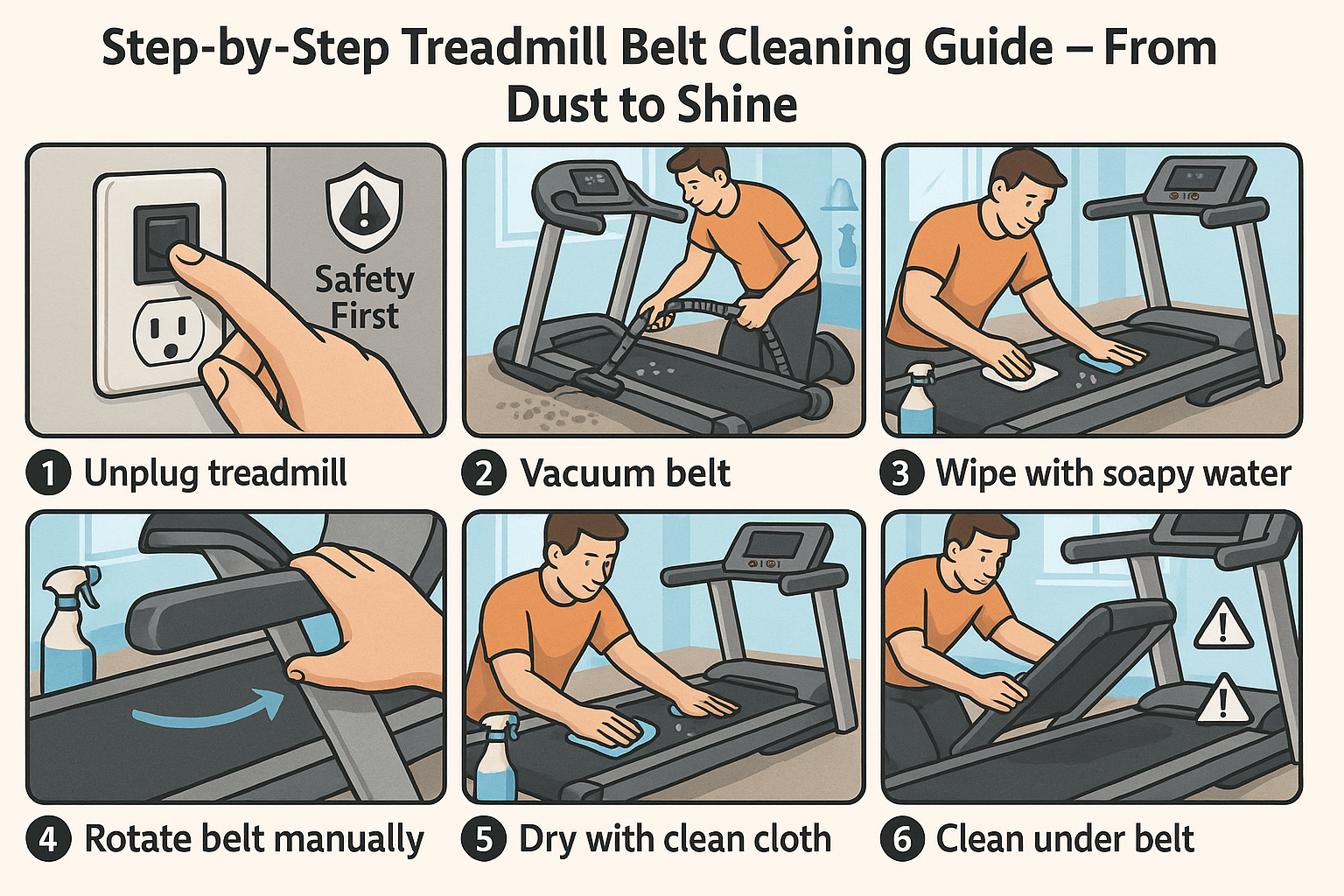
How to Clean Your Treadmill Belt (Step-by-Step Guide)

Cleaning your treadmill belt might seem like a lot, but skipping it is like running with untied shoes.

And please take my word for it. Sometimes ago and while running on my home treadmill, the belt slipped like I was trying to moonwalk on a slippery floor.

Let’s not repeat that.

Here’s a simple, step-by-step guide to clean your treadmill belt and keep it running like new.

  1. Turn off and unplug your treadmill.
  2. Grab a cloth or vacuum and clean the belt. Dust, dirt, and grime pile up faster than you think. If you skip this part, you’re asking for trouble.
  3. Use mild soap with warm water. You don’t need anything fancy—just something gentle.
  4. Wipe the belt gently, moving it by hand to get all the corners. Don’t skip any spots—this is like giving your belt some TLC.
  5. Take a dry cloth and wipe the belt again. Make sure it’s dry before you start running.
  6. Lift the belt if you can and clean underneath. Be careful not to mess with the belt’s alignment.
  7. Let it air dry. Don’t start running again until the belt is dry.
  8. After cleaning, make sure the belt is aligned and properly tensioned. It should be centered and tight enough that it’s not slipping, but not so tight that it stresses the motor.


Checking and Adjusting Belt Tension

Just like you adjust your shoes for comfort, your treadmill belt needs some tuning too.

If it’s too loose, the belt slips, and your workout turns into a guessing game. If it’s too tight, you’re putting too much stress on the motor.

Here’s how to get it just right:

  1. Turn off and unplug the treadmill.
  2. Press down on the belt in the middle. You should be able to press it down about 2 to 3 inches. If it’s too tight, it won’t move. If it’s too loose, it moves too easily.
  3. Walk slowly on the treadmill. If the belt slips, it’s too loose.
  4. Look at the back of the treadmill for the tension bolts. Check your manual for the exact location.
  5. Make small adjustments using an Allen wrench. Tighten the left and right bolts equally.
  6. Test the belt again by walking on it. Keep adjusting until it feels just right.
  7. Don’t over-tighten. A belt that’s too tight can damage the motor and the belt itself.
  8. Check for alignment. Keep an eye on the belt while you run. If it starts to drift, adjust it a bit.

Lubricating Your Treadmill Belt

I’m all about smooth runs, and lubrication is the secret sauce.

If you skip this step, you’re running on borrowed time.

Lubing the belt reduces friction, prevents wear, and keeps your treadmill whisper-quiet. Here’s how to do it right:

  1. Turn off the treadmill and clean the deck. You don’t want to lube over dirt.
  2. Gently lift one side of the belt. If it’s too tight, loosen it a bit.
  3. Apply silicone-based lubricant evenly. Apply it from the front to the back of the belt.
  4. Walk on the treadmill at a slow pace for a few minutes. This helps spread the lubricant evenly.
  5. Wipe away any excess lubricant. You want a smooth surface, not a slippery one.
  6. Check your treadmill manual for how often to lube it. Usually, every 3-6 months is good.

Using Your Treadmill the Right Way

The way you use your treadmill affects how long it lasts. Misuse, overloading, or running without care can cause more wear than you think. Here’s how to keep your treadmill happy:

  • Know Your Weight Limit: Exceed it, and you’re asking for trouble.
  • Use Clean Shoes: Outdoor dirt can scratch the belt and the deck.
  • Start Slow: Don’t rush into high speed. Build up gradually, like warming up a car in winter.
  • Vary Your Workouts: Switch it up to help the belt wear evenly.
  • Listen for Strange Noises: If something sounds off, fix it before it gets worse.

Your Treadmill Maintenance Plan

Here’s an easy-to-follow maintenance schedule:

Daily Users:

  • Daily: Wipe down the treadmill.
  • Weekly: Vacuum underneath and around the treadmill.
  • Monthly: Check the belt’s alignment and tension. Lubricate the belt.
  • Every Six Months: Inspect the belt for wear and do a full check-up.

Weekly Users:

  • After Each Use: Clean the belt and handrails.
  • Monthly: Vacuum the area and check tension.
  • Every Six Months: Lubricate the belt and inspect for wear.

Infrequent Users:

  • Monthly: Dust and clean the treadmill.
  • Every Six to Twelve Months: Perform a full inspection, including lubrication.

Keep a Maintenance Log: Track your treadmill’s care so you never miss a step.


Conclusion

I get it—sometimes you just want to hop on and get your run in, but giving your treadmill some TLC will keep it running strong for a lot longer.

A little cleaning, tension checking, and lubrication will save you from headaches later. So take care of your gear and keep crushing those runs!

Here’s your guide for buying a new treadmill.

Why Your Calves Hurt and How to Fix It

I know you’ve probably felt this before.

You’re out for your run, feeling good, maybe even picking up the pace, and then—bam—your calves start hurting.

Suddenly, you start thinking about what you might have done wrong in your training.

I’ve been there too—thinking, “A little pain won’t stop me.” But that never really works out, does it?

So why do calves hurt when you run? Well, there’s usually more to it than just running too fast.

From my experience, after running and coaching for so long, I’ve learned it’s often something that builds up.

If you’re hitting a wall with calf pain, it’s time to figure out what’s causing it—and fix it fast before you’re stuck on the sidelines.

Why Your Calves Hurt When Running (And How to Fix It Fast)

Calf pain isn’t always because you ran too fast. It’s like when you skip your warm-up and then wonder why your legs feel heavy halfway through your run.

1. Pushing Yourself Too Hard

I’ve been guilty of pushing too hard, thinking more miles meant bigger gains. And guess what? Your calves will be the first to let you know that’s not how it works. They need time to adapt. If you push yourself too hard, you’ll get soreness—or worse, strains.

2. Weak Calves

Weak calves are like running on a flat tire—something’s bound to break. When I first started running, I thought I could skip calf raises and just “run through it.” Well, my calves didn’t agree with that. They need to be built up properly if you want them to handle the load.

3. Tightness

Tight calves make your heel come off the ground too soon, putting too much pressure on your toes. That’s a recipe for overuse injuries like bunions. When your calves feel tight, you’re asking for trouble.

4. Improper Running Form

Thinking about changing your stride from heel-striking to forefoot running? Trust me, it’s like asking your calves to do a completely new job. They’ll be sore at first, but it’s part of the process. Just make sure to give them time to adjust.

5. Dehydration

You wouldn’t run without good shoes, so don’t run without proper hydration. The truth is that running on an empty tank isn’t just uncomfortable, it’s dangerous. Mild dehydration can cause tight muscles, and full-on dehydration brings cramps. When your calves start cramping, it’s your body saying, “Hey, I need water!”

6. Lack of Warm-Up

If you’re always sore at the start, it’s a sign you’re skipping your warm-up. Running on cold muscles is a recipe for cramps or spasms. If you want to avoid calf pain, always make sure to warm up properly before you start.


How to Stop Your Calves From Hurting While Running

Now that we’ve nailed down the issues, let’s talk about how to fix them.

No more suffering through every run with painful calves.

Here’s the game plan:

Calf Cramps: The Mid-Run Nightmare

Run long and/or hard enough and you know that calf cramps can hit hard, and out of nowhere. You’re running along, everything’s great, and then—bam—your calf tightens up like a vice.

Here’s how to handle it:

  • Stretch & Massage: Gently stretch and massage the affected calf. It’s like telling your muscle, “Hey, chill out, we’re almost done here.”
  • Hydration Is Key: After a cramp, make sure to hydrate. Water is your friend, especially if you’re running in the heat.
  • Don’t Be a Hero: If the cramp doesn’t loosen up, stop running. Nothing is worse than pushing through a painful cramp and making it worse. If this happens a lot, see a doctor.

Dealing with a Calf Strain

Strains are a bit nastier, and if you’re dealing with one, you need to act fast. This isn’t the time to tough it out. Follow the R.I.C.E. method:

  • Rest: Don’t make it worse. Give that leg a break.
  • Ice: Throw some ice on it—use a bag of frozen peas if you have to (trust me, they work).
  • Compress: Wrap it up with a compression bandage, but not too tight. You want to support it, not cut off the circulation.
  • Elevate: Prop up that leg while you relax. Elevation helps with swelling.

When to See a Doctor

If the pain doesn’t go away, especially if you notice swelling, numbness, or redness, it’s time to call in the pros. A doctor can help figure out what’s going on and give you a treatment plan tailored to your needs.


The Return to Running

I get it—you want to get back out there.

But if you rush it, you’re just setting yourself up for a bigger mess.

I hate to break it to you but jumping back too soon only makes the injury worse. Give your calf the time it needs to heal, strengthen, and come back stronger. When you do get back on the road, start slow, and ease into it. The longer you let your calf recover, the less likely you’ll have to deal with this mess again.


Hydration & Electrolyte Balance

Look, I get it—sometimes you’re running through the heat, sweating like crazy, and you just want to hit that last mile.

But if you’re not properly hydrating or ignoring the electrolytes your body needs, you’re basically inviting cramps. Trust me, I’ve been there. I used to think I could just drink water and be fine. Wrong. You need potassium, magnesium, and sodium—those are the big hitters. They keep your muscles working right.

So here’s the deal: don’t just drink water; go for something that’s going to replace what you’re sweating out. Sports drinks or electrolyte tablets are key. If you’re running long or going hard, consider electrolyte supplements.

I swear by them on hot days or after tough sessions.

My go-to? Something with potassium and magnesium—helps your muscles chill out and keeps you from locking up mid-sprint.


Achilles Tendonitis & Stress Fractures

Feeling a deep, sharp pain in the back of your lower leg, right behind the ankle? 

That might be Achilles tendonitis—basically, the tendon that connects your calf muscles to your heel is inflamed. It’s not fun. And trust me, it’s a real pain to shake off without the right care.

When the Achilles goes south, it’s like running with an anchor tied to your leg. That inflammation doesn’t just stop when you stop running.

You’ve got to give it rest, ice it, and—most importantly—take care of the root cause.

I’ve had this happen a couple of years ago, and of course, I blame overuse. Pushing it when I should’ve been taking it easy.

If the pain doesn’t settle down with rest and ice, it’s time to get a doctor’s opinion. Don’t wait this one out.

But let’s talk about stress fractures. These are tiny cracks in the bone from too much impact. They don’t hurt right away, but they’ll sneak up on you. If you’re feeling persistent calf pain that doesn’t go away after rest, or if it seems to worsen after running, a stress fracture might be the problem. These things don’t heal on their own unless you treat them properly. Rest, ice, and a proper diagnosis are key.


The Bottom Line

Calf pain doesn’t have to stop your running. Whether it’s dehydration, improper form, or just overdoing it, there’s always a way to get back on track. The key is listening to your body, taking care of those calves, and being smart about your training.

Remember, running is a marathon, not a sprint—especially when it comes to injuries. Let your calves heal, give them the TLC they deserve, and get back out there stronger than ever.

And remember this—every mile builds the runner you’re becoming, even the ones you take to recover.

How Much Should I Run to Lose Weight?

lose fat

One of the questions I hear all the time as a running coach is: “How much should I run if I want to drop weight?”

I get it.

I was that guy in his early 20s pushing 200 pounds, wheezing through short jogs, and hoping running would be the magic fix.

Back then, I had no clue what I was doing. Just tied my shoes and hoped for the best.

But here’s what I learned: running can absolutely help you lose weight, but it’s not just about piling on the miles. It’s about being consistent, eating smart, and trusting the process.

Fast-forward 14+ years, and I’ve lost over 50 pounds.

It didn’t happen overnight, but I picked up a lot of hard-earned lessons along the way. If you want to lose weight through running, I’ll walk (or run) you through what actually works—without the BS.

Why Running Helps With Weight Loss

Let’s break it down: You lose weight when you burn more calories than you eat.

Simple.

That’s called a calorie deficit.

Running just happens to be a great way to create one.

On average, you burn around 100 calories per mile if you’re a mid-weight person (shoutout to VeryWellFit).

So a 3-mile run? That’s 300 calories down.

If you weigh more, like I did when I started at around 200 lbs, you’ll burn even more. Your body’s working harder to move the extra weight. Built-in bonus.

But here’s the catch: you might also get extra hungry. That muffin you eat post-run might cancel out the calories you just burned.

I’ve seen it happen. Hell, I’ve done it.

I believe that it takes an hour to burn what takes two minutes to eat.

Truth bomb.

A lot of folks actually gain weight when they start running because they overcompensate with food.

Bottom line?

Running can burn fat, but it won’t fix your diet. You gotta do both. Think of running as your fat-burning engine and food as your fuel. The right mix matters.

So, How Much Should You Run?

Let’s be real: it depends.

But if you’re new and want a starting point, go for 3 days a week.

That’s what worked for me early on. It gave my body time to rest, recover, and still burn a decent amount of calories.

Even 2 days is fine to start.

Just build the habit.

Each session?

Shoot for 20–30 minutes.

Walk/run intervals totally count.

I used to do 3 minutes jogging, 2 minutes walking, and repeat.

That added up to 2 or 3 miles. And yeah, I took breaks.

Nobody cares how fast you go.

What matters is you showed up.

Once you’re consistent, you can add more time or days.

A good long-term target is 150–250 minutes of moderate cardio each week. That might look like 4 or 5 days of 30 to 50 minutes.

The American College of Sports Medicine even says more than 250 minutes a week can lead to bigger weight loss.

But don’t get overwhelmed. That includes everything—running, walking, biking, even dancing around your kitchen.

Mix it up.

In terms of mileage?

15–20 miles a week is a solid range for fat loss.

Just don’t jump into that right away. Add a mile or two per week, max.

Time or Distance—Which One Should You Track?

Both work.

Early on, I say go by time.

It feels less intimidating.

Promise yourself 20 minutes of movement. Doesn’t matter how far you go. Later, you can aim for distances.

Calories burned = time spent being active. That’s what matters. Over time, your pace will naturally get faster, and you’ll go farther in the same amount of time.

Consistency Wins

You want results?

Run consistently.

Running for 30 minutes, 3–4 times a week beats a single monster run every Sunday.

Your body adapts to repetition so please  build the habit first. Run short, run easy, but run often. That’s how you avoid injuries and stay in the game.

Eventually, you’ll stack those runs into real mileage. And that’s when the magic starts to happen.


A Realistic Running Plan for Weight Loss

So what does a smart plan look like?

Start small:

Run 2–3 times a week, even if it’s just 15–20 minutes of run/walk intervals.

That’s how I started, wheezing through jogs and catching my breath on lamp posts.

The trick is to build the habit, not win a medal on Day One.

Once you feel comfortable, bump it up to 3–4 runs per week, around 20–30 minutes each.

That’s when momentum kicks in. You’ll start seeing changes in your endurance, your mood, and the scale—slowly but surely.

The American College of Sports Medicine recommends 150–250 minutes of moderate activity per week to help with modest weight loss. That might sound like a lot, but it adds up quick—like 4 runs a week plus a long weekend walk.

In terms of mileage, a good target is 15–20 miles per week once you’re fully rolling. That might take a couple of months to build toward—and that’s okay.

I still remember the first time I hit 15 miles in a week. I was gassed, my legs were toast, but I felt unstoppable. That week lit a fire under me.

Minutes or Miles?

This one’s common: Should you focus on time or distance?

Honestly, both work.

Early on, I suggest going by minutes—say, a 20-minute jog. T

hat way, you’re not stressing about pace. You just show up, move, and put in the time. As your fitness improves, distance naturally increases.

Eventually, you’ll start caring about miles too—but don’t obsess. Whether you run 1 mile or 3 miles in 30 minutes, you’re building momentum. And that’s what matters.

Build the Habit First

Don’t overdo it.

Don’t aim for 10 miles a day right out of the gate.

That’s how you burn out or get injured. Instead, build consistency.

One runner on Reddit nailed it: “Run 4–5 times a week, even if it’s short and easy. Just show up.” And that’s what I tell my athletes too. It’s not about perfection—it’s about getting your feet moving again and again.

Walk when you need to. Breathe. Build slowly. The results will come.

Training Smart

Running is simple: one foot in front of the other.

But if you want to lose weight and stay injury-free, there are a few smart moves that can make a huge difference.

These are the same strategies I used when I started from zero.

Trust me, I made all the rookie mistakes so you don’t have to.

Start Slow with Run/Walk

If you’re just getting into running (or coming back after a long break), start with a run/walk combo. I used to think walk breaks were cheating.

Now? I swear by them.

Back when I was starting out, I’d jog for 1 minute and walk for 1 minute.

That was it. No shame in that.

Over time, I built it up to 2 minutes running, then 5, then 10. Eventually, I could run 30 minutes straight—something that once felt impossible.

Run/walk training helps you go longer, stay injury-free, and actually enjoy the process. More time on your feet usually means more calories burned. Doesn’t matter if you walk some of it.

You can also check out my couch to 5K plan for more details.

Build Mileage Gradually

The temptation to go all in is real.

I once jumped from 0 to running 6 days a week and ended up sidelined with shin splints. Learn from my mistake.

Stick to the 10% rule: don’t increase your weekly mileage by more than 10%. If you ran 10 miles last week, do 11 next week—not 15.

Soreness is normal at first, but if it turns into sharp pain, back off. Rest, cross-train, or just take the day off.

So please don’t get injured chasing progress. You can’t burn calories if you’re stuck on the couch nursing an overuse injury.

Mix Up Your Intensity 

Once you’ve got a few weeks of consistent running under your belt, it’s time to spice things up. Intervals and hill runs are calorie-burning gold.

A simple interval workout: run hard for 30 seconds, jog or walk for 1 minute.

Do that 8 times. Done right, this will skyrocket your heart rate and keep your body burning calories even after you stop.

Hill sprints? Brutal. But effective.

Find a hill, charge up it, walk back down, and repeat. These workouts build strength and torch calories. I used to dread them, but they made me a better runner, no question.

Studies back this up: short bursts of intense effort improve metabolism and break plateaus.

Limit these hard sessions to once or twice a week max. Too many and you’ll burn out or get hurt. Easy runs still matter.

Add Strength Training and Cross-Training

This one changed everything for me.

I used to only run. But once I added two 20-minute strength sessions per week—squats, lunges, push-ups, that sort of thing—I noticed big changes.

More muscle = more calories burned at rest.

Plus, strength training helped fix my form and ease joint pain. Some experts even argue that strength workouts and HIIT can be more effective for fat loss than running alone.

Cross-training counts too.

I’d go for long walks, bike rides, even jump rope sessions on my off days. It’s all about staying active without constantly pounding your joints.

Respect Rest Days and Sleep

I used to feel guilty about rest days.

Now, I treat them like gold.

You don’t get fitter while running. You get fitter while recovering.

At least 1–2 full rest days per week, no exceptions.

And sleep? If you’re skimping on it, your body pays the price. I noticed that when I slept poorly, I craved junk and my runs felt like crap.

Getting 7–8 hours of sleep a night helped me train harder, eat better, and lose weight steadily. Don’t skip this part.

Hydrate and Cut the Liquid Calories

Water matters more than you think. I used to crush sugary drinks all day. Once I cut those and stuck with water, tea, and black coffee, the scale started moving.

Hydration keeps your energy up and your performance steady. And it keeps you from mistaking thirst for hunger. That alone can save you hundreds of calories a day.

Final Thoughts

Weight loss through running isn’t about smashing every workout.

It’s about stacking wins over time. I dropped 1–2 pounds per week by sticking to the basics: run/walk, strength train, rest smart, eat right. A few months later and you already lost 25 pounds or even more.

And don’t do it alone.

In my early days, I had a friend who ran with me twice a week. We were both beginners, but we kept each other going. Accountability changes everything.

So… what’s your goal?

What’s your current mile time?

What’s your next step?

Drop it in the comments or tell a friend. This journey’s better when we do it together.


7 Best Hip Stretches for Runners to Improve Flexibility and Prevent Injury

hip stretches for runners

Let’s talk hips.

If you run long enough, your hips will eventually start complaining.

Maybe it’s a dull ache in your hip flexors.

Maybe it’s that locked-up stiffness after a long drive home from your weekend long run.

Either way, tight hips are the silent performance killer most runners ignore — until they can’t.

Here’s the truth.

Your hips are the engine room of your stride.

When they’re tight or weak, your form falls apart, your stride shortens, and your risk of injury skyrockets.

But when they’re mobile and strong? You run smoother, faster, and with way less effort.

In this guide, I’ll break down:

  • Why runners get tight hips in the first place
  • The hidden dangers of neglecting hip mobility
  • 7 game-changing stretches to open up your stride and protect your body

Remember: You don’t run with just your legs — you run with your hips. Treat them right, and they’ll pay you back in miles.

Understanding the Hip Flexors: Your Stride’s Hidden Power

Before we jump into the stretching part, let’s understand what’s actually tightening up.

Your hip flexors are the muscles on the front of your hips and upper thighs that lift your knee toward your chest.

Every time you take a step, sprint up a hill, or drive your knee in a stride, these muscles are working.

Here are the main players:

  • Psoas major & iliacus (together: iliopsoas) — the deep engines of hip flexion
  • Rectus femoris — part of your quads, adds knee extension power
  • Sartorius — the long, diagonal “tailor’s muscle” across your thigh
  • Tensor fasciae latae (TFL) — the small but mighty outer-hip stabilizer

When these guys are strong and supple, your hips stay aligned, your pelvis stays neutral, and your stride feels smooth.

When they’re tight or weak? You get chain reactions: shortened stride, hunched posture, sore lower back, and slower running economy.

Why Runners End Up With Tight Hips

Most runners don’t wake up with tight hips — we earn them through modern life and repetitive miles.

Here’s why your hips are probably cranky:

Running Only Works a Narrow Range

Running is basically thousands of mini-leg-lifts in the same small arc. You never take your hips through their full range of motion, so your flexors adapt to a shortened position.

We Sit… A Lot

Desk job? Commute? Netflix? Your hips are bent most of the day. Muscles adapt to the positions we spend time in, so your hip flexors get “stuck” short.

Weak Glutes = Overworked Hip Flexors

If your glutes aren’t firing, your hip flexors pick up the slack. This imbalance is common in runners — especially those who never strength train. The result: overworked, tight flexors and less power in your stride.

Your Anatomy & Running Form

Some of us are naturally tighter or have running form quirks that stress the hips. But even then, the main culprits are the same: sitting, repetition, and skipping mobility work.

Think of your hip flexors like coiled springs. Keep them loose and strong, and they’ll launch you forward mile after mile. Ignore them, and they’ll tighten, pull on your back, and eventually steal your speed.

Do You Have Tight Hips? Try the Thomas Test

If you’ve ever finished a long run and felt like your hips were made of concrete, you’re not alone. Runners love to stretch hamstrings and calves, but tight hip flexors? Those sneaky little muscles will wreck your stride and trash your posture if you ignore them.

One of the easiest ways to check if your hips are tight is with a classic physical therapy move called the Thomas Test.

Sounds fancy, but it’s basically a quick, no-equipment way to see if your hip flexors are locking you up.

Here’s how to do it, step by step — no PT clinic required.

1. Set Up on the Edge

  • Sit on the edge of a sturdy table, bench, or firm bed — tailbone near the edge.
  • Slowly roll back onto your back and bring both knees to your chest. Hug them in.
  • Press your lower back into the surface. That locks your pelvis in place.

This position sets the baseline: spine neutral, hips ready.

2. Drop One Leg

  • Keep one knee hugged to your chest.
  • Slowly lower the opposite leg off the edge and let it dangle.
  • Relax it completely — no tensing.
  • Keep your back flat. No arching. If your low back lifts, the test is off.

3. Check Your Hanging Leg

Now the detective work:

  • Does the back of your thigh touch the table (or get close)? If yes, your iliopsoas — your main hip flexor — isn’t overly tight.
  • Is your knee bent around 90°? If it wants to straighten, your rectus femoris (a quad muscle that crosses the hip) is tight.
  • Does your leg drift out to the side? That’s a tight TFL (tensor fasciae latae) pulling things outward.

4. Test Both Sides

Reset and switch legs. Most runners find one hip is tighter than the other. That’s your body’s way of telling you where the imbalance is.

Here’s how to read the results:

  • Thigh stays up, can’t touch the table → Tight iliopsoas
  • Knee straightens instead of staying bent → Tight rectus femoris
  • Leg drifts out → Tight TFL on the outside of your hip

Most runners “fail” because their thigh floats above the table — classic shortened hip flexors from miles of running and hours of sitting.

Here’s the silver lining: the Thomas Test doubles as a stretch. Hug one knee, let the other leg hang, and hold for 30–60 seconds. That’s free hip flexor therapy right there.

If You Fail the Test

Failing doesn’t mean you’re broken. It just means your hips are locked up and need attention. Work the stretches and mobility drills (will get into that later, don’t worry).

If you pass but still feel “tight” or achy, it might not be flexibility — it could be weakness or glutes not firing.

Weak hips can feel tight because other muscles are overworking to stabilize you. In that case, pair mobility work with strength training for glutes and core for the best payoff.

The Real Cost of Ignoring Tight Hips

Here’s the deal: tight hip flexors are silent saboteurs. Ignore them long enough and your running form, your power, and eventually your knees and back will all pay the price.

Here’s what happens when you run with locked-up hips:

1. Your Pelvis Tips Forward and Your Back Takes the Hit

Tight hip flexors yank the front of your pelvis down like they’re pulling on a drawbridge. This is called anterior pelvic tilt, and it does two nasty things:

  • Caves your lower back into an exaggerated arch
  • Weakens your glutes, leaving them stretched and underpowered

When your pelvis is tipped, every stride means your lumbar spine is doing extra work it was never meant to do. Cue low back pain and micro-trauma that adds up over miles.

2. Your Glutes Go Offline — And Hamstrings Pay the Price

Tight flexors shut down the muscles that make you fast and powerful: your glutes.

  • Weak or inhibited glutes = less hip extension
  • Overworked hamstrings start doing double duty

Result? Hamstring strains, glute tendinopathy, or just chronically “dead” legs.

You’re basically running with the brakes on — and sooner or later, something snaps.

3. Your Stride Falls Apart

Hip tightness destroys stride efficiency. With limited hip extension:

  • You push off early → shorter stride
  • You might start overstriding to compensate → stress shoots into your knees
  • Or you lean forward from the waist instead of the ankles → hello, low back and neck pain

Researchers have literally observed that hip-tight runners show less hip extension and earlier toe-off.

Translation: you’re leaving speed and efficiency on the table every step.

4. Your Knees and Feet Start Complaining

The kinetic chain starts at the hips. When your hips are locked:

  • Your femurs rotate inward
  • Your knees track wrong
  • Your arches collapse

This is why PTs so often target hip mobility when treating runner’s knee or IT band issues.

5. Overuse Injuries Are Coming for You

Running with tight hips is like driving with your emergency brake half on — the extra strain builds silently until something fails.

  • Studies link hip flexor tightness to hamstring strains and even ACL injuries
  • Overuse injuries creep in because your form is compromised and your muscles are fighting each other

And here’s the brutal truth: pushing through hip pain rarely ends well.

Top 7 Hip Stretches for Runners

Tight hips will wreck your running if you let them. They’ll steal your stride, mess with your form, and leave you hobbling after a few miles. The good news? A few minutes of the right stretches can save you a world of pain.

These are my go-to hip openers for runners — they loosen up your glutes, hip flexors, and deep rotators, keeping your stride smooth and your joints happy. No fancy equipment, no excuses.

1. Pigeon Pose (a.k.a. Runner’s Butt Saver)

Targets: Outer hips, glutes (piriformis, glute med), and the hip flexors of the back leg.

Why Runners Swear by It: This is the king of hip openers. If your glutes are tight, your lower back and knees will eventually pay the price. Pigeon gets deep into the hip capsule and melts that post-run tension. Perfect if you deal with piriformis pain or that nagging “dead butt” stiffness.

How to Do It (No-Nonsense Version):

  • From a push-up or plank position, swing your right knee toward your right hand and set it down. Your shin angles under your torso — tight hips mean the foot will be closer to your left hip, looser hips mean you can angle it out more.
  • Slide your left leg straight back, top of the foot on the ground. Keep your hips square — imagine headlights on your hip bones facing forward.
  • Sit tall first. Lengthen your spine before you fold forward.
  • Ease into the stretch. Walk your hands forward and lower down as far as feels good. Forearms or forehead to the mat if you’re flexible, but there’s no medal for face-planting.
  • Breathe. Hang out here 30–60 seconds, letting that tightness melt on every exhale.
  • Switch sides and repeat.

Modifications:

  • Knee complaining? Skip the floor and do a Figure-4 on your back — right ankle over left knee, pull the left thigh toward you.
  • Need more control? Do it on a bench or couch so you can adjust the angle without grinding your joints.
  • Can’t get your hip down? Use a block or folded towel under the hip for support.

Coach’s Tip: Don’t lean like you’re falling off a bike — keep the weight centered. Over time, pigeon will loosen your hips and make post-run stretching feel like hitting a reset button.

2. Kneeling Runner’s Lunge (Hip Flexor Lunge Stretch)

What It Hits: Your hip flexors (iliopsoas + rectus femoris) on the back leg, plus a little bonus for your front glutes and quads.

Why It’s Gold for Runners: Tight hip flexors are almost a badge of honor for runners — but they’re also a recipe for sluggish strides and cranky knees. Hours of running plus all that sitting we do? Your hips are basically locked up. This lunge opens the front of the hip, restores mobility, and even sneaks in a bit of core engagement if you do it right.

How to Nail It:

  • Set up your lunge: Kneel down, step your right foot forward so your knee is stacked over your ankle (90° angle). Slide your left knee back until you feel a light stretch in the front of the hip. (Pad your knee if the floor is unforgiving.)
  • Tuck and engage: Slightly tuck your tailbone under (posterior tilt) and gently squeeze your left glute. Boom — instant hip flexor stretch without arching your back.
  • Ease forward: Shift your hips just a touch forward until you feel that juicy stretch along the front of your left hip and thigh. Keep your torso tall — don’t dump forward.
  • Add the reach: Want to level it up? Raise your left arm overhead and lean slightly toward your front leg. This lengthens the hip flexor line even more.
  • Hold and breathe: 30–60 seconds, nice and slow. With each exhale, sink a touch deeper.
  • Switch sides: Left foot forward, right knee down — same drill.

Coach’s Tip: Don’t chase the stretch by arching your lower back. The magic comes from the hip tilt + glute squeeze, not cranking your spine. If kneeling hurts, do a standing split-stance version or the “couch stretch” with your back foot up on a sofa.

3. Happy Baby Pose (Ananda Balasana)

What It Hits: Deep hip rotators, groin, and gives your lower back a big sigh of relief.

Why Runners Should Care: After miles of repetitive forward motion, your hips feel like rusty hinges. Happy Baby does the opposite — it opens the hips in flexion and rotation, gently decompresses the lower back, and basically makes your body go, “Ohhh, thank you.”

How to Do It:

  • Lie on your back and pull your knees toward your chest.
  • Grab the outer edges of your feet (or shins/ankles if that’s easier).
  • Open your knees wider than your torso, aiming them toward your armpits. Feet face the ceiling, shins vertical.
  • Gently pull down while pressing your tailbone toward the floor. Your lower back should stay flat.
  • Hold for 30–60 seconds (or longer). Optional: Rock side to side for a little lower-back massage.
  • Release, hug your knees in, and straighten out.

Coach’s Tip: Keep your neck and shoulders soft. If reaching your feet is a struggle, hold behind your thighs or try “Half Happy Baby” (one leg at a time). After a long run, this move feels like hitting the reset button on your hips and spine.

4. Butterfly Stretch (a.k.a. Seated Groin Stretch)

Targets: Inner thighs, groin, hips, and a little love for the glutes.

Why It Matters: If you run trails, tackle hills, or even just pile up road miles, your hips and adductors (inner thighs) can tighten up. That tightness? It steals your stride length and makes lateral movements feel stiff. This stretch is your ticket to more hip freedom.

How to Do It (Runner-Friendly Version):

  • Get set up: Sit on the floor and press the soles of your feet together so your knees drop out to the sides. Slide your feet closer to your body for a stronger stretch, or farther away if your hips are screaming at you.
  • Posture first: Grab your ankles or feet. Sit tall, chest proud, spine long. Don’t hunch — think “tall runner,” not “tired desk worker.”
  • Gentle pressure: Use your elbows (lightly!) to nudge your knees toward the floor. Feel that inner thigh stretch? That’s the sweet spot.
  • Optional forward fold: Want more? Inhale tall, exhale, and hinge forward from the hips. Lead with your chest, not your head. Stop before your back rounds.
  • Breathe and hang out: Hold 30–60 seconds. Every exhale, let gravity do its thing — knees sink, hips open.
  • Come up slow: Bring your torso upright and fold your knees together gently.

Coach’s Tips:

  • If your knees are sky-high, sit on a cushion or folded blanket.
  • No pain in the knees — ever. Adjust or support with yoga blocks if needed.
  • This is a Netflix-friendly stretch. A few minutes a day works wonders on hip mobility for your runs.

5. Extended Wide Squat (a.k.a. Deep Yogi Squat)

Targets: Hips (inside and out), glutes, hamstrings, lower back, and even your ankles.

Why It Matters: Runners spend hours moving forward, but rarely open up laterally. This squat reverses that one-dimensional grind, prying open tight hips and improving ankle mobility.

Translation? Smoother strides and happier knees.

How to Do It (Runner-Friendly Version):

  • Stance up: Feet a bit wider than shoulders, toes turned out ~45°. Adjust until it feels natural.
  • Drop down: Squat slowly, keeping heels on the floor if possible. Sink until your hips are between your heels or as low as you can go without tipping forward.
  • Elbow assist: Bring your elbows inside your knees, palms together at your chest. Gently press your knees out — feel that groin and hip stretch kick in.
  • Stay tall-ish: Slight forward lean is okay, but keep your chest proud and back engaged.
  • Breathe and hold: 30–60 seconds. On each exhale, think: tailbone heavy, knees open.
  • Exit clean: Hands to the floor for support, then either sit down or rise up with control.

Modifications for Tight Hips:

  • Can’t hit depth? Place a yoga block or low stool under your tailbone for support.
  • Heels coming up? Slide a rolled towel under them.
  • Need balance help? Hold a door frame or post.

Coach’s Tip: Don’t let your knees cave in — press them out. A few rounds of this in your cooldown can keep your hips loose and ankles ready for real-world terrain.

6. Frog Stretch

Targets: Groin and inner thighs (hip adductors like the gracilis and adductor magnus) plus the hip joint capsule.

Why I Love It: Ever try a side lunge and feel like your legs are made of concrete? Or notice your knees collapsing inward on a run? That’s your tight adductors talking.

Enter the Frog Stretch — named because, well, you look like a frog squatting. It’s one of the deepest groin openers out there. If your hips feel locked or lateral movements (think side lunges, trail running twists, or even some yoga poses) make you stiff, this one’s a game changer.

Coach Tip: Go easy if you’ve got cranky knees or hip issues. This stretch can be intense. Use padding and ease in. Your body will thank you.

How to Do It:

  • Start on all fours — hands and knees — on a soft mat or with padding under your knees.
  • Slide your knees apart slowly. Keep them in line with your hips, not pushed forward. Your legs will form a wide “V,” with your knees bent around 90 degrees. Picture a frog squatting — that’s the vibe.
  • Check your feet and shins: They should line up with your knees so you’re not torquing the joints. Feet can be flexed (toes out like a duck) or relaxed — whatever feels best.
  • Drop onto your forearms. Keep your spine neutral — don’t arch like crazy or round like a cat.
  • Ease your hips back slightly, like you’re trying to sit into the stretch. You should feel it lighting up the groin and inner thighs.
  • Hold for 30–60 seconds (work up to 1–2 minutes). Breathe deeply. On each exhale, let gravity do its thing and see if your hips sink a hair lower.
  • Come out slowly. Slide your hips forward or bring your knees together gradually. Trust me, you don’t want to snap your legs in — your muscles need a second to wake up.

7. Standing Wide-Legged Forward Fold (Straddle Stretch)

Targets: Hamstrings, inner thighs, hips, and a gentle release for the lower back.

Why I Love It: This one’s a two-for-one: hamstrings + adductors. For runners, tightness in either can make your hips feel jammed. This stretch not only opens the legs but also gives your spine a mini traction session. Perfect cooldown after a long run — plus it’s a sneaky way to get some blood to your brain and calm the system down.

How to Do It:

  • Take a wide stance — about 3 to 4 feet apart. Toes can point forward or slightly inward for more hamstring focus.
  • Hands to hips, inhale, and hinge forward from your hips as you exhale. Keep your back flat as long as possible — like your pelvis is tipping forward.
  • Fold forward fully once you hit your limit. Let your hands drop to the floor (or blocks if the floor is miles away). Super flexible? Maybe your head brushes the ground — but that’s extra credit, not the goal.
  • Relax your neck and let gravity pull your upper body down. Shift weight slightly to the balls of your feet for hamstring fire, or back to feel more in the inner thighs.

Spice It Up:

  • Walk your hands forward (like a wide-legged downward dog) for more hip lengthening.
  • Or bend your elbows and drop forearms if you’ve got the mobility.

Breathe and hold: 30–60 seconds. Each exhale, let yourself sink a tiny bit more. Keep a micro-bend in the knees if needed — no locked joints.

Come up slow: Engage your core, rise halfway, pause, then all the way up. You can step your feet in a little first if you went super wide.

Mod It: Tight hamstrings? Rest your hands on a chair or wall. Adjust your stance width until you find that “good stretch” without strain.

When to Perform These Stretches

Timing matters. Stretch smart, not just hard.

Here’s the deal: static stretches — the ones where you hold a position — work best after your run, not before. That’s because your muscles are warm, loose, and ready to actually lengthen.

Try holding these deep stretches on cold muscles and you’ll feel like a rusty hinge. Worse, research shows that long static holds before a run can even take the spring out of your stride temporarily.

So if you want to run strong, save the long holds for after the miles are done.

Before your run? Stick to dynamic moves — stuff like leg swings, lunges with a twist, high knees, and hip circles. These wake up your hips and prep your joints without killing your power.

My go-to routine looks like this:

  • Post-run: Quick jog or walk to cool down → hit 2–3 key hip stretches for 30–60 seconds each.
  • Tight day? Add a few more stretches or longer holds.
  • Rest day or evening session: Go for a 15–20 minute hip-focused routine. Think of it as maintenance for your running machine.

Pro Tip: Skip long static holds before speed workouts or races. Studies show it can dampen muscle explosiveness for an hour or so. Do your dynamic warm-up, crush your run, then hit the long stretches after.

Bonus Tips for Bulletproof Hips

Stretching is good. But strong, mobile hips? That’s next-level.

Static stretching is just one piece of the puzzle. If you really want hips that feel loose, strong, and ready to handle miles, add these tools to your kit:

1. Strengthen Your Glutes & Core

Tight hip flexors often come with a lazy butt and weak core. If your glutes aren’t firing, your hip flexors do way more work than they should — and boom, tight hips.

Do this twice a week:

Even 10–15 minutes can change your running form. A strong backside takes pressure off your hip flexors and keeps your stride snappy.

2. Dynamic Mobility is Your Warm-Up Superpower

Dynamic drills aren’t just fluff — they prep your hips to move through their full range without strain.

My pre-run favorites:

  • Forward and sideways leg swings
  • Walking lunges with a torso twist
  • High-knee marches
  • Hurdle steps or hip circles

Do 5–10 minutes before runs, especially speedwork or after long sitting sessions. Your first mile will feel way smoother.

3. Foam Roll & Self-Massage

Sometimes “tight” isn’t just muscle — it’s the surrounding fascia and trigger points screaming for attention.

  • Foam roll your quads and IT bands to ease tension on your hips.
  • Target glutes and upper hip flexors with a lacrosse ball — life-changing for some runners.
  • Avoid bony areas and stick to the muscle belly.

Fix Your All-Day Posture

Your hips don’t just tighten up during runs — they’re reacting to how you spend the other 23 hours.

Long desk sessions? Netflix marathons? That’s basically a hip flexor boot camp (and not the good kind).

  • Stand up at least once an hour. Walk, stretch, or hit a quick lunge.
  • When sitting, stay on your sit bones, not slumped onto your tailbone.
  • Avoid “hip-jut” standing or always leaning on one leg. Little posture habits add up.

Think of it this way: every hour in a posture is training your muscles. Train them for running, not stiffness.

Respect the Training Ramp-Up

Hip flexor issues love sudden mileage spikes. Stick to the 10% rule: don’t jump mileage or intensity faster than your hips can adapt.

  • New speedwork? Balance it with recovery and mobility work.
  • Trail or hill focus? Expect your hip flexors to work harder — treat them accordingly with stretching and activation.

Smooth, steady progress beats “hero weeks” followed by injury timeout.

Listen to the First Whispers

Your body rarely goes from healthy to injured overnight. That twinge in the front of your hip? That’s a whisper. Ignore it, and it’ll start shouting.

  • Shorten or swap a run for mobility work.
  • Heat, stretch, and foam roll before it’s a problem.
  • One missed run beats three weeks on the sidelines.

As one veteran runner said: “Tight hip flexors don’t just hurt — they hijack your stride.”

Long-Term Payoff: Strong, Mobile Hips = Better Running

Healthy hips aren’t just injury insurance — they’re a performance boost.

Runners who stick with hip mobility work often notice:

  • Smoother strides and better posture
  • Less random aches in knees and lower back
  • More power on hills and sprints

Forget chasing a six-pack — build hips that actually let you run like an athlete. Strength plus flexibility is the real secret sauce.

Rotating Running Shoes Can Lower Injury Risk by 39%

You’ve probably heard that rotating shoes is just a “runner’s myth,” right?

But trust me, it’s not.

I get it—who wants to deal with switching shoes all the time?

Here’s the thing—if you want to lower your injury risk by almost 39%, rotating shoes is the way to go (check the science here)

I ignored this advice for way too long.

I used to run in the same pair until the soles were practically hanging off.

Thought I could power through it, but, yeah, my knees and hips quickly reminded me that they don’t like that kind of treatment.

IT band pain? Check.

Knee flare-ups? Check.

Once I started rotating shoes, my pain started to fade. Don’t me wrong – I’m not implying that all my running pains disappeared, but I felt the difference. 

Let’s break down the reasons behind why you should be shoe-rotating as well as how to do it right.


What’s the Big Deal with Rotating Running Shoes, Anyway?

Running puts a lot of strain on your body. Every. Single. Time. Switching shoes is like giving your body a quick rest, which it really needs.

When you switch shoes, you change the way your body takes the impact, and that helps prevent injuries. It’s a simple fix, and it works!

You wouldn’t wear the same pair of socks for a week straight, would you? So why do it with shoes? Trust me, your feet (and your body) will thank you.

Now let me get into the science part. I promise you  it’s not as boring as it sounds.


How Rotating Shoes Prevents Injuries (Science-Backed Proof)

Here’s the deal: if you’ve heard that rotating your running shoes can help prevent injuries, that’s not just old runner’s wisdom — there’s solid science backing it up now.

A fresh study from Luxembourg tracked 264 regular runners over 22 weeks and found that those who switched between several pairs of shoes had 39% fewer injuries than those who mostly stuck to just one pair.

To break it down: about half of these runners mainly ran in just one shoe—like 91% of their miles in basically the same kicks. The other half rotated through around 3 or 4 pairs, mixing things up a lot more.

And the injury difference? Pretty clear. The shoe-rotators came out way better off.

Why? Well, different shoes shift the way impact hits your legs.

One pair might hit your calves harder, another your knees, or change how your stride feels.

By rotating shoes, you spread out that pounding, giving your tissues a break and lowering the chance of overuse injuries.

The researchers aren’t 100% sure which shoe features matter most here — midsole firmness, height, or shape — but they’re confident that mixing it up forces your legs to move differently each run. That variety seems to keep you safer.

Running in the same shoes means your joints take the same hit with every step. But rotating shoes gives your body a break by changing how it handles each run.

One day you get more cushion, the next day less—your body gets some needed relief.

If you’re feeling aches and pains that keep popping up in the same spot, your shoes might be more to blame than your mileage.


How Many Shoes Should You Have in Your Rotation?

So, you’re ready to start rotating shoes? At least two pairs, but three is even better if you’re running a lot.

  • Two pairs: Perfect if you run 3-4 times a week.
  • Three pairs: Great for heavy mileage, different terrains, or if you’re training for a marathon.

In other words, if you’re running 3-4 days a week, two pairs are enough. For higher mileage or specific races, aim for 3-4 pairs in rotation. The key is keeping things fresh—not just for your shoes, but for your body too.

Quick Advice: Have one pair for speedwork, one for longer runs, and another for recovery or trails. Trust me, your body will thank you. Different shoes for different runs? It’s a total game-changer. You wouldn’t wear trail shoes on the road, would you? And you wouldn’t wear road shoes on the trails either.


Rotation Based on Running Experience

Let’s dive into how shoe rotation changes depending on your experience level.

For Beginners:

If you’re just starting out, I get it, one pair of shoes might seem like enough.

And honestly, it can be for a while.

But here’s the kicker—don’t stick with that same pair for all your runs.

Once you’ve got your form dialed in and you’re running consistently (even if it’s just a couple of days a week), add a second pair for easy runs and longer recovery days.

You don’t need to go wild with different models—maybe something cushioned for those long, slower days, and something a bit lighter for your speed sessions. But please, don’t wear the same pair for both. Your body will thank you.

For Intermediate Runners:

Alright, you’re putting in more miles, your legs are a little more seasoned, but there’s still room for improvement, right?

You should have at least three pairs of shoes in your rotation. Here’s the play:

  1. Daily trainers for easy, steady runs.
  2. Speed shoes for your tempo workouts or intervals—think lighter, more responsive.
  3. Cushioned shoes for long runs when you need to absorb all that impact.

Your body is starting to ask for more variety—different surfaces, different paces, different impacts. Don’t ignore it.

For Advanced Runners:

Now you’re in the game. You know what you’re doing. But, just because you’re racing marathons and knocking out fast times doesn’t mean you can throw caution to the wind. Four pairs of shoes—that’s where you wanna be:

  1. Daily trainers for easy runs.
  2. Tempo shoes for speed sessions and hill workouts.
  3. Carbon-plated racers for race day—yes, you want those.
  4. Cushioned shoes for your long runs—comfort is your best friend here.

And let me tell you, as someone who’s been there, the more you rotate the better. You’re pounding the pavement hard, and your body needs that variety to stay fresh. Different shoes mean different angles, different stresses, and different muscle groups engaged. Keep the body guessing, and you’ll stay injury-free.


Shoes for Specific Training Types

When it comes to speedwork, think light. You want a shoe that makes you feel like you’re flying—not like you’re lugging around bricks.

That means something fast and responsive, like a racing flat or a lightweight trainer. The goal here isn’t comfort—it’s speed. You’re gonna feel the ground, but in the best way.

Now, for your long runs, you need something that feels like a pillow but doesn’t make you sink into the ground.

You’re out there for hours, so you need a shoe with plenty of cushion, but not so much that you feel like you’re running in marshmallows. Trust me, your joints and your mind will thank you around mile 18.

And then there’s the recovery shoe—my favorite part of the rotation. After pounding the pavement for a few hard weeks, you need a shoe that wraps around your foot like a warm blanket.

Something with max cushion, because your feet are begging for relief. Hoka Bondi? Perfection. I don’t care how much cushion you like, after a tough week of mileage, your legs will fall in love with these.


Treadmill-Specific Shoes

Now, if you’re running indoors on a treadmill—yeah, your shoes still matter. They don’t need to be anything crazy, but if you’re putting in time indoors, you want something that’s gonna give you that smooth stride while protecting your joints from that constant impact.

Treadmills don’t give much back, so having the right shoe can make a huge difference.

You’re gonna want a shoe with extra cushioning to handle that repetitive pounding.

Not all shoes are built for this, so go for something with a softer ride, like the Nike React Infinity Run or Asics Nimbus.

These are built for cushion, plain and simple. You don’t need speed here—you need comfort, especially if you’re doing long treadmill sessions. It’s like running in place, and you don’t want to add more impact to that, right?

Plus, don’t forget about breathability. You’re indoors, and trust me, things can get warm. Make sure your shoes have solid airflow to avoid getting too swampy in there.


Conclusion

So, no matter where you’re at in your running journey, don’t sleep on shoe rotation.

It’s simple, but it’s the difference between chronic injuries and running injury-free. Use that tool to get your ideal rotation, and adjust it as you get faster, stronger, and more experienced. You’ll be a smarter runner—and feel better doing it.

And one last thing—I once made the mistake of having zero rotation for months.

Didn’t realize it until my knees started screaming. Don’t be that guy. Rotate your shoes, and keep those legs fresh!

Thank you for dropping by.