Whether you’re lacing up for your first mile or you’ve been pounding pavement for years, one thing’s for sure: good form matters.
Back when I was a rookie, I figured running was just… running. You move your legs and go, right?
Wrong. A few months in, I was nursing sore knees, a tight back, and wondering if running just “wasn’t for me.”
Turns out, I was running like a collapsed lawn chair—slouched over, feet flopping, breathing like I was chasing a bus.
One day my cousin (also national athlete) said, “David, straighten up. You look like you’re melting.” That stung—but he was right.
When I fixed my posture, everything changed. My body stopped fighting itself, and running finally started to suck less.
If you’re frustrated with aches, sluggish miles, or just want to run smoother, you’re in the right place.
This isn’t some complicated breakdown. It’s a runner-to-runner guide, built on real experience and coaching others through the same struggles.
Let’s get to it.
What Is Good Running Form
Running form is just how your body moves while you run—your posture, how your feet hit the ground, your arms, your rhythm.
Think of it like building a house: if the foundation’s solid, the rest holds up.
So why does it matter? Two big reasons:
It saves energy. Good form helps you run with less effort. No wasted motion. You’re not dragging or fighting gravity—you’re moving with it.
It prevents injuries.Bad form puts stress in all the wrong places. Ankles, knees, hips—stuff breaks down fast if you’re landing heavy or slouching.
I had one client who showed up with shin splints every week. We figured out he was overstriding—reaching too far out in front. We fixed his stride and boom—pain gone. He went from dreading runs to actually enjoying them.
No two runners look exactly alike—your body, flexibility, and past injuries all play a role. But there are some basic principles that work for just about everyone.
Kinda like how everyone has their own handwriting, but we all use the same alphabet. Same idea here.
Trying to “fix your form” all at once is like trying to juggle five watermelons.
Let’s break it down piece by piece. Work on one thing at a time. Give it a few weeks. Let it click before moving on.
1. Posture: Run Tall with a Small Lean
If I could give just one tip to every new runner: run tall.
Seriously.
It changes everything.
When I first started out, my form was a mess—shoulders hunched, head down, arms dangling. After every run, my upper back was toast. I remember one brutally humid morning in Bali, halfway through a 5K. I was cooked.
Then I remembered my “string cue”—imagine a string pulling you up from the top of your head. I straightened up, leaned in slightly, and boom—my breathing got easier. It felt like my body started working with me instead of against me.
Here’s what to focus on:
Stand tall. Don’t slouch. Imagine that invisible string lifting your head up. Keep your spine long and proud.
Lean forward slightly. Not from your waist—hinge from your ankles. It should feel like you’re just about to fall forward, and your foot catches you.
Engage your core. You don’t need to flex like you’re doing a plank, but stay lightly braced. Think “ready for a light punch” – just enough to stay stable.
Relax your shoulders. This one gets missed all the time. I literally drop my arms and shake them out mid-run if I feel tension creeping in. Reset and keep moving.
Eyes up. Not glued to the ground. Looking ahead naturally lifts your chest and sets your spine right. Plus, you won’t trip on a crack.
When you get this right, running gets smoother. You feel lighter. More flow, less fight.
Real Talk from the Trail
Some of this might feel weird at first—especially if you’ve been slumping for years. That’s normal. Your body’s learning a new habit.
But once it clicks, you’ll wonder how you ever ran any other way.
And trust me, this isn’t about chasing some picture-perfect “elite runner” form. It’s about feeling better, running stronger, and keeping your body happy over the long haul.
Arm Swing: Pump Back, Not Across
Most runners obsess over their legs. I get it—that’s what’s doing the pounding.
But your arms? They matter for your stride.
If your form feels off or you’re constantly dealing with side stitches, don’t just blame your core—check your arm swing.
I used to make a rookie mistake without even realizing it. During a workshop, a coach pointed out that I was swinging my arms across my chest like a boxer guarding his ribs.
It looked harmless, but that twist in my torso? It was messing with my balance and probably the reason I’d cramp up during faster runs.
Once I cleaned up my arm movement, it was like flipping a switch—my stride felt lighter, smoother. No more cramp. Just flow.
So What Should Your Arms Be Doing? Simple: Drive Them Back, Not Across.
Here’s how to make your arms work for you, not against you:
Bend your elbows to about 90 degrees. Keep them close but relaxed—not clamped to your ribs or flapping out like chicken wings. Picture an L-shape. Compact, chill, efficient.
Swing from your shoulders, not your elbows. Your hands should move from your waist up to around chest level. Coaches call it “hip to lip” or “pocket to ear.”
Drive your elbows back. Think about elbowing someone behind you. That mental cue forces the right motion and helps your legs drive forward too. I still imagine an invisible runner behind me—keeps my form honest.
Don’t let your hands cross your body’s midline. Picture a line dividing you in half—your hands shouldn’t drift across it. If they do, chances are you’re twisting your torso and throwing everything out of sync. Some runners imagine a narrow hallway in front of them. Stay in your lane.
Your arms should swing with intention, not tension. Don’t clench your fists or shrug your shoulders. If your arms start feeling tight, shake them out mid-run and reset.
Want a quick drill? Stand still and pump your arms like you’re sprinting—just your arms. Drive them straight back. Feel the rhythm? That’s what you want while running—toned down a bit when jogging, but same motion.
When I finally fixed my swing, everything clicked. I wasn’t just avoiding cramps—I could charge up hills by pumping my arms a little more.
Head Position: Run Tall, Look Forward
“Keep your head up!” It’s not just something people yell at races to cheer you on. It’s legit running advice.
Your head controls the chain from your neck down—if it’s off, your whole form can go sideways.
Here’s the real talk on how to hold your head like a pro:
Eyes forward, not down. Gaze about 10–15 feet ahead. That keeps your posture tall and helps you spot what’s coming. Don’t get stuck staring at your feet—you’re not running to admire your shoes.
Don’t crane your neck. Looking down too long rounds your shoulders and collapses your chest. Try it right now—tilt your head down and feel how your whole upper body folds forward. Not great for breathing.
Chin level. Not jutting out. Not tucked in like a turtle. I once had a coach tell me to imagine balancing a book on my head while running. Sounds silly, but it helps you stay upright.
Ears over shoulders. This is the gold standard. If someone took a side photo of you, your ears should stack right above your shoulders. If your head’s poking out, you’re stressing your neck.
Oh—and don’t forget your face. Relax it. Drop the jaw tension. I’ve done mid-run cheek shakes and even blown out my lips like a horse to reset (yeah, I look ridiculous—but it works and always makes me laugh).
Hands and Shoulders: Keep It Loose, Not Lazy
Let’s talk tension — the kind you don’t notice until your shoulders are up by your ears and your fists feel like you’ve been punching walls for the last 10K.
If you’ve ever finished a run with a tight neck, sore forearms, or even tingling fingers, you’ve met the silent form killer: upper body tension.
Fix Your Hands First
Your hands aren’t just passengers. Clenched fists chain-react all the way up — tightening your forearms, then your biceps, then your shoulders. That’s energy you’re wasting, and in running, every ounce matters.
Here’s a trick I use (and teach): Pretend you’re holding a potato chip between your thumb and finger — light enough not to break it, firm enough not to drop it. Some runners literally train with chips in hand. Pringles don’t lie. Crack one, and you’re gripping too tight.
I personally go with a soft “OK” sign — thumb barely touching the side of my middle finger. Keeps everything chill. No curled fingers. No fists. Just flow.
Now Drop Those Shoulders
Your shoulders shouldn’t ride up like you’re bracing for a fight. Keep them down, relaxed. If they creep up mid-run (and they will), do what I call a “shrug-drop”: shrug your shoulders way up to your ears — then let them fall like dead weight. Boom. Reset.
Want a bonus posture fix? Gently squeeze your shoulder blades like you’re holding a pencil between them. Not tight — just enough to open up your chest and undo that desk-job hunch.
Quick Reset Tricks You Can Use Mid-Run
Shake it out. Drop your arms, dangle ‘em for a couple strides, then get back to form. Works like a charm.
Breathe deep. When you’re tight or anxious, your breathing goes shallow. Fix it with deep belly breaths — it calms the body and the brain.
Smile or laugh. Sounds silly, but it works. I sometimes force a grin on tough hills. Instantly loosens my face and helps my shoulders relax too. (And hey, running’s supposed to be fun, right?)
Drop your arms. If everything’s locking up, pause and let those arms hang. Shake ‘em out. Reset. Then back to business.
Forward Lean: Let Gravity Help You, Not Slam You
Here’s a form tip that changed the game for me: leaning slightly forward while you run. And I mean slightly. Think gentle slope, not nosedive.
I first came across this through the Chi Running method. They talk about leaning from the ankles — not the waist — to tap into gravity. I was skeptical. Thought I’d fall flat on my face.
But one day I gave it a shot.
And man — it clicked.
I wasn’t pushing harder, but I was moving faster. It felt like gravity was giving me a gentle pull, not dragging me down.
I thought, “This almost feels like cheating.” But it wasn’t — it was just smarter running.
Want to Feel It? Try This Drill:
Stand tall. Let yourself start to fall forward like a stiff board.
The moment you feel like you’re about to tip over, start running.
That angle — right there — is your sweet spot.
Form Fix Tips:
Lean from the ankles. Keep that body line tight — no bending at the hips.
Core on. Keep it tight like you’re doing a standing plank. That stabilizes everything.
Keep it small. A few degrees is all you need. If you feel like you’re fighting to stay upright, dial it back.
Use the downhills. Gentle downhill runs naturally put you in the right lean. Mimic that same feeling on flats.
When I combine a slight lean with a quicker cadence, I feel like I’m gliding. Less pounding, more flow.
I used to ignore this until I realized how much it was messing with my running.
Fixing my cadence was one of those game-changing shifts that didn’t require any fancy gear—just attention and consistency.
Think of cadence like the rhythm of a song. The faster the beat (within reason), the smoother the tune. In running terms, a higher cadence usually means shorter, quicker steps instead of long, pounding strides. That translates into less stress on your joints and better form.
Most runners aiming for efficient form hit somewhere around 170–180 steps per minute on easy runs. It’s not some magic number—but it is a solid target zone that reduces overstriding and impact.
You land lighter, closer to under your body, and your knees, hips, and shins will thank you.
Here’s how you improve it:
Count your cadence: Run at your usual pace and count how many times one foot hits the ground in 30 seconds. Multiply by 4 (for both feet). If you’re under ~165, you’ve got room to bump it up.
Build up slowly: Don’t shoot for 180 right away. A 5% increase is a solid starting point. So if you’re at 160, aim for 168. Let your body adapt before inching higher.
Use music or a metronome: Apps that tick at 170 bpm help lock in rhythm. Or grab songs that match the beat—rock, pop, even EDM. Your brain will follow the tempo.
Think “hot coals”: I once read a Reddit post that said, “Run like you’re on hot coals.” That image stuck with me. You’ll naturally start lifting your feet faster, which prevents overstriding and teaches light contact.
Shorten your stride: You can’t increase steps per minute if you’re overreaching. Take slightly shorter steps so your feet land closer under you. Not only is this safer, it’s more efficient. No more heel-slamming out in front.
Now, let’s be real—180 spm isn’t gospel. That number came from elite runners, not weekend warriors.
Taller runners might sit in the 170s. The real goal? Avoid plodding at 150 with long strides that beat up your legs.
One study showed even a 5–10% cadence bump can reduce joint impact. That’s big.
Going from 160 to 168 might seem small, but it means your knees and hips take less of a beating.
The science is clear: more steps, less stress, fewer injuries.
Personally, when I shifted from ~160 to ~174, my runs felt smoother. I wasn’t bouncing as much, and I didn’t feel like I was braking with every step. Cadence became my hidden gear.
Remember—cadence changes with speed. Don’t expect the same number when you jog and when you sprint.
But if you want an easy place to start improving form? Start with your easy-run cadence. It’s simple to measure, practice, and stick with.
Traveling is all about creating unforgettable experiences, but finding the perfect balance between relaxation and excitement can be challenging. Whether you’re exploring a bustling city, lounging on a serene beach, or embarking on an adventurous road trip, the key is to plan wisely and stay flexible. From choosing the right destinations to incorporating moments of rest without missing out on fun activities, there are many ways to make your journey both enjoyable and stress-free. This season, embrace a travel style that lets you unwind while still making the most of every adventure. Here’s how you can achieve the perfect mix of relaxation and fun on your next trip!
7 Ways To Make Your Travel Adventure Relaxing Yet Fun This Season
Plan a mix of adventure and relaxation
Plan a mix of adventure and relaxation to make your travel adventure relaxing yet fun this season. A well-balanced itinerary allows you to enjoy thrilling experiences without feeling exhausted.
Start your days with exciting activities like sightseeing, hiking, or exploring local markets, and set aside time to unwind with a spa visit, a quiet sunset view, or a leisurely walk. This approach ensures you make the most of your trip while feeling refreshed. By blending excitement with moments of rest, you create a travel experience that is both fulfilling and enjoyable.
Stay in comfortable accommodations to make your travel adventure relaxing yet fun this season. Where you stay plays a big role in your trip’s enjoyment, so choosing a hotel, resort, or rental that offers both convenience and a cozy atmosphere is essential.
Look for places with amenities that match your needs, whether a peaceful retreat with scenic views or a centrally located spot with easy access to attractions. A good night’s rest and a welcoming environment help you recharge after a day of exploring, ensuring you wake up refreshed and ready for new adventures.
Balance exciting and laid-back activities
Balance exciting and laid-back activities to make your travel adventure relaxing yet fun this season. While adrenaline-filled experiences like zip-lining, city tours, or water sports add thrill to your trip, it’s just as important to slow down and enjoy peaceful moments. Spend an afternoon at a quiet café, take a scenic boat ride, or unwind at a local park to recharge.
Alternating between high-energy and relaxed activities ensures you don’t feel overwhelmed while still making the most of your journey. This thoughtful balance keeps your travel experience both enjoyable and refreshing.
Pack light and stay organized
Pack light and stay organized to make your travel adventure relaxing yet fun this season. Carrying only the essentials saves you from the hassle of lugging around heavy bags and makes moving between destinations easier.
Choose versatile clothing, pack travel-sized toiletries, and use packing cubes to keep everything in order. A well-organized bag means you can quickly find what you need without stress, allowing you to focus on enjoying your trip. Simplifying your packing creates a smoother and more enjoyable travel experience.
Keep a flexible schedule
Keep a flexible schedule to make your travel adventure relaxing yet fun this season. While having a planned itinerary helps maximize your trip, leaving room for spontaneity allows you to embrace unexpected experiences without feeling rushed.
Avoid overloading your days with too many activities, and give yourself time to explore at your own pace. Whether discovering a hidden café, extending a beachside stay, or simply taking a break when needed, a flexible approach reduces stress and makes your journey more enjoyable. By balancing structure with freedom, you create a trip that feels both exciting and effortless.
Enjoy local food and culture slowly
Slowly enjoy local food and culture to make your travel adventure relaxing yet fun this season. Instead of rushing through meals or sightseeing, take the time to truly experience the flavors and traditions of each destination. Savor authentic dishes at local restaurants, visit markets, and engage with artisans to learn about their craft.
Whether you’re tasting regional delicacies or exploring a cultural festival, immersing yourself fully enhances your trip. Pairing a leisurely evening with a cup of herbal tea or browsing specialty shops for unique finds, like THC oil tinctures from https://cbdfx.com/collections/thc-oil-tinctures/, can add a touch of relaxation to your adventure. By embracing the local pace, you make lasting memories while keeping your journey enjoyable.
Unplug when needed
Unplug when needed to make your travel adventure relaxing yet fun this season. Constant notifications and digital distractions can take away from the joy of exploring new places, so setting aside moments to disconnect allows you to be fully present. Put your phone away during meals, enjoy scenic views without a screen, and take in your surroundings without needing to capture every moment.
Whether it’s a quiet morning walk, a deep conversation with locals, or simply soaking in the atmosphere, stepping away from technology helps you appreciate the experience. Finding a balance between staying connected and being in the moment makes your journey more fulfilling and stress-free.
Why To Make Your Travel Adventure Relaxing Yet Fun This Season?
Making your travel adventure relaxing yet fun this season ensures you enjoy the best of both worlds—excitement and rejuvenation. A trip that is all adventure can leave you feeling exhausted, while one that is only about relaxation might lack memorable experiences.
Striking the right balance allows you to explore new places, try exciting activities, and still have time to unwind. It helps you create lasting memories without feeling overwhelmed or rushed. By planning a mix of thrilling and peaceful moments, you make the most of your journey while returning home refreshed and satisfied.
A well-planned trip should leave you with unforgettable memories, not stress and exhaustion. By balancing adventure with relaxation, choosing comfortable accommodations, staying organized, and embracing local experiences at a leisurely pace, you can create a travel adventure that is both exciting and refreshing. Flexibility and moments of unplugging allow you to truly soak in the beauty of your journey without feeling rushed. This season, focus on making your travels enjoyable, stress-free, and fulfilling so you return home with stories to cherish and a renewed sense of joy.
Heat exposure has long been a key component in athletic conditioning, with sauna use emerging as a powerful tool for endurance athletes. For runners, integrating saunas into their training regimens can lead to significant physiological adaptations, such as increased plasma volume, improved thermoregulation, and the activation of heat shock proteins (HSPs) that aid in muscle recovery.
The Science Behind Heat Adaptation and Endurance
One of the primary benefits of heat exposure for endurance athletes is an increase in plasma volume. Sauna use can cause a temporary expansion of blood plasma, allowing for better circulation and oxygen delivery to working muscles. This adaptation improves stroke volume and reduces cardiovascular strain during exercise.
Studies have shown that after several weeks of heat exposure, plasma volume can increase by 4-15%, contributing to improved endurance and faster recovery times.
Regular sauna exposure helps the body become more efficient at cooling itself. Over time, the sweat glands adapt to activate sooner and produce more diluted sweat, allowing runners to maintain a lower core temperature during exercise. This improvement in thermoregulation is crucial for athletes who compete in hot and humid environments, as it delays the onset of fatigue caused by overheating.
Heat shock proteins (HSPs) play a critical role in protecting and repairing muscle tissue. These proteins become activated in response to heat stress, helping to prevent cellular damage and accelerate muscle recovery after intense training. Studies indicate that sauna exposure for 20-30 minutes at temperatures of 176-212°F (80-100°C) can significantly increase HSP expression, reducing inflammation and soreness in endurance athletes.
Heat Training vs. Altitude Training for Runners
Both heat training and altitude training have been shown to improve VO2 max, a key indicator of cardiovascular endurance. While altitude training increases red blood cell production due to lower oxygen availability, heat training enhances blood plasma volume, leading to similar aerobic performance benefits. Some studies suggest that combining both methods can yield the greatest improvements in endurance performance.
Altitude training forces the heart and lungs to work harder due to lower oxygen levels, while heat training strengthens the cardiovascular system by increasing blood flow and improving thermoregulation. Both methods enhance cardiovascular efficiency, allowing runners to maintain a faster pace for longer periods.
Altitude training requires access to high-altitude environments or hypoxic chambers, making it less practical for many runners. In contrast, heat training can be easily incorporated into a routine using saunas or running in warm conditions, making it a more accessible option for endurance athletes looking to gain performance benefits.
How Often Should Runners Use Saunas?
Studies suggest that runners can benefit from sauna sessions 3-5 times per week after workouts, with each session lasting 15-30 minutes at temperatures between 176-212°F (80-100°C). This frequency allows for heat adaptation without excessive strain on the body.
For endurance training, sauna sessions should be performed immediately after a run to extend the effects of heat exposure. Research indicates that post-exercise sauna use can increase endurance by up to 32%, with adaptations occurring within 10-14 days of consistent use.
Beginners should start with shorter sauna sessions (10-15 minutes) and gradually increase exposure time. Overexposure can lead to dehydration, dizziness, and electrolyte imbalances, which can negatively impact performance.
If you’re considering investing in your own setup, reputable providers like Sun Valley Saunas offer options that can bring the benefits of heat training right into your home.
Sauna Use for Marathon and Ultramarathon Runners
For runners competing in hot climates, such as the Boston Marathon, Western States 100, or Badwater Ultramarathon, sauna training can be a crucial tool for adaptation. Heat acclimation through sauna use allows the body to perform efficiently in extreme temperatures, reducing the risk of heat exhaustion and dehydration.
Marathon and ultramarathon runners place immense strain on their muscles. Sauna exposure post-run aids in reducing muscle damage, improving circulation, and accelerating glycogen replenishment, ensuring faster recovery between sessions.
Long-distance races require mental resilience. Sauna use conditions the body to withstand heat-related stress, training runners to stay focused and composed under challenging race conditions.
Potential Risks and Overuse of Saunas
Excessive sauna use can lead to dehydration, particularly if proper hydration strategies aren’t followed. Runners should drink electrolyte-rich fluids before and after sauna sessions to maintain optimal hydration levels.
Frequent exposure to high temperatures can influence hormone levels, potentially leading to increased cortisol production. While short-term sauna use enhances recovery, excessive exposure may result in chronic stress and fatigue.
To prevent negative effects, runners should monitor their body’s response to heat training and adjust sauna session frequency based on their individual tolerance levels. Listening to the body and prioritizing rest is essential for preventing burnout.
Scientific and Expert Insights on Sauna Training
Multiple studies have demonstrated the positive impact of sauna training on endurance. A 2015 study published in the Journal of Science and Medicine in Sport found that runners who used post-exercise sauna sessions saw a 32% increase in their time to exhaustion compared to those who didn’t incorporate heat exposure.
Elite athletes like Cristiano Ronaldo, LeBron James, and Tom Brady have long incorporated saunas into their training and recovery routines to maintain peak performance. Ronaldo often shares images of himself using saunas to aid muscle relaxation, while LeBron swears by heat therapy to help with post-game recovery.
Tom Brady, known for his longevity in the NFL, regularly uses infrared saunas to reduce inflammation and keep his body in top condition. Tennis superstar Novak Djokovic also integrates sauna sessions as part of his contrast therapy, helping him stay resilient through long, grueling matches.
These athletes understand that heat therapy can improve endurance, enhance circulation, and accelerate muscle recovery, keeping them at the top of their game.
If you’re interested in wagering on any of these athletes’ sporting events, click here to explore sportsbook apps.
While professional athletes have access to advanced recovery techniques, everyday runners can still benefit from sauna use. Whether training for a 5K, half-marathon, or ultra-distance race, integrating sauna sessions can enhance endurance and aid in post-run recovery.
Is Sauna Training Worth It for Runners?
Sauna training offers a host of benefits for endurance athletes, including improved cardiovascular efficiency, enhanced thermoregulation, and faster recovery times. Compared to altitude training, heat exposure provides an accessible and practical way to increase endurance performance.
However, proper hydration and moderation are key to avoiding risks such as dehydration and hormonal imbalances.
For marathon and ultramarathon runners, heat acclimation through sauna use can be a game-changing factor when preparing for hot-weather races. With scientific research and endorsements from elite athletes supporting its effectiveness, sauna training proves to be a valuable tool in a runner’s endurance arsenal.
Office workers? You probably have sleepy glutes too—clamshells can help reset the system.
Even elite athletes throw these in their warm-up routines because they know: when the small muscles fire first, the big ones follow better.
If you’ve ever felt your hamstrings or quads take over during squats, try doing 2–3 sets of clamshells beforehand. You’ll feel your glutes light up—and your form tighten up.
No Gym? No Excuse
Clamshells are as no-BS as it gets. No machines, no fancy gear. Just you, the floor, and gravity.
You don’t even need resistance bands to get benefits (though they do ramp things up).
The barrier to entry is zero, which is why physios and coaches hand them out like candy — because you’ll actually do them.
They’re joint-friendly, low-impact, and take up about as much space as your foam roller. Add a few sets to your rest days or warm-ups and they’ll quietly start building serious hip strength.
This, overtime, guards you against all sorts of overuse injury. What’s not to like, really!
Builds Symmetry & Hip Stability (No More Wobble)
Here’s the deal: your body is a master at compensating.
If your glutes are asleep, other muscles step in — but that often leads to breakdown.
Clamshells target the gluteus medius, that sneaky little muscle on the side of your hip that stabilizes everything when you run, squat, or walk stairs.
Strengthening it balances the load between your outer hips, thighs, and core.
That means fewer wobbly landings, less knee collapse, and a smoother stride.
Ever feel your knee cave inward on squats? Or your hip drop on one side when running? That’s your glute med not doing its job. Clamshells fix that.
Makes Your Big Lifts Better (Yes, Really)
Want to squat deeper? Lunge with more control? Stop your back from taking over deadlifts? Clamshells help you get there.
They fire up the hip abductors and external rotators — the muscles that keep your knees tracking over your toes and prevent your pelvis from tipping.
And when your glutes are properly activated, your quads and hamstrings don’t have to carry the whole show.
Do a few sets of clamshells before squats, and you might be surprised at how much cleaner your form feels.
It’s pre-activation that primes your glutes so they show up when it counts.
How to Do the Classic Clamshell (The Right Way)
The clamshell is a simple move—but don’t let that fool you. Most runners either rush it or butcher the form, and then wonder why their glutes aren’t firing.
Do it right, and your glute medius (aka the muscle that keeps your hips stable and knees happy) will light up in a good way.
Let’s break it down so you get the full benefit.
Step-by-Step: Classic Clamshell Form
Lie on your right side on a mat or soft surface.
Stack your left leg directly on top of your right, knees bent at about 90°.
Your knees should be slightly in front of you, feet in line with your butt.
Feet stay stacked, and your hips stay stacked—left hip right over right, no tipping back.
Rest your head on your right arm or a pillow so you’re not straining your neck.
Brace That Core
Pull your belly button in just slightly—like someone’s about to lightly jab your stomach. This keeps your pelvis stable and your spine from twisting.
Lift the Top Knee (Slow and Controlled)
Keep your feet touching, and raise your top knee (left) as high as you can without rolling your hips. This is the clamshell “opening.”
Your movement is at the hip, not the back or waist.
🧠 Form cue: Imagine a hinge at your hip joint. Your knee opens, but your pelvis stays frozen. If your top hip rolls back, you’re cheating and missing the glutes.
Don’t Overdo the Range
Most people max out around 45°–60°. You don’t need to go crazy high. Just get enough lift to feel that upper butt working.
Pause and Squeeze at the Top
Hold for a second at the top. Squeeze your glutes. This pause is where the magic happens.
Lower with Control
Bring the knee back down slowly. No flopping. Take 2–3 seconds.
Eccentric control = stronger hips.
Reps and Burn
Go for 12–20 reps per side, depending on your current strength. Start lower if you’re new. Do 2–3 sets.
If 20 feels like a breeze? Time to add a resistance band or level up.
Switch Sides
Roll over and hit the other side for the same number of reps. Balance matters.
Pro Tips to Nail Your Clamshells
Keep hips stacked like you’re resting against a wall—don’t roll open.
Thighs stay angled about 45° in front of your torso—don’t let the knees drift up toward your chest.
Spine neutral—no twisting, no arching.
Feet together at all times.
Abs engaged the whole way to stop pelvic tilting and protect your back.
Feel the burn in your glute, not your lower back or IT band.
If you’re feeling it in the wrong spots, slow down and reset your form.
Who Should Be Doing Clamshells? (Short Answer: Pretty Much Everyone)
Runners & Endurance Athletes
If you run — even casually — you need clamshells. Period.
Every stride puts you in a single-leg stance. That’s a stability challenge. Weak glutes = poor form = injuries.
We’re talking IT band syndrome, runner’s knee, hip pain, shin splints, ankle sprains — the whole messy list.
Your foot or knee pain? Probably starts with weak hips.
Clamshells target your glute medius — the little side butt muscle that keeps your stride aligned and your pelvis level.
In fact, studies show that hip strengthening beats knee-only exercises when it comes to fixing runner’s knee.
Add clamshells to your weekly routine — especially during peak mileage or race prep. They’re injury insurance.
Lifters, CrossFitters, and Booty Builders
Lifters, listen up: if your knees cave in on squats, or you struggle to feel your glutes in deadlifts, guess what?
You’re likely under-activating your glute medius.
Clamshells help fix that. They strengthen the hip abductors and retrain the glutes to fire properly.
This means better mechanics, more power, and less risk of injury.
Even bodybuilders use clamshells or cable abductions to round out the upper glute — yep, that’s glute medius, giving your butt that nice wide cap.
No shame in chasing aesthetics and performance.
Desk Warriors & Sedentary Folks
Sitting all day turns your glutes off. It’s called glute amnesia — and it’s real.
Meanwhile, your hip flexors get tight and start yanking on everything. That’s how you get low back pain, poor posture, and hip dysfunction.
Clamshells are the antidote. You can literally do them while watching Netflix.
Even 2–3 sets every other day will start reversing the damage. Wake up your butt and take the pressure off your spine.
Your posture (and future back) will thank you.
Rehab Warriors
Got knee surgery, hip surgery, or low back pain? Clamshells are one of the first things a good PT will throw into your plan.
Why? Because they safely re-strengthen the hips without loading the injured joint. Gentle, controlled, low-impact — and ridiculously effective when done right.
I’ve seen clamshells used for:
ACL rehab
Post-hip surgery strength
Chronic low back pain relief
Early-stage return-to-walk training
Studies show that people with back pain often have weaker hips. Strengthen the hips, and everything else feels better.
If you’re rehabbing, follow your therapist’s plan. But know this — clamshells are probably coming your way.
Older Adults or Anyone Working on Balance
As we age, we lose hip strength and balance. That’s what causes so many falls — not clumsiness, just weakness.
Clamshells are perfect because:
They’re done lying down
They’re safe and stable
They directly improve hip control for walking and balance
Mix them with bridges or gentle leg lifts, and you’ve got a solid base program for staying strong and upright for years to come.
Common Clamshell Mistakes (and How to Fix Them)
Clamshells look simple—and they are. But don’t let that fool you.
Bad form can turn this great glute move into a total waste of time (or worse, an injury waiting to happen).
Here’s what I tell runners who aren’t feeling the burn where they should, or are wondering why their hips still suck even after doing “all the right stuff.”
1. Rolling Your Hips Back
This one’s the biggie. As soon as your top hip starts to roll backward, you’re out of position. What you think is glute work turns into TFL or lower back compensation.
Fix it:
Keep your hips stacked vertically—think: one hip right over the other
Only the top knee moves, not your whole body
Do it with your back against a wall—if your hips or shoulders come off the wall, you’re cheating
👊 Coach tip: Smaller range, strict form > big range, sloppy reps.
2. Speeding Through Reps
Going fast might feel like a workout, but momentum isn’t muscle. If you’re bouncing your knee up and down, you’re not actually working the glute.
Fix it:
Go slow and controlled
Pause at the top for a beat—squeeze your glute
Lower down just as slow
You should feel the burn kick in around rep 10. If you don’t, slow it down more.
3. Not Squeezing at the Top
That “open like a clam” position? That’s where the magic happens. If you just tap that spot and drop back down, you miss the whole point.
Fix it:
Pause at the top, even just for a second
Actively squeeze your glute
Don’t just go through the motion—engage the muscle
🎯 Think: lift, squeeze, then lower. That’s a full rep.
4. Knees and Feet Drifting
As you rep out, your setup might start shifting—knees inching forward, feet sliding around. That changes the angle and pulls in the wrong muscles.
Fix it:
Start with knees bent about 90°
Feet in line with your body
Keep everything locked in—only the top knee opens
If your bottom leg is sliding? Reset. If your knees creep up toward your chest? Reset.
5. Tension in the Neck and Shoulders
Weird, but common. You’re working your hips, but suddenly your neck’s stiff and your traps are on fire.
Fix it:
Relax your upper body
Support your head with your hand or a pillow
Let your face and shoulders chill—all the work should be below the belt
6. Feeling It in the Wrong Places
If your lower back, IT band, or hip flexors are taking the heat? Something’s off.
Fix it:
Check your hip position—are you rolling back?
Slow it down, engage the glute consciously
Try pressing your heels together—it helps cue the glute
You can even poke your glute while doing the rep—yes, seriously. It boosts muscle activation
One runner said, “I feel it everywhere but my glutes!” That’s a dead giveaway that your form needs a reset.
7. Doing Too Much Too Soon
Clamshells seem easy—until you do them right. If you go from zero to 3 sets of 30 with a heavy band, you might end up sore in all the wrong places.
Fix it:
Start small: 1 set of 10–15 unbanded reps
See how you feel the next day
Add a band or more reps only when your body says it’s ready
Don’t let ego wreck your hips. Progress takes consistency, not heroics.
Final Thoughts: Boring, Unsexy… and Absolutely Essential
Let’s be honest—clamshells aren’t sexy. No one’s flexing after a killer set of clamshells. You’re not gonna post a time-lapse of you knocking out reps next to your foam roller and get a thousand likes.
But here’s the truth I’ve learned after years of running and coaching: it’s the boring stuff that saves your butt—literally.
Clamshells won’t give you a pump. They won’t leave you gasping for air. But they will do something way more important: keep you in the game.
When you’re 18 miles into a marathon, or deep into a squat cycle and your form holds, that’s clamshells doing their quiet work.
Foundations First
In my playbook glutes and hips are your foundation.
That’s your power center.
And if it’s weak, it’s just a matter of time before your knee hurts, your IT band flames up, or your piriformis locks up like a vice.
I tell my athletes this all the time:
“If you skip the small stuff, don’t be surprised when the big injuries show up.”
Clamshells are the small stuff. They’re the no-glory, rehab-style drills that actually fix the real issues.
They teach your body to fire the right muscles, the right way, at the right time. That’s how you move better, stay pain-free, and rack up miles without breaking down.
Your Turn
Have clamshells saved your running career like they did mine?
Got a favorite way to sneak them into your routine?
Or still doubting the power of the “boring stuff”?
Drop a comment. Let’s hear it.
Because consistency beats cool. And the clamshell?
It’s the unsung hero of strong, injury-free running.
People ask me this all the time—especially newer runners or folks trying to get back in shape:
“Will running give me abs?”
I get it.
You see these lean, ripped marathoners flying past the finish line and think, “That’s it—just run more, and the six-pack will show up.”
Honestly?
I used to think the same thing.
Back when I first laced up, I figured the road to abs was just… more miles. I imagined my belly fat melting away with every step.
But here’s the truth bomb—running can help reveal your abs by burning fat, yeah.
But if you think running alone will carve out a six-pack, you’re setting yourself up for disappointment.
Quick and Dirty Answer:
Running burns calories. It can lower your body fat.
But that shredded look?
That comes from a mix of running, solid core training, a dialed-in diet, and brutal consistency.
No shortcuts. No hacks.
My “Running for Abs” Wake-Up Call
I remember the moment the illusion cracked.
I was in my 20s, running six days a week, chasing abs like they owed me money.
I’d knock out 5Ks before breakfast, fantasizing about the lean, cut midsection I’d see in the mirror.
Except… the mirror didn’t cooperate.
Months passed. My endurance was up. I could run farther than ever.
But those abs? Still buried under a layer of late-night pizza and zero core training.
That’s when it hit me: running wasn’t the problem. My approach was.
I was treating running like some magic bullet. But abs don’t come from cardio alone. They come from training smart, eating right, and building strength where it counts.
When I finally got my act together—ditched the junk food, added planks and lifts to my routine, and ran with purpose instead of just clocking miles—things changed.
My performance improved. My body leaned out. And slowly, those abs started to show. Not because of running alone—but because I finally treated it like part of the equation, not the whole thing.
That shift is why I hammer this message home to every runner I coach:
Don’t fall for the myths. Understand the full picture. And then get to work.
Why Running Alone Won’t Cut It
Sure, running is awesome cardio. It builds endurance, gets your lungs working, and yes—engages your core, especially when you’re pushing the pace or holding good form.
But just running won’t automatically bring out the abs.
Let’s talk about why.
Body Fat Is the Real Gatekeeper
Here’s the deal:
We all have abs.
Yep. Even if you’ve never seen yours, they’re there.
The catch?
They’re hiding under a layer of fat—and how much fat you carry determines whether they show or not.
To start seeing abs, you typically need to be around:
15% body fat or lower for men
20% or lower for women
(Everyone’s different, but these are decent ballpark numbers)
But if you’re still smashing donuts and skipping strength work, your six-pack’s staying undercover.
I had a client who ran daily, swore off carbs, and did 200 sit-ups a night. But she wasn’t strength training, and her meals were all over the place. Her belly stayed soft—until we cleaned up the plan and approached fat loss from all angles.
That’s when her core started to tighten.
You Can’t Target Fat—So Stop Trying
One of the biggest fitness myths I’ve had to un-teach is spot reduction.
No, you can’t burn belly fat by doing more sit-ups. And no, running 5 miles a day won’t only trim your waistline.
Fat comes off your body in its own messed-up order—usually starting with places you don’t care about, like your face or arms. Your belly? That’s often the last to go.
So if you’re only running to flatten your stomach, you’re going to get frustrated fast.
Here’s what works:
Whole-body fat loss through smart, consistent training.
Pair running with core strength work and a clean, realistic eating plan. The fat will come off eventually—just not on your schedule.
How Running Can Actually Help You See Your Abs
Let’s be real — running isn’t some magic trick that gives you abs overnight.
But does it help? Hell yes, it does.
If your goal is to see your abs, running can play a major role — especially when it comes to torching fat and training your core without even stepping into a gym.
Here’s how I’ve seen running reveal abs — both in my own journey and with the runners I coach:
Fat Burn = Ab Reveal
Running is one of the best fat burners out there.
When you lace up and start logging miles, your heart rate climbs, your body taps into its energy stores, and over time, you start burning more calories than you take in. That’s how fat loss happens — simple math, really.
And the belly fat? That’s the first layer you’ve got to strip off if you want your abs to show.
According to research (yeah, this one’s backed by science), aerobic training like running is especially helpful at reducing belly fat — as long as you’re also eating like someone who gives a damn about their goals.
Every mile you run is like taking a hammer to that soft layer covering your core. You’re not “building” abs with every step — you’re uncovering them.
Core Engagement on the Run
Now let’s talk core. Ever notice how your abs tighten up when you’re sprinting or grinding up a hill? That’s not just in your head — your abs are firing to keep you upright and in control.
When you run hard — especially during sprints — your abs have to brace with each stride.
According to one exercise physiologist, sprinting actually forces your core to contract in a way that can lead to a bit of muscle growth too.
I always tell runners: Good running form is a core workout in disguise.
You’re not just building endurance — your abs are learning how to stay rock-solid for longer. Better posture. Better balance. Less wobble. That’s the real benefit.
HIIT Runs for Fat Loss
Want to take it up a notch?
Throw some interval training into the mix.
High-Intensity Interval Training (HIIT) is one of the fastest ways to burn fat. One review even showed that people lost around 28% more fat with intervals compared to steady-state jogging.
And here’s the kicker — HIIT keeps your body burning calories even after your workout is over. That “afterburn” effect is real.
You finish a hard session, and your metabolism keeps humming for hours.
I like to keep it simple: Sprint 100 meters, walk or jog for 30 seconds, and repeat that 10 times.
That’s 15–20 minutes of pain — the good kind — and your core will be sore tomorrow. Trust me. I tell my runners all the time: “This workout is like doing planks at full speed.”
So if you’re only logging slow, steady miles — no shame in that — but adding one HIIT session per week? That’s your fat-burning booster shot.
Hill Sprints = Core on Fire
Another underused gem?
Hills.
Running uphill is brutal, and that’s why it works. Gravity pulls you down, and your abs have to lock in to keep your form together.
It’s basically a moving plank. You’re driving your knees up, pumping your arms, and your midsection is doing overtime.
A lot of coaches (myself included) recommend hill sprints as a super useful tool. They don’t just torch calories — they build serious strength in your legs and your core.
Here’s a hill workout you can try:
Sprint hard up a hill, walk back down to catch your breath, then repeat.
Four or five reps is enough to leave your core buzzing. Stick with it, and your abs will start to feel like a steel plate.
Stay Consistent or Don’t Bother
Fancy workouts are cool. But if you only run once in a while, don’t expect miracles.
Consistency is what really builds results. If you want to lean out and see progress, aim to run most days — not just once a week.
Even basic cardio guidelines suggest 4–5 sessions a week, at around 30–45 minutes per session.
You don’t have to go all-out every time — please don’t — but make running part of your weekly rhythm. Mix in some HIIT. Hit some hills.
But most importantly, show up regularly.
You don’t earn your abs with one run — it’s a streak thing. Keep stacking those miles.
Want to See Your Abs? Build Them First
A strong core isn’t just about looking good — it’s about building strength you can use. And that means doing resistance work.
Think: planks, crunches, leg raises, bicycle kicks, Russian twists — the stuff that burns in all the right places.
Even big lifts like squats and deadlifts? Yep, those hammer your core too.
When I started adding serious core work to my routine, things changed.
Not overnight, but over weeks and months, I noticed my posture got better, my stride tightened up, and yeah — my abs finally stopped looking like a flat pancake.
Don’t be afraid of “bulking up” from ab work. You’re not going to turn into a bodybuilder by doing planks and side crunches.
Abs respond well to 2–3 sessions a week. That’s it. Slot them in after a run or on your off days. Even 10–15 minutes of focused core training can make a huge difference if you stick with it.
Here’s my usual breakdown:
Planks: deep core and spine stability
Crunches/sit-ups: upper abs
Leg raises/flutter kicks: lower abs
Russian twists/side planks: obliques (the side abs)
Mix and match, but don’t skip the hard stuff. Over time, your core tightens up — and once your body fat dips, those abs you built underneath finally show up.
Lifting Builds Abs Too — Don’t Sleep on It
Let me say this loud: strength training isn’t just for muscle heads. It’s one of the best ways to boost your metabolism and improve your overall body comp — especially if you’re chasing visible abs.
Lifting makes your body burn more calories even when you’re chilling on the couch.
And a lot of those lifts — deadlifts, squats, overhead presses — crush your core without you even realizing it. You’re bracing, stabilizing, holding good form — all of that is core work.
There’s this quote I saw on Reddit that nailed it:
“Every person on the planet that has really rocking abs got them by resistance training… You’re not going to get a well-muscled physique by running alone.”
Harsh? Maybe. True? Absolutely.
If you’re new to lifting, no stress. Start with bodyweight basics: push-ups, pull-ups, squats, planks. These moves build real-world strength and light up your core at the same time.
Got access to a gym? Great — toss in some:
Squats/lunges (your legs and core will thank you)
Overhead presses (engages your entire midsection)
Pull-ups or rows (sneaky core activators)
The cool part?
You’re not just chasing abs — you’re becoming a stronger, more powerful runner along the way.
Trying out the keto diet for the first ? I know exactly how you feel.
My first keto attempt sucked.
I had the dreaded “keto flu,” this weird metal taste in my mouth, and zero social game at group runs. Imagine finishing a long run in the heat and turning down banana pancakes and a beer for… bacon and water.
Awkward.
But once I broke through that fog? It was like flipping a switch.
My energy evened out. My long runs felt smoother. I stopped bonking at mile 10. It didn’t happen overnight, but the shift was real — and I started to feel like my engine was running on rocket fuel made from coconuts.
If you’re a runner thinking about going keto, you’ve probably asked yourself:
What does ketosis actually feel like?
How do I know if I’m in it?
What’s normal, and what’s just plain weird?
That’s exactly what this guide is about. I’ll walk you through the signs and symptoms of ketosis — the good, the bad, and the “why do I suddenly smell like nail polish?” stuff. I’ll keep it honest, share what I’ve lived through, and throw in tips to help you get through the rough patches.
Let’s get to it.
What Is Ketosis?
Alright, before we break down the symptoms, let’s clear up the basics.
Normally, your brain and muscles run on carbs — think rice, bread, pasta, sugar. But when you cut carbs way down, your body gets hungry for fuel and starts breaking down fat instead.
That fat turns into ketones — and those ketones become your new fuel source.
In short? Ketosis = running on fat, not sugar.
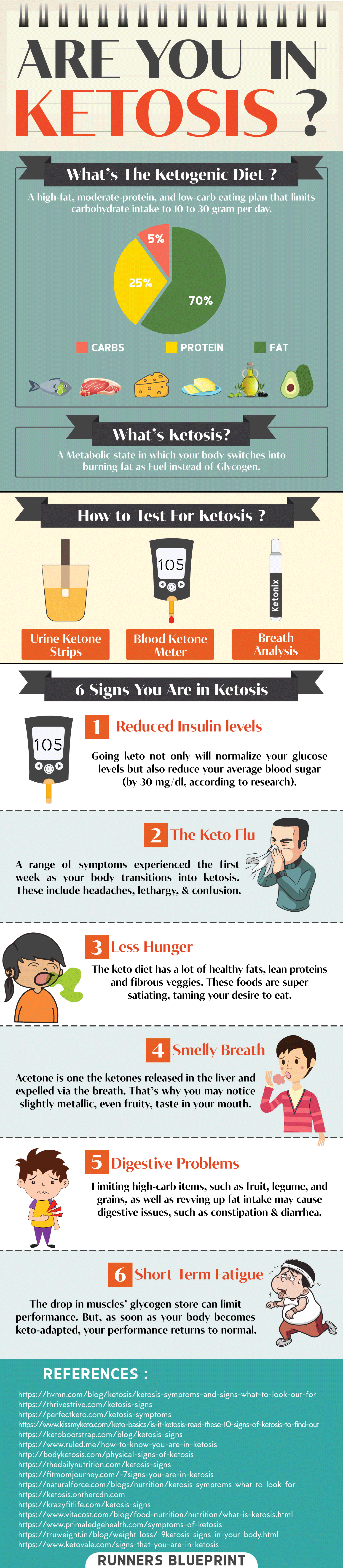
Technically, you’re in nutritional ketosis when your blood ketone levels hit about 0.5 mmol/L or higher.
But let’s be real — most runners don’t have a ketone meter in their sock drawer. And the good news? Your body gives you plenty of clues (we’ll cover them all).
Important: This isn’t the same as diabetic ketoacidosis — that’s a serious medical condition. Nutritional ketosis is safe for healthy people and happens naturally when we fast or eat super low-carb.
In fact, it’s been around since humans were chasing antelope barefoot and going days between meals.
Keto Diet: The Short Version
So, how do you get into ketosis?
Simple: eat a ton of fat, moderate protein, and almost no carbs. That usually breaks down to something like:
70–80% fat
15–25% protein
5–10% carbs
In real-life food terms? That means saying goodbye to bread, rice, fruit juice, pasta, and pretty much anything that lives in the snack aisle. You’ll be eating things like avocado, steak, eggs, nuts, olive oil, and spinach.
For most runners, this means keeping carbs under 30 grams a day — which is roughly one banana or a slice or two of bread. Yeah, it sounds brutal at first. And trust me, your body will complain for a few days.
In my case, I started seeing signs around day 3. Stronger symptoms kicked in after about a week. Research backs this: most people enter ketosis within 2–7 days of seriously cutting carbs.
But adapting — like, really teaching your body to perform on fat — takes longer. Most experts say it takes 4 to 6 weeks to become truly fat-adapted. Some athletes need up to 8–12 weeks to see real endurance benefits.
I’d compare it to building aerobic base. Getting into ketosis is like jogging a 5K — quick. Fat-adaptation is like marathon training — it takes time, consistency, and patience.
Why the Heck Would a Runner Go Keto?
Great question.
For me, there were three big reasons:
Steady Energy. I was tired of hitting the wall in long runs. I’d run out of glycogen and feel like my engine died. With keto, I knew I’d be tapping into fat — and fat stores are pretty much endless, even for lean runners.
Mental Clarity. I’d read about how ketosis helps some folks feel sharper, calmer, more focused. As someone juggling coaching, training, and writing, that sounded like a win.
Weight Loss Curiosity. Yep, I was curious. Lots of runners drop weight on keto, mostly from losing water and eating fewer calories overall. One Reddit guy said he lost 7 pounds in a month and shaved nearly a minute per mile off his pace. That’s not nothing. (Just remember: a lot of early weight loss is water, not fat.)
But I won’t sugarcoat it — the transition was rough. I had no kick. My intervals felt like I was running in sand. And socially? It was weird turning down beer and bananas after a long Sunday run.
Still, I kept at it. Tracked my runs. Watched the symptoms. Adjusted. And eventually, my body started firing on all cylinders.
How to Tell If You’re in Ketosis (Without a Blood Test)
So, you’re wondering if you’ve actually hit ketosis — without needing a lab coat or pricking your finger? I got you.
Here are the clearest signs I’ve noticed (both in myself and in the folks I’ve coached) when your body finally flips that metabolic switch.
Quick Signs You’re in Ketosis:
Keto Flu: Like catching the flu without the germs. Headache, crankiness, and low energy in the early days.
Keto Breath: Fruity, sometimes like nail polish remover. Not cute, but a solid sign.
Short-Term Fatigue: You’ll probably feel weak in the gym or on your run the first week or two.
Digestive Drama: Constipation or sudden trips to the bathroom as your gut adjusts to the fat load.
Appetite Drop: You might start forgetting to snack. Ketosis can naturally quiet your hunger.
Stable Energy & Focus: Once you’re past the misery, your brain lights up. No sugar crashes.
Testing Confirms It: Ketone strips or breath testers can give you the hard proof.
Each one of these is like your body tapping you on the shoulder saying, “Hey, we’re switching gears here.”
Let’s unpack the big one first…
1. The “Keto Flu” (aka Your Carb Withdrawal Hangover)
This one’s a beast. Most people — myself included — get slammed with the keto flu sometime in the first week (usually between days 2 and 7). I like to think of it as your body’s version of a sugar tantrum. You’ve been feeding it carbs your whole life, and now suddenly you’ve yanked away its favorite treat. It freaks out.
How it feels (from my own foggy nightmare):
Day three hit me like a truck. My head throbbed. I was dizzy, confused, snapping at everything, and dragging myself up the stairs like I was 90. One moment, I was trying to journal — the next, I forgot why I even opened the notebook.
Legit brain fog.
My throat felt scratchy like I was about to get sick. I even had night sweats. I wasn’t alone — a friend told me that his first keto run felt like “the hardest 10K of my life” with full-body cramps and a splitting headache.
Headaches. Weakness. Grumpiness. Nausea. Sleep troubles. It’s all part of the package.
Why it happens:
Your body’s dropping insulin fast, which tells your kidneys to flush out water and electrolytes. Suddenly you’re low on sodium, potassium, magnesium — the trio that keeps you from feeling like a dried-up raisin.
At the same time, your brain hasn’t figured out ketones yet, so it’s running low on fuel. Hence the fog and fatigue. It’s basically a system reboot.
Here’s how to survive it:
Rehydrate Like It’s Your Job
Drink water like it’s race day, and salt your food a little extra. I kept a shaker of Himalayan salt nearby and even added a pinch to water. Broth was my go-to. Aim for:
Sodium: 3,000–4,000 mg/day
Potassium: Around 1,000 mg/day
Magnesium: Roughly 300 mg/day
Replenishing these helped kill my headaches and leg cramps.
2. Don’t Starve Yourself (Yet)
Now is not the time to slash calories. If you’re hungry, eat. Fat is your friend here — almond butter, cheese, eggs. Your body needs to see the new fuel to use it.
3. Ease Up on the Training
As a coach, I rarely tell people to scale back — but during keto week one, you’ll thank yourself. I swapped my runs for brisk walks and kept heart rate low. Going hard too soon will just make the flu worse. Even Healthline recommends easing off the intensity until you feel more human again.
4. Taper Off Carbs (If Needed)
If cold-turkey feels brutal, you’re not weak — you’re human. Some folks do better slowly trimming their carb intake over a couple weeks. Fewer symptoms, same end goal.
2. Bad Breath (Yep, “Keto Breath” is Real)
Let’s just call it what it is—keto breath stinks. Literally.
It’s one of those weird little side effects that shows up early when your body flips the fat-burning switch. Your breath starts smelling… off. Some folks say it’s fruity. Others say nail polish remover. My girlfriend? She said I smelled like rotting mangoes. Romantic, right?
That smell comes from acetone—one of the ketones your liver cranks out when you’re in ketosis. It’s the same stuff you’ll find in nail polish remover. Your body doesn’t really use acetone for fuel, so it just dumps it—mostly through your breath and pee.
So yeah, if your breath suddenly smells like a high school chemistry lab, congrats—you’re burning fat.
According to Healthline and research noted in the Journal of Strength & Conditioning Research, this breath change is actually used to measure ketosis in clinical settings. Some breathalyzers can even estimate your ketone levels just by sniffing that sweet, weird air you’re exhaling.
What it feels like socially:
It’s awkward. No way around it.
As a coach, I’m around people a lot—especially on runs. I remember one morning, telling a story mid-run, super animated, and my buddy kept leaning away from me. I knew right then: the keto dragon had escaped my mouth.
Waking up with a dry mouth and that metallic-sweet aftertaste became normal. Water didn’t do much. I’d brush, rinse, chomp gum—but it stuck around. It wasn’t forever, though (thank God).
Here’s what helped me manage it:
Double down on mouth care. I brushed after every meal. Not just twice a day—every time I ate. I also added a tongue scraper. Trust me, that thing scrapes off more gunk than you think. Sugar-free mints and gum helped too—just make sure they’re actually sugar-free or they might kick you out of ketosis.
Stay on top of hydration. Dry mouth makes it worse. I kept a water bottle on me all day. The more hydrated I stayed, the better my breath got. Plus, keto can make you dehydrated in general, so it’s a win-win.
Try natural rinses. I found a drop or two of peppermint oil in water made a solid DIY mouth rinse. Just make sure your mouthwash isn’t full of alcohol or sugar.
Wait it out. Honestly, the best solution? Time. As my body got better at using ketones, the smell faded. After about a month, it was barely noticeable. Or maybe we just got used to it—hard to say.
3. Short-Term Fatigue & Sluggish Performance
Let’s be real—your energy might tank during the first few weeks of keto. Especially if you’re a runner. And if you’re trying to train for a marathon on keto, be ready to slow the heck down.
This isn’t just regular tired. It’s “why do my legs feel like wet logs?” tired. That 5K that used to feel easy suddenly feels like a half marathon.
The first few weeks of switching to fat for fuel are rough for a lot of us.
Why it happens:
Your body is learning to run on fat. That’s it.
In the beginning, you burn through your stored glycogen fast—and along with it, a ton of water. For every gram of glycogen you lose, you also lose about 3 grams of water. That’s why you drop water weight so fast.
But here’s the kicker: with no glycogen left and your fat-burning engine still in warm-up mode, your muscles are running on fumes. You lose that explosive power, especially for sprints, lifts, or anything high intensity. (Healthline confirms this, by the way.)
Also—electrolytes? Gone with the water loss. That messes with muscle function, too. Cue the cramps, sluggishness, and that heavy-leg feeling.
Here’s what worked for me:
Ease off and train smart. Don’t expect to hit PRs in week 2. I backed off hard intervals and just focused on easy base runs. Think Zone 2 stuff—where fat can actually fuel you. Skip races, tempo work, and time trials for now. This is your adaptation window.
Sleep like it’s your job. I aimed for 8–9 hours, plus naps if I needed them. Stretching and low-stress activities helped me feel more human. Stress makes the fatigue worse, so I even threw in some walking meditation to chill out.
Dial in your electrolytes. Sodium, potassium, magnesium—all crucial. I took magnesium before bed to help with sleep and muscle twitches, and loaded up on potassium-rich foods like avocado and spinach. In week 2, I added an electrolyte powder, and that was a game changer.
Eat enough. Seriously. Keto doesn’t mean you have to eat less. If anything, you need more fat and protein in the beginning. I bumped up my calories a bit with things like coconut milk, nuts, olive oil—just to make sure I wasn’t under-fueling. Starving yourself during keto adaptation is a one-way ticket to crash town.
What I’ve learned since:
Once your body adapts, the steady energy is awesome. I could knock out 10+ miles fasted with no crash. That never happened on a high-carb diet—I’d bonk hard after 6–7 miles without fuel.
But it’s not all roses. Sprinting? 5K races? I felt slower. That’s where I learned to blend strategies.
On most days, I stick to keto-style eating for endurance. But if I’ve got a race or hard interval session, I’ll throw in a bit of carb pre-workout. It’s called “targeted keto,” and it works. An energy gel just before starting usually does the trick for me.
Here’s the part of keto that doesn’t get hyped enough: the clean, stable energy and sharper focus you get once you’re over the initial keto flu. It’s not just about weight loss. Once you’re fully adapted and running on fat, your energy feels level all day.
You don’t crash, you don’t get hangry, and you don’t need a caffeine IV to survive the afternoon.
In fact, I’m a big coffee addict but I’d rarely finish my Latte when I’m on keto – as if my body saying “ah we don’t need that”.
The old 11 a.m. and 3 p.m. snack attacks? Gone. My brain was firing clean, and it felt like I was cruising all day.
This isn’t just personal hype either. Research published in Frontiers in Psychology found that ketosis may help fuel the brain more steadily, reducing energy dips and mental fog compared to a high-carb diet. Think of it like switching from a rollercoaster to a bullet train.
How it feels for running:
As a runner, the big win here is no more hitting the wall. When I was training for half marathons while on keto, I could go 10–15 miles without a gel or sports drink. No bonk, just steady energy.
One ultra-runner on Reddit mentioned doing 15-mile fasted runs needing only water and electrolytes. I’m not an ultra guy, but I can back that up for anything under 2 hours. It builds a kind of endurance confidence. You stop worrying about fuel and start trusting your body to just go.
Why it happens:
Once you’re in solid ketosis, blood sugar stays low and stable. You’re not riding that sugar spike and crash cycle anymore. Ketones, the byproduct of fat metabolism, are excellent brain fuel. Some studies even call them a “superfuel” for the brain. They’re being researched for everything from epilepsy to Alzheimer’s.
But for everyday life, they just make you feel more focused and stable.
Mood often gets better, too. For me, I became more chill and patient (my wife noticed it before I did). Once the early keto fog lifted, I found myself sharper, more upbeat, and far less reactive.
How to keep it going:
Stick with it. Don’t cheat yourself out of this clarity by yo-yoing in and out of ketosis. Save carbs for when they matter, like pre-race or big workouts.
Stay hydrated + salted. Sometimes you think you’re tired, but you just need salt. I always keep water with a pinch of sea salt handy. If I get sluggish, it’s usually hydration, not hunger.
Caffeine can be a rocket booster. I love a cup of coffee in keto mode. No crashes, just smooth focus. Bulletproof coffee is still in my rotation on big writing or coaching days.
Use carbs smart. If I’ve got a hard interval session, I’ll have a banana 30 minutes before. Doesn’t kick me out of ketosis long-term but gives that extra kick when needed.
Digestive Changes
Alright, let’s talk gut. Keto can mess with your digestion at first. It’s common. Some folks get backed up. Others are sprinting to the toilet. It’s just your gut adjusting to a radical shift in how you eat.
When I started keto, I had a rough Week 2. My usual morning runner’s ritual? Gone. I felt bloated, sluggish, and kind of off. It wasn’t fun. But I knew it was part of the transition.
One of my buddies had the opposite problem – high-fat meals would send him running to the bathroom within 30 minutes. The gut needs time to rewire itself.
Why it happens:
Fiber drop: You ditch bread, grains, beans – and with them goes a lot of fiber. If you don’t replace that with low-carb veggies or chia seeds, things slow down.
Dehydration: Keto flushes water out fast. Less water = slower stool movement.
Fat overload: Your body isn’t used to high fat meals, so things can either get sluggish or move too fast.
Gut bacteria shift: Your gut bugs change based on what you eat. Fewer carbs = new bacterial balance. That shift takes time.
How to handle it:
Get your fiber in. Load up on leafy greens, avocados, chia seeds, flax, zucchini, etc. I started adding ground flax to smoothies and eating big salads daily.
Hydrate like a boss. Half your body weight in ounces of water – minimum. More if you live somewhere hot like Bali or sweat a lot (me = both).
Watch dairy and fake sweets. Some folks get clogged from cheese. Others get the runs from sugar alcohols in keto snacks. For me, packaged keto treats were a gut bomb, so I ditched them early.
Add magnesium. I take magnesium glycinate nightly. It helps with sleep and keeps me regular.
After a few weeks, things leveled out. I wasn’t as frequent as I was on a grain-heavy diet, but I found my rhythm. Don’t freak out if things change – your body is learning a new routine.
And if your gut feels fine? That’s great too. Everyone reacts differently. The key is to listen and adjust.
6. Reduced Appetite
Once ketosis kicks in, your hunger dial shifts. A lot of people report that their cravings ease up, and that constant urge to snack? It fades.
This isn’t magic—it’s one of the keto diet’s biggest perks when it comes to fat loss. You’re still eating tasty meals, but the random “gotta raid the pantry” moments start to disappear.
I’ll be honest—I didn’t buy it at first. I thought, “No way I’ll stop being hungry all the time.” Then I lived it. And yeah, I had to eat my words… and fewer snacks.
How it feels (my take):
Before going keto, I was the guy who was always hungry. I’d eat a full breakfast, go for a run, and by 10 a.m., I was already thinking about my next snack.
On long-run days? Total fridge bandit. I was shoveling down food just to stay ahead of the hunger beast.
But something shifted a couple weeks into keto. I started skipping lunch by accident—not because I was trying to fast, but because I legit forgot to eat.
I’d have a big breakfast—eggs, cheese, avocado—and then suddenly it’d be 3 p.m. with zero cravings, no hanger, no brain fog. That was wild for me.
Even during marathon training, I could stick to two or three solid meals and feel fine. Smaller portions naturally felt “enough.” That steady energy—no crashes—was what hooked me.
Let me explain why does this happen so you won’t freak out:
Hormones shift gears. Research shows keto lowers ghrelin, the hormone that screams “FEED ME.” Normally, when you diet or lose weight, ghrelin shoots up and makes you ravenous. But in ketosis? Ghrelin chills out. At the same time, hormones like CCK (the “you’re full” signal) go up. Even leptin sensitivity may improve. One study even tied high ketone levels (specifically BHB) to lower hunger and higher satiety peptides [MDPI].
Blood sugar stays steady. Without the carb rollercoaster, you avoid those big crashes that make you want to devour a whole pizza. Think about it—how many times have you eaten a pile of pancakes only to feel starving again in two hours?
More protein, more fullness. Keto isn’t high protein, but it’s not low either. Most folks end up eating enough meat, eggs, and dairy to benefit from protein’s filling power. It slows digestion and signals your brain that you’re good. Honestly, bacon and eggs at 8 a.m. kept me fuller than any cereal or granola bar ever did.
You stop fighting your food. When you stop counting every calorie and just eat to satisfaction, your body starts playing along. With fat and protein doing their job, most people fall into a mild calorie deficit without even trying. I didn’t obsess over numbers. I just ate real meals, and over time, the fat came off naturally.
Here how to manage it:
Listen to your body, but don’t under-eat. If you’re never hungry, great. But don’t push your intake so low that you’re undernourished—especially if you’re training. I had days where I only ate twice, but I made sure those two meals were loaded with veggies, fats, and protein. Just skipping food isn’t the goal—fueling smart is.
Match food to your training. I noticed that after big workouts—especially long runs—my hunger kicked up a notch. So I planned for that. If I wasn’t super hungry right after, I still made sure to get in something small—like a protein shake or cheese and nuts—within an hour. That helped recovery. Then later, when hunger snuck back in, I was ready for a real meal.
Use the freedom to ditch the junk. One of my favorite things about reduced appetite on keto? I wasn’t pulled toward crap food. I stopped needing nightly snacks and didn’t miss them. That made space for better choices—whole foods, different protein sources, and way more veggies. Just don’t fall into the trap of eating the same thing daily. Mix it up and keep those nutrients coming.
Fasting, if it fits. A lot of keto folks slide into intermittent fasting without even trying. I sometimes did a 16:8 schedule (skipping breakfast), and it felt natural. But don’t force it—especially if you’re training hard. I often run fasted in the mornings, but I always eat a solid brunch afterward. Find what feels right. Keto gives you flexibility—that’s a tool, not a rule.
7. Testing for Ketones: When You Want Cold, Hard Proof
Let’s be real—sometimes, you want more than just a “feeling” to know you’re in ketosis. You want proof. That’s where testing comes in.
You’ve got three main ways to check:
Blood meters: Measures beta-hydroxybutyrate (BHB). This is the big one—your cells actually use it for fuel.
Breath analyzers: Detects acetone—yep, the same stuff behind keto breath.
Urine strips: Looks for acetoacetate, the ketones your body dumps early on when it hasn’t figured out how to use them well yet.
If you’re in ketosis, these numbers will spike compared to a regular carb-heavy state. For example, blood BHB levels from 0.5 to 3.0 mmol/L mean you’re in nutritional ketosis, according to the Journal of Strength & Conditioning Research and other solid sources.
How It Feels
You won’t “feel” the test itself (unless we’re talking a finger prick). The real hit is mental.
The first time I used a blood meter was about a week into my third keto attempt. I poked my finger, dropped the blood on the strip, and boom—1.2 mmol/L. I was pumped. It was like seeing a gold star on a test you didn’t study for. I even did a happy little dance in my kitchen.
Urine strips were my entry point. I saw dark purple on day three and thought, “Okay, this is working.” But here’s the catch: after a few weeks, those strips didn’t show much—even though I felt more dialed in than ever.
That’s because your body gets better at using ketones, so less spills out in pee. If you’re sticking with keto long-term, blood testing is your best bet for accuracy.
Why It’s Worth Doing
Testing ketones isn’t mandatory, but it helps in a few solid ways:
Reassurance: Not sure if that brain fog is from keto or just a bad night’s sleep? A quick test can clear things up.
Learn Your Threshold: I found out I drop out of ketosis around 45g of carbs, but I’ve coached runners who stay in even at 60g. Everyone’s different.
Understand What Affects You: Tough workouts bumped my ketones up. Stress and poor sleep? They pulled them down.
Avoid Slip-Ups: When you know you’re testing tomorrow, that late-night cookie feels less worth it.
If You’re Going Deep: For medical uses (like epilepsy), numbers matter more. But for runners or fat-loss folks, any ketosis is good enough.
Pro tip? Don’t obsess. I used to chase high numbers (like 3–4 mmol) thinking more was better—but that just led me to overeat fat and cut back protein. Bad call. Now I shoot for 1.0–1.5 mmol and feel amazing.
The Tools & How to Use Them
1. Blood Meters
These are like glucose meters. Finger prick, drop of blood, done. Brands like Keto-Mojo, Precision Xtra, and Nova Max are legit. You’ll get a clear mmol/L reading. Most folks in ketosis fall between 0.5 and 3.0. I usually landed around 1.2 to 1.5.
Downsides? Strips cost $1–2 each, and pricking your finger isn’t fun. I tested 2–3 times a week, tops. If you’re a data geek, you might go daily—fasted mornings or post-meal checks can show patterns.
2. Breath Meters
These pick up acetone, another ketone byproduct. You just breathe into the device—some show a color (like Ketonix), others give numbers (like Biosense). They’re decent, not perfect.
Studies back them up, but your breathing style affects the results.
I used one early on. Watching it shift from blue to red as I adapted was a cool motivator. Bonus: no recurring costs after buying the device.
3. Urine Strips
The cheapest, easiest intro tool. Pee on the strip, check the color. The darker it goes, the more ketones are in your system.
During week one, they’re super helpful. I remember hitting pink on day 3 and feeling like I won the keto lottery.
But they fade fast. After a few weeks, the readings drop even if you’re still in ketosis. That’s your body getting better at using ketones. Hydration also messes with the results.
Still, for beginners, they’re a great “you’re on the right track” nudge.
Do You Need to Test?
Nope.
If you’re feeling the signs—less hunger, clear focus, steady energy, maybe some keto breath—you’re probably in ketosis. Testing is optional. But if you’re a numbers person or tweaking things for performance, it’s a helpful tool.
Here’s how I usually coach it:
Short-term keto? Grab some urine strips and call it a day.
Going long-term or doing cyclical/targeted keto? Consider a blood meter.
Just want peace of mind? Spot-checking once or twice a week works fine.
Just don’t let the numbers boss you around. This isn’t school—you’re not getting graded. Ketosis is a tool, not a scoreboard.
Final Thoughts
When you see those ketones show up on the meter, know this: your body is running on a different kind of fuel now.
The real key is understanding your energy systems.
Here’s a quick breakdown using a 17-minute run as an example:
Minutes 0–5: The Warm-Up (Fat-Burning Mode On)
This is your body in aerobic mode. You’re jogging easy. Breathing’s under control. Your muscles are pulling in oxygen and tapping into fat for fuel.
👉 This is your “fat-burning zone.”
👉 Low effort = high % of fat used for energy.
Minute 6: The Sprint (Fat Takes a Backseat)
Now you hit a hill and sprint for 60 seconds. You’re going hard. Your body can’t deliver oxygen fast enough, so it flips to anaerobic mode—burning mostly carbs for quick fuel.
👉 Fat burning pauses.
👉 You’re burning sugar fast—and building up lactate.
But here’s the kicker: this kind of effort jacks up your metabolism for hours after you’re done (thanks to EPOC—the afterburn effect). That means more fat gets burned later while you’re chilling.
Minutes 7–16: The Cruise (Back to Fat-Burning)
You ease back into a steady pace. Breathing slows. You’re back in aerobic mode, burning mostly fat with a side of carbs. This is where fat oxidation shines—especially if you’ve built a good aerobic base.
Minute 17: Final Sprint (Go Time Again)
Last push. Full sprint. For the first 10 seconds, your body uses the phosphagen system—basically quick-fire ATP stored in your muscles. After that, you’re right back in anaerobic territory, torching carbs again.
The Takeaway
Easy/moderate runs = more fat burned during the run
Hard efforts = mostly carbs burned now, but fat torched later thanks to EPOC
Smart training blends both for max fat loss and fitness
The 6 Best Fat-Burning Running Workouts
Without further ado, let’s get to the actually running routines that can help you max out your calorie burn like nothing else.
Hill Intervals (20–30 Minutes of Pain-Fueled Progress)
Want a workout that builds explosive strength, torches fat, and transforms your flat-ground running? Sprint the hill.
No fancy gear, no machines — just you and gravity trying to beat each other up.
Why It Works:
Hills are nature’s gym. Every uphill stride fires your glutes, quads, hamstrings, calves — even your arms if you’re doing it right.
And because you’re working against gravity, your heart rate goes through the roof fast.
That means HIIT-level calorie burn, but with less joint pounding than flat-out sprints.
You’re climbing, not just running — that vertical challenge trains your lungs and legs like nothing else. And since there’s less impact than flat sprinting, your joints don’t hate you for it.
Regular stair sessions improve VO₂ max, burn fat, build muscle, and boost coordination. It’s like HIIT with a side of functional strength.
How to Do It:
Find stairs: A park, stadium, parking garage, even your apartment. Bonus if there are 50–100 steps — you want a challenge.
Warm up: 5–10 minutes of light jogging or stair marching.
Sprint up the stairs as hard as you can. Stay controlled, but aggressive.
Walk down carefully to recover.
Repeat for 10–15 minutes, depending on your fitness.
You can break it into rounds:
4 sprints, 1 min rest → Repeat for 3 rounds.
Cool down: Light jog + deep quad/hip stretches.
Stair machine? Use it. But be honest — don’t let it carry you. Step with purpose.
What to Expect:
You’ll gas out fast. That’s the point. Five minutes in, your legs will feel like jelly and your lungs like a furnace.
But that’s when the work kicks in. Push through, and you’ll finish drenched, wrecked… and stronger.
Runners who add stair sprints often feel like they’re gliding on flats. Their turnover improves. Their legs fatigue less in races.
Fartlek Pyramid – Speed Play Meets Structure (30 Minutes)
“Fartlek” = Swedish for “speed play.”
In real terms? Unstructured intervals that let you run fast, recover, and repeat—without a stopwatch breathing down your neck.
This version gives the freedom of a fartlek with the structure of a solid speed session.
Who it’s for:
Anyone who wants to boost endurance, burn more fat, and shake up their routine without getting bored.
Why it works:
You’re mixing short and long efforts, keeping your heart rate in that sweet spot between aerobic and anaerobic.
That variation trains you to deal with fatigue, recover fast, and handle surges—just like you’d face in a race.
How to Do the Pyramid:
Warm-up:
Jog easy for 5 minutes
Main set:
1 min fast, 1 min slow
2 min fast, 1 min slow
3 min fast, 2 min slow
2 min fast, 1 min slow
1 min fast, 1 min slow
Cool-down:
Jog easy for 5 minutes
That’s 30 minutes total, including warm-up and cool-down. Easy to remember, hard enough to challenge anyone.
Target Paces:
“Fast” = somewhere between 5K and tempo pace—you’re working but not sprinting
“Slow” = true recovery pace—jog or walk if needed
Beginner? Just dial back the “fast” to a steady run and the “slow” to a walk.
Advanced? Run the fast sections near threshold pace, and shorten recovery if you want an extra push.
Why Runners Love This:
Burns more calories than steady runs
Builds mental grit with pace shifts
Less boring than track work or the same loop every day
Great for breaking through plateaus (weight loss or performance)
Long, Slow Distance (LSD) — The Underrated Fat-Burner
Not every fat-burning run has to be high intensity.
In fact, one of the most effective workouts for long-term fat loss is also one of the easiest: the Long Slow Distance run — or LSD for short.
This is your relaxed, conversational-pace run.
The kind where you can chat with a friend, breathe through your nose, and not feel like you’re pushing at all.
It might not sound hardcore, but these longer Zone 2 efforts are gold when it comes to teaching your body to burn fat.
Why It Works
When you run at a low intensity for an extended period, your body leans more heavily on fat for fuel.
Over time, this improves your metabolic flexibility — meaning you get better at tapping into stored fat, even when you’re at rest.
During LSD runs, up to 60–70% of calories burned come from fat.
In contrast, high-intensity runs might only use 20% fat — the rest is carbs.
You’ll also burn 400–600+ calories in a single hour, depending on your pace and weight.
Even better? These runs increase your mitochondrial density and fat-oxidizing enzymes — meaning your body literally gets better at burning fat, not just during runs but after, too.
LSD runs are also easier to recover from, help suppress appetite for some runners, and come with the mental perks of reduced stress and boosted mood — all of which indirectly support fat loss.
LSD vs. HIIT: Why You Need Both
LSD runs won’t give you the “afterburn” of HIIT.
And if all you ever do is slow running, your body adapts and becomes super efficient (translation: it burns fewer calories to do the same work).
That’s why a balanced mix is best.
But LSD is the foundation.
It conditions your body to handle tougher sessions and builds the aerobic base needed for sustainable, long-term fat burning.
How to Do It Right
Choose your long run day: Once a week is ideal. For beginners, start with 45 minutes. More experienced runners may go 60–90 minutes or longer, increasing time by no more than 10% per week to avoid injury.
Stay in Zone 2: This is your fat-burning zone — roughly 65–75% of max heart rate, or an RPE of 4/10. You should be able to speak full sentences without gasping.
If you’re breathing too hard, slow down or take walk breaks. Pride has no place here — aerobic is the goal.
Go by time, not distance: For example, a 60-minute run might be 5–6 miles for many recreational runners. But don’t stress the distance — what matters is keeping the effort easy and steady.
Optional: Add gentle pickups: If you want to stay sharp, add 4×20-second strides in the second half. But keep them gentle — not sprints.
Hydrate properly: For runs over an hour, consider taking in fluids or light carbs (sports drink, gel) — or, if you’re comfortable, you can try fasted running (more on that below).
What to Expect
At first, LSD runs may feel too easy. That’s fine — and exactly the point.
Around the second half, fatigue slowly builds as your carb stores deplete and your body shifts even more toward fat.
That’s the moment when your body is doing the deep metabolic work — burning fat and building endurance.
Over time, these easy-effort runs improve:
Fat oxidation (even at rest)
Cardiovascular endurance
Running economy
Recovery between harder workouts
Fat Loss Bonus
Many runners find the scale starts to budge when they add weekly long runs. Why? It’s a high-calorie burner that doesn’t feel brutal.
A relaxed 6-mile run burns ~600 calories — that’s essentially an extra meal gone, without the stress of another HIIT session.
Plus, fat adaptation from these runs lasts beyond the workout, especially when paired with good nutrition.
Pro Tips
Fasted long runs: If you’re used to it and feeling strong, try running in the morning before breakfast. Research shows this may increase fat utilization — just keep the effort low, and don’t fast before speed workouts.
Make it enjoyable: Put on a podcast, audiobook, or favorite playlist. LSD runs are perfect for zoning out and finding rhythm.
Track time, not speed. Resist the urge to go faster — let your ego take a nap on long run day.
Fat-Burning Running Workouts FAQ
You’ve got goals. I’ve got answers. Here’s what runners like you ask most about shedding fat with running — let’s break it down:
Q: Is running better than walking for fat loss?
A: In most cases, yeah — running burns more calories in less time.
A 150-pound person can torch around 250–300 calories in 30 minutes of running
Brisk walking hits ~150–170 calories in the same time
That extra burn adds up, especially if you’re eating smart.
Running also gives you a bigger afterburn (EPOC), meaning your body keeps burning calories even after you stop. Intervals, sprints, tempo runs? They’ll keep the engine revved for hours.
That said — walking still works, especially if you’re just starting or need low-impact options. One great strategy: run 3–4 times a week, then walk on rest days to increase your daily burn without beating up your joints.
Bottom line: Running is a fat-loss powerhouse, but walking is still part of the toolkit.
Q: How often should I run to burn fat?
A: Aim for 3–4 runs per week. That’s the sweet spot for results and sustainability.
You’ll create a regular calorie burn, improve fitness, and leave room for rest — which your body needs to actually change.
Think of it like this:
1–2 HIIT or tempo runs
1 long run (fat-adaptation + calorie burn)
1 easy/recovery run or extra rest day
Not ready for 4 days? Start with 2–3 and build from there. Consistency beats volume every time.
Pro tip: Mix up your runs. Don’t hammer the same pace every session. Variation = results.
Q: What’s the best type of run for fat loss?
A: Hands down, intervals and sprints (HIIT) are top-tier. Think: hill sprints, fartleks, Tabatas. They’re short, intense, and torch fat during and after the workout.
Other effective options:
Tempo runs (comfortably hard for 20–30 minutes)
Fartlek runs (alternate effort levels)
Long slow runs (60+ mins at easy pace) for pure calorie burn and fat utilization
Mix it all in. Don’t go all-HIIT, all the time — your body needs recovery and variety to keep progressing.
Best combo: 2–3 HIIT/tempo sessions per week + 1 longer run.
Q: How long should I run to burn fat?
A: Aim for 20–45 minutes per session, with one longer run (60–90 mins) per week if you can handle it.
Long runs (60+ mins) → deep calorie burn, tap into fat as fuel
You don’t need marathons. You need weekly consistency — say, 3–4 hours of total running.
Example:
3 × 30-minute runs
1 × 60-minute long run
That’s 2.5 hours — plenty to lose fat when paired with the right nutrition.
Q: Should I run every day to lose fat?
A: Nope. For most runners, running 7 days a week is overkill — and risky.
Running is high-impact. Your muscles, joints, and tendons need recovery. So does your brain. Overtraining tanks performance and actually makes fat loss harder (thanks, cortisol).
The smart move:
3–5 runs/week max
Add cross-training on off days (bike, swim, hike)
Take 1–2 full rest days to reset
Unless you’re a seasoned high-mileage runner, quality > quantity. A well-balanced plan beats daily grind every time.
Q: Will running help me lose belly fat?
A: Yes — eventually. Running reduces total body fat, including belly fat, but you can’t pick where you lose it first. Genetics call the shots.
But good news: running is excellent for burning visceral fat — the dangerous kind around your organs. HIIT and long runs especially help.
Other belly-fat-fighting moves:
Prioritize sleep + stress management
Train your core for strength and better running form
Keep your diet clean — abs are made in the kitchen, too
Track waist size, not just the scale. Sometimes the belly shrinks even when weight stalls.
Q: How do these workouts fit into a weight loss plan?
A: Running is just one part of the puzzle. Pair it with:
A sensible, high-protein diet
Strength training 2x per week (preserves muscle)
1–2 rest or active recovery days
Here’s a sample weekly fat-loss setup:
Mon: Intervals (HIIT)
Tue: Strength
Wed: Easy or moderate run
Thu: Rest or walk
Fri: Tempo run
Sat: Long run
Sun: Rest or mobility/stretching
Track progress with waist measurements, clothes fit, and energy — not just the scale.
And keep your nutrition tight: fuel your workouts, but don’t eat back all your calories thinking you “earned it.” That’s the trap.
Q: Can beginners do these fat-loss workouts?
A: Absolutely — just scale them.
Here’s how:
Intervals: Start with run-walks (e.g., jog 30 sec, walk 90 sec)
Tempo: Go “moderate effort” instead of hard — you control pace
Hills: Brisk walks up mild hills still burn fat
Stairs: Walk/jog up 1–2 flights. Build over time.
Fartlek: Mix light jogging with walking — no pressure
Long run: 20–30 mins at easy pace is plenty to start. Break it into chunks if needed.
⚠️ Don’t skip warm-ups or cooldowns. And increase weekly run time slowly — 5–10 mins more per week max.
Remember: start slow, build smart, stay consistent. Progress comes fast when you run smart, not just hard.
So you’ve signed up for a half marathon — awesome.
Now the real question kicks in: how far should your longest run be before race day?
If that question’s been looping in your brain every time you lace up, you’re not alone.
The long run is the workout that makes or breaks your half marathon training.
It’s where your endurance, confidence, and grit all come together — or fall apart.
In this guide, we’ll break down exactly how far you should run before a half marathon, based on your experience level — from first-timers to advanced runners.
You’ll learn how to build your mileage safely, what pace to run your long runs at, and how to recover like a pro so you’re primed (not fried) by race day.
Long Runs for Half Marathoners: How Far Should You Go?
Let’s get started with experience level…
Newer Runners (Under 1 Year Experience)
Goal: Cross the finish line, smiling — not crawling.
If you’re new to running or have never trained for a long race before, this isn’t about pace or finish time. This is about building your engine slowly and showing up healthy on race day.
Forget the pressure to run the full 13.1 in training. You don’t need to.
Most first-timers who make it up to 9–10 miles in their long runs finish just fine — thanks to race-day adrenaline and crowd energy pulling them through those final miles.
Start with a long run of 3–5 miles, depending on where you are now.
Add 0.5 to 1 mile per week, tops.
Every 3–4 weeks, do a “cutback” week where you scale back mileage to recover.
Repeat distances if needed — no shame in doing 7 miles two weeks in a row to let your body catch up.
Beginners with Running Experience (Been at It a Year or So)
Goal: Finish strong — maybe even hit a time goal.
If you’ve got a few 5Ks or 10Ks under your belt, you’re not starting from scratch. You’ve got some aerobic base. Now it’s about dialing in that endurance and testing your limits a bit.
A good target for your longest run is 10–12 miles. That’s close enough to the full race to build mental and physical confidence without grinding yourself down.
How to Build
Start your long runs around 5–6 miles.
Add ~1 mile per week, with down weeks every 3–4 weeks.
Alternate long runs like this: 8 miles → 5 miles → 10 miles → 6 miles → 11 miles
(This lets your body adapt without pushing too fast.)
If you’re chasing a time goal, you might stretch your longest run out to 13 or even 14 miles.
That’s called over-distance training — and it works. It trains your legs to resist fatigue and builds confidence when the going gets tough late in the race.
Intermediate Runners: You’ve Got Some Miles Under You — Now Let’s Level Up
Alright, if you’ve already run a few races or have a solid base built up, you’re in that sweet “intermediate” zone.
You’re not starting from scratch, but you’re still on the climb. And this is where your long run game starts to change.
For you, peaking at 12–14 miles in training isn’t just doable — it’s smart. Many solid plans top you out with a 12 or 13 miler two weeks before race day, and that’s a great way to walk into the half marathon with confidence, not nerves.
A classic buildup might look like this:
8 → 9 → 10 → 11 → (cut back to 8) → 12 → 13 → taper
That cut-back week isn’t slacking — it’s strategy. It’s what keeps you from frying your legs.
I like to call this the “two steps forward, one step back” system. It keeps you climbing without blowing up.
Now, here’s where things get interesting. You’re ready to start sprinkling some quality work into those long runs. Stuff like:
That combo of endurance + speed = race day strength.
Trying to PR? Pushing that long run to 14 miles can be your secret weapon.
You’ll build an endurance buffer so that when you hit mile 10 on race day, your body’s not freaking out. You’ve already run past it. Just remember — respect the taper after those big runs. Don’t peak in training. Peak on race day.
Advanced Runners: Want That PR? Time to Go Long — Really Long
If you’ve been around the block — multiple half marathons, marathons, chasing a sub-1:30 or other goal — you’re in “advanced” territory.
And that means you can push the long run even further.
I’m talking 14–16 miles. Some plans even go up to 18 (yep, really). You’re basically training like the half marathon is a “short marathon” — because on race day, you want 13.1 to feel well within your comfort zone.
A smart advanced progression might start around 10–12 miles and build to a couple of 15–16 milers.
And yeah, you’re throwing in race-pace work, long progression finishes, or tempo chunks.
Here’s what an advanced long run might look like:
14 miles with the last 6 at goal pace
16 miles with 2 × 3 miles at tempo in the middle
But let me be real: these runs are tough. You’ll need to prioritize recovery like it’s your job — sleep, food, mobility, downtime.
Push hard, but know when to pull back. If your legs are sending SOS signals, listen up.
The payoff? Confidence and durability.
That’s a good thing if you ask me.
Quick Rule of Thumb: Long Run Mileage by Experience Level
Runner Type
Longest Run in Training
Newer Runners
8–10 miles (enough to finish strong)
Beginners
10–12 miles
Intermediate
12–13, maybe 14 miles
Advanced
14–16+ miles (sometimes up to 18)
The Real Benefits of Long Runs — Broken Down
Let’s get one thing straight: speedwork sharpens you — but long runs build you. They’re the heart and guts of distance training. Without them, your fitness has no real engine. You can nail tempos and intervals all day, but if you haven’t built your long-run legs? Good luck lasting 13.1.
Every time you go long, you’re turning your legs into oxygen-burning machines.
You grow more mitochondria (aka your cells’ power plants) and capillaries (tiny blood highways that bring oxygen in and waste out).
One study showed endurance training can jack up mitochondrial content by up to 40%. That’s like dropping a bigger motor into your car — more energy, less strain, better mileage.
More mitochondria = more stamina = less dying at mile 10.
Fat for Fuel: Become a More Efficient Runner
Your body only holds so much glycogen (carbs), and it burns fast during a hard run — about 90 minutes’ worth if you’re pushing. After that? Bonk city.
But long runs teach your body to burn fat better, saving glycogen for later. Even lean runners carry enough fat for hours of effort — your system just needs to learn how to use it.
Mental Toughness: Learn to Embrace the Suck
You don’t learn grit from treadmill sprints — you learn it on mile 13 of a 15-miler when everything hurts and quitting sounds awesome.
Long runs put you face-to-face with boredom, fatigue, self-doubt. That’s exactly what race day throws at you. And when your brain starts whispering, “Slow down, this is too hard,” you’ll have an answer: I’ve already run through worse than this in training.
Better Form Under Fatigue
You start fresh, but you finish tired — and that’s the point. The longer you go, the more your body learns to keep form together under stress.
You tighten up your cadence.
You stop overstriding.
You learn how to run efficiently, not just powerfully.
Over time, you waste less energy at every stride. That means you go further on the same gas tank.
In one study, runners who did longer long runs only slowed about 9% in the second half of their race.
Others who ran shorter? They slowed 10–12%. Sounds small, but that gap is the difference between a strong finish and a death march.
Myth: Long Runs = Injury Risk
Some folks act like long runs are dangerous. Not true — reckless long runs are dangerous.
If you build gradually and keep the effort easy, long runs are no riskier than any other part of training. Actually, it’s speedwork that tends to cause more breakdowns.
One study (Scandinavian Journal of Medicine & Science in Sports, 2020) tracked over 500 half marathoners. Runners who did long runs over 21K (over 13 miles) finished faster than those who capped out earlier.
Here’s the breakdown:
>13 miles: average finish time of 1:51:31
9.3–13 miles: 2:03:28
<9.3 miles: 2:06:48
And guess what? No higher injury rates in the longer-running group. They trained smarter — not just harder.
Here’s the full list of the benefits:
Benefit
Why It’s a Big Deal
Builds Endurance
More capillaries + mitochondria = stronger engine. Your body gets better at using oxygen, so you can go longer with less effort.
Improves Fat Metabolism
You learn to burn fat instead of torching through all your carbs. This helps avoid the dreaded crash near the end.
Boosts Glycogen Storage
You start runs with a bigger “gas tank” and better ability to hold pace late in the race.
Teaches Pacing
You learn how it feels to run steady. Long runs = real-world race rehearsal.
Builds Mental Grit
Long runs are mental battles. They teach you to push past the quit voice — that’s gold on race day.
Improves Running Economy
You get smoother, more efficient. Your form tightens up. Your stride costs less energy per step.
You get better at clearing fatigue. Your “redline” gets higher, so you can hang at race pace longer.
What Pace Should You Run Your Half Marathon Long Runs?
Let’s get this straight: your long run is not race day. And the biggest mistake I see runners make? Treating it like it is.
You wanna crush your half marathon? Then slow your long runs down. Way down.
The Short Answer: Long Runs Should Be Easy
I’m talking 60 to 120 seconds slower per mile than your target half marathon pace. For some beginners, it could even be 2–2:30 per mile slower — and that’s perfectly fine.
It’s not about pace on these days. It’s about building endurance without trashing your legs.
Long Runs Build Endurance, Not Speed
This is the workout where you practice lasting — not racing. Go too fast, and you’ll burn out halfway or limp through your week’s training wrecked.
Why go slow?
You stay aerobic
You recover faster
You go farther
You teach your body to spend time on its feet — which is what race day actually requires
One coach told me, “Long runs are about time, not pace. Practice duration, not destruction.”
Real Talk: What Does “Easy Pace” Look Like?
You should be able to hold a full conversation. If you’re gasping, you’re doing it wrong.
Breathing should feel steady — like a 3:3 or 4:4 rhythm (inhale for 3 steps, exhale for 3).
You should finish feeling tired, but not toasted. Like you could’ve gone a bit farther.
Still unsure? Use the talk test. If you can say a full sentence without sucking wind, you’re golden.
Here’s a Simple Pace Guide
Goal Half Pace
Long Run Pace Range
8:00 / mile
9:30 – 10:30 / mile
9:00 / mile
10:30 – 11:30
10:00 / mile
11:30 – 12:30
11:00 / mile
12:30 – 13:30
These are ballpark figures — adjust based on your fitness, the weather, how you feel that day. When in doubt, slow it down.
Here’s What Happens If You Go Too Fast
You run 10 miles at goal pace. Congrats. But now:
You’re cooked for three days
You can’t hit your next interval session
And worst of all? You never trained your body to go long
Here’s the math kicker: if your half marathon goal is 2 hours (9:09/mile), but you’re running long runs at 9:00 pace, you might only get 1h45m of practice.
But race day is 2+ hours. You just skipped training for the last 15 minutes of the race — the hardest part.
Slow down, stretch that run out to the full 2 hours, and boom — better endurance, better results.
Advanced Move: Sprinkle in Goal Pace (Sparingly)
Once you’re more experienced (and not still building mileage), you can start playing with goal pace segments inside your long runs.
Examples:
Last 2–4 miles at race pace (aka “fast finish”)
12-miler with miles 8, 10, and 12 at goal pace
10 easy, then 2 hard to close it out
That teaches your body how to push tired legs, which mimics race-day reality. But do this only once every 3–4 long runs — and only when your body’s ready for it.
One marathoner said: “If you can run your whole long run at goal pace and recover easily… your goal pace is too slow.” He’s right.
When to Schedule Your Last Long Run Before a Half Marathon
Let’s talk timing — because when you do your final long run before race day can make or break your half marathon.
I’ve seen it too many times: runners crush their training, then panic and throw in a last-minute 13-miler the week before the race — only to show up to the start line sore, sluggish, or burned out.
Don’t do that.
Trust me.
Here’s how to schedule your final long run and taper the smart way — so you toe the line rested, ready, and full of fire.
The Magic Number: 14 Days Out
Your last big long run — the one that tops off your training — should happen two weeks before race day.
That gives your body just enough time to:
Recover from any fatigue or muscle damage
Absorb the benefits of the training
Rebuild stronger, so you’re peaking at the right time
If your goal was to hit, say, 12 miles as your peak long run, then schedule that for 14 days out. After that, you taper.
Not one week out. Not four days before. Two weeks.
This 14-day window is backed by running coaches and training data — including Runner’s Worldand Hal Higdon himself.
It’s the sweet spot where you still hold onto fitness without carrying fatigue into race day.
How to Taper Without Losing Your Edge
Tapering doesn’t mean you stop running and sit on the couch with carbs for two weeks (although… carbs are definitely part of the plan).
Here’s the basic structure:
14 Days Out (2 Weeks Before the Race). Final long run (e.g., 12 miles easy pace). This is your capstone. Finish it feeling like you could’ve done more — not totally drained.
7 Days Out (1 Week Before the Race). Medium-long run (6–8 miles easy). Keep it chill. This is more of a dress rehearsal — maybe wear the shoes and gear you’ll race in, but don’t push the pace. It’s about rhythm and routine, not performance.
Race Week. Keep things short, easy, and sharp:
A couple of 3–5 mile easy runs
Optional: 5×100m strides mid-week to keep your legs snappy
Prioritize sleep, hydration, and solid meals
Stretch, foam roll, and dial in your mindset
Tapering Feels Weird — That’s Normal
You’re gonna feel restless. You’ll probably second-guess yourself. That’s the taper playing tricks on your brain.
You’re running less, so your energy is up. You start thinking, “Shouldn’t I be doing more?”
No. That energy you’re feeling? That’s the point. Store it up. Come race day, you’ll want that spring in your step.
As Hal Higdon says: “The hay is in the barn.” You’ve done the work. Now let your body cash in on the investment.
Here are my best taper tips:
Stick to familiar foods — this isn’t the week to test out that new protein bar
Sleep 7–9 hours a night — your body’s rebuilding right now
Get a massage or stretch session midweek, but nothing too aggressive
Don’t pick up new sports — now’s not the time to try CrossFit or climb a mountain
Do a mini gear check — race shoes, socks, outfit, fuel, pacing plan — have it locked in
And on the day before the race? Go for a short, easy shakeout run or rest. Whatever makes you feel loose and calm — go with that.
Long Run Progression: Sample 12-Week Half Marathon Plan
Here’s a sample 12-week build, perfect for a beginner or intermediate runner aiming to peak at 12 miles two weeks out from race day. This is how you build endurance the smart way — gradual progress, cutback weeks, and a taper.
12-Week Long Run Progression
Week
Long Run Distance
Week 1
5 miles – Get rolling 🏁
Week 2
6 miles
Week 3
7 miles
Week 4
8 miles
Week 5
6 miles – Cutback week 🔄
Week 6
9 miles
Week 7
10 miles
Week 8
11 miles
Week 9
12 miles – Peak week 🔥
Week 10
8 miles – Taper begins 🧘
Week 11
6 miles – Final tune-up 🧼
Week 12
13.1 miles – Race Day! 🎉
What’s Happening Here?
Weeks 1–4: A steady climb, increasing just 1 mile per week. That’s your base.
Week 5: Back off a bit. This is your first cutback week to let your body absorb the training. Don’t skip it just because you “feel great.” Trust the process.
Weeks 6–9: The big build. These are the meat-and-potatoes weeks. You’ll jump from 6 to 9 miles in one week — a little aggressive, yes, but manageable because of the rest from Week 5.
Week 9: Your peak long run — 12 miles. Close enough to race distance to build confidence, but early enough to allow recovery.
Weeks 10–11: Taper time. You’re keeping the legs moving but dialing back the distance. Let that fitness soak in.
Week 12: You show up and run your race with gas in the tank and fire in your legs.
Alternate Strategy: Train by Time, Not Miles
Some runners — especially those at slower paces — get more out of training by time rather than distance.
Why?
Because if your pace is 12–13 min/mile, a 12-mile run could take over 2.5 hours — that’s a big ask on your body. Instead, just run for 2 hours. You’ll still build endurance without the extra pounding.
Rule of thumb: Max out your long runs at about 2–2.5 hours, even if you don’t quite hit race distance. It’s the time on your feet that matters.
Post-Long Run Recovery: Do It Right, Or Pay for It Later
Look, the long run isn’t just where your endurance is built — it’s also where recovery makes or breaks the gains.
You can nail the miles, but if you crash and burn after, you’re leaving fitness on the table (or worse, limping into overuse injury).
Here’s how to recover like a pro — because your body’s not a machine:
1. Cool It Down – Don’t Just Stop Dead
The last mile of your long run? Ease it down — think slow jog or shuffle pace.
Then, once you stop, keep walking for 5–10 minutes. Let your heart rate coast back to normal. It helps prevent dizziness and keeps the blood from pooling in your legs.
Pro tip: Don’t flop on the curb the second you finish. Keep moving. Your body will thank you later.
2. Rehydrate & Refuel (ASAP)
You just sweated out electrolytes, water, glycogen — your tank is empty.
First 30–60 minutes: Slam some fluids — water with electrolytes, or a sports drink if that’s your jam.
Food: Think carbs + protein. A good target? 3:1 or 4:1 carb to protein ratio.
Examples:
Chocolate milk
A smoothie with banana, almond butter, and protein
Bagel + peanut butter
Rice + eggs and veggies
This is the window where recovery happens fast. Miss it? You’ll feel it tomorrow.
3. Stretch & Roll the Tight Stuff
Once you’re rehydrated and fed, do some light stretching. Focus on the usual suspects:
Quads
Hamstrings
Calves
Hips
Then grab the foam roller and hit the tight spots: calves, IT bands, glutes.
Keep it chill — now’s not the time to go deep-tissue mode. Save the longer yoga/stretching session for later that day or the next.
4. Ice or Heat? Depends on How You Feel
If you’ve got swelling or inflammation (like a sore ankle or angry knee), 10–15 minutes of ice might help.
But if you’re just generally sore, a hot bath or Epsom salt soak feels amazing.
Some runners swear by cold showers or ice baths. Some don’t. Do what works — just be consistent.
5. Rest Like a Champ (Seriously)
If you ran long in the morning, don’t go haul mulch or repaint the house that afternoon. Kick your feet up. You earned it.
And sleep? Non-negotiable. Your body repairs during deep sleep — growth hormone spikes, muscles rebuild, joints recover.
Aim for 7–9 hours, minimum.
Train hard, sleep harder. That’s how gains are made.
6. Active Recovery (But Don’t Push It)
The day after your long run? Move. Just don’t move hard.
Options:
Easy bike ride
Walk the dog
Swim a few laps
Super easy 3-mile jog
This flushes out the legs and fights soreness better than sitting on the couch all day. But if you’re truly wrecked, it’s fine to rest. Listen to your body, not your ego.
7. Keep Eating Clean for 48 Hours
Recovery doesn’t end after one protein bar.
For the next day or two:
Eat high-quality protein
Get complex carbs to refill glycogen
Load up on fruits, veggies, and hydration
Keep electrolytes coming — especially if your long run turned you into a sweat machine
8. Know the Difference Between Soreness and Injury
There’s sore… and there’s something’s wrong.
If it’s a deep, sharp pain (like in the knee, shin, or foot), don’t tough it out. Ice it. Rest it. Address it.
One extra rest day now beats 6 weeks of limping later.
You’ve gotta know your body’s signals — and respect them.
Long Run FAQs (The Real Runner’s Guide)
Even with all the tips and plans out there, long runs still come with a lot of “what ifs.”
So let’s answer some of the most common long-run questions — the ones I’ve been asked by runners at every level, from couch-to-half to seasoned PR hunters.
Do I need to run the full 13.1 miles in training?
Nope. Most half marathon plans do not have you run the full race distance before race day.
If you get up to 10 or 12 miles in training, you’re in solid shape. On race day, the taper, adrenaline, and crowd energy will carry you the rest of the way.
Now, if you’re an advanced runner chasing a time goal or just want that mental boost, sure — doing 13+ miles might help. But beginners? Stick with 10–12 and trust the process.
Coach truth:If you can run 12 miles in training, you can survive 13.1 in a race. Don’t fry yourself trying to prove it early.
What if I miss a long run during training? Am I screwed?
Relax. One missed long run won’t kill your race.
Life happens — sickness, travel, bad weather, whatever. Don’t try to “make up for it” with extra mileage the next week. That’s how people get hurt.
Just move on, stay consistent, and keep stacking good weeks. Long-term consistency beats one perfect run every time.
Coach tip:One skipped run is nothing. A dumb overcompensation injury? That’s something.
Can I take walk breaks during my long run?
Heck yes. Walk breaks are a smart tool — not a sign of weakness.
Use a structured run/walk method (like Jeff Galloway’s), or just walk when you need to. I’ve seen runners crush half marathons using a 10:1 or 5:1 run/walk pattern. Some even hit negative splits that way.
Even experienced runners walk at aid stations during races — to drink, fuel, or regroup. Walking doesn’t “cancel out” your run. Time on your feet is still endurance training.
Coach reminder:13.1 miles is 13.1 miles — whether you run every step or walk some. What matters is finishing strong and injury-free.
Should I ever do a long run at my goal race pace?
Sometimes — but not every weekend.
A race-pace long run is a powerful workout, but it’s also a high-risk one. You might do something like 10 miles with 5–6 miles at goal pace, once in your peak training block (usually 3–4 weeks out).
If you’re going to do it, treat it like race day:
Start rested
Fuel properly
Recover after
But don’t go chasing race pace every Sunday. You’ll burn out or, worse, break down.
Coach rule:Most long runs should be easy and steady. Save the pace work for when it counts.
Long Runs = The Backbone of Your Training
Want to finish strong on race day? Want to feel ready instead of wrecked when you hit mile 10?
Then you need to respect the long run.
It’s not about being fast. It’s about being consistent. Every weekend you show up and put in 8, 10, 12 miles — you’re building the engine. That’s what carries you through race day.
You can fake a 5K.
You can suffer through a 10K.
But a half marathon? That distance exposes gaps in your training.
If you’ve skipped the long run work, you’ll feel it. If you’ve done the work? You’ll toe the line knowing you’ve got the grit to go the distance.
Final Coach Thoughts
There’s no magic number for how long your longest run has to be.
Some folks thrive on 10 miles.
Others go to 15 for confidence.
Both can work.
The key? Week-by-week consistency. Showing up. Respecting the miles.
So put the long run on your calendar. Treat it like the cornerstone it is. Then treat race day with the same respect.
And when the miles get tough? Remember — you’ve already been there. One weekend at a time.
Over to You
Still got questions about long runs? What’s the longest you plan to run before race day?
Drop it below. Let’s hear how your long-run training is going — and how you’re getting it done, one mile at a time.
Here’s to strong weekends and stronger finish lines.
I’ll be the first to admit it—I used to skip hip work.
Like most runners, I figured miles on the road and a few squats in the gym would keep me covered.
Big mistake.
It wasn’t until nagging IT band pain sidelined me for weeks that I realized just how much I was neglecting my lateral hips.
Weak abductors don’t scream at you during the first mile.
They wait until mile ten, when your stride breaks down, your knees cave, and your body cashes a check your muscles can’t cover.
That’s when I dug into the science, the training, and yes—the cables.
And let me tell you, the difference has been night and day.
Stronger hips gave me smoother form, better stability, and most importantly—kept me running pain-free.
Now, every runner I coach hears the same thing: don’t wait for injury to wake up your hip training.
Build that strength before it’s too late.
Let me share with you some of favorite exercises.
1. Standing Cable Abduction
(The bread-and-butter for outer hip strength)
This is your go-to if you want to isolate the glute med and TFL with control and resistance. It’s like a standing leg lift on steroids—minus the momentum.
How to do it:
Set the pulley low (near your ankle).
Strap the ankle cuff to your right leg.
Stand sideways to the machine (machine on your left if your right leg is working).
Plant the non-working leg solidly.
Kick your right leg straight out to the side. Lead with the heel. Don’t swing—lift with control.
Bring it back slowly. Repeat. Then switch legs.
Form tips:
Keep your torso upright—don’t lean like you’re dodging a punch.
Engage your core, keep toes pointing straight forward, and avoid turning this into a forward kick.
It’s a pure side movement. If you’re using your upper body to yank the weight, it’s too heavy.
Sets & reps:
Start with 2–3 sets of 12 reps per leg.
Want strength? Go heavier for 8–10 reps.
Need more endurance or rehab? 15s with lighter weight.
Got a weak side? Hit it with an extra set.
Why it works:
The constant tension fires up your abductors the entire rep. That’s massive for hypertrophy and strength building.
Plus, the standing position forces your stabilizing leg to do work too. That’s real-world core and balance training—especially useful for runners pounding uneven pavement or trails.
A study once showed runners with IT band syndrome had weaker abductors. This exercise? It’s the antidote. If bands are your warm-up, cables are your strength builder.
2. Cable Side Kicks with Pause
(Time-under-tension monster)
This is the slower, meaner sibling of the standing abduction. Same move—but with a hold. And man, that hold burns.
How to do it:
Set up just like the standing cable abduction.
But this time, when you lift your leg out, hold it at the top for 2–3 seconds before bringing it back.
You can:
Do normal tempo reps with a short pause
Add a brutal tempo: 3-sec up → 2-sec hold → 3-sec down
Or just hold for 10 seconds straight as a finisher
Want to hit the TFL a bit more? Kick the leg out at a ~30° angle forward instead of perfectly lateral. Just don’t let it turn into a front kick.
Form tips:
That pause should be solid. No bouncing, no shaking.
If you can’t hold it, lighten the weight.
Focus on squeezing the side-hip hard at the top.
No leaning back or twisting your torso.
Sets & reps:
Try 2 sets of 8–10 reps per leg (with 2–3 second pause each rep).
Or tack it on after regular abductions: do 10 reps, then hold the last one as long as possible.
Why it works:
Holding the leg in that extended position builds control and peak strength—stuff you need when your stride’s loaded on one leg mid-run.
This isn’t just about building size—it’s about teaching your hips to hold position under stress. It’s like isometric training for stability endurance.
More control = fewer wobbles = better running form = less injury.
3. Standing Cable External Rotation
Let me tell you about one of the most underrated moves I’ve ever added to my routine—it’s called the standing cable external rotation. Sounds fancy, right? But this little move has helped me and some of the runners I coach fix nagging form issues like knees collapsing in and hips wobbling like crazy on long runs.
It’s not some trendy band exercise or glute kickback fluff. This one hits deep—targeting the piriformis, external rotators, and even your glute max where it matters most: rotation.
How to Do It Right
Setup
Head to the cable machine. Set the pulley to about knee height. Use the ankle strap.
Face the machine. Strap your right ankle.
Stand on your left leg, just in front of the cable line.
Your right foot should cross slightly in front of you—the cable should be pulling it inward across your body.
Execution
Keep your right knee bent at about 90°, foot lifted just off the ground.
Now, externally rotate the right hip—move your right foot out and away in an arc.
It’s not a big swing; think of your thigh as a door hinge. You’re rotating, not flailing.
Slowly bring it back across your body under control.
Feel that deep burn in the side of your hip? That’s the stuff.
Form Tips That Actually Matter
Keep hips level. No twisting your torso.
Use light weight—this isn’t about ego.
Don’t turn it into a side-leg kick or let momentum take over.
Hold something for balance if needed. Precision > performance here.
No cable machine? Loop a resistance band around a post and do the same thing.
Reps and Sets
2–3 sets of 10–15 clean reps per side
Go slow. If you’re not feeling it in your deep hip muscles, something’s off.
Hip Abductor Strength Plan for Runners (No Excuses Version)
Let’s be honest—most runners don’t carve out time for this stuff. And then they wonder why they’re getting IT band pain, knee flare-ups, or funky form in mile 10.
In my practice as a running coach, I’ve always found a strong link between strength and overuse injuries.
Here’s the fix: train your abductors and glutes twice a week. That’s it. Just two short sessions.
Stick to non-consecutive days.
Add it after easy runs, or on cross-training days when your legs aren’t shot. You only need 15–20 minutes. That’s shorter than the time you spend scrolling Strava or Instagram.
Sample Weekly Setup
Option 1 – Tues/Thurs
Option 2 – Mon/Fri
Option 3 – Post-run add-on (on easy days)
What to Do
A mix of:
Band work
Bodyweight
Cables
Focus on:
External rotation (like this move)
Hip abduction (side steps, clamshells)
Glute med and glute max activation
Core stability (dead bugs, planks)
Use it for injury prevention. Use it for stronger strides.
Just use it.
Sample Hip Abductor Training Plan for Runners
If you’re a runner and you’re ignoring your hip abductors, you’re leaving performance on the table—and flirting with injury.
These little muscles on the outside of your hips keep your knees tracking straight, your stride smooth, and your form strong when you’re dog-tired late in a race.
This isn’t fluff work. It’s armor-building.
Here’s a smart, no-frills schedule that I’ve used myself and with runners I coach:
You just finished a recovery run. Now what? You hit this little 10-minute circuit. No excuses.
Monster Walks (banded): Get that side-to-side hip fire going. Walk left, walk right. Keep tension.
Fire Hydrants: Drop to all fours and hit those glute meds one leg at a time. Don’t rush.
Rest 60 seconds between rounds. That’s it.
This pairing lights up both hips dynamically, then zooms in on each one individually. Think of it as prepping your stabilizers for battle.
Thursday Breakdown (Strength + Control)
You’re not running today—or maybe just cycling or walking. Perfect time to hit strength.
Clamshells (floor-based): Add a band if you’re breezing through 20 reps. Feel the burn on the side of your butt? Good.
Cable Standing Abductions: Or band kick-outs if you’re at home. Controlled movement. No flailing.
You can alternate legs or go all one side then switch. Either way, make it clean. No rushing. This is where you build raw strength and movement quality.
Alternate Pairing Ideas (Mix It Up)
Keep your hips guessing. These are some plug-and-play combos:
Option A: Glute Bridge with Band Abduction + Side-Lying Leg Raises
Option B: Single-Leg Squats + Clamshells
Option C: Hip Hikes + Monster Walks
Option D: Cable External Rotation + Fire Hydrants
You can run these as circuits (minimal rest, cardio bonus) or straight sets (more rest, more strength). Depends on your focus.
Scheduling Tips That Actually Work
Don’t lift heavy or do long hip sessions the day before speed or long runs.
If you run hard on Wednesdays and Sundays, hit the hips Monday and Friday.
Doing workouts on Tuesday/Thursday? Train hips on Monday/Friday or even Wednesday/Saturday.
And don’t forget—on workout days, a quick mini-band warm-up (5 minutes tops) with monster walks, clamshells, and leg swings is killer for activation. Just enough to wake things up, not wear them out.
Set your routine in stone: “Tues & Thurs = Hip Time.” Write it down. Stick to it.
Track What Matters
Log your reps. Note the band tension or cable weight. Write down how the exercises felt. After 4–6 weeks, you’ll notice:
Less knee pain
Better stability during runs
More power in your stride
Stronger finish when others fade
This stuff is your injury insurance and performance booster rolled into one.
How to Add Hip Abductor Work Without Burning Out
So, you get it now—hip abductor strength isn’t optional if you want to stay injury-free and run strong.
You’ve got your go-to moves, bands in hand, motivation on point. But how do you actually fit this into your routine without turning every week into a leg day and killing your run mojo?
Here’s how I coach runners to train smart, not just train more.
Keep It Tight: 2–3 Days Is Plenty
You don’t need to do hip work every single day. In fact, more isn’t better here. Research—and experience—suggests that 2–3 days a week of targeted glute/hip work is the sweet spot for most runners. Enough to get stronger. Not so much you’re waddling around too sore to run.
If you’re already lifting heavy—like squats or deadlifts—twice a week for your lower body, then 2x hip-specific sessions are probably enough.
Not lifting? You can go 3x a week, but space it out (like Mon/Wed/Sat) and keep your sessions short and sharp.
👉 Start small: 2 sets per move, 4–6 moves total. That’s it. Shoot for 10–15 reps per set, quality over quantity.
If your side glutes are sore the next day? That’s normal. If you can’t walk straight for 3 days? You overdid it. Ease in.
When Should You Do It?
Timing makes or breaks your recovery. Here’s how to play it:
After Easy Runs
One of my favorite times to add hip work is right after an easy run. You’re already warm. You’ve already got movement patterns going. So just finish with 10–15 minutes of focused strength.
Think of it as reinforcing your form while your body is already a bit fatigued—which mimics how your hips will feel late in a race.
On Cross-Train or Rest Days
Got a swim, bike, or full rest day? Perfect slot for hip work. Cycling barely hits those lateral stabilizers anyway, so your hips will be fresh.
On total rest days, a short routine can help recovery—gets blood flow going without overtaxing you.
Avoid Before Long Runs or Key Workouts
Please don’t crush monster walks or heavy band circuits the night before a tempo or long run. That’s a fast track to wobbly hips, trashy form, and possible injury.
👉 Pro move: On race day or before a big workout, just do a light activation set—like a single round of clamshells, band walks, or bridges. Low resistance. Just enough to wake the glutes up—not burn them out.
Know When to Back Off
Strength is good. But there’s a line between productive fatigue and overcooked.
Sharp Pain = Stop Immediately. If you feel pain—especially sharp, pinchy, or in the joint—shut it down.
Form Breaking Down? Call It. Your last rep should still be clean. Once you start leaning, shaking, or compensating like crazy, the set’s done.
Muscle “Failure” Isn’t the Goal .You’re not a bodybuilder trying to annihilate every fiber. You’re a runner. You want fatigue—not collapse.
Watch for Overtraining Red Flags. These include:
Heavy, dead-feeling legs on every run?
Glutes that stay sore 4–5 days after every session?
Progress stalling instead of building?
That’s your body saying, “Too much.”
Back off. Drop volume. Cut to 1–2x a week. Let your legs bounce back.
Have a Past Injury?
If you’ve dealt with glute med pain, bursitis, or tendinopathy, tread carefully. Ease back in slow.
If a move flares something up repeatedly, pause and see a PT. This stuff should help—not hurt.
For example, if hip hikes make things worse, you might be better off with modified side planks or band clams until your hip calms down.
Bottom line: Hip abductor work makes you stronger, more efficient, and less injury-prone—but only if you respect recovery, timing, and form.
Recovery Is Training – Don’t Skip It
Just because you’re not doing hip circuits today doesn’t mean you’re off duty. Recovery days aren’t rest days in disguise—they’re how you set up your next strong session.
Here’s how to recover like a pro:
Gentle glute and hip flexor stretching
Foam rolling your outer thigh and IT band
A massage ball under the glute to hit tight spots
That’s not fluff—that’s maintenance. The stuff that makes the next session work.
And if Monday’s hip workout torched you? Make Thursday’s lighter. Maybe more mobility, less load. That’s smart progression, not weakness.
Remember why you’re doing this: you’re not training to win a hip-thrust contest—you’re training to run better.
After a few solid weeks, you’ll feel it:
Smoother stride
Stronger push-off
Fewer mystery twinges in the knees or hips
That’s your reward for training smart.
Final Word From Coach David
Here’s something I tell my athletes all the time:
“You can’t run your best on a shaky foundation.”
And your hips? That’s your foundation. If you’re running on weak hip abductors, you’re asking for trouble—just like running on worn-out shoes. Doesn’t matter how fit you are. If your hips collapse under pressure, everything falls apart with them.
These exercises aren’t optional. They’re essential gear. Just like your shoes, your GPS watch, your fueling plan. The difference? You don’t see them until something goes wrong. But trust me—they matter just as much.
Strong Hips = Injury Shield
Weak abductors are sneaky. They don’t scream when they’re off—they just quietly mess up your form until something else breaks.
Your stride gets sloppy
Your knees take the heat
Your lower back pays the price
Train your lateral hips now, and you won’t need rehab later.
Quality Over Quantity (Every Time)
Don’t chase 20 new exercises. Master five good ones. Do them well. Do them often.
Track your progress
Focus on form
Stick with it
You’ll go from wobbling in a single-leg stand to feeling rock-solid in less than two months if you’re consistent.
🚫 Random YouTube routines every day = overkill
✅ Two smart, focused sessions each week = results
Remember: consistency > novelty.
Strength Takes Time – But Pays Off for Miles
The first couple weeks? You’ll be sore. That’s your body learning.
By week 4 or 5? You’ll feel solid. Stronger. Quieter form. More control on downhills. Less wobble in your stride.
Don’t drop the routine once you’re feeling good. That’s when most runners fall into the trap—“Oh, I’m fine now.” Then a few weeks later: injury.
Keep your hip work going year-round. Even in off-season. Even when nothing hurts. It’s way easier to maintain strength than rebuild it after everything falls apart.
Train to Support the Miles
Injuries don’t just happen on the run. They happen in the gaps—when we ignore the small stuff.
“Training isn’t just the miles you run. It’s what you do to support those miles.”
Strong hips let you run longer, smoother, and with fewer setbacks. They help you race harder, recover faster, and stay in the game.
So treat this stuff like your daily brushing and flossing. Maybe not exciting—but if you skip it, the cost adds up.
Your Move
Not sure which hip exercises to start with?
Coming back from a strain and need a safe progression?
Want a two-day-a-week hip strength plan that actually fits your training?
Drop your goal and schedule—I’ll help you set up a no-fluff routine that keeps your hips solid and your stride strong. Let’s build the foundation your running deserves.
It keeps your form from falling apart when you’re tired.
It keeps your joints protected and your stride clean.
I can go on and but don’t just take my word for it.
Research shows a solid strength routine can slash your injury risk by over two-thirds.
That’s not a guess—that’s cold, hard data.
The logic?
Strong glutes? They keep your hips from collapsing.
Strong quads and hamstrings? They take pressure off your knees.
Strong core? That’s your posture and breathing in the final miles.
Now, I know what some of you are thinking:
“I don’t have time for the gym.”
“Won’t lifting slow me down?”
Here’s my answer: Cut the excuses. You don’t need machines or barbells. You just need to move your own body the right way.
Calisthenics—bodyweight training—is the no-excuses solution.
Living room? Do it.
Hotel room? Do it.
Backyard at sunrise with your dog watching? Do it.
Say it with me: Strong legs don’t start in the gym. They start on the floor.
Now let me share with you the bodyweight exercises you need to take to your running to the next level.
1. Forward Lunges – Single-Leg Strength that Actually Translates
Let me say this straight up: if you’re skipping lunges, you’re shortchanging your running.
Period.
Lunges are the real deal.
While squats are great, lunges mimic how we actually run—one leg working while the other balances and recovers.
That split-stance forces your body to deal with real-world mechanics: glutes firing, hips stabilizing, core keeping you upright, and each leg pulling its own weight.
It’s like strength training with a side of balance work built in.
And if your knees or hips tend to act up after longer runs? This is one of those fixes you can actually feel working.
What They Hit:
Glutes, quads, hamstrings – your power crew
Core and stabilizers – for balance and injury prevention
Hip flexors – that trailing leg gets a dynamic stretch every rep
Not to mention, lunges are killer for ironing out imbalances between your left and right legs. Better symmetry = fewer injuries.
How to Do Them Right:
Start standing tall, feet hip-width apart.
Step forward with your right leg (roughly 2–3 feet out).
Lower your body straight down – like an elevator, not an escalator.
Front knee should line up over your foot (not way past it), and the back knee drops toward the ground.
Torso stays mostly upright—slight lean is okay. Keep your chest up and core braced.
Push through the heel of the front foot to come back up to standing.
Repeat on the other side.
Keep your front knee tracking straight (don’t let it cave inward) and aim to feel it in your glutes and quads, not just the quads alone. You can even slightly tuck your tailbone to avoid putting stress on your lower back and to fire up those glutes more.
Common Screw-Ups to Avoid:
Knee flying past toes – You’re probably stepping too short or leaning forward. Fix it.
Torso collapsing forward – Keep your chest proud and spine tall.
Wobbly knee – Squeeze those glutes and keep that knee tracking in line.
All quad, no butt – Push through the heel and think “squeeze the cheeks” on the way up.
Too short or too long a step – Find the stride where your front shin stays vertical at the bottom.
Bouncing off the back leg – Nope. The front leg is the star of this show.
Losing balance?
You’re not alone. Try reverse lunges or hold onto a wall at first. The balance will come.
Once you’ve nailed the basics, level up:
Reverse lunges – easier on knees
Walking lunges – more dynamic
Jump lunges – next-level power (covered later)
Bulgarian split squats – pure fire
Side lunges – because runners move forward, but trails don’t always play nice
2. Push-Ups – For When You Want Strong Arms That Don’t Quit at Mile 13
Push-ups? Don’t sleep on them. They’re not just a chest pump for gym rats—they’re a secret weapon for runners.
Upper body strength matters.
Ever felt your arms droop or your shoulders tense up late in a race? That’s fatigue talking—and a solid push-up routine shuts it up.
Push-ups strengthen your chest, triceps, shoulders, and yes, your core and glutes.
That’s a full-body move, folks.
They also build endurance in your upper half so you can power up hills and stay upright when your legs are screaming.
Form You Can Be Proud Of:
Start in a high plank: hands just wider than shoulder-width, fingers forward.
Legs extended behind you, feet hip-width apart.
Your body = one strong line from head to heels. Engage your core and glutes to keep from sagging or popping your butt in the air.
Lower yourself by bending elbows back at 45°, not flaring them out like wings.
Get your chest close to the floor – an inch or two above.
Push back up without collapsing or shrugging your shoulders.
Modifications if needed:
Drop to your knees
Do them against a wall
Use a bench for incline push-ups
When You’re Ready to Level Up:
Diamond push-ups – Triceps killer. Hands close together under your chest.
Wide push-ups – More chest focus. But don’t go ultra-wide.
Decline push-ups – Feet up on a bench = more resistance.
One-arm or plyo push-ups – Advanced moves for strong runners who want more pop.
3. Planks: Simple, Brutal, Effective
Let’s switch gears for a sec.
If you want to be a better, stronger, more stable runner—planks are non-negotiable.
They train your core to resist sagging and twisting, which is exactly what you need when your legs are moving but your torso needs to stay tight and tall.
Why Planks Matter for Runners
Every time you run, your core stabilizes your spine and pelvis while your legs swing like pistons.
A weak core = a floppy run and wasted energy.
A strong core = better posture, better breathing, and less strain on your back.
Planks also train your transverse abdominis (the deep stuff), obliques, rectus abdominis, and even your glutes and shoulders.
It’s full-body tension, and it carries over directly to your stride.
Proper Plank Form (Don’t Slack Off)
Here’s how to set up:
Lie on your belly, forearms on the ground.
Elbows right under your shoulders.
Lift onto your toes and forearms. Now hold that line—head to heels.
Brace your core like someone’s about to punch you in the gut.
Squeeze your glutes. Tuck your pelvis slightly.
Press the ground away through your forearms to activate the shoulders.
Neck neutral. No saggy hips. No pike-up butt. Just a rock-solid line.
How Long Should You Hold It?
Forget the “5-minute plank” show-offs. Quality beats quantity.
Start with 20–30 seconds of perfect form. Build up from there. A minute is a solid goal—but only if you can hold it with tight glutes and braced abs.
If it hurts your back? Hips might be sagging—raise them a bit and re-brace.
Feeling it in your shoulders? Check elbow position—you might be leaning too far forward.
Too hard to start? Try kneeling planks (head-to-knees straight line), or elevate your hands on a bench for an incline variation.
4. Bench Dips (a.k.a. Triceps Dips) – Don’t Skip These
Alright, I get it — you’re a runner, not a bodybuilder. So why mess with dips, right?
Because your triceps matter more than you think. Every time you swing your arms back on a run — that’s your triceps doing work.
And when they get tired? Your form crumbles, your rhythm goes wonky, and next thing you know, your legs are doing more work than they should.
Ever seen someone in the last few miles of a marathon with arms flopping around like cooked noodles? Fatigued triceps. Don’t be that person.
Why Dips Are a Win for Runners
Bench dips hammer your triceps, no doubt, but they also light up your shoulders, chest, and even your traps and rhomboids (yeah, those little posture muscles that stop you from looking like a hunchback).
And guess what? Better posture means better breathing and less wasted motion while you run.
Plus, strong arms aren’t just about looks. They’re about keeping that drive going late in a race, powering through tough terrain, or even pushing a stroller up a hill if you’re running dad or mom duty.
How to Nail It
You need a solid bench or chair (and I mean solid—no spinning office chairs, okay?).
Sit down, plant your hands next to your hips gripping the edge, fingers over the front.
Scoot your butt forward off the edge — legs bent for an easier version, straight for more of a challenge.
Lower yourself down by bending your elbows straight behind you (not out to the sides — that’s asking for shoulder trouble).
Stop when your elbows hit about 90 degrees.
Push yourself back up by pressing through your palms. Boom — that’s one rep.
Quick Form Tips:
Keep your butt close to the bench — like you’re brushing against it.
Don’t shrug — shoulders down and proud.
Breathe — inhale on the way down, exhale as you push up.
Go full range — but not too deep. Stop at parallel.
Mistakes I See All the Time:
Dipping too low = shoulder pain city.
Letting your elbows flare = sloppy form.
Setting up too far from the bench = awkward angles and bad leverage.
Using legs too much = cheating yourself.
Ignoring wrist pain = long-term regret. Try parallel bars or adjust grip if needed.
Using a sketchy chair = trip to the ER.
If you’ve got cranky shoulders, sub in tricep push-ups or band pushdowns instead. But if your shoulders are game and form is tight, dips are money.
Rep goal: 8–15 reps. Cranking out 15 with ease? Elevate your feet or slap a plate on your lap and go beast mode.
5. Pull-Ups – The Ultimate Upper Body Gut-Check
Pull-ups are the real deal. No machine, no cable, no fluff. Just you and gravity — and it doesn’t lie.
They hit your lats, biceps, shoulders, forearms, and core in one brutal package.
For runners, this is your counterpunch to all that forward motion. Running makes you tight in the front. Pull-ups open you up in the back. That’s how you fight the slouch.
Why Runners Need These
You ever see someone fade late in a race — not because their legs gave out, but because their whole upper body collapsed inward?
That’s fatigue up top. When your back muscles aren’t pulling their weight (literally), your posture suffers.
Pull-ups fix that. They build the strength to keep your torso tall, chest open, and arms swinging clean — even when your legs are screaming.
Plus, grip strength is no joke. It’s tied to overall fitness, injury resistance, and aging well. And guess what? Hanging from a bar builds grip in a way nothing else does.
How to Do It Right
Grab that bar with an overhand grip — palms facing away, hands shoulder-width or a smidge wider.
Let yourself hang. Cross your feet behind you if you want, but don’t just dangle like a rag doll.
Engage your shoulders — imagine tucking them into your back pockets. That’s how you protect those joints.
Now pull. Drive those elbows down and slightly back. Think about pulling the bar down to your chest, not just getting your chin over it.
Lead with your chest — puff it out a little at the top — and aim for bar height or better.
Lower back down slow and controlled. Full arm extension, but don’t totally relax at the bottom. Keep a little tension to protect your shoulders and keep things clean.
Breathing: Exhale as you pull up, inhale on the way down. Body cue: Keep your body tight — abs on, no wild swinging.
Common Cues That Help
“Drive elbows into the floor.”
“Squeeze your armpits shut.”
“Pull your chest UP, not your chin forward.”
And yeah, it’s okay if your legs arc forward a bit — that’s a natural part of the movement. Just don’t kip like you’re in a CrossFit comp. We’re building strength here, not momentum.
What If You Can’t Do One Yet?
No shame in that. Try:
Band-assisted pull-ups
Jumping pull-ups with slow negatives
Inverted rows (aka body rows)
Just hanging — seriously, just hang from the bar 20–30 seconds at a time. Grip and shoulders will thank you.
Don’t Screw It Up
Here’s what to avoid — and what I see all the time:
Half-reps – You’re not fooling anyone. Get your chin over and go all the way down.
Swinging like a monkey – No kipping. Keep it clean. Pause between reps if you need to reset.
Flared elbows – Your elbows should drive down, not out. Tuck them in and let your lats do the heavy lifting.
Neck strain – Don’t try to cheat the rep by craning your neck. Lift with your body, not your face.
Free-fall descent – Control the negative. That’s where a lot of the strength gains live.
Weird grip widths – Stay around shoulder width. Super wide or super narrow? That’s for advanced variations later.
Skipping chin-ups – Chin-ups (palms facing you) are great too — a bit easier because of bicep help. Use them as a stepping stone to pull-ups.
6. Side Lunges – Train the Muscles You’ve Been Ignoring
Running is a straight-ahead sport.
Your legs just keep repeating the same motion over and over — which is fine, until it isn’t.
Because when life throws you a curve (literally — trails, track turns, uneven roads), your body needs strength in all directions.
That’s where side lunges come in. They hit the stuff that forward lunges and squats leave behind — like your glute medius, adductors, and lateral stabilizers.
Translation: the muscles that keep your hips steady, knees tracking, and groin injury-free.
Why You Should Be Doing These
Let’s be honest — no one brags about their side lunges. But these are a secret weapon for runners.
They boost lateral mobility and balance, which keeps you more durable, especially on trails or hilly courses.
They also improve your hip and knee stability, helping ward off things like IT band syndrome, groin pulls, and general knee pain.
And here’s a bonus — they dynamically stretch your inner thigh each rep.
So if your hips are tight (and most runners’ are), this hits two birds with one lunge: strength and mobility.
Road runners who want to fix muscle imbalances and stay bulletproof
Side lunges = durability. That means more miles, fewer injuries, and stronger hips that don’t quit halfway through your long run.
How to Do It (The Right Way)
Start tall, feet together or hip-width. Take a big step out to the right. As that foot plants, bend your right knee and sit your hips back—like a squat, but sideways. Your left leg stays straight and fully grounded.
Your chest should stay proud, your back flat—no hunching forward like you’re searching for your dropped keys. Think “hips go back, chest stays up.” Your right thigh drops toward parallel (if your mobility allows), but stop before your form breaks down.
✔ Your right knee should track over your toes—not cave inward like a wet noodle.
✔ Keep the weight in your heel—if your heel’s lifting, you’re too wide or not sitting back enough.
✔ Push off your right foot and come back to standing. Repeat on the other side. That’s one each.
You can alternate sides or knock out all reps on one leg before switching. Alternating feels smoother for most people, like a natural rhythm: step, lunge, push back, reset. Rinse, repeat.
Pro tip: If your balance sucks at first (been there), keep your stance wide and shift side-to-side. Or grab a band or doorframe for support while you dial in the movement.
Once you nail the basics, you can level up:
Add a goblet weight (hold a dumbbell or kettlebell at your chest)
Try Cossack squats (toes of the straight leg lift, more depth + mobility)
Even unweighted, 10–12 solid reps each side will light up your glutes and adductors—and that’s good news for any runner who wants stronger, more stable hips.
7. Spiderman Plank Crunch
If side lunges hit the hips, this move hits the core, especially those deep obliques that keep your spine locked in while your legs fly underneath you.
It’s a killer move for core control, mobility, and coordination. Think of it like armor for your midsection.
During every run, your core’s job is to stay steady while your arms and legs go nuts. That’s exactly what this move trains.
Oh—and it’ll raise your heart rate too. So yeah, it’s a sneaky little cardio booster in disguise.
How to Do It
Start in a forearm plank—elbows under shoulders, body in a straight line. (Push-up plank works too if you want more challenge.)
From there:
Lift your right foot, bend the knee, and drive it out and forward toward your right elbow.
Rotate your hip open slightly—think “spiderman crawling up a wall.”
Squeeze your right-side abs like you’re doing a crunch.
Pause at the end—then drive that foot back to plank.
Repeat with the left leg.
That’s one rep per side. Do them slow and smooth, not fast and sloppy.
Form Fixes & Tips
Don’t let your hips sag. That’s a low-back injury waiting to happen.
Minimize twist. A little is okay, but don’t corkscrew your torso.
Keep shoulders level. Don’t lean side-to-side.
Brace your core. Like you’re about to take a gut punch.
Pick your plank:
Forearms = more core, less shoulder strain
High plank = harder on arms and chest, easier to hit the elbow
If you can’t get your knee to your elbow yet, no sweat. Just bring it as far forward and out as you can with control. It’ll improve with time.
Common Mistakes (And How to Clean Them Up)
Sagging hips = sad plank. When you lift one leg, the temptation is to let your hips droop. That’s when your lower back takes the hit. Fight for that plank line. If anything, err on keeping your hips slightly high instead of letting your core collapse.
Too much twisting. Some rotation is natural — you’re human, not a statue — but this isn’t a spin move. Keep your chest square to the ground as much as possible. The movement should come from your hip, not your torso trying to cheat the rep.
Speed demons, slow it down. If your knee is whipping forward and back in one second, you’re missing the point. Think control. Pull your knee toward the outside of your elbow, hold it for half a beat, then return. Focus on muscle engagement, not just movement.
Breathe like an athlete. Exhale as you crunch the knee in, inhale as you extend it back. Don’t hold your breath. You’re not bracing to take a punch — you’re building strength and rhythm here.
Don’t shortchange the range. Aim that knee to the outside of the elbow, not just a lazy tuck. Even if you don’t reach it yet, the effort activates your obliques way more. The intent matters.
Don’t turtle your neck. Keep your gaze slightly forward or straight down — not chin-to-chest. This isn’t a crunch with your neck; keep it neutral and let the core do the work.
Drifting shoulders? Reset. As you fatigue, your body may slide back so your shoulders aren’t stacked over your wrists or elbows. That kills the stability and shifts load away from the core. Keep everything aligned.
Pro tip: If a full spiderman plank is too spicy right now, regress it. Start on all fours (bird-dog style), or from a push-up plank but only bring the knee partway. Build range and control over time.
Start with 6–10 reps per side. Focus on clean movement over quantity.
You’ll feel it — abs, sides, hip flexors, even your quads.
And yeah, you might get a little winded.
That’s a good sign.
You’re training the same core pathways you use while running. Runners who stick with this often notice better knee drive and smoother coordination out on the road.
Ever tried spiderman planks in your routine? What do you feel first — obliques or quads?
8. Dive Bomber Push-Ups: Strength Meets Flow
These things are part yoga, part push-up, and part total-body workout.
Dive bombers — or Hindu push-ups — are one of my favorite bodyweight moves for runners because they hit so much at once: chest, shoulders, triceps, back, core, hamstrings, and yes, even your heart rate.
If regular push-ups feel stale, this movement brings the heat and the mobility.
How to Nail the Form:
Start in a pike position (like a Downward Dog): hands shoulder-width apart or a bit wider, hips high, legs mostly straight, heels trying to touch the floor.
From here:
Dive forward — head and chest scoop toward the ground between your hands, elbows bending back (close to the ribs).
As your chest passes your hands, swoop upward into an Upward Dog or cobra position: arms straight, hips low, chest lifted, back arched.
Now reverse the motion: push your hips back up the way you came — or if that’s too advanced, just hike your hips back up into the pike.
That full flow — pike → swoop under → upward dog → back to pike — is one rep.
Why Runners Should Care:
You’re building pushing strength — shoulders, triceps, chest — in a way that actually teaches your body to move fluidly. You’re opening up the tight zones — hamstrings, chest, spine — all in one motion.
Your core works overtime stabilizing through each phase. And you get a sneaky cardio benefit. String 8–10 reps together and you’ll feel the burn.
I recommend starting slow — maybe 4–6 reps per set — and focus on control. Once you get the rhythm down, you’ll start to feel like a well-oiled machine. Plus, your arm swing during runs will feel smoother and more controlled.
Dive Bomber Push-Ups: Where Strength Meets Mobility (and Humility)
Let me tell you, dive bombers look cool… until you actually try one.
Then you realize they’re the real deal—part push-up, part yoga flow, and 100% humbling if you get sloppy.
But when done right? They light up your chest, shoulders, triceps, core, hips, and even your hamstrings.
It’s one of those moves that builds strength and opens you up at the same time—perfect for runners with tight backs and shoulders.
Don’t Butcher the Form – Common Screw-Ups to Watch For:
Choppy Movement: Early on, most folks break this into pieces—lower to the ground, pause, then kind of slither forward. That’s not it. You want this move to flow. Think head, chest, then hips. Like you’re diving under a low fence and rising up on the other side. It’s okay to start segmented, but the goal is a single, fluid motion.
Chicken Wings (Elbows Flaring Out): Keep your elbows tucked back, like in a regular push-up. If they flare out like a T, your shoulders won’t be happy, and your triceps will check out. Stay tight.
Saggy Hips: If your hips drop before your chest moves, you’re not diving—you’re just collapsing. You should feel like you’re scraping the ground with your chin, chest, then belly before arching up.
Lazy Legs: Don’t forget your lower body. In the pike position, press those heels down and fire up your quads. Use that leg drive to help shift your weight forward into the dive. It’s a full-body move—don’t let your legs nap.
Short-Changing the Range: Half-reps don’t cut it. If you’re just nodding your head forward, you’re missing the point. Start in an inverted V and finish in a full upward dog (or as close as your mobility allows). Quality over quantity.
Low Back Shouting at You?: That upward dog position can feel crunchy if your core is weak or your back’s tight. Don’t force it. Engage your glutes and abs when arching, and if you can’t drop your hips all the way, no big deal—just go as far as feels okay. Over time, mobility improves.
Breath Holding: You’re not powerlifting—breathe! Inhale on the dive, exhale as you push up into cobra, then inhale again as you reset to the top. Or find your own rhythm—just don’t hold your breath like it’s a deadlift max.
Pro tip: These are tough, even for experienced athletes.
Start with 4–6 clean reps per set. If you’re struggling, regress to Hindu push-ups with knees on the ground or break the movement into two parts (like a pike push-up to cobra).
Build up slowly. You’ll get there—and your shoulders will thank you post-run.
9. Side Plank Crunch: The Core Killer You Didn’t Know You Needed
Now this one? Side plank crunches are sneaky hard. You’ll feel it the next day—deep in the obliques, hips, and stabilizers.
It’s not just an ab move. It’s a full-core lockout that builds strength where runners often fall apart: lateral stability.
Running isn’t just forward motion. Your core has to stop all that twisty, wobbly, side-to-side movement. That’s where this move shines.
Why Runners Should Care:
Targets Obliques: These are the side-core muscles that keep your torso from twisting too much with each stride. Weak obliques = wasted energy and poor posture.
Fires Up Hip Abductors: The side you’re balancing on is working overtime—just like your stance leg during a run.
Improves Balance + Coordination: You’re supporting yourself on one arm and one foot while moving the other two.
That’s stability gold—great for trail runners or anyone dodging curbs and cones mid-run.
Bonus: Your shoulder gets a stability workout too. And since it’s dynamic, your heart rate gets a little nudge too. Feels like cardio and strength rolled into one.
How to Do It Right
Start in a side plank: Forearm on the floor, elbow under shoulder. Feet stacked or staggered (stacked is harder). Lift those hips high—no sagging allowed.
Put your top hand behind your head (like a crunch position). Now, bring your top knee up toward your chest and top elbow down toward it. Like a sideways crunch.
Don’t worry if they don’t touch—just get ’em as close as you can. Then return to your starting plank. That’s one rep. Boom.
Don’t Let These Mistakes Steal Your Gains:
Losing That Straight Line: A lot of people sag or pop their hips up too high. You want one solid line from head to heels. Keep it tight.
Rolling Into a Front Plank: As you crunch, some rotation is fine, but don’t twist all the way forward. Stay mostly side-facing—this is a side plank crunch, not a twisty oblique mess.
Neck Strain: Don’t yank your head forward with your hand. Keep your neck chill—eyes slightly down is fine. That hand is just resting, not pulling.
Wimpy Elbow/Knee Movement: Don’t be lazy. Really drive that knee up and drop that elbow down. Half-crunches = half results.
Shrugged Shoulder: Keep your base shoulder away from your ear. Press the ground away and stay strong through that shoulder blade.
Droopy Start: If your hips are sagging before you even start the crunch, reset. You need to start in a tall, solid side plank to have room to move.
Wobbling All Over: If balance is a problem, stagger your feet or bend the bottom knee for more stability. Still effective, just less likely to dump you onto your face.
Even 6–8 reps per side will light you up. If the combo’s too hard at first, break it apart—master the side plank, then side hip dips, then crunch. Then earn the full version.
10. Pike Jumps (a.k.a. Jackknife Jumps): Explosive Core + Power in One Nasty Move
If you’re looking for one move that lights up your abs, legs, lungs—and maybe your soul—pike jumps are it.
These things are brutal. But they work.
Why Runners Should Care
Pike jumps hit everything: lower abs, hip flexors, quads, shoulders—you name it.
It’s a full-body fire drill. You’re jumping your feet toward your hands from a plank, which takes core control, hip snap, and leg drive.
That motion? It’s like exaggerating your knee drive in a sprint.
When done right, it trains you to fire your core and legs in sync. That translates to quicker leg turnover and a more powerful stride—especially during hill charges or race-ending kicks.
Your heart rate? It’ll skyrocket. These are high-intensity, high-reward.
They crank up your cardio engine and torch calories fast.
I’ve had runners include them in HIIT circuits and come out gasping—just like a nasty interval set.
And bonus: since you’re in a plank, your upper body’s working too.
Shoulders stabilize while your legs and core do the flying. You’ll feel it everywhere.
How to Do Them Right
Start in a strong plank (top of a push-up): hands under shoulders, core tight, feet together.
Now explode—jump both feet up toward your hands like you’re trying to land in a tight squat or pike shape.
Aim to land close to your hands (or as close as flexibility allows).
Immediately spring your feet back to plank. That’s one. Boom. Keep it fast, keep it controlled.
Breathe: Exhale as you jump in. Inhale on the way out. Or just pant—this move doesn’t leave a lot of room for breathing technique.
Land soft on your toes to protect your joints. Keep the rhythm snappy: jump in, jump out, no pause.
Rookie Mistakes to Watch For:
Half-jumping: If you only bring your feet halfway up, your abs are coasting. Get those knees in.
Saggy hips on the way back: Hit that plank hard each time—straight line from head to heels. Don’t melt into a swayback.
Wobbly hands or wrists caving in: Keep pressure in your palms and fingers. If your wrists hate you, use push-up handles or do fewer reps on a softer surface.
Floppy form: Don’t let your elbows lock out or your shoulders shrug up to your ears. Stay solid and athletic.
No core engagement: Don’t make it all hip flexors. Think about crunching your abs as your feet fly in.
Too slow: This is a plyo move. If you’re stepping one foot at a time, that’s a different drill. Start with mountain climbers if needed, but work toward the fast in-and-out rhythm.
Start Smart
Never done these? Ease in. Mountain climbers or even burpees are good stepping stones. But once you’ve got some core strength, add sets of 10–15 pike jumps into your circuits.
You’ll feel the burn fast. But if your form’s locked in, the payoff is huge—faster sprints, quicker reflexes, stronger abs. And that final gear at the end of a race? This’ll help build it.
11. Jump Squats: Plyo Power for Speed and Spring
Jump squats are old school—and for good reason.
They’re one of the most effective ways to build explosive power in your legs.
And for runners, that means a lighter stride, faster pickups, and stronger hills.
Why They Work
Jump squats fire up your quads, glutes, hamstrings, and calves in one brutal, beautiful motion.
You drop into a squat, then explode up, using everything you’ve got.
It teaches your body to produce force fast—and absorb it on landing. That kind of power shows up in your running as better efficiency and top-end speed.
They also train your fast-twitch muscle fibers.
Most runners live in slow-twitch land (long, steady miles), so these bring the balance back.
They also boost your leg stiffness—which sounds bad, but in running, it’s good. It means your legs don’t collapse on impact. You bounce. You glide.
And let’s not forget: these burn calories like crazy. They get your heart rate sky-high. And they build leg muscle that keeps you going when fatigue kicks in.
Think of them like hill sprints—but vertical.
The Performance Boost
Running economy improves → more power, less effort
Acceleration gets snappier → great for surges or race starts
VO₂ max and anaerobic capacity get a boost thanks to the intensity
Core stability improves → you’ve gotta brace on every landing
They’re great for coordination, too. Landing with control, resetting into the next rep—it trains your nervous system to fire clean and quick.
Want to feel bouncier, springier, more athletic on flats or trails? Do your jump squats.
Jump Squats: Build That Spring Like a Boss
Let’s talk about jump squats. These are the real-deal leg builders. They’ll make your legs explosive, your push-off snappy, and your running form feel smoother and more powerful. But only if you do them right.
The Setup: Keep It Clean and Controlled
Start just like a regular squat—feet about shoulder-width, toes pointed slightly out.
Drop those hips down until your thighs are about parallel to the floor (or as low as feels good without breaking form). Keep your chest up, back straight, and weight in your heels.
Now, blast off. Jump straight up as high as you can.
Swing your arms if you need help with momentum. The goal? Full extension—ankles, knees, hips. Think: rocket launch, not frog hop.
The Landing: Cat-Like and Quick
Land like a ninja—quiet and soft. First the balls of your feet, then let your heels follow. Bend your knees right away and sink straight into the next squat. No pausing, no clunky landings. It should feel like a rhythm: squat → jump → land → squat → repeat.
Keep your form tight every rep—don’t let it fall apart just because you’re doing them back-to-back. Chest stays proud. Core braced. Knees pushed slightly outward, always tracking with your toes.
Pro Tips to Stay Safe and Get Strong
Land Soft – Pretend your downstairs neighbor is watching. Quiet = good.
No Locked Legs – Never land with stiff knees. That’s a shortcut to pain.
Knees Out, Not In – Watch for knees caving in. That’s a big no. Use a resistance band around your knees if you need a cue.
Don’t Cheat the Squat – Go deep. Not that fake half-squat, bounce-up garbage. Get those quads and glutes working.
Drive Through Your Heels – Keep ‘em down until the jump. Don’t tip-toe the squat.
Form First, Reps Later – Tired form is bad form. Quality over quantity, every time.
Jump squats are high-intensity. If you’re sucking wind and losing height or your knees start to wobble, shut it down. Take a breather. Three sets of 10 clean reps beats 1 set of 30 floppy jumps any day.
When to Throw ‘Em In
1–2 times a week, max. Best on strength days, or after an easy run when your legs are warmed up. You’ll feel it—legs get springier, push-off sharper. Some runners even say their running form just clicks better once they add plyos like this.
Jump squats = explosive power. Use it wisely.
12. Windshield Wipers: Twist Your Way to a Stronger Core
Windshield wipers aren’t just for abs—they build the kind of rotational strength and control runners actually need.
You’re not just flailing your legs around here.
You’re learning to own your movement, especially when your torso wants to twist out of control—like when you’re dodging a rock on a trail or cornering hard on a track.
How They Work (And Why They Matter)
This move trains your:
Obliques (those twisty-side muscles)
Lower abs (hello stability)
Hip flexors and adductors
Spine stabilizers (the “anti-collapse” muscles)
You’re rotating, controlling, resisting gravity—all while keeping your core tight. It’s like telling your body, “Yeah, I’m gonna twist, but I’m in charge.”
Runners who skip this kind of core work often develop lopsided strength. Your right leg might be stronger. Your left shoulder drops mid-stride. That stuff matters, especially on trails or longer runs where form starts to break.
What It Looks Like
Lie on your back, arms out wide like a T. Legs go up, either bent (easier) or straight (hard mode). Slowly lower your legs to one side, keeping control. Stop before you touch the floor, then pull them back to center. Then hit the other side.
It’s not about speed—it’s about control. You’re resisting gravity, keeping tension in the core the whole time. It burns. It works.
Bonus Benefits
Helps with trail running control (you’ll feel more stable dodging roots and rocks).
Balances out the one-direction torque of track running (all those left turns add up).
Trains your body to resist lazy, wasted motion in your stride (goodbye, wild arm swings).
Plus, honestly? They’re kinda fun. Feels athletic. Like you’re doing some gymnastics core training—even if your version looks more like windshield wipers in a thunderstorm.
Proper Form (Bent-Knee Version First)
Start by lying flat on your back on a mat. Stretch your arms out wide like a “T” — palms down. Your arms are your anchors here. Think of them as outriggers keeping your body steady in rough waters.
Bend your knees to 90 degrees — shins parallel to the floor. That’s the beginner setup. Want more pain (and gain)? Go straight legs, but we’ll get to that in a sec.
Now here comes the fun part:
Engage your core — brace like someone’s about to sucker-punch you.
Lower both legs slowly to the right. Don’t rush. Let the hips rotate, let the lower back twist. BUT — keep your left shoulder pinned to the floor. If it lifts? You’ve gone too far.
Before your legs hit the ground, slam on the brakes using your obliques. That “oof” you feel on the side of your gut? That’s the money zone.
Bring legs back to center, and flow straight into the left side. Same rules apply. Right shoulder stays down.
That’s one full rep. Right and left = one.
This move is about control, not chaos. Keep it slow, steady, and surgical.
Want to Level Up?
Straighten your legs. Now you’re moving two long levers instead of little bent ones. Much harder. You’ll feel the burn faster, and it’ll expose any weak spots.
Only go as far as you can control. I know folks who can touch toes to the ground — and others who stop at 45 degrees. Doesn’t matter. What matters is keeping your form locked in.
Common Mistakes (A.K.A. “Don’t Do This Stuff”)
Swinging like a maniac – Momentum doesn’t build strength. Count it out: 2–3 seconds down, slight pause, 2–3 seconds back up.
Shoulder popping up – Once your shoulder lifts, you’ve lost the core tension. Keep it glued to the floor.
Arching your back – Don’t let your back curve on return. Keep your lower back pressed gently to the mat.
Baby reps – Don’t twitch side to side without reaching 30–45 degrees. Aim toward 60–70 degrees with control.
Holding your breath – Inhale as you lower, exhale as you return.
Lopsided movement – Most runners have a stronger side. Start on the weaker one.
Neck strain – Keep your chin neutral. Don’t crane up to watch your legs.
Overusing arms – Arms are anchors, not lifters. Focus on obliques doing the real work.
Regressions & Progressions
Too hard? Start with partial reps at 45 degrees, or do side-to-side knee drops with feet on the floor as a mobility warm-up.
Too easy? Try this:
Hold a light medicine ball between your knees or ankles.
Go straight legs with tempo control.
Hang from a pull-up bar and do hanging windshield wipers for beast mode.
Pro tip: Place these later in your core session. Obliques get tired fast, and you don’t want them toast before your planks or dead bugs.
Why It Matters for Runners
This move trains anti-rotation — controlling your torso when everything else is trying to twist and flail. Late in races, tired runners twist and slump. Strong obliques keep your form upright, your spine stable, and your stride efficient when it counts most.
Got a weak side? Feel off-balance when fatigued? Add these twice a week and check back in a month. You’ll feel the difference in your posture and control, guaranteed.
13. Single-Leg Elevated Glute Bridge – The Glute Crusher You Didn’t Know You Needed
If I had to pick one move to expose weakness in a runner’s stride—and fix it—it’d be this one. The single-leg elevated glute bridge is a total sleeper. It looks simple. It’s not. This thing hits hard, and it delivers.
For runners, it’s gold. We run one leg at a time, right? Not in tandem like a squat. So we’ve got to train that way too. This bridge isolates each side, fires up the glutes and hamstrings, and shines a light on which leg is lagging behind. That’s how you build real, run-specific power.
Plus, it unlocks a deeper range of motion when your foot’s up on a step or bench — and that extra range? That’s what calls your hamstrings and glutes into full duty.
Why You Need This
Single-leg strength → mirrors your running stride
Glutes & hamstrings → stronger push-off and better stride control
Pelvic stability → prevents hip drop, knee tracking issues, IT band flare-ups
Core engagement → keeps hips square and prevents twists or dips mid-stride
Translation to running: If you’ve ever had one side feel “off” or noticed your form breaking down on hills or in the late miles, this exercise is the fix.
How to Do It
Grab a step or bench about knee height (lower if you’re new).
Lie on your back, right foot up on the bench, knee bent ~90°.
Lift your left leg into the air — bent (easier) or straight (harder).
Drive through the right heel and lift your hips up — don’t arch your back, squeeze your glutes.
At the top, shoulders, hips, and lifted foot should line up straight.
Squeeze hard, then lower with control.
Switch legs.
Start with 8–15 reps per side. Stop if form breaks — this is about quality, not reps.
Don’t Make These Mistakes
Dropping your butt fully to rest — that’s a break, not a rep.
Favoring one side forever. Start with the weaker leg while fresh.
Feeling it in your back, not glutes — reset, reduce range, or regress to double-leg bridges.
Progression & Payoff
Once you’re hitting clean sets of 15 per side with control, congrats — your glutes are solid.
Want more? Add a dumbbell or plate on your hips. Or try a single-leg hip thrust with your back on a bench.
But for most runners, bodyweight is plenty. Stick with it, and here’s what happens:
That “off” feeling between left and right sides fades.
Your stride feels smoother and stronger — like both legs are finally pulling equal weight.
That nagging knee or back twinge? Might’ve been your lazy glute all along.
14. Burpees: Love ’Em or Hate ’Em, They Work
Ah, burpees. Just hearing the word makes some folks groan—and for good reason. These bad boys are brutal. But they also flat-out work. Burpees crank up your heart rate, torch calories, build grit, and fire up just about every muscle from your shoulders to your calves.
For runners, they’re the next best thing to a hill sprint—minus the hill. They boost your cardio engine, challenge your anaerobic threshold, and add a dose of full-body strength training.
The push-up? That’s chest, shoulders, and arms. The squat and jump? Quads, glutes, calves. The plank? Core city.
And don’t sleep on the mental side: string together a set of 15 burpees with no break and tell me it doesn’t build toughness. They’re explosive, awkward, hard—and incredibly effective. That’s why I toss them into cross-training days all the time. They mimic sprint finishes, build coordination, and make you an all-around more athletic runner.
How to Do a Solid Burpee
Here’s the basic burpee with a push-up (the classic kind runners should know):
Drop into a squat: From standing, squat down and plant your hands just in front of your feet.
Kick your feet back: Jump into a plank. Body straight, core tight.
Push-up: Chest to the floor, then press up. Modify or skip it if needed, but ideally it’s in there.
Jump feet forward: Land with feet just outside your hands, back into squat position.
That whole thing is one burpee. Keep it smooth and connected. Don’t treat it like six separate moves—think rhythm, not pause-and-pray.
Common Screw-Ups (Fix These First)
If you’re going to do burpees, do them right. Here’s where folks go sideways:
Hip flop in the push-up: Keep the plank tight. Drop to knees or skip the push-up if form breaks.
Feet land wide or uneven: Aim to land just outside or between your hands, shoulder-width max.
No real squat on the way down: Bend your knees. Don’t just fold at the waist.
Lazy jump at the top: Don’t skip the explosive extension. Get some air.
Stiff, hard landings: Land softly—toe-ball-heel, knees bent.
Holding your breath: Inhale on the way down, exhale on the way up. Keep rhythm.
Weird neck/head position: Neutral spine during push-up and jump. No whipping.
Sloppy reps when tired: Better to pause and reset than crank out garbage reps.
How to Train with Burpees
Burpees hit fast and hard. Just 10–15 reps will get your lungs burning. Try:
Burpees for time: As many clean reps as possible in 1 minute.
Sets + rest: 3–5 sets of 10–15 reps, with 30–60 seconds rest.
Circuit style: Add them into a bodyweight circuit for extra cardio burn.
Heads-up: High-rep burpees fry your upper body, especially arms and chest. If you’ve got a long run the next day, be cautious—you’ll feel it more than you think.
Runner Challenge:
Try 3 sets of 10 burpees after your next short run.
Can you keep good form all the way through?
Time yourself—then try to beat it next week.
They’re tough. They’re ugly. But man, do they work.
Wrap-Up: Your Body Is the Gym
Here’s what it comes down to:
Running builds your engine — heart, lungs, stamina.
Strength training builds the frame — the structure that carries that engine.
If you ignore the frame, stuff starts rattling. Ankles ache. Knees bark. Hips get cranky. Eventually, you break.
But if you train your body right — bodyweight movements, smart progressions, consistent effort — you build a machine. One that runs smoother, lasts longer, and performs better.
And the best part? You don’t need a gym. You don’t need machines. You are the machine.
Like I always say: Your body is your gym. You carry it with you everywhere. That means no excuses — you can train in your living room, at the park, even during lunch break in your work clothes (been there). Ten minutes here, fifteen there — it adds up.
The Secret Sauce? Consistency.
No, you won’t see six-pack abs or a perfect stride overnight. But keep at it for a few months, and you’ll feel it:
That long-standing knee pain? Gone.
That final mile of your 10K? Feels lighter.
That old sluggish form? Upgraded to smooth and strong.
Strength training isn’t about showing off. It’s about staying in the game. It’s about injury-proofing your body and stacking up months of uninterrupted running. That’s how you really improve — by not getting hurt.
You already did the hardest part — you showed up and learned the plan. Now it’s time to put it to work.
Yeah, there’ll be days your legs feel dead. Some days you’ll want to skip. But remember — even 10 minutes is better than nothing. And when you’re feeling fired up? Add a new move. Push a little harder. Those tiny wins stack up.
Picture This
A few months from now, you’re crushing hills that used to break you. You finish your runs with fuel left in the tank. Your posture is tall, your stride is sharp. You feel solid — not beat up.
People ask, “What changed?” And you’ll know: a simple strength routine done consistently. That’s it.
So here’s your mission:
Keep it simple.
Stay consistent.
Mix strength with your running in a way that lifts you up, not drags you down.
Do more in the off-season, scale it back when you’re peaking.
Adjust, adapt, but never stop.
And when motivation dips — come back to your why:
To run pain-free?
To get faster?
To build a body that supports you for the long haul?
Whatever it is, own it. Let it drive you.
So lace ‘em up. Hit the mat. Get a few reps in. Your stronger, faster, injury-proof self is waiting on the other side.