The Best Fat-Burning Running Workouts for Weight Loss (No Gym Required)

trail running

I started running when I was over 30 pounds overweight.

And trust me—it wasn’t pretty at first.

I wasn’t logging 10 milers or doing perfect strides.

I was just showing up, sweating hard, and trying not to quit.

But over time, I learned that the secret to losing fat wasn’t just about running more—it was about running smarter.

Running became my weapon—not just to burn calories, but to clear my head, build discipline, and reset my life.

And here’s what I found: casual jogging is fine, but purposeful training gets results.

You don’t need to train like an Olympian.

But if fat loss is the goal, you can’t just shuffle around the neighborhood hoping the pounds melt away.

You’ve got to mix it up, push your body, and build a weekly plan that actually works.

This guide is your roadmap. We’re going to cover:

  • How running burns fat (and when it doesn’t)
  • The six best fat-burning workouts (from beginner to beast mode)
  • How to build your week for max results
  • Tips on recovery, food, and staying sane

Let’s get into it.

The Science: How Your Body Burns Fat on the Run

Want to lose fat? First, you need to know what’s actually going on under the hood when you run.

Because not all runs burn fat the same way.

Some torch calories but mostly carbs.

Others chip away at fat more directly.

The real key is understanding your energy systems.

Here’s a quick breakdown using a 17-minute run as an example:

Minutes 0–5: The Warm-Up (Fat-Burning Mode On)

This is your body in aerobic mode. You’re jogging easy. Breathing’s under control. Your muscles are pulling in oxygen and tapping into fat for fuel.

👉 This is your “fat-burning zone.”
👉 Low effort = high % of fat used for energy.

Minute 6: The Sprint (Fat Takes a Backseat)

Now you hit a hill and sprint for 60 seconds. You’re going hard. Your body can’t deliver oxygen fast enough, so it flips to anaerobic mode—burning mostly carbs for quick fuel.

👉 Fat burning pauses.
👉 You’re burning sugar fast—and building up lactate.

But here’s the kicker: this kind of effort jacks up your metabolism for hours after you’re done (thanks to EPOC—the afterburn effect). That means more fat gets burned later while you’re chilling.

Minutes 7–16: The Cruise (Back to Fat-Burning)

You ease back into a steady pace. Breathing slows. You’re back in aerobic mode, burning mostly fat with a side of carbs. This is where fat oxidation shines—especially if you’ve built a good aerobic base.

Minute 17: Final Sprint (Go Time Again)

Last push. Full sprint. For the first 10 seconds, your body uses the phosphagen system—basically quick-fire ATP stored in your muscles. After that, you’re right back in anaerobic territory, torching carbs again.

The Takeaway

  • Easy/moderate runs = more fat burned during the run
  • Hard efforts = mostly carbs burned now, but fat torched later thanks to EPOC
  • Smart training blends both for max fat loss and fitness

The 6 Best Fat-Burning Running Workouts

Without further ado, let’s get to the actually running routines that can help you max out your calorie burn like nothing else.

Hill Intervals (20–30 Minutes of Pain-Fueled Progress)

Want a workout that builds explosive strength, torches fat, and transforms your flat-ground running? Sprint the hill.

No fancy gear, no machines — just you and gravity trying to beat each other up.

Why It Works:

Hills are nature’s gym. Every uphill stride fires your glutes, quads, hamstrings, calves — even your arms if you’re doing it right.

And because you’re working against gravity, your heart rate goes through the roof fast.

That means HIIT-level calorie burn, but with less joint pounding than flat-out sprints.

It’s like strength training and cardio had a gritty love child.

You’re not just building lungs — you’re building muscle, form, and mental grit.

Plus, research backs it: hill intervals improve VO₂ max, race performance, and metabolic rate.

And yeah — they’ll give you that “hill booty.”

How to Do It:

  • Find a hill that takes ~20–30 seconds to sprint up. Not too steep, but enough to make you earn every step.
  • Warm up: 5–10 minutes easy jogging + some dynamic moves. Don’t skip this.
  • Sprint up: 20–30 seconds at 90–100% effort. Pump the arms. Drive the knees. Get to the top like you’ve got something to prove.
  • Recover on the walk back down. Take your time. Breathe. Reset.
  • Repeat: 6–8 rounds. New? Start with 4–5. Veteran? Push for 10, but keep the quality high.
  • Cool down: 5 minutes easy jog + stretch the calves and hamstrings — you’ll thank yourself later.

Treadmill option: Set incline to 5–7%, then hammer the 30-second sprints. Recover by walking it flat or hopping off.

What to Expect:

By round three, your legs will burn. By round five, your lungs will scream. Good. That’s where progress lives.

Hill sprints are a shortcut to power, speed, and fat loss — and they’re beginner-friendly compared to track sprints.

The incline naturally limits your stride length, helping prevent overuse injuries and teaching efficient mechanics.

It’s a built-in coach.

After a few weeks, you’ll feel the difference — your pace on flats improves, your endurance holds longer, and your legs look stronger.

Stair Sprint Circuit (15–20 Minutes of Vertical Destruction)

Stairs are like hills on steroids.

No coasting, no flat sections — just relentless upward movement, step after step.

You want a no-equipment workout that melts fat and builds serious leg power? Run the stairs.

Why It Works:

Every step is a loaded plyometric. You’re jumping your bodyweight up, using your glutes, quads, calves, hamstrings, core, and even your arms.

Your heart rate spikes fast, and the calorie burn per minute? Off the charts.

Stair sprints are the definition of work.

You’re climbing, not just running — that vertical challenge trains your lungs and legs like nothing else. And since there’s less impact than flat sprinting, your joints don’t hate you for it.

Regular stair sessions improve VO₂ max, burn fat, build muscle, and boost coordination. It’s like HIIT with a side of functional strength.

How to Do It:

  • Find stairs: A park, stadium, parking garage, even your apartment. Bonus if there are 50–100 steps — you want a challenge.
  • Warm up: 5–10 minutes of light jogging or stair marching.
  • Sprint up the stairs as hard as you can. Stay controlled, but aggressive.
  • Walk down carefully to recover.
  • Repeat for 10–15 minutes, depending on your fitness.

You can break it into rounds:

  • 4 sprints, 1 min rest → Repeat for 3 rounds.

Cool down: Light jog + deep quad/hip stretches.

Stair machine? Use it. But be honest — don’t let it carry you. Step with purpose.

What to Expect:

You’ll gas out fast. That’s the point. Five minutes in, your legs will feel like jelly and your lungs like a furnace.

But that’s when the work kicks in. Push through, and you’ll finish drenched, wrecked… and stronger.

Runners who add stair sprints often feel like they’re gliding on flats. Their turnover improves. Their legs fatigue less in races.

Fartlek Pyramid – Speed Play Meets Structure (30 Minutes)

“Fartlek” = Swedish for “speed play.”

In real terms? Unstructured intervals that let you run fast, recover, and repeat—without a stopwatch breathing down your neck.

This version gives the freedom of a fartlek with the structure of a solid speed session.

Who it’s for:

Anyone who wants to boost endurance, burn more fat, and shake up their routine without getting bored.

Why it works:

You’re mixing short and long efforts, keeping your heart rate in that sweet spot between aerobic and anaerobic.

That variation trains you to deal with fatigue, recover fast, and handle surges—just like you’d face in a race.

How to Do the Pyramid:

Warm-up:

  • Jog easy for 5 minutes

Main set:

  • 1 min fast, 1 min slow
  • 2 min fast, 1 min slow
  • 3 min fast, 2 min slow
  • 2 min fast, 1 min slow
  • 1 min fast, 1 min slow

Cool-down:

  • Jog easy for 5 minutes

That’s 30 minutes total, including warm-up and cool-down. Easy to remember, hard enough to challenge anyone.

Target Paces:

  • “Fast” = somewhere between 5K and tempo pace—you’re working but not sprinting
  • “Slow” = true recovery pace—jog or walk if needed

Beginner? Just dial back the “fast” to a steady run and the “slow” to a walk.

Advanced? Run the fast sections near threshold pace, and shorten recovery if you want an extra push.

Why Runners Love This:

  • Burns more calories than steady runs
  • Builds mental grit with pace shifts
  • Less boring than track work or the same loop every day
  • Great for breaking through plateaus (weight loss or performance)

Long, Slow Distance (LSD) — The Underrated Fat-Burner

Not every fat-burning run has to be high intensity.

In fact, one of the most effective workouts for long-term fat loss is also one of the easiest: the Long Slow Distance run — or LSD for short.

This is your relaxed, conversational-pace run.

The kind where you can chat with a friend, breathe through your nose, and not feel like you’re pushing at all.

It might not sound hardcore, but these longer Zone 2 efforts are gold when it comes to teaching your body to burn fat.

Why It Works

When you run at a low intensity for an extended period, your body leans more heavily on fat for fuel.

Over time, this improves your metabolic flexibility — meaning you get better at tapping into stored fat, even when you’re at rest.

  • During LSD runs, up to 60–70% of calories burned come from fat.
  • In contrast, high-intensity runs might only use 20% fat — the rest is carbs.
  • You’ll also burn 400–600+ calories in a single hour, depending on your pace and weight.

Even better? These runs increase your mitochondrial density and fat-oxidizing enzymes — meaning your body literally gets better at burning fat, not just during runs but after, too.

LSD runs are also easier to recover from, help suppress appetite for some runners, and come with the mental perks of reduced stress and boosted mood — all of which indirectly support fat loss.

LSD vs. HIIT: Why You Need Both

LSD runs won’t give you the “afterburn” of HIIT.

And if all you ever do is slow running, your body adapts and becomes super efficient (translation: it burns fewer calories to do the same work).

That’s why a balanced mix is best.

But LSD is the foundation.

It conditions your body to handle tougher sessions and builds the aerobic base needed for sustainable, long-term fat burning.

How to Do It Right

  • Choose your long run day: Once a week is ideal. For beginners, start with 45 minutes. More experienced runners may go 60–90 minutes or longer, increasing time by no more than 10% per week to avoid injury.
  • Stay in Zone 2: This is your fat-burning zone — roughly 65–75% of max heart rate, or an RPE of 4/10. You should be able to speak full sentences without gasping.

If you’re breathing too hard, slow down or take walk breaks. Pride has no place here — aerobic is the goal.

  • Go by time, not distance: For example, a 60-minute run might be 5–6 miles for many recreational runners. But don’t stress the distance — what matters is keeping the effort easy and steady.
  • Optional: Add gentle pickups: If you want to stay sharp, add 4×20-second strides in the second half. But keep them gentle — not sprints.
  • Hydrate properly: For runs over an hour, consider taking in fluids or light carbs (sports drink, gel) — or, if you’re comfortable, you can try fasted running (more on that below).

What to Expect

At first, LSD runs may feel too easy. That’s fine — and exactly the point.

Around the second half, fatigue slowly builds as your carb stores deplete and your body shifts even more toward fat.

That’s the moment when your body is doing the deep metabolic work — burning fat and building endurance.

Over time, these easy-effort runs improve:

  • Fat oxidation (even at rest)
  • Cardiovascular endurance
  • Running economy
  • Recovery between harder workouts

Fat Loss Bonus

Many runners find the scale starts to budge when they add weekly long runs. Why? It’s a high-calorie burner that doesn’t feel brutal.

A relaxed 6-mile run burns ~600 calories — that’s essentially an extra meal gone, without the stress of another HIIT session.

Plus, fat adaptation from these runs lasts beyond the workout, especially when paired with good nutrition.

Pro Tips

  • Fasted long runs: If you’re used to it and feeling strong, try running in the morning before breakfast. Research shows this may increase fat utilization — just keep the effort low, and don’t fast before speed workouts.
  • Make it enjoyable: Put on a podcast, audiobook, or favorite playlist. LSD runs are perfect for zoning out and finding rhythm.
  • Track time, not speed. Resist the urge to go faster — let your ego take a nap on long run day.

Fat-Burning Running Workouts FAQ

You’ve got goals. I’ve got answers. Here’s what runners like you ask most about shedding fat with running — let’s break it down:

Q: Is running better than walking for fat loss?

A: In most cases, yeah — running burns more calories in less time.

  • A 150-pound person can torch around 250–300 calories in 30 minutes of running
  • Brisk walking hits ~150–170 calories in the same time

That extra burn adds up, especially if you’re eating smart.

Running also gives you a bigger afterburn (EPOC), meaning your body keeps burning calories even after you stop. Intervals, sprints, tempo runs? They’ll keep the engine revved for hours.

That said — walking still works, especially if you’re just starting or need low-impact options. One great strategy: run 3–4 times a week, then walk on rest days to increase your daily burn without beating up your joints.

Bottom line: Running is a fat-loss powerhouse, but walking is still part of the toolkit.

Q: How often should I run to burn fat?

A: Aim for 3–4 runs per week. That’s the sweet spot for results and sustainability.

You’ll create a regular calorie burn, improve fitness, and leave room for rest — which your body needs to actually change.

Think of it like this:

  • 1–2 HIIT or tempo runs
  • 1 long run (fat-adaptation + calorie burn)
  • 1 easy/recovery run or extra rest day

Not ready for 4 days? Start with 2–3 and build from there. Consistency beats volume every time.

Pro tip: Mix up your runs. Don’t hammer the same pace every session. Variation = results.

Q: What’s the best type of run for fat loss?

A: Hands down, intervals and sprints (HIIT) are top-tier. Think: hill sprints, fartleks, Tabatas. They’re short, intense, and torch fat during and after the workout.

Other effective options:

  • Tempo runs (comfortably hard for 20–30 minutes)
  • Fartlek runs (alternate effort levels)
  • Long slow runs (60+ mins at easy pace) for pure calorie burn and fat utilization

Mix it all in. Don’t go all-HIIT, all the time — your body needs recovery and variety to keep progressing.

Best combo: 2–3 HIIT/tempo sessions per week + 1 longer run.

Q: How long should I run to burn fat?

A: Aim for 20–45 minutes per session, with one longer run (60–90 mins) per week if you can handle it.

Here’s the breakdown:

  • Short, intense sessions (20–30 mins) → boost metabolism
  • Mid-range runs (30–45 mins) → build endurance + steady burn
  • Long runs (60+ mins) → deep calorie burn, tap into fat as fuel

You don’t need marathons. You need weekly consistency — say, 3–4 hours of total running.

Example:

  • 3 × 30-minute runs
  • 1 × 60-minute long run

That’s 2.5 hours — plenty to lose fat when paired with the right nutrition.

Q: Should I run every day to lose fat?

A: Nope. For most runners, running 7 days a week is overkill — and risky.

Running is high-impact. Your muscles, joints, and tendons need recovery. So does your brain. Overtraining tanks performance and actually makes fat loss harder (thanks, cortisol).

The smart move:

  • 3–5 runs/week max
  • Add cross-training on off days (bike, swim, hike)
  • Take 1–2 full rest days to reset

Unless you’re a seasoned high-mileage runner, quality > quantity. A well-balanced plan beats daily grind every time.

Q: Will running help me lose belly fat?

A: Yes — eventually. Running reduces total body fat, including belly fat, but you can’t pick where you lose it first. Genetics call the shots.

But good news: running is excellent for burning visceral fat — the dangerous kind around your organs. HIIT and long runs especially help.

Other belly-fat-fighting moves:

  • Prioritize sleep + stress management
  • Train your core for strength and better running form
  • Keep your diet clean — abs are made in the kitchen, too
  • Track waist size, not just the scale. Sometimes the belly shrinks even when weight stalls.

Q: How do these workouts fit into a weight loss plan?

A: Running is just one part of the puzzle. Pair it with:

  • A sensible, high-protein diet
  • Strength training 2x per week (preserves muscle)
  • 1–2 rest or active recovery days

Here’s a sample weekly fat-loss setup:

  • Mon: Intervals (HIIT)
  • Tue: Strength
  • Wed: Easy or moderate run
  • Thu: Rest or walk
  • Fri: Tempo run
  • Sat: Long run
  • Sun: Rest or mobility/stretching

Track progress with waist measurements, clothes fit, and energy — not just the scale.

And keep your nutrition tight: fuel your workouts, but don’t eat back all your calories thinking you “earned it.” That’s the trap.


Q: Can beginners do these fat-loss workouts?

A: Absolutely — just scale them.

Here’s how:

  • Intervals: Start with run-walks (e.g., jog 30 sec, walk 90 sec)
  • Tempo: Go “moderate effort” instead of hard — you control pace
  • Hills: Brisk walks up mild hills still burn fat
  • Stairs: Walk/jog up 1–2 flights. Build over time.
  • Fartlek: Mix light jogging with walking — no pressure
  • Long run: 20–30 mins at easy pace is plenty to start. Break it into chunks if needed.

⚠️ Don’t skip warm-ups or cooldowns. And increase weekly run time slowly — 5–10 mins more per week max.

Remember: start slow, build smart, stay consistent. Progress comes fast when you run smart, not just hard.

6 Effective Strategies to Cut 500 Calories Daily for Weight Loss

Dreaming of shedding those extra pounds and flaunting that summer-ready body? Well, spoiler alert: the race to lasting weight loss isn’t a sprint; it’s a marathon. You might be thinking, “Ugh, another weight loss cliche,” but trust me on this one. If you’re in it for the long haul, the slow and steady pace wins every time—no matter where you’re starting from.

Now, let’s dive into the nitty-gritty. Weight loss isn’t some mystical equation; it’s essentially about the balance between the calories you consume and the ones you burn off. Think of it as Weight Loss Basics 101.

But the burning question (pun intended) is: how many of those pesky calories should you let go of to truly see some magic happen? Let’s find out!

The Math of Losing A Pound

Ever heard of that magical number we often hear in the world of fitness – 3,500 calories? Well, consider it the marathon finish line for bidding farewell to one whole pound of body weight.

Now, let’s dive into the nitty-gritty of this weight loss journey. Just as in running, where every step counts, weight loss is all about the calories you take in versus the calories you burn off. These are the ABCs of weight loss, my friend.

But here’s the million-dollar question: How do we reach that 3,500-calorie finish line? Let’s unravel this calorie game together.

The Art of Shedding Pounds

Here’s the truth. Cutting 500 calories daily from your diet isn’t that hard. It’s actually about pacing yourself, making small adjustments that allow you to stay on course without hitting the dreaded wall.

And here’s the exciting part: trimming those 500 calories isn’t as daunting as it may sound. It doesn’t mean waving goodbye to all your favorite foods or subjecting yourself to an extreme diet that feels like a punishing uphill climb.

It’s about adopting gradual changes, just like improving your running form over time. These changes won’t leave you feeling deprived or craving empty calories.

Note – Here’s how many calories running burns.

Staying in the Race

Consistency is key, whether in running or weight loss. Just like sticking to a training plan week after week, the results will start to show if you keep at it for a few months. It’s like training for a race and finding yourself eight pounds lighter on the big day, a rewarding outcome for your hard work and dedication.

6 Simple Ways to Cut 500 Calories a Day

Here are seven easy, calorie-reducing strategies that will help slash 500 calories from your daily eating menu in ways that you’ll barely notice.

1. Practice Undistracted Eating

In our fast-paced lives, we often eat while distracted by emails or TV. This habit can lead to overeating. It’s like trying to run a race with untied shoelaces. Studies show that people who eat while watching TV can consume up to 288 extra calories. Using phones during meals can add around 200 extra calories per day, research shows.

The solution is simple yet effective. During meals, focus solely on eating. Put away digital devices, turn off the TV, and find a quiet space. It’s like finding a peaceful running path where you can concentrate on your steps and surroundings. Sit at the table enjoy the flavors, textures, and the food itself.

2. Put The Fork Down

Here’s a simple trick that can help you cut down on calories during meals: put your utensils down between bites. Research from the Journal of the American Dietetic Association suggests that this practice can save you 200 to 250 calories per meal. Over the course of a day, that’s over 500 calories saved.

So how does it work? It’s straightforward. Slowing down your eating pace helps you feel more satisfied. Plus, it takes about 15 to 20 minutes for your brain to register fullness. This practice also makes you more mindful of your food intake, as opposed to mindlessly shoveling food into your mouth.

3. Eat Smart Snacks

Let’s explore the world of intelligent snacking, where every bite becomes an opportunity to support your weight loss journey. Instead of focusing on eating less, the key is to snack wisely.

The snack aisle doesn’t have to be off-limits; it’s all about finding equilibrium. Think of snacks as your dependable companions rather than adversaries. Smart snacking combines art and science, where you choose snacks that satisfy your cravings while keeping your calorie intake in check.

Remember the golden rule: aim for snacks under 150 calories. However, it’s not just about calorie counting; it’s about selecting nutrient-rich options that make those calories count. It’s not about eating less; it’s about eating smarter.

So, the next time you feel hungry between meals, embrace it. Reach for a piece of fruit, a handful of nuts, or a yogurt. These intelligent snacks act as stepping stones, guiding you toward your weight loss goals, one delicious bite at a time.

Top Smart Snack Ideas

nstead of giving in to high-calorie temptations like tortilla chips (400 calories per serving), cookies (300 calories), or pretzels (380 calories per 100g!), consider these healthier alternatives:

  1. Cheese & Grapes Combo: Pair a low-fat cheese stick with a cup of grapes for a delightful blend of creamy and fruity goodness, totaling just 180 calories.
  2. Almond-Apple Crunch: Enjoy the satisfying crunch of almonds along with the natural sweetness of apple slices for a delightful duo that adds up to a mere 140 calories.
  3. Crunchy Carrot Sticks: Savor a cup of crunchy baby carrots, guilt-free munching at its finest with just 40 calories.
  4. Banana-Raspberry Delight: Mix a banana with fresh raspberries for a burst of fruity flavor that’s only 150 calories.
  5. Zesty Kiwi Bites: Two kiwis provide a zesty zing to your snack time while adding only 84 calories to your day.
  6. Classic Apple Snack: A medium apple is not only a timeless choice but also a wise one at 90 calories.
  7. Sweet Peach Treat: A medium peach is like a sweet, low-calorie whisper at just 60 calories, perfect for a light snack.
  8. Popcorn Pleasure: A bowl of air-popped popcorn is like a party in your mouth for only 30 calories. It’s the ultimate guilt-free munch.

The variety of smart snacks is endless. The key is to explore and discover your favorites that fit within your calorie limit and satisfy your taste buds.

4. Drink Plenty of Water Instead of Liquid Calories

Our bodies consist largely of water, around 60 to 70 percent to be exact. It’s a crucial element for our health. Staying properly hydrated isn’t just important; it’s essential for our overall well-being.

Drinking a 16-ounce glass of water about 30 minutes before a meal can be a valuable strategy in managing your weight, as demonstrated in a study published in Obesity. Those who adopted this practice lost more weight than those who didn’t.

Think of your metabolism as a fire. Consuming 30 to 60 ounces of water daily is like adding fuel to that fire, making it burn more calories.

Liquid calories, such as those found in a 12-ounce soda with roughly 160 calories or a 16-ounce flavored latte with over 250 calories, can sneakily contribute to excess calorie intake. They are like unwanted extra calories in your daily diet.

By replacing just one sugary drink with water, you can eliminate more than 1800 unnecessary calories each week. It’s a simple way to reduce your calorie intake.

Swap out high-calorie beverages like soda, fruit juices, sweetened tea, alcoholic drinks, and even milk with water. It’s a healthier choice for staying hydrated.

5. Eat in A Smaller Plate

Our eyes can sometimes deceive us, especially when it comes to food. Eating from a smaller plate creates the illusion of a fuller plate, tricking your brain into feeling satisfied with less.

In our world of ever-expanding plate sizes, it’s time to take a step back. Modern plates have grown to be a whopping 40% larger than their 1980s counterparts. It’s not just about appearances; it’s a fundamental aspect of portion control.

Larger plates often lead to larger portions, and larger portions can contribute to weight gain. It’s a cycle where more plate space often means more food, and more food means more calories consumed.

Imagine two groups: one dining from large plates and the other enjoying meals from smaller ones. The group with the larger plates ends up consuming a whopping 45% more food. Having ample room on your plate can lead to overindulgence.

Swap your 12-inch plate for a modest 10-inch one, and you’ll be amazed by the results. Research suggests you’ll eat 20 to 25% less, and the best part is that you won’t feel deprived. It’s like having your cake and savoring every bite, even if it’s a smaller slice!

This simple switch can translate to about 500 fewer calories in your daily intake, equivalent to skipping a dessert-sized portion of calories each day.

6. Try Intermittent Fasting

Intermittent Fasting (IF) shifts the focus from what you eat to when you eat. By restricting your daily calorie intake to specific time periods and abstaining during others, you give your body a metabolic break.

Choosing nutritious foods and avoiding overindulgence during your eating windows can naturally lead to reduced calorie consumption. It’s not just about fasting; it’s about making smart eating choices.

Consider integrating the Mushroom Diet into your eating windows to enhance the benefits of IF. Mushrooms are nutrient-dense, low in calories, and rich in fiber, making them a perfect choice for maintaining satiety and nutritional balance. They provide essential vitamins, minerals, and antioxidants while supporting digestive health and reducing calorie intake.

Interested in the scientific basis of IF? Explore this resource to gain scientific insights into how intermittent fasting can support your weight loss journey. Knowledge is empowering, especially when it comes to your health.

The 16/8 Method: Fast for a continuous 16 hours, then enjoy an 8-hour eating window. Think of it as skipping breakfast and indulging in meals from 1 pm to 9 pm. It’s like giving your digestive system a daily mini-vacation.

The 24-Hour Reset: Take on the challenge of a complete 24-hour fast twice a week. Consider it as resetting your eating patterns, allowing your body to focus on processes beyond digestion.

The Warrior Approach: Embrace your inner warrior with 20 hours of fasting (or light snacking on raw fruits and veggies) followed by a 4-hour evening feast. It’s about conquering the day and celebrating your victories at night.

Don’t forget to run too. Here’s your guide for running for defined abs.

Eat Smart, Burn More: The 7 Best Metabolism-Boosting Foods

Are you on a mission to shed those extra pounds and turbocharge your weight loss journey? If so, you’re probably no stranger to the term “metabolism.”

It’s often celebrated as the secret ingredient for achieving your weight loss goals. But here’s the deal: while you can’t change your genetics, age, or gender, you can certainly give your metabolism a gentle push in the right direction.

In this article, we’re setting off on a flavorful adventure—one that doesn’t involve guilt or deprivation. We’ll explore a mouthwatering lineup of metabolism-boosting foods that not only dance on your taste buds but also transform your body into a calorie-burning dynamo.

So, get ready to uncover delicious ways to rev up your metabolism and put your weight loss journey on the fast-track.

The Problem With Metabolism

Metabolism, the engine behind weight management, can be a puzzle. Some seem to have it naturally fast, while others struggle. But before we blame genetics, let’s understand the facts.

We’re dealt a metabolic hand from birth. Some are lucky with a turbocharged calorie-burning engine. However, as we age, especially after 40, metabolism tends to slow down, making it harder to shed those extra pounds.

But don’t despair! You can influence your metabolism through physical activity and food choices. Protein, in particular, is metabolism’s ally. It requires extra energy to digest, boosting post-meal calorie burn by up to 30%.

No need for extreme diets. Making smart food choices can keep your metabolism in good shape. It’s like having a reliable running partner on your fitness journey.

1. Eggs

You might not realize it, but eggs pack a punch, especially when it comes to protein. Just one large, hard-boiled egg contains a whopping 7 grams of protein. That might not sound like much, but it’s a game-changer for anyone looking to supercharge their metabolism.

Think of protein as your metabolism’s best friend. Your body has to work extra hard to break down and digest protein compared to other foods. This metabolic workout can crank up your post-meal energy expenditure by as much as 30 percent, and that’s not just a theory—it’s backed by some pretty impressive research.

2. Coffee

Research has spilled the beans (pun intended!) that caffeine found in coffee can give your metabolic rate a boost of up to 11 percent. Wondering how it works? Well, caffeine has a thermogenic effect on your body. In simpler terms, it cranks up your metabolism by giving your central nervous system a gentle wake-up call.

Now, you might be wondering, “How much caffeine do I need to get that metabolism firing?” A cup of coffee with around 150mg of caffeine should do the trick. But here’s the catch: coffee’s effects can be a bit like your favorite playlist—everyone’s got their own jam. It might work wonders for one person and be less effective for another, depending on factors like body weight and age.

3. Green tea

Green tea is loaded with Catechin Polyphenols, particularly one called EGCG (Epigallocatechin gallate). These are like the VIPs of antioxidants, and they’re found in high concentrations in green tea.

Now, let’s spill the tea on the research findings: the combination of caffeine and catechins in green tea can give your metabolism a nudge of up to 10 percent. It might not sound like a lot, but let’s break it down—this could mean burning an extra 100 to 120 calories daily. Over time, that adds up like coins in a piggy bank!

EGCG, the superhero of green tea, has a mission: to turbocharge your metabolism and jumpstart fat burning. It does this by finely tuning your nervous system functions in just the right way.

But wait, there’s more!

Green tea isn’t just a metabolism booster; it’s also armed with powerful compounds that battle against cancer. So, by sipping on this antioxidant-rich brew, you’re not only giving your metabolism a boost but also fortifying your body against potential health threats.

4. Grapefruit

Grapefruit is loaded with special chemicals that help regulate insulin levels. These compounds work tirelessly behind the scenes to ensure your body’s insulin response is in tip-top shape. Why is that important? Balanced insulin levels mean your blood sugar is less likely to go on a rollercoaster ride, which often leads to those pesky cravings.

But that’s not all! Grapefruit goes above and beyond by being the ultimate craving-buster. Those same chemicals I mentioned earlier have a knack for curbing your desire for unhealthy snacks. Say farewell to those late-night munchies!

And here’s the cherry on top: grapefruit keeps you feeling satisfied without expanding your waistline.

5. Chili Peppers

Let’s add a bit of spice to the mix—literally!

Imagine this: You take a bite of a spicy chili pepper, and that fiery sensation is your metabolism kicking into high gear. That’s right! Capsaicin has the incredible ability to raise your body’s temperature, and this increase in temperature comes with an added bonus—burning calories.

But the benefits of Capsaicin don’t stop there. It’s not just about giving your metabolism a boost. Research has unveiled its potential in pain management, reducing inflammation, and even promoting heart health.

Here’s the spicy revelation: A research review dropped some knowledge bombs. They discovered that consuming about 150 mg of capsaicin per day could help your body torch an extra 50 calories daily.

6. Blueberries

Blueberries aren’t just a delicious addition to your morning yogurt or smoothie; they’re bursting with antioxidants that can work wonders for your metabolism and overall well-being.

First off, those antioxidants in blueberries are like sparks of vitality for your metabolism. While they may not directly set your body on fire to burn calories, they play a crucial role in keeping your metabolic rate in tip-top shape. Think of them as the loyal cheerleaders of your metabolism, ensuring it operates smoothly.

But wait, there’s more! Blueberries don’t stop at being metabolic boosters; they also don their capes as protectors of your health. These antioxidants do more than rev up your metabolism; they also act as formidable shields against a range of illnesses. From heart disease to cognitive decline, blueberries have your back

7. Coconut Oil

Unless you’ve been living under a rock, you’ve probably heard about the numerous benefits this versatile oil has to offer.

But here’s the exciting part—coconut oil isn’t just a flavorful addition to your culinary adventures; it can also perform miracles for your metabolism. It contains something known as medium-chain triglycerides, or MCTs for short. These are special fatty acids that naturally occur in coconut oil and have a knack for firing up your metabolism.

So, how does it work? Well, MCTs are like the turbochargers of metabolism. They kickstart a process called thermogenesis, which is just a fancy way of saying that they crank up the energy expenditure in your body. In simpler terms, your body becomes more efficient at burning fat.

But that’s not all. Research even suggests that a daily intake of approximately 30 milligrams of MCTs could lead to a notable reduction in waist size, particularly in individuals dealing with obesity.

The Pros & Cons Of Caffeine For Runners

Are you a runner who loves coffee? Many of us in the running community share a fondness for caffeine, found in our morning brew, tea, and even chocolate. But have you ever wondered what coffee really does for your running?

In this article, we’ll dive into how coffee and caffeine impact runners. We’ll cover the benefits and potential drawbacks, helping you understand how your go-to drink affects your running.

Whether coffee is your morning wake-up call or your pre-run energizer, knowing its effects is crucial. So, with your favorite coffee in hand, let’s delve into what it means for your running performance.

Ready to discover more? Let’s begin.

What is Caffeine

Caffeine is a familiar name globally, often associated with our morning coffee’s energizing aroma and promise. But what exactly is in your cup of coffee?

Caffeine is a natural substance found in coffee, tea, chocolate, some sodas, and energy drinks, famed for its energy-boosting properties. It helps keep us alert and wards off tiredness.

Interestingly, caffeine is more than just a key ingredient in our favorite beverages; it’s also classified as a drug, impacting our bodies and minds significantly.

In the United States, caffeine is a daily staple for about 90% of the population. It’s our morning kickstarter and keeps us energized throughout the day.

An FDA survey reveals that the average American adult consumes about 300 milligrams of caffeine daily, which is roughly equivalent to two 8-ounce cups of coffee. This underscores just how much America loves its caffeine!

The Timing of Caffeine Consumption: Finding Your Perfect Window

Finding the perfect timing for caffeine consumption can be a game-changer for runners. It’s like the art of tying your running shoes just right – it can significantly enhance your performance. The question is, when is the ideal time to have that energizing coffee before a run?

Based on my experience and research, the sweet spot is about 30 to 60 minutes before running. This timing allows your body to absorb the caffeine and gives you that energy surge as you start your run.

However, caffeine sensitivity varies from person to person. Some may feel energized almost immediately after a shot of espresso, while others might need more time. It’s a personal journey, similar to finding your perfect running pace.

Performance Enhancement: Unleashing Your Inner Athlete

As a runner, finding that extra performance edge is crucial, and caffeine can be that secret weapon. Science has revealed caffeine’s remarkable ability to boost running performance, and the results are exciting.

Think of caffeine as a turbo button in your running kit, ready to provide a burst of energy when you start to feel tired mid-run. A cup of coffee is more than just a warm drink; it’s a source of untapped energy.

Research has shown that caffeine not only enhances performance but acts as a powerful ergogenic aid. It stimulates the nervous system, boosting energy and transforming an average run into an extraordinary one. For example, a study in the “Sports Medicine” journal highlights caffeine’s role in enhancing athletic abilities, demonstrating how it can elevate your running game.

The Research

Exploring the research on caffeine’s impact on exercise is fascinating for runners seeking to enhance performance. Scientists have uncovered several benefits of this popular stimulant.

Starting with a study from the “Sports Medicine” journal: caffeine is identified as a potent ergogenic aid. It energizes us, reduces fatigue, eases pain, and aids recovery, acting like an additional gear during challenging runs.

Another exciting find comes from the “British Journal of Sports Science.” Runners who consumed coffee before a 1,500-meter treadmill run were, on average, 4.2 seconds faster than their non-caffeinated counterparts. Coffee here emerges not just as a morning ritual but as a performance booster.

Japanese research contributes further, showing that coffee consumption before exercise improves circulation by 30%. Enhanced circulation means more oxygen-rich blood to the muscles, leading to longer, more enduring runs.

Moreover, a comprehensive meta-analysis reveals that caffeine can make workouts feel over 5% easier. For runners, this is akin to having a secret ally that makes running more manageable and helps maintain high performance with less perceived effort.

Additionally, individuals who drank two cups of coffee before a 30-minute workout reported significantly less muscle pain than those who didn’t consume caffeine.

The Secret Sauce

The secret behind caffeine’s effectiveness lies in its interaction with adenosine, a compound that can induce feelings of tiredness. Caffeine blocks adenosine, acting like a barrier against fatigue and pain, enabling us to power through challenging workouts with more resilience and less discomfort.

Pain Management: Caffeine’s Soothing Touch

We’re all familiar with muscle burn during a tough run or the soreness that follows. Pain is a constant companion for runners, but there’s a way to alleviate it: caffeine, a surprisingly effective weapon against discomfort.

When you’re deep in a workout and your muscles are protesting with every step, caffeine can provide relief. Its pain-relieving qualities aren’t just anecdotal; they’re backed by science.

Delayed onset muscle soreness (DOMS) can be a major challenge, but caffeine has shown to be a valuable ally in this fight. It works by blocking adenosine, a byproduct of energy breakdown in our bodies, known for causing fatigue and muscle pain. Caffeine effectively dulls this pain, helping you endure tough workouts and recover with greater ease.

Caffeine’s role doesn’t end with the workout. Consider the post-run scenario where your muscles are sore and fatigued. Caffeine steps in here as well, acting like a gentle massage for your tired muscles.

Research indicates that caffeine can lessen muscle soreness and facilitate recovery. For instance, individuals who drank two cups of coffee before a 30-minute workout experienced significantly less muscle pain than those who didn’t. This built-in recovery mechanism allows you to recover quicker and return to running with more energy.

Lose Weight

Looking to turn up the heat on your fat-burning workouts? Caffeine might just be the partner you need. It’s like having a secret weapon in your fitness arsenal. Research points out that caffeine can increase the number of fatty acids in your bloodstream. What does this mean for your runs? It’s like turning up the dial on your body’s fat-burning furnace, helping you use fat as fuel more efficiently.

Improved Heat Tolerance

Studies have shown that a caffeinated drink before working out in high temperatures can give you a much-needed boost. It’s akin to a refreshing, cool breeze on a hot summer day, giving you the extra push to keep going. Imagine running through the heat with that added edge, making your summer workouts feel a bit more bearable.

The Downsides Of Drinking Coffee

Exploring the potential downsides of consuming caffeinated beverages before running is crucial, even for the most devoted coffee lovers.

The Dehydrating Factor:

First, let’s clear up a misconception: moderate caffeine intake doesn’t significantly impact overall hydration. Research indicates that even up to five cups of coffee a day doesn’t drastically affect your hydration levels. So, your daily coffee isn’t likely to dehydrate you.

However, balance is essential. While caffeine alone might not dehydrate you, combining it with intense exercise could tip the balance slightly. It’s akin to adding a bit of extra weight to an already heavy load.

Increased Urge to Poop:

Yes, coffee can sometimes prompt more frequent bathroom breaks. It’s not dehydrating per se, but it can make your runs more…interrupted. Imagine a little gremlin urging you toward the nearest restroom at inconvenient times – not exactly ideal for running.

Digestive Issues:

For some, coffee can cause digestive unrest, particularly when combined with exercise. It’s like a turbulent party in your stomach, and not in a good way. Adding milk, sweeteners, or other ingredients might exacerbate this discomfort.

Additionally, caffeine can have a laxative effect for some people, potentially leading to urgent stops during your run.

Stomach Sensitivities

Experiencing a surge of energy after a pre-run coffee? That’s caffeine sensitivity at play, and it varies greatly from person to person.

For many runners, a pre-run coffee is essential for energy, but reactions to caffeine can differ. Some may feel energized, while others could become jittery. If you’re sensitive to caffeine, it’s worth exploring other ways to boost your run. Watch out for these common symptoms of caffeine sensitivity:

  • Heart Palpitations: Caffeine can sometimes cause an irregular heartbeat, which can be unsettling.
  • Increased Heart Rate: A spike in heart rate, leaving you feeling anxious, is another possible side effect.
  • Headaches: Too much or too little caffeine can trigger headaches, which are far from ideal for running.
  • Nervousness or Jitters: Overconsumption of caffeine might leave you restless, which is counterproductive for a focused run.

Alternatives for Caffeine-Sensitive Runners: If caffeine makes you more jittery than energized, there are plenty of alternatives:

  1. Decaffeinated Coffee: Enjoy the taste of coffee without the caffeine kick.
  2. Herbal Tea: Options like chamomile or peppermint are caffeine-free and soothing.
  3. Green Tea: A milder source of caffeine, it’s less intense than coffee.
  4. Water: Simple and essential for hydration.
  5. Nutrition-Focused Snacks: Opt for a banana or whole-grain toast with almond butter for sustained energy.
  6. Coconut Water: A natural choice rich in electrolytes, offering a gentle energy boost.

Remember, everyone’s body reacts differently to caffeine. If it’s not working for you, these alternatives can be just as effective for an enjoyable, energized run. Find what suits you best and embrace it.

A Beginner Running Plan For Overweight People

If you’re carrying extra weight and thinking about getting into running for the first time, you’re exactly where you need to be.

As someone who’s seen the transformation running can bring, I can tell you it’s an incredible journey—one that’s about much more than just physical fitness.

Running is a journey of self-discovery and improvement, and it’s for everyone. Regardless of your size or background, you can start, progress, and succeed in your own way.

Now, I know starting might feel daunting if you’re heavier. You might worry about joint pain or getting out of breath too quickly. I get it, and that’s exactly why I’m here to help. In this article, I’ll walk you through a beginner running plan designed specifically for those carrying extra weight. This plan will help you get moving, feeling great, and doing it all injury-free.

By the end of this post, you’ll be ready to hit the ground running, taking the best care of your body along the way.

Consulting a Healthcare Professional

Before you start, it’s crucial to get a green light from your doctor. It’s like getting a car serviced before a long journey – you want to ensure everything is running smoothly. Be open with your healthcare provider about any concerns, including heart health, kidney function, respiratory issues, joint problems, and any medications you’re taking.

When you see your doctor, it’s time for total honesty – no holding back. This is your chance to get a complete physical assessment that’s tailored just for you. Remember, keeping secrets from your doc is like trying to run with your shoelaces tied together – not helpful!

Here are some crucial topics to bring up during your appointment:

  • Heart Matters: Discuss any history of heart conditions or blood pressure issues.
  • Kidney Check: Keep your kidneys in the loop.
  • Breathing 101: Chat about any respiratory conditions, like asthma or other lung issues.
  • Joint Ventures: Don’t forget to mention any joint problems, like arthritis or past injuries.
  • Medication Roll Call: List all the meds you’re currently taking.
  • History Lesson: Share any significant points in your medical history.

Once your doctor gives you the all-clear, you’re ready to embark on your running journey with confidence and peace of mind.

The Gradual Approach

Rushing into running can do more harm than good. I learned this the hard way when I started. So, I recommend the walk/run method. This approach gradually builds your stamina and helps you avoid overuse injuries.

Here’s the brief scoop to give you the big picture:

Week 1-2: Getting Started

Day 1-3 (Alternate Days): Begin with a 20-minute workout.

  • Start with a 5-minute brisk walk to warm up.
  • Run for 30 seconds, followed by a 2-minute walk to recover. Repeat this cycle for 15 minutes.
  • Finish with a 5-minute cool-down walk.

Week 3-4: Building Stamina

Day 1-3 (Alternate Days): Increase the workout duration to 25 minutes.

  • Start with a 5-minute brisk walk.
  • Run for 45 seconds, followed by a 2-minute walk to recover. Repeat this cycle for 20 minutes.
  • Finish with a 5-minute cool-down walk.

Week 5-6: Progressing Further

Day 1-3 (Alternate Days): Extend the workout duration to 30 minutes.

  • Begin with a 5-minute brisk walk.
  • Run for 1 minute, followed by a 2-minute walk to recover. Repeat this cycle for 25 minutes.
  • Finish with a 5-minute cool-down walk.

Week 7-8: Building Confidence

Day 1-3 (Alternate Days): Continue with a 30-minute workout.

  • Start with a 5-minute brisk walk.
  • Run for 2 minutes, followed by a 2-minute walk to recover. Repeat this cycle for 25 minutes.
  • Finish with a 5-minute cool-down walk.

Now, let’s dive into the actual structured two-month plan, including weekly progressions.

Goal: To comfortably run for 20-30 minutes at an easy pace by the end of 8 weeks.

You can also try this 8-week running plan.

Key Tips:

  • Pace Yourself: Always run at a pace where you can carry on a conversation.
  • Stay Hydrated: Drink water before and after your runs.
  • Warm-Up & Cool-Down: Start each session with a 5-minute walk as a warm-up and end with a 5-minute walk to cool down.
  • Rest Days: These are just as important as training days. They allow your body to recover and prevent injuries.

Week One

  • Monday: Run 2 mins, Walk 2 mins. Repeat 6 times.
  • Wednesday: Run 2 mins, Walk 2 mins. Repeat 8 times.
  • Friday: Run 2 mins, Walk 1 min. Repeat 6 times.

Focus: Getting your body used to movement.

Week Two

  • Monday: Run 2 mins, Walk 1 min. Repeat 8 times.
  • Wednesday: Run 2 mins, Walk 1 min. Repeat 10 times.
  • Friday: Run 2 mins, Walk 1 min. Repeat 8 times.

Focus: Building stamina.

Week Three

  • Monday: Run 3 mins, Walk 2 mins. Repeat 6 times.
  • Wednesday: Run 3 mins, Walk 2 mins. Repeat 8 times.
  • Friday: Run 3 mins, Walk 1 min. Repeat 6 times.

Focus: Increasing running intervals.

Week Four

  • Monday: Run 5 mins, Walk 3 mins. Repeat 3 times.
  • Wednesday: Run 5 mins, Walk 3 mins. Repeat 4 times.
  • Friday: Run 5 mins, Walk 3 mins. Repeat 5 times.

Focus: Building longer running blocks.

Week Five

  • Monday: Run 5 mins, Walk 2 mins. Repeat 5 times.
  • Wednesday: Run 5 mins, Walk 2 mins. Repeat 5 times.
  • Friday: Run 5 mins, Walk 1 min. Repeat 4 times.

Focus: Reducing walk intervals.

Week Six

  • Monday: Run 5 mins, Walk 1 min. Repeat 4 times.
  • Wednesday: Run 5 mins, Walk 1 min. Repeat 5 times.
  • Friday: Run 7 mins, Walk 2 mins. Repeat 3 times.

Focus: Gradually extending running time.

Week Seven

  • Monday: Run 7 mins, Walk 2 mins. Repeat 3 times.
  • Wednesday: Run 7 mins, Walk 2 mins. Repeat 3 times.
  • Friday: Run 10 mins, Walk 3 mins. Repeat 2 times.

Focus: Preparing for longer continuous runs.

Week Eight

  • Monday: Run 10 mins, Walk 3 mins. Repeat 2 times.
  • Wednesday: Run 12 mins, Walk 3 mins. Repeat 2 times.
  • Friday: Run 20 mins at an easy, slow pace.

Focus: Running for longer durations without breaks.

Final Thoughts:

  • Celebrate Your Progress: Each week, acknowledge how far you’ve come.
  • Listen to Your Body: If you feel pain or extreme discomfort, take extra rest or consult a doctor.
  • Stay Motivated: Remember why you started and visualize how much healthier and stronger you’re becoming.

The Easy 60-Day Plan For Beginners

If the above plan is a bit complicated for you, try the following simplified version.

Overall Goal: To progressively increase endurance and stamina, balancing longer walks with run-walking intervals.

Week 1: Establish a Solid Base

  • 4-5 Times/Week: Walk for 30 minutes, either indoors, on a treadmill, or outdoors.
  • Focus: Building a strong walking routine.

Week 2: Increase Walking Duration

  • 4-5 Times/Week: Extend to 40 minutes of walking.
  • Focus: Enhancing endurance and stamina.

Week 3: Expand Your Walking Range

  • 4-5 Times/Week: Walk around the block four times or aim for 1 mile on the treadmill.
  • Focus: Increasing your walking distance.

Week 4: Step Up the Walking Challenge

  • 4-5 Times/Week: Walk around the block six times or complete 1.5 miles on the treadmill.
  • Focus: Preparing for more intense exercise.

Week 5: Begin Run-Walking

  • 4-5 Times/Week: Alternate between walking two blocks and jogging one block, gradually increasing the jogging portion.
  • Focus: Introducing run-walking.

Week 6: Enhance Run-Walking Intervals

  • 4-5 Times/Week: Alternate between walking two blocks and jogging three blocks.
  • Focus: Increasing the length of run-walking intervals.

Week 7: Challenge with Longer Run-Walking

  • 4-5 Times/Week: Walk two blocks, then jog four blocks.
  • Focus: Building up to longer run-walking intervals.

Week 8: Intensify Your Effort

  • 4-5 Times/Week: Walk two blocks, jog six blocks, then walk three blocks.
  • Focus: Significantly boosting your run-walking distance.

Week 9: Maximize Endurance

  • 4-5 Times/Week: Walk two blocks, jog eight blocks, then walk two blocks.
  • Focus: Pushing your run-walking distances to new heights.

Chill & Enjoy The Process

If you find yourself hitting a bit of a wall and can’t quite move to the next step in your plan, there’s no need to fret or toss and turn at night over it. This journey you’re on is not a race; it’s a personal journey of growth and improvement.

Here’s the key: stick with the level you’re comfortable with until you feel ready to take that next step. There’s no rush. Every bit of effort you put in is valuable and contributes to your overall progress. Remember, every great runner started somewhere, and the most important thing is that you’re out there doing it.

The fact that you’re trying, that you’re committed to this path, already sets you up for success. Progress isn’t always linear, and sometimes, we need a bit more time at a certain stage to build our strength and confidence. That’s perfectly okay!

Running Technique For the Obese Runners

Let me level with you: if you’re not careful about your running technique, you’re playing with fire. As a beginner, especially if you’re carrying some extra weight, your risk of injury skyrockets if you don’t get your form right from the start.

Yes, we’re designed to run, but that doesn’t mean running form comes naturally to most of us. It’s like trying to learn a new dance routine – at first, you’ll feel clumsy and uncoordinated, but with practice, you’ll start moving with grace and ease.

The problem is a lot of beginners make the mistake of running with bad form, and they end up hobbling to the sidelines with an injury.

Fear not – I’ve got some tips to help you run with proper form and reduce your risk of injury.

  • Run tall. Imagine a string pulling you up from the crown of your head, keeping your back flat and your spine straight. Roll your shoulders back and keep your eyes focused on the road ahead. You’ll feel like a superhero, powering through your run with strength and confidence.
  • Engage your core. Think of your abs like a suit of armor, protecting your back and keeping your posture strong.
  • Hips matter. Don’t forget to keep your hips straight – no sticking your butt out or arching your back like a cat stretching.
  • Go flow. As you run, try to create flow by swinging your arms back and forth in time with your strides. It’ll feel like you’re conducting an orchestra, the rhythm of your feet and hands working together in harmony.
  • Stay relaxed. Running with tension in your body is like driving with the emergency brake on – it wastes energy and increases your risk of injury. Keep your face, neck, shoulders, and hands loose and easy, and let yourself sink into the rhythm of your run.
  • Hire someone. Consider booking a session with a coach or taking a class to work on your technique. Trust me; it’s worth the investment in your health and well-being.

Conclusion

Remember, the journey to becoming a runner is unique for each person, especially if you’re starting with extra weight.

It’s not about speed or distance; it’s about finding joy in the movement and celebrating your progress.

Listen to your body, take your time, and embrace the journey. Running is not just a path to physical health; it’s a gateway to a happier, healthier you.

Thank you for dropping by.

Keep training strong.

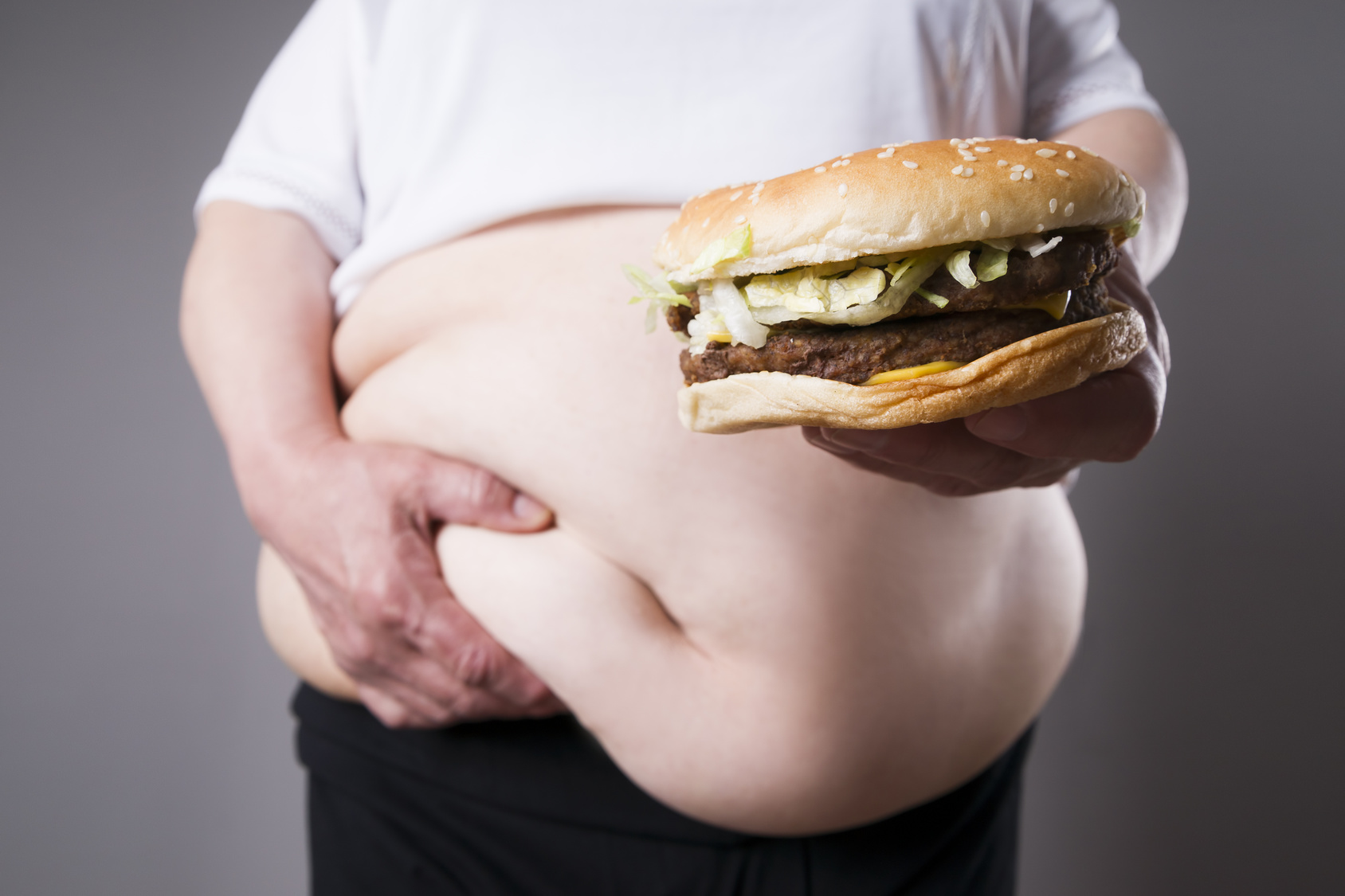
Does Running Burn Belly Fat?

runner belly fat

Does running burn belly fat?

The answer is a heck yeah!

In fact, a lot of beginners take up running to lose belly fat and and get a flat stomach.

When it comes to losing weight, it’s hard to beat running.

You can burn up to 600 to 800 calories while running, depending on your factors such as your size, training intensity, and fitness level.

But long runs alone aren’t going to help you lose that belly fat.

In fact, you need to back up your plan with the right diet and lifestyle changes—or else, you’ll fail miserably.

And you don’t want that.

In today’s post, I’m sharing with you some of the most effective ways to get rid of that stubborn belly fat and get a flat stomach.

But first things first, let’s discuss what’s belly fat as well as some of the dangers it poses.

What’s Belly Fat?

Belly fat, or “visceral fat” in medical terms—is the most dangerous fat there is.

This lethal fat accumulates in the abdominal area and envelopes your organs.

Surveys show that 30 percent of U.S. adults are classified as obese.

That’s just over one in three people, making the US one of the fattest countries in the world.

Probability, half the population of the US will be obese by 2040.

This fat not only affects how you look, but it’s also a significant risk factor for many serious diseases, including:

  • Type II diabetes
  • Heart diseases
  • Coronary artery disease
  • Hypertension
  • Some cancers
  • Sleep apnea
  • Shorter life expectancy

Part 1 – Diet Changes to Get A Flat Stomach

The kitchen is the heart of the house and also where the battle for losing belly fat is won or lost.

Make the following changes to your nutrition plan and see your belly slimming down as a result.

1. Remove The Sugars

One of the best things you can do right now to get a flat stomach as soon as possible is to reduce your daily sugar intake.

Don’t take my word for it.

Science agrees.

Here are a few studies:

  • Research revealed that subjects who consumed four to five servings of white bread a day resulted in more belly fat gains than those who only had one serving of white bread, even though both groups consumed the same amount of calories.
  • Research has found that consuming low-carb diets resulted in reduced appetite, which is conducive to weight loss.
  • A study from the University of North Caroline at Chapel Hill determined that the average American consumes about 80 more calories per day than they did in 1977.

Action Step

Cut back (or eliminate them for good) on all forms of refined and processed calories, including white bread, cookies, waffles, muffins, candy, chips, bagels, pastries, cakes, donuts, pasta, crackers, junk & fried foods and any other processed foods you get in a bag or a box.

I know that’s a lot, but you can do it in a slow manner.

2. Banish Liquid Calories

These liquid calories come in just about any form—soda, coffee, energy drinks, fruit juice, beer, and other sugar-sweetened beverages.

Liquid sugars are the worst as they don’t get “indexed” by the brain in the same way as it would index solid food.

In short, you end up taking in a lot of extra calories without even taking notice.

Even diet coke is bad for you.

A study published in the Journal of the American Geriatrics Society found that people who consumed diet soda on a regular basis gained about triple the amount of fat over a period of nine years as those who didn’t drink it.

That’s why I said any form of sugar, even artificial.

Action Step

Mindful eating!

Eat what’s essential and good for you.

Limit your intake of all sources of liquid calories, and that includes coke, sports drinks, beer, alcohol, juice, coffees, and other forms of sugar-sweetened drinks.

Instead, drink water.

Note – Looking for the best Beginner’s Guide To Running?
Then Check my Runners Blueprint System Here.

3. Eat More Healthy Fats

Are you in the habit of skimping on fats because you want to lose weight? That’s a big mistake

The truth is, not all fats are bad for you.

In fact, you need fats as much as you need carbs and proteins in your diet.

Healthy fats increase satiety levels, improve fat burning, increase metabolism, regulate blood sugar levels, etc.

Research published in the journal Diabetic Care reported that a diet rich in monounsaturated fats is more effective at regulating blood sugar levels than a high-carb diet

Another study published in the medical journal Appetite revealed that long-chain omega-3 fats could help control hunger.

Action Step

Healthy fats are abundant in:

  • Olives and olive oil
  • Canola oil
  • Flax oil
  • Seeds
  • Peanuts
  • Cashews
  • Almonds
  • Peanut butter
  • Avocadoes
  • Sesame seeds
  • Tahini
  • Pesto sauce


4. Count Your Calories

Let’s be honest, we are terrible at guesstimating the amount of calories consumed during a meal, and the number of calories burnt during a workout.

Research out of the Pennington Biomedical Research Center found that subjects who kept track of calories consumed still missed roughly 18 percent of them.

Further research also has shown that people—both those who are overweight or those within a healthy weight—tend to overestimate the amount of calories burnt during exercise.

So, you are not alone.

Action Step

Learn how to log smarter.

There is a wide range of apps and online resources to help you simplify the calorie counting process—provided that you’re willing to engage in it regularly.

Here are a few apps and websites:

  • SparkPeople
  • Lose it!
  • MyPlate
  • FitDay
  • MyFitnessPal
  • Cron-o-meter

To figure out how many calories you should eat each day, use this calculator

  • Training intensity
  • Fitness level
  • Age
  • Bodyweight
  • Gender

5. Eat A High-Protein Diet

Protein is an essential nutrient that not only helps you build muscle but also loses weight.

During an experiment published in The FASEB Journal, female subjects were instructed to follow a diet for two months that consisted of roughly 30 percent protein, 30 percent fat, and 40 percent carb.

While the control group stuck to a diet that was 16 percent protein, 26 percent fat, and 55 percent carbs.

Result shown that the first group lost drastically more fat—including belly fat—than the other group without losing muscle mass.

Action Step

As a general guideline, roughly 30 to 35 percent of calories should come from lean sources of quality protein.

These include:

  • Lean meats
  • Whole eggs
  • Fish
  • Nuts, and
  • Dairy

6. Eat Probiotics

Probiotics are various types of healthy bacteria found in a variety of foods and supplements. Bioma Probiotics is a great example of a supplement that can help introduce these beneficial bacteria into your system.

These have a lot to offer, but more importantly, they help reduce tummy fat.

In research published in the European Journal of Clinical Nutrition, subjects had two cups per day of fermented milk containing Lactobacillus Gasseri, (a probiotic strain), for a period of three months.

The subjects reported a reduction in abdominal visceral fat by roughly 4.6 percent and subcutaneous fat by just over 3 percent.

Another research shows the supportive result that: Probiotics are not only conducive to weight loss, but also work very well for belly fat.

Let’s say its like a detoxing agent.

Action Step

You need to support the growth of probiotic bacteria by eating plenty of prebiotic foods that naturally pack in a lot of soluble fiber.

These include:

  • Asparagus,
  • Bananas,
  • Jerusalem artichokes
  • Garlic,
  • Onions,
  • Leeks.

7. Try Intermittent Fasting

A review of research conducted on intermittent fasting reported that subjects experienced a 4 to 7 percent reduction in abdominal fat within a period of two to six months.

Another research published in the journal Cell Research revealed that intermittent fasting could cause drastic weight loss in just weeks in a mice group who were fed a typical diet for two days, followed by a 24-hour fast.

So, how does IF work?

Intermittent fasting is effective due to a mix of the following mechanisms:

  • Lowering insulin levels.
  • Regulating ghrelin levels, AKA “the hunger ”
  • Promoting the release of human growth hormone.
  • Increasing abdominal subcutaneous blood flow.
  • Stimulating anti-inflammatory cells.

Action Step

In the past few years, I’ve experimented with a few different IF schedules, and this is my personal favorite as it’s easy to implement once your body has adjusted to the new eating approach.

The 16/8 method involves fasting for 16 hours per day, then having all of your meals in an 8 hour period.

For example, you could restrict your food intake to the hours of 1 pm to 9 pm.

So, basically, you’re just hopping breakfast and making lunch your first meal of the day.

Sure, feel free to drink your coffee in the morning—but that’s it.

Try to refrain from any sugar or sweets for breakfast if you don’t want to spend the remaining hours with hunger pangs.

I know there are a lot of IF variations, but 16/8 is the best and easiest form for beginners.

8. Drink Green Tea

When it comes to healthy beverages, green tea tops the list.

I’m talking about pure green tea, no latte, no frappe.

Just classic green tea ala Japan.

Research reported that drinking green tea can increase metabolism by up to 4 percent.

It may not seem as much, but it adds up.

What’s more?

According to research published in the American Journal of Clinical Nutrition, subjects who drank green tea with caffeine saw their weight drop and also reduced their belly fat more than those who only had caffeine.

Action Step

Shoot for 600 mg—or the equivalent of two to three cups of green tea per day.

For those with insomnia, try to have it gradually so you won’t disrupt your sleeping pattern.

Additional resource – Here’s how to lose body fat.

9. Eat Plenty of Soluble Fiber

An experiment, published in the journal Obesity, reported that for every ten grams increase in soluble fiber intake per day, subjects were able to reduce their tummy fat by roughly 3.7 percent over a period of five years.

Examples of ten grams of soluble fiber include two servings of black beans, two small apples, and two cups of asparagus

Another study published in the Journal of Nutrition revealed that subjects who consumed more fiber from whole grains and cereals had less body fat and belly fat than those who skipped the fiber.

lose belly fat

Action Step

Soluble fiber can be found in different foods, including:

  • Flaxseeds
  • Brussel sprouts
  • Avocadoes
  • Shirataki noodles
  • Legumes
  • Blackberries

10. Eat Fatty Fish

A study published in the British Journal of Nutrition that found that consuming omega-3 fatty acids from fatty fish, like mackerel, is effective at reducing visceral fat.

You can also turn to fish oil supplements if you can’t find a good fish source.

Research conducted on subjects with liver fatty diseases reported that fish oil supplements could drastically reduce abdominal and liver fat.

Action Step

Aim for, at least, three servings of fatty fish per week to get enough levels of omega-3’s.

Here are the few:

  • Sardines
  • Halibut
  • Salmon
  • Herring
  • Mackerel

11. Go Easy on The Alcohol

They call it a beer belly for a reason.

A single serving of wine, beer, or spirits can pack in roughly 120 to 150 calories, and if you tend to overindulge, you can end with severe calorie overload.

A study published in Obesity found that alcoholic drinks make your brain more sensitive to the smell of food, increasing appetite.

Action Step

I’m not saying that you should give up beer altogether.

But a little moderation can go a long way in helping you get a flat stomach.

Part 2 – Exercise & Running Strategies to Lose Stomach Fat 

The way you run, and exercise in general, also matters when it comes to burning belly fat.

Apply the following strategies to ensure you’re making the most out of your sweat time.

12. Do Intervals

I’ve already confirmed that running does burn stomach fat, however, logging endless miles isn’t the best way to go.

Instead, do intervals by alternating between high-intensity bursts of running and slow jogging or walking for recovery.

Not only good for speed work, according to studies, intervals are proven to reduce belly fat and boost metabolism.

Action Step

Start with a proper warm-up of 5 to 10 minutes of slow jogging to raise your core temperature and get your muscles ready for the task ahead.

Go hard for 30 seconds, then rest for one minute, then go hard again.

Shoot for 8 or 9 on the RPE scale.

Repeat the process for 15 to 20 minutes. Don’t forget a proper cool down.

For more, check my six fat burning workouts. This guide on running for abs is also helpful.

13. No More Crunches

Classic ab exercises like sit-ups and crunches can strengthen your abs, but they’re not the most efficient exercises you can do to help you lose belly fat.

So what kind of ab exercises you should be doing?

You need exercises that engage multiple muscle groups and also challenge your cardiovascular system, so you end up burning off more calories.

These also work well for building strength in the core muscles—upper and lower abs, obliques, glutes.

Action Step

One of the best core exercises in the world is the good ol’ planks, where you hold yourself in a standard push-up position, core engaged, back flat, forearms resting firmly on the ground.

Planks cannot only hit your core hard, but they also activate your legs, chest, and shoulders.

Alignment first, strength later.

If you are beginner, then start with 3 to 5 sets of plank hold for 20 to 30 seconds each.

As you get stronger, hold it for longer and try adding in more variations.

14. Try HIIT Bodyweight Training

High-intensity interval training, as the name implies, consists of alternating between intense exercise intervals with recovery periods of low-intensity training.

Greek researchers found that performing intervals helped subjects lose more belly fat than moderate steady-state cardio training.

Another research published in the Journal of Sports & Physical Fitness showed that HIIT style workouts increase metabolism.

This means you continue burning calories at a higher rate for several hours post-workout.

“Also, You can try some waist cinchers while HIIT Bodyweight Training. Learning about Best Waist Trainer it will make your time less consumed and eventually you would see the results much faster.”

Action Step

You can copy my bodyweight routine below and do reps as many as possible with good form.

Take 20 seconds of rest between each exercise, then rest for one to two minutes between each round.

Aim for six to eight rounds

15. Perform Resistance Training

Research reported that resistance training to be super beneficial for people with prediabetes, type II diabetes, and other metabolic issues.

For instance, this experiment revealed that a mix of strength training and cardio exercise is most effective in reducing visceral fat in overweight teenagers.

Action Step

Incorporate the following guidelines into your training program:

  • Start out training with a personal trainer. This will help you nail good form from the get-go—key to injury-free and efficient training.
  • Combine it with cardio. How? By adding kettlebells, battle ropes, medicine ball exercises.
  • Do compound moves. Spot reduction is a myth. Instead, do multi-joint, full-body exercises that target many muscles at once. Examples include squats, bench presses, deadlifts, overhead presses, burpees, etc.
  • Go heavy or go home. Research shows that opting for heavier weight with fewer reps is most useful for shedding body fat. And don’t worry about getting bulked up.

Lifestyle Changes To Get a Flat Stomach

Your everyday lifestyle choices can also affect your belly fat loss results.

Don’t worry.

I’m sharing with you below the exact measures you need to take to get your lifestyle up to speed.

The sweat will be for nothing if you neglect your lifestyle.

Does Running burn belly fat

16. Sleep Well

According to a study published in the journal Sleep, people how logged six to seven hours of sleep during the night’s time had the lowest levels of visceral fat.

The researchers concluded that sleeping above or below that range was linked to more belly fat, and those who slept less than 5 hours reported the worst numbers.

In a 16-year study, 68,000 women who logged in less than five hours of sleep per night were likely to gain weight than those who slept seven hours or longer per night.

Research also has associated sleep deprivation with a number of conditions that contribute to excess visceral fats.

These include:

  • Increased concentration of the hormone cortisol and serotonin..
  • Reduced insulin sensitivity
  • Reduced levels of the satiety hormone leptin and increased secretion of hunger-inducing ghrelin.

Action Step

Here is what you need to ensure that you are getting enough sleep.

  • Sleep at least 7 to 8 hours of high-quality uninterrupted sleep during the night’s time.
  • Ensure quality sleep by removing all sorts of distractions, like your TV, Smartphone, and other electronics, from your bedroom.
  • Keep your room cool—around 65 degrees. Some people prefer a warm room, so make it as comfy as you want.
  • Avoid caffeine and other stimulants three to four hours before going to bed.
  • Keep a strict and fixed sleeping schedule by going to bed and getting up at the same time, even on the weekend.
  • Accept the fact that you cannot accomplish everything on the to-do list. That’s life, and bad stuff happens to good people all the time.
  • Your bedroom has two functions: Sleep and sex. So keep it that way.

17. Reduce Stress

 A study from the Ohio State University revealed that stress could hinder you from losing weight, or even add more pounds, by disturbing healthy hormone regulation.

It will make you hungry as your body keeps on releasing cortisol as long as the stress continues.

The bad news is when you are stressed out, you will tend to go for high-fat, high-calorie treats, and foods because these foods stimulate the brain to release good-feel chemicals that ease the tension.

Action Step

Here are a few things you can do here:

  • Start meditating. Techniques like Vipassana and Transcendental Meditation can be easily learned in the comfort of your house. Not into silent meditation? Try vibrational meditation like a Tibetan bowl or gong bath.
  • Keep a daily journal and jot down what’s bothering you. This will help you identify major stressors in life, along with ways of dealing with them.
  • Start a yoga class, especially restorative yoga.
  • Make more time for yourself. Learn how to be more assertive and say no to family members, friends, and the rest of the world, especially when they ask you for something you just don’t have the time to do.
  • Get enough sleep—at least 7 to 8 hours a night.
  • Remove friction and grey zone areas from your life.
  • Find time to do the things you enjoy—even if it’s watching South Park for the third time.

 18. Set Challenging Goals

Research reported in the Journal of Human Nutrition & Dietetics suggested that the key to long-term weight loss is setting challenging goals.

The study, led by researchers at Nottingham University, assessed the impact of goal setting in roughly 24,000 overweight participants for a 12-month duration.

The following conclusion:

  • Subjects who set no clear goals were the least successful overall
  • Those who set relatively modest goals shed 10 percent of their body weight.
  • Those who set more challenging goals lost an average of 19 percent of their body in one year–almost twice as much weight as the “realistic group.”

Also, this falls within the expert recommendation for a safe weight loss of one to two pounds per week.

Action Step

As a rule of thumb, start out by setting short-term fat loss goals.

These shorter, mini, goals are gradual achievements that lead up to your ultimate goals.

A good example would be to lose one pound per week.

That might not seem like much, but it adds up.

Keep that weight loss consistent for three months, and you’ll achieve the longer-term goal of shedding 10 to 12 pounds, in other words, aim for 10-20% from your old bodyweight.

You should expect slow, gradual weight loss, but not instant results. Everything instant are never good.

19.  Stay Consistent

Consistency at its best!

The key to shedding the pounds and keeping them off is consistently losing a small amount each week, according to research conducted at the Drexel University.

Duing the experiment, a group of 183 overweight participants went on a weight loss plan for a year.

In the end, subjects who shed a consistent amount of weight over the first two months of the experiment ended up losing more weight than the yo-yo dieters, despite the latter group reporting bigger weight loss results to start.

Further research on achievement and personal success shows that the most successful people in the world—those you might consider lucky—possess a tremendous level of perseverance.

Never give up before you even start it.

Action Step

Make exercise a daily must remove junk foods from your life, do the work, and you’ll see improvement, but just not right away.

It’s okay to have some time for recreational foods or cheating day, but please limit it as much as possible.

And that’s all.

Today’s post is full of useful strategies to help you burn belly fat and get a flat stomach.

But it’s up to you to get started on the path.

Eat right, exercise often and take care of your body.

The rest is just details.

Conclusion

I think that’s it for today. If you’re still asking yourself “does running burn belly fat?” then today’s article should get you started on the right path.

Don’t worry, I will be writing more about running to lose belly fat in the near future.

Please do your best to put into action what you just learned so you can lose your belly fat and enjoy a flat stomach.

In the meantime, thank you for reading my post.

Feel free to leave your comments and questions below.

David D

Running But Not Losing Weight? Here Are The 10 Reasons

runner trying to lose weight but he keeps gaining pounds

Why can’t I lose weight while running?

If you don’t already know the answer to that question, then this post is perfect for you.

Running & Weight Loss Results

Running is the best thing you can do to help you lose weight and keep it off for good.

If truth be told, the reason I started running in the first place was to lose weight, and chances you’ve started (or thinking about it) for similar reasons.

Scores of beginners take up running because, mostly, they want to lose weight.

In other words, running does help you lose weight.

Nonetheless, and as I have learned the hard way, running does not always lead to weight loss.

This is a hard one to swallow…

Just because you took up running, it doesn’t necessarily mean that you’re going to get a flat stomach.

In fact, even if you are following a healthy diet and are hitting the pavement on a regular basis, there is no guarantee for weight loss.

My Story

When I first took up running circa 2006, I lost around 25 pounds in the first few months.

However, I couldn’t keep the weight off—regardless of my efforts and how much I wanted to stay slim.

Within six months of my initial success, I gained about 15 pounds back, even though I was running more than before and trying to set my diet in the right direction.

The irony, I know.

This frustrated the hell out of me.

All the same, I kept going after my weight loss goals.

I knew that I had no option other than staying consistent—giving up was not an option.

After a long process of trial and error, I was able to keep the weight off.

And today I’m going to share with you some of the main reasons you’re not losing weight as fast as you’d like to, along with a few tips to help you expedite the process and increase the chances of your success.

So are you excited? Then here we go…

Running But Not Losing Weight? – The Answer(s) You Seek

runner Gaining Weight While Running

Running But Not Losing Weight Reason – 1. You are Gaining Muscle Mass

When you take up running, and for the first few months, your body responds to the new rigorous activity by making some adaptations and physiological changes.

One of these changes is a significant shift in your body composition as you gain muscle mass and lose fat.

How does that happen?

Running can increase muscles mass—especially in key running muscles, such as the glutes, quads, and calves.

In fact, you could be building muscle mass faster than you are shedding fat.

The Fix

The only thing you need to here is: Patience.

That’s it.

Once you keep up the good work, the fat will eventually burn off, and you’ll end up with a leaner and sculpted body.

Also, use other measurements for weight loss beyond the scale.

You might consider taking regular measures of your waist and circumference, or calculating your body mass index—BMI—via this online calculator.

This will give you a better ballpark figure of your percentage of body fat, according to your weight and height.

Running But Not Losing Weight Reason – 2 Bad Nutrition

This seems like a no-brainer, but even if you believe that you’re eating sensibly, you might be still off the mark.

Even if you exercise regularly, it doesn’t mean you can get away with eating a big mac and chocolate cake guilt-free and still lose weight.

That’s not how things happen in the real world.

A moderate 45-minute run may burn roughly 500 calories, but follow it with a soda drink, or a donut, and the calorie deficit is effectively erased.

What’s more?

Research published in JAMA revealed that subjects underestimated the amount of calories contained in a high-caloric food virtually 100 percent of the time.

The Solution

Here’s how to eat for weight loss when running.

Eat right. While your eating plan depends heavily on many factors, including your genes, body type, metabolism, the rule is to opt for natural, whole foods, at least 90 percent of the time.

Eat Well. Shoot for three meals a day satisfying enough that you can go for four to five hours before you feel the need for food.

Skip the sugar. Say no to sugary foods, bread, and anything else that’s processed.

The fewer the ingredients on the label, the better.

If you can’t pronounce, it’s likely not something you want to be putting in your mouth.

Practice Portion Control. Use cups and spoons to measure your serving sizes and make sure they’re appropriate.

Here’s the full guide.

Time your meals. When you eat also impacts your weight loss efforts. Here’s the full guide.

Monitor your calories. Use this simple online calculator to figure your daily calorie intake.

Additional resource – Clean keto food list for beginners

Running But Not Losing Weight Reason – 3 You Run too Much

Logging in too many miles without giving your body enough recovery time can lead to overtraining and all sorts of health troubles.

But that’s not the whole story.

Overtraining also has an impact on your weight loss vision.

If you an overtrained runner, especially when it comes to fluids, electrolyte balance, blood sugar, and stress levels, then you might be harming your thyroid and hindering your metabolic rate, all of which can compromise your weight loss efforts.

In other words, stress is bad for you—regardless of how much of healthy lifestyle you are championing.

The Fix

Give recovery the priority it calls for by doing the following:

  • Eat for recovery with an emphasis on post-run eating and eating natural and nutritious food.
  • Shoot for at least 7 to 8 hours of high quality interrupted sleep during the night’s time.
  • Schedule recovery runs, recovery workouts, recovery days, and recovery weeks into your training program.
  • Do your best to eliminate and reduce stress and its triggers in your life.
  • For more recovery practices, check my post here.

Running But Not Losing Weight Reason – 4 You’re Not Running Hard (or Long) Enough

Some runners are able to lose a few pounds at first by just going for a few short runs around the block while opting for sensible diet guidelines.

But after a couple of months of doing the same thing, they suddenly hit a wall and stop seeing progress?

What’s gives?

The reason is actually quite simple.

The human body is pretty smart, and it’s designed to be as efficient as possible; this means that if you are running the same route at the same intensity and training level, your body will eventually adapt to the workload, and you’ll stop seeing results.

In fact, this is guaranteed way to encounter a weight loss plateau

According to research conducted at the University of Tampa, running on the treadmill for 45 minutes at a steady pace promotes weight loss, but only during the first few weeks.

The Fix

Be consistent.

If you are serious about losing weight, make sure to schedule at least three runs per week, aiming for a minimum of 240 minutes of exercise a week.

Plus, and this is super important, try to diversify your training intensity and duration.

HIIT running workouts, such as sprints, hill reps and other HIIT workouts might be the exact thing you need to break a weight loss plateau and reach your weight loss running goals.

Thus, Instead of doing the same steady state runs over and over again, add a couple of interval training sessions to your weekly training routines, such as interval sprints and hill reps.

Also, incorporate a couple of cross training sessions to your training program to keep you consistent and speed up your fitness gains.

Spinning, Yoga, weight training, and swimming are some of the best options.

What’s more? If you are not into cross training, then I recommend that you find smart and practical ways to add more physical activity into your daily routine.

Here are a few things to consider:

  • Stand more.
  • Play with the kids.
  • Get a stand-up work desk.
  • Play sports with the kids.
  • Exercise the dog.
  • The list is almost endless.

Just get out there and be as active as possible.

Additional link – Slow running vs fast running for weight loss

Running But Not Losing Weight Reason – 5 The Scale is Just One Piece of a Much Bigger Puzzle

“The scale is a bastard trickster” as I like to say.

If truth be told, the scale might not be your best friend when it comes to keeping track of your weight loss progress—or lack thereof.

Why?

Well, it’s really simple.

Body weight tends to rise and fall by a few pounds from one day to the next.

This fluctuation depends, mainly, on hormones activity, the foods you are eating, dehydration level, etc…and when you hang your hopes on the scale, then you are actually setting yourself a vicious cycle of ups and downs.

So please, please remember this: the numbers on the scale do not tell the whole story.

The Fix

The best advice I can give you when it comes to tracking weight loss the right way is to use a variety of measurement.

As I have already stated, you need to opt for other ways than the scale to measure your progress.

Try some of these ways to measure your progress:

  • Measure your body fat percentage once per month.
  • Measure your waist circumference.
  • Keep tabs on how well your clothes fit. Try on the same pair shirts or jeans every four to six weeks, and look for the subtle differences.
  • Take before and after pictures on a monthly basis.
  • Keep tabs on your emotional states and energy levels. Are you sleeping better? Do you have more energy? Are you feeling less stressed? Do you feel more alive? Etc.
  • Keep tabs on your athletic performance. Is your athletic performance improving? How much you can you run? How long can you run? How fast can you run? Take these fitness tests on every six to eight weeks to see how your fitness level stacks up to the average Joe.

Running But Not Losing Weight Reason – 6 Unrealistic Weight Loss Expectations

I hate to break it to you, but weight loss is not something that happens overnight.

In reality, and contrary to popular belief, weight loss is a much slower process than the majority of people want it to be.

Don’t get me wrong.

Overnight success stories do happen.

In fact, it is even possible to lose a bunch of weight fast in the first few weeks of a weight loss resolution, but the truth is, this cannot be sustained.

And according to research, this is not the healthiest thing to do.

Therefore, if you are struggling with the scale, one reason might be that you just haven’t given it enough time.

And that’s it.

Additional Resource – Here’s how to much to run to lose weight

Fix it

Stop looking for short-term results.

Weight loss is more of a marathon, not a sprint.

Slow and steady wins the weight loss race…

Yeah, that’s easier said than done.

Here is your action plan:

Aim for no more one pound per week—that’s roughly 3500 calories.

As a rule of thumb, you should, ideally, shoot for a 300 to 500 calorie deficit a day if you are serious about shedding weight the healthy and sustainable way.

Give the process time, and with enough persistence and flexibility on your part, you’ll achieve what you are after.

Just keep in mind that everybody is different and responds differently to training routines and diet habits.

No suit fits all.

That’s the beauty of life.

And in the end, it pays for the long term to start accepting your body the way it is.

I hate to break it to you, but not everyone can look like a fitness model—no matter how entitled you feel and regardless of what the latest fitness magazine covers promise—we are all different.

The truth is, most of the fitness magazine covers and the fit-inspiration are often embellished and enhanced using special software—no one actually looks like that in real life (thank you Photoshop), and you shouldn’t be hard on yourself since you are not meeting any particular standard.

Running But Not Losing Weight Reason – 7 You Are Under Too Much Stress

Plenty of research has revealed that stress and weight gain go hand in hand.

Not convinced? Check the following studies:

Research 1

Research 2

Research 3

Research 4

Research 5

Chronic stress can contribute to a host of health issues, including:

Elevated cortisol. Not only does this mess up your hunger hormone, but also cause extra belly fat storage.

Cravings. Research shows that we’re more likely to reach for ‘comfort foods’ that are rich in sugar and fat when we’re stressed.

Skipping Runs.  When you feel like the world of the world is on your shoulders, it’s easy to put your run on the backburner in favor of a delicious waffle or a beer.

The Solution

Take a few minutes throughout your day to consciously check in with yourself and reduce your stress level.

Don’t take my word for it.

Research published in the journal Eating Behaviors revealed that regular meditation could help tame binge eating and decrease emotional eating.

Running But Not Losing Weight Reason – 8 You’re Sleep Deprived

Making time for your morning runs can mean less time for sleep, but it’s vital to get enough between the sheets hours if you’re trying to lose weight.

Why it’s the case?

Plenty of research has found that poor sleep to be one of the most common risk factors for obesity.

Here are a few:

Study 1

A study out of the University of Chicago found that sleep-deprived subjects opted for foods with twice as many carbs and fats as those who had enough sleep.

Study 2

One Mayo Clinic research found that sleep deprived subjects consume an average of 500 extra calories a day.

Study 3

Research out of the American Journal of Clinical Nutrition found that sleep deprivation can increase the chances of late-night snacking and unhealthy food decisions.

Study 4

Research proposes that lack of sleep may lower your resting metabolic rate, which is the rate at which your body burns calories when at rest.

In other words, by skipping on sleep, your body is cooking up a perfect recipe for weight gain.

The reasons sleep affects your weight are manifold. These include :

  • Sleep deprivation can boost both insulin and leptin levels, resulting in the body becoming desensitized to their response.
  • You’re more likely to get takeout for dinner then hit the bed late because you feel uncomfortably full.
  • When tired following a bad night, you may choose to skip your workout or simply do less, burning fewer calories.
  • Being tired and moody the next day sets your brain up to make bad food decision, research shows.

The Solution

Get at least seven to eight hours of quality sleep every day. That may require you to change your schedule around a bit, but it’s worth the effort.

Improve your sleep quality by doing the following:

  • Build the habit of napping –30 minutes max—every
  • Try different bedtime schedules and see which one works best for you. For example, go to bed at 11 pm so you can wake up at 7 am.
  • Go to bed and wake up at the same time, including weekends
  • Reduce distraction and light exposure in the few hours leading to bedtime
  • Avoid stimulates such as caffeine or nicotine for three hours before bed.

Running But Not Losing Weight Reason – 9 You’re Losing Weight Without Realizing It

If you’ve been training hard lately and suddenly see the number on the scale go up, don’t panic.

The stats on the scale provide one variable, your absolute weight, which isn’t always the more reliable judge of what’s happening in (and to) your body.

By stepping on the scale day in day out, you’re simply measuring everyday fluctuations in your hydration levels and other trivial weight metrics.

What’s more?

Muscle gain can also be a culprit.

Sure, pounding the pavement doesn’t create a lot of bulk, but it does allow you to increase muscle mass, especially in your lower body.

In fact, if you’re running consistently enough to develop telltale running calves and quads, then you gained some muscle.

And since muscle weight more than fat, you might not see the scale move to the direction you desire, or you could put on a few pounds.

This is especially the case if you pick up training for the first time and/or are close to your ideal weight.

The Solution

Don’t jump on the scale every day.

It’s not unheard of for body weight to go up and down by a few pounds throughout the day.

Instead look for gradual, yet consistent, changes in your weight every three to four weeks.

To remove ups and downs from external factors form the equation, build the habit of weighing yourself at the same time of day and same day.

And make sure to do it first thing in the morning, before eating or getting dressed.

Use other measurements other than the scale to keep track of your progress.

  • Measure your waist circumference
  • Measure your body weight percentage.
  • Get your body composition analyzed
  • Track your body fat percentage.

Running But Not Losing Weight Reason – 10  You Have A Medical Condition

Maybe you’re not losing weight, despite running regularly and eating well, is because you have got an underlying health condition.

A host of medical conditions can hinder weight loss or cause weight gain. Among them are:

Cushing’s syndrome. Occurs when your adrenal glands release too much cortisol, resulting in the buildup of fat in your abdomen, upper back, and face.

Hypothyroidism. Happens when your thyroid is underactive, resulting in a limited production of the thyroid hormone, which is key for burning stored fat.

Polycystic over syndrome. Or PCOS, this condition is caused by a hormonal imbalance, affecting more than 5 million women in the US alone.

Insulin resistance. Or hyperinsulinemia, this is the umbrella term for host health issues thought to be rooted in insulin resistance.

Depression. You’re more likely to turn into eating to ease your emotional issues.

Some antidepressant medications (SSRIs) can also cause weight gain.

The Solution

Regardless of your exercise, diet, or lifestyle habits, if you’re piling up the pounds and don’t know why, consult with your doctor to rule out a medical issue as the cause.

Although you might feel tempted to give up, don’t. Most of these medical problems can be solved.

Conclusion

If you’re having trouble losing the pounds while running, you need to get real get back to basics—most of which I shared with you today (as well as this previous post).

It’s not only important to pay attention to what you’re putting in your mouth, but also how much sleep you’re getting, your stress level, your training intensity, and the fact that you might have medical issues that are sabotaging your weight loss efforts.

I know it’s hard to keep track off, but it’s worth the effort.

Just remember to take action, start small, and build these healthy habits gradually.

Then it’s just a question of time.

Losing weight is a messy business, especially when you’re a fat runner.  There are no shortcuts nor silver bullets—and it requires hard and persistent work to see results—the type of result that works for the long term.

Please feel free to leave your comments and questions in the section below.

In the meantime, thank you for reading my post.

Keep Running Strong.

David D.

New to Running? Start Here…

If you’re serious about running, getting fit, and staying injury free, then make sure to download my Runners Blueprint Guide!

Inside this guide, you’ll learn how to start running and lose weight weight the easy and painless way. This is, in fact, your ultimate manifesto to becoming a faster and a stronger runner. And you want that, don’t you?

 Click HERE to check out my Runners Blueprint System today!

Don’t miss out! My awesome running plan is just one click away.

Conclusion

The above reasons are the main ones to blame for not losing weight. So, if you’re still wondering what to do when you can’t lose weight, be honest with yourself and assess the possibility that you might be actually doing it to yourself.

The 101 Best Weight Loss Tips of All Time

Weight Loss woman

If you’re looking to lose weight—whether it’s 5 pounds, 10 pounds, 20 pounds or more —then you’ve come to the right place.

This article will take you through just about every aspect of weight loss possible, from exercise to diet, motivation to lifestyle, and everything in between.

Without further ado, here are 101 ways to lose the extra pounds for good. I hope you find my tips and strategies helpful.

Note:  This is a super-long article (10000+ words). Don’t sit down to read it until you have enough time to dig into it. To make sure you don’t forget, bookmark this post and read it later, when you have time. In addition to the content I’ve written, I’ve also provided links to over 70 scientific studies related to weight loss and exercise.  They’re worthwhile reading as well, so click through on the links for even more helpful information and detail.

  1. Find Your Big Why

 In my experience, the first step toward achieving anything in life—let alone losing weight—is having the right motivation.

Without a “Big Why,” you’ll have no (or too little) motivation — especially when you come across roadblocks. When you’re motivated enough, you’re in a good place. I can guarantee that you ’ll lose weight and keep it off for good once you know your Big Why.

So, What’s YOUR WHY?

Why do you want to lose weight?

Why do you want to start exercising?

Why do you want to live a healthy lifestyle?

Why?

Is it because you’re ashamed of your body?

Is it because losing weight is a matter of life or death?

Whatever your real reason is, after you’ve figured out your big WHY (or WHYs), write it down and keep it somewhere that you’ll see it on a daily basis. This will serve as a constant reminder when the going gets tough.

Diet Tips

  1. Eat More Vegetables

There is no such thing as healthy eating without vegetables.

Why? Well for starters, vegetables score high in fiber and are low in calories— both key nutritional elements for successful weight loss. They’re also chock-full of minerals, vitamins, antioxidants and plenty of other valuable nutrients.

Do your best to eat as much as green stuff as possible. Some of the best options include broccoli, watercress, kale, cabbage, lettuce, cucumber, cauliflower, Swiss chard, and Brussels sprouts.

3. Eat Protein At Every Meal

Protein is your friend, whether you’re trying to increase muscle mass or lose weight.

Good protein can help keep you feeling full longer and controls your blood sugar levels, both of which can cut cravings for sugary, high-calorie, high-fat foods. Protein is also critical for muscle recovery and fat burning.

There is plenty of research to back these claims up.  According to a study published in the American Journal of Clinical Nutrition, people who eat protein at each meal lost more weight than those who didn’t have the nutrient at certain meals.

Another study conducted at the University of Missouri found that people who had protein with each meal reported the most weight loss benefits.

Some of the best animal-based sources of lean protein include lean meat, seafood, and egg whites, and the best plant-based are nuts and beans.

Limit processed meats like ham, sausage, and bacon, or better yet avoid them entirely. These foods contain a lot of saturated fats and a plethora of chemicals and harmful ingredients.

Additional Resource: What is in a dairy-free Protein Powder?

  1. Plan Your Foods

“If you fail to plan, then you’re planning to fail.” This maxim holds true whether you are the CEO of a 500-Fortune company or just a regular Joe (or Jane) trying to build healthy eating habits.

Planning your meals can help you take the guesswork out of the equation, and this, in turn, increases your chances of success.

The best way to plan your food intake is to spend at least an hour every Saturday or Sunday evening thoroughly planning your meals for the upcoming week. Then all you have to do the rest of the week is stick to the plan.

Try to prepare at least 10 to 12 meals and put them in Tupperware bowls, so you have them ready for the week ahead.

  1. Eat More Fiber

Fiber is a type of carbohydrate found in plant foods like vegetables, fruits, and whole grains. According to a study published in the Journal of Nutrition, increasing fiber intake by 8 grams for every 1,000 calories you take in can promote weight loss and prevent weight gain.

Why?

Fiber, unlike other carbs, does not get easily absorbed by your body. This means that it helps you feel full for longer. Increasing your intake of fiber can also lower your cholesterol, and may even prevent colon cancer and other health ailments.

Shoot for at least 30 to 40 grams of fiber a day. Some of the best sources of fiber include beans, broccoli, asparagus, oats, Brussels sprouts, apples, and flax seeds, to name just a few.

woman trying to lose weight

  1. Cut the Bad Carbs

Not all carbs are created equal. If you want to lose weight, eat the good carbs and avoid bad ones.

Good carbs are also known as complex carbs. They take longer to digest and can help you feel full longer. Some of the best sources of good carbs include vegetables, fruits, sweet potatoes, beans, brown rice, and other whole grain products.

Bad carbs are also known as simple carbs. They are digested quickly by the body, and this can lead to blood sugar spikes, cravings, and a host of health troubles.

Classic examples of simple carbs include bread, pasta, bagels, candy, muffins, donuts, French fries, sugary cereals, white rice, and any sugary or highly processed food.

Additional resource – A 7-day keto meal plan

  1. Eat Low GI Foods

Established about 30 years ago, the glycemic index is a scale that ranks foods from 0 to 100 based on the impact they have on blood sugar levels. According to studies, subjects who followed a low-GI diet have reported losing double their fat as compared to a high GI group.

Check the following list.
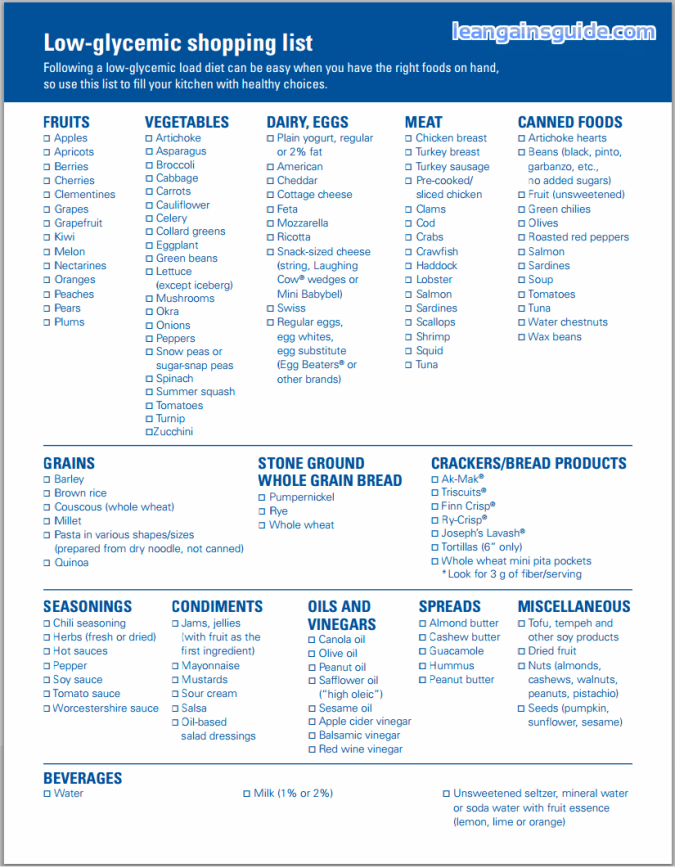
glycemic food index

Many thanks to LeanGainGuide.com for this awesome list.

  1. Don’t Fear Fats

Fats get a bad rap in the health community, but if you avoid them entirely, you’re doing yourself a great disservice.

Here’s the truth. Fats — the healthy kind — are an integral part of a healthy diet. Research shows that eating the right kinds of fats can help you lose weight and increase your overall health and well-being level.

So, which fats are good ones?

Good fats are monounsaturated fats, AKA MUFAs. They increase good HDL cholesterol while reducing bad LDL cholesterol.

Research shows that good fats can protect against the buildup of artery plaque, preventing heart disease and other health troubles. They can also suppress your appetite, reducing the number of calories you eat in a day while boosting your metabolism.

Some of the best sources of MUFAs include olive oil, coconut oil, canola oil, avocados, almonds, peanuts, and sesame seeds.

You don’t need too much good fat to get its benefits. Research suggests that two to three tablespoons of olive oil per day are enough to do the trick.

  1. Consume Water-Rich Foods

According to a study conducted at the Pennsylvania State University, eating water-rich foods cuts overall calorie consumption, as many of these foods are low in calories but high in fiber.

Here is a list of some of the best water-rich foods:

  • Tomatoes
  • Cucumbers
  • Iceberg lettuce
  • Zucchini
  • Green peppers
  • Celery
  • Cantaloupe
  • Spinach
  • Strawberries
  • Radishes
  • Grapefruits
  • Watermelon
  • Cauliflower
  1. Keep a Food Journal

According to a six-month study published in the American Journal of Preventative Medicine, people who kept tabs on their daily eating habits for six days a week reported losing about twice as many pounds as those who didn’t keep written records.

By monitoring your daily eating habits, you give yourself a better idea of what’s going into your mouth, This can help you better assess your daily eating choices and habits.  If traditional food tracking apps haven’t worked for you, consider exploring some myfitness pal alternatives that may better suit your needs and preferences.

Here’s what you need to do. Get yourself a diet journal and start tracking the amount of food you consume throughout the day, including snacks and treats.

  1. Take Pictures of Your Food

Photographing your meals and snacks is another helpful way to keep tabs on your daily eating habits.

Doing so can also help you examine the quantity and quality of the meals you’re eating, as well as holding you accountable for every bite you eat.

Research backs this up.

According to a study conducted at the University of Wisconsin-Madison, taking pictures of every meal and snack you eat can encourage you to change your diet.

  1. Eat Five Times a Day

Although there are no conclusive studies that prove that eating 4 to 5 mini meals a day can help you shed weight, many people say that eating small healthy meals multiple times a day has helped them lose weight.

As long as you’re eating the right foods, eating small meals throughout the day can help you win the battle of the bulge.

Try eating four to five 350 to 500-calorie meals every three to four hours. These small meals should include breakfast, a mid-morning snack, a small early lunch, a mid-afternoon snack, a finally a small, light dinner.

Here is a sample schedule:

  • 7:30 am—Breakfast
  • 10:00 am—Mid-morning snack
  • 1:00 pm—Lunch
  • 4:00 pm—Evening snack
  • 7:00 pm—Dinner
  1. Try Intermittent Fasting

Intermittent fasting is the artful form of skipping meals without hurting your weight loss efforts.

Intermittent fasting, or IF, involves regular, short-term fasts. According to research, fasting during short, specific windows during the day can help you consume fewer calories. It also optimizes some hormones linked to weight control.

There are several methods of intermittent fasting. One of the most popular is the 16/8 method in which you skip breakfast and eat during a limited 8-hour feeding period.

During the 16/8, you fast for 16 hours (including sleep time). For example, fasting from 9 p.m. to 1 p.m. adds up to 16 hours of fasting.

This method only requires that you trade your regular breakfast for a cup of coffee or some other non-caloric fluid. Then you can have lunch at 1:00 as your first meal of the day. This method only requires that you trade your regular breakfast for a cup of coffee, MUD\WTR, or some other non-caloric fluid

The 16/8 Method is convenient and simple, and does not require counting calories. You can do the 16/8 fast twice a week, on weekends, or every single day.

Additional resource – Here’s how long does it take to lose 100 pounds.

  1. Fill Your Plate with Veggies First

As you may already know, eating more vegetables has been proven one of the most significant predictors of weight loss and ideal health.

But how do you ensure you’re getting enough veggies?

It’s simple. Fill up half of your plate with vegetables, then divide the other half into two equal-sized areas. Fill one with good carbs like sweet potatoes, brown rice or a slice of whole-grain bread. Fill the other with lean protein such as skinless poultry, fish, lean beef or beans.

With this simple trick you won’t even need to count your calories or worry about portion size.

  1. Spice it Up

Spicy items like hot sauce, chopped jalapeno, and Cajun seasonings add a lot of flavor to meals with few calories. But that’s not the whole story.

According to research, most spicy foods contain a compound called capsaicin, which is the source from which chilies get their heat. According to research, this compound can tame your appetite and increase your metabolism.

Not only that, but capsaicin also may have a thermogenic effect, boosting body temperature after consumption. This may lead to a higher calorie burn for 20 to 30 minutes after you’re finished eating.

Additional resource – The best running songs

  1. Cook with Coconut Oil

Two tablespoons per day of coconut oil can help you reduce your waist circumference by an average of 1.1 inches over the course of a month, according to a study.

Coconut oil scores high on the healthy medium chain saturated fatty acids fats (known as Medium Chain Triglycerides, or MCTs) that increase metabolism for immediate energy and decrease appetite.

To get the most benefit from this, use virgin coconut oil. It’s usually made with no chemicals, while refined or RBD oil is usually chemically treated.

  1. Have Breakfast

A study conducted at Harvard revealed that obesity rates are roughly 40 to 50 percent lower in people who have breakfast on a consistent basis, compared with those who skip breakfast.

A healthy breakfast will make you less likely to be hungry later, which often leads to overeating over the remainder of the day.

Unless you’re doing intermittent fasting, you should never skip breakfast. As a rule, have up to 500 calories each day at breakfast, depending of course on your weight loss goals, age, fitness level, and exercise goals.

A healthy breakfast should consist of a serving of protein, a serving of whole grain carbs, and a serving of fruit—especially after a morning workout.

  1. Eat Eggs for Breakfast

Eggs should be a staple of your daily eating plan, and research shows that the best way to get the most out of eggs is to start your day off with them.

A study found that obese subjects lost more weight and had a higher reduction in waist circumference when they ate a breakfast of two eggs instead of bagels, even though each group’s breakfast contained the same amount of calories.

Why? Eggs are rich in protein (one egg contains about six grams of protein) and other valuable nutrients, helping you feel full longer.

  1. Have Barley for Breakfast

If you don’t like eggs for breakfast, then another healthy choice is barley.

Barley is one of the best foods you can eat.

According to Swedish researchers, having barley for breakfast can help you keep your blood sugar levels under control. Barley scores low on the GI index, meaning it raises your blood sugar level more slowly than high carbs foods like bagels and donuts.

As a rule, buy minimally processed hull barley, and avoid processed forms such as pearl barley.

  1. Watch the Salad Dressing

Salads should be a big part of your eating plan. They’re one of the best ways to ensure you’re eating enough veggies.

But, if you don’t keep an eye on the goodies you put into your salad, they can end up more calorie-laden than pizza or bagel.

Many salad dressings are chock-full of preservatives, trans fats and artificial flavor, which can spell disaster for an otherwise healthy and green dish.

For more flavor, opt for low-calorie, healthier alternatives.  Try avocado oil, refined olive oil, homemade Paleo mayonnaise, a squeeze of lemon juice, tomato juice, macadamia, balsamic vinegar or even some homemade salsa.

  1. Eat Light at Night

By eating lightly during the late evening, you’ll not only prevent weight gain, you’ll also sleep much better and have a better appetite for a healthy breakfast in the morning.

Here’s how to make it happen:

Aim to consume at least three-quarters of your calories before dinner, then make sure to leave at least a gap of two to three hours between your last meal of the day and bedtime. This will help give your body enough time to digest your food before you sleep.

If you feel super famished just before going to bed, then opt for a small serving of protein such as a piece of cheese or a hard-boiled egg.

  1. Eat More Slowly

It takes roughly 20 minutes for leptin, the body’s satiety hormone, to kick in. Once it does, your brain gets the signal of “fullness” from your stomach. In other words, your brain doesn’t register when your stomach is full right away.

As a result, give yourself at least 20 minutes to eat, and then wait after you’re done. If 20 minutes go by and you’re still hungry, go back and have a healthy snack. To help you eat slowly try using a set of chopsticks, or eat your meal with your less dominant hand.

  1. Chew Your Food

Eating your meals more slowly and mindfully can drastically help you decrease the amount of calories you consume during a meal, according to a study published in the American Journal of Clinical Nutrition.

Chewing and eating your food slowly helps you feel full faster, and it’s when you feel full that you should stop eating.

Next time you sit down to a meal, make sure to take your time to chew your food rather than gulping it down as fast as you can.

  1. Sit Down to Eat

If you’re in the habit of eating on the go, you may be heading in the wrong direction.

Research published in the Journal of Academy of Nutrition and Dietetics found that taking a seat at the table while eating can help you eat at a slower pace, and the slower you eat, the better.

As a rule, eat your food while sitting down, preferably from a plate.

  1. Mind your Portion Sizes

According to a study, subjects who practiced portion control for two years lost 5 percent more weight than those who didn’t.

Here’s more good news. Portion control is not rocket science. To master it, you simply need to learn how to measure portion size correctly. Doing so will help you know for sure the amount of calories you’re taking in and how they’re affecting your weight loss efforts.

Here’s a simple infographic to help you understand portion sizes.

  1. Use Smaller Plates

A simple change from a 12-inch plate to a 10-inch plate can cut your food consumption by up to 20 percent, according to the Cornell and Brand Lab’s Small Plate Movement.

Make sure to serve yourself on a smaller plate that’s roughly the size of your grandmother’s china instead of one of the larger, more modern ones.

Photo courtesy of SkinnyRules.com
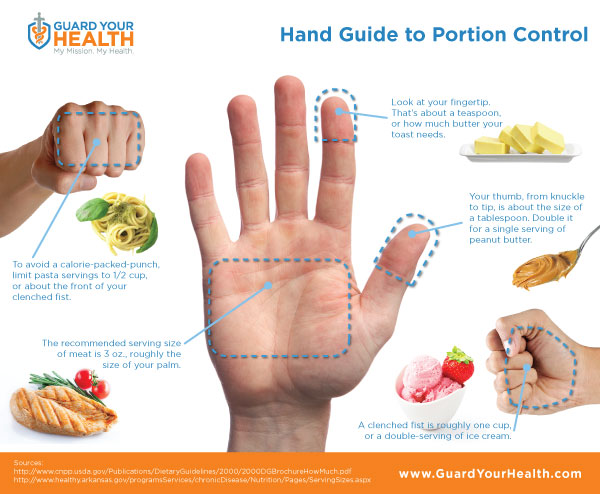
serving size

  1. Change Your Plate Color

According to a study conducted at Cornell University, you can cut your serving size by 20 percent when opting for a contrasting plate color instead of for a plate whose colors blend in with your meal’s color.

Next time you sit down to a meal, make sure that your food color and plate color are different from one another. Many experts recommend using blue plates, but at the very least make sure your plate doesn’t match the color of your meal.

  1. Turn Off the TV

According to a study from the University of Massachusetts, eating in front of the TV leads to consuming more than 300 extra calories. That’s because if you’re busy watching TV, you’re more likely to be so distracted that you devour an entire plate quickly without thinking about whether you’re satiated or not.

Create a distraction-free eating environment. Turn off the TV, put away your phone, shut down Facebook and enjoy your meal.

  1. Find a Healthy Meal You Love and Eat it Over and Over Again

Come up with a list of low-calorie foods that you love and which satisfy your daily energy needs, then mix and match them, so you’re eating the same meals over and over again.

By planning your healthy meals this way, you’ll be less likely to make unhealthy last-minute food choices. This method will also help you spend less time fretting about the foods you need to eat.

  1. Never Shop Hungry

According to a study conducted at Cornell University, eating something healthy before going to the grocery store makes shoppers less prone to buy junk food.

How come this trick works is no mystery. Shopping while feeling full strengthens your willpower and makes you immune to junk food temptations.

As a rule, never go shopping when you’re hungry. Instead, eat a filling meal, some produce or a healthy snack before you hit the grocery aisle.

  1. Read the Labels

Not only will learning this skill give you a better idea of the number of calories you’re consuming, but it will also help you be more aware of food’s nutritional value. Take the time to read the labels, making sure you know how to interpret what you read.

Here is an infographic to provide you with a quick and easy guide.

Photo courtesy of UC Davis and Gkplace.com
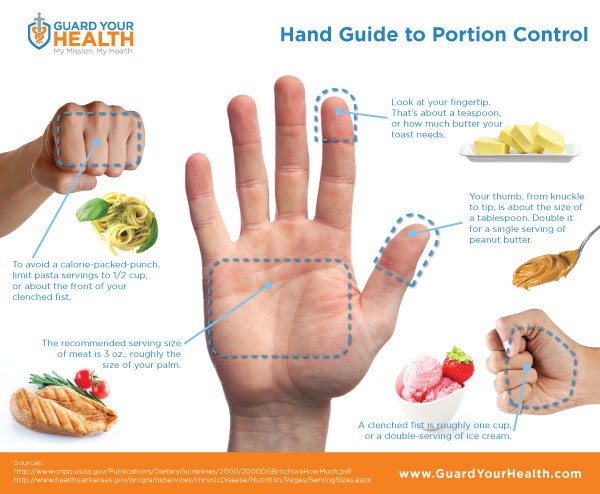
  1. Make a Weekly Grocery List

To make sure you’re putting the right kind of foods in your shopping cart, write a detailed and thorough grocery list. Doing so not only help you get in and out of the store as quickly as possible, but it can also help you decrease impulse purchases and stick to your healthy eating plan.

Use this simple list to stock your kitchen up with healthy food all week (or month) long.

Here’s an infographic to help.

Infographic courtesy of Greatist.
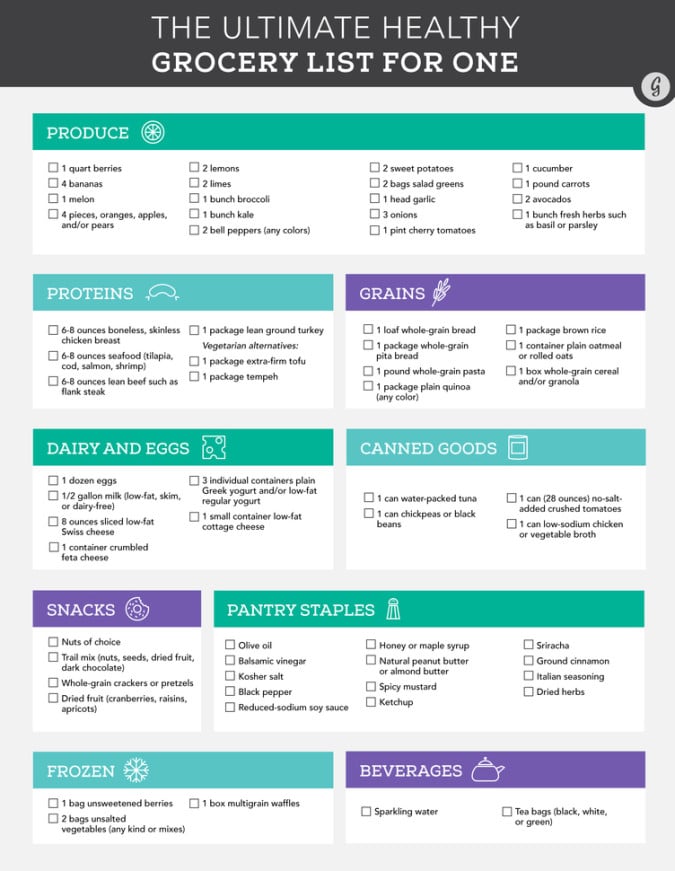
food list for weight loss

  1. Banish Emotional Eating

If you’re more likely to eat when you’re feeling depressed, anxious or lonely, you might be prone to emotional eating. According to research, emotional eating is one of the leading causes of bad food choices.

Emotional eating can compromise your weight loss efforts, especially since the food we crave at those times tend to be sweet, high-calorie, and fatty.

Reevaluate your relationship with the food you eat and learn how to differentiate between real hunger (physical hunger) and fake hunger (head hunger).

  1. Say No to the Bread Basket

Research has found a direct link between regular consumption of white bread and being prone to weight gain.

White bread is bad for you for a slew of reasons. It adds a lot of empty calories to your meals, and it doesn’t keep you feeling full.

Bread is also high in carbs. Eating it in bulk will prevent stored body fat from being used as fuel, hindering your fat-burning process.

The real bad news is that white bread is a staple in most pantries.

So what should you do here?

It’s simple: Replace your white bread with whole grain or whole wheat bread whenever you can.

  1. Banish Junk Food

To set yourself up for total weight loss success, declare your house a junk-food-free zone.

If you have no unhealthy food laying around, you’ll be more likely to stick to your healthy eating plan. In other words, practice the mantra “out of sight, out of mind.”

Purge your kitchen of as cookies, cakes, pies, candy, sugary drinks, biscuits, crisp pretzels pastries, and other sugar-filled, highly processed junk foods.

  1. Stock Up on Healthy Foods

Instead of letting junk food into your home, fill your kitchen cupboards with healthier foods and snacks so when hunger pangs strike, you’ll reach for something that’s good for you.

Here are a few food items you should stock up on:

  • Fruits
  • Unsweetened or unsalted popcorn
  • Baby carrots
  • Nuts and seeds
  • Hard-boiled eggs
  1. Stop Drinking Soda

Research has linked soda to a host of health troubles, including obesity, diabetes, and a plethora of other troubles. And if you believe diet soda is a good alternative, you’re WRONG.

Diet soda is just as bad as regular soda. A study conducted by the University of Texas Health Science Center showed that subjects who drank two cans of diet soda are more likely to gain weight compared to those who didn’t drink the stuff. That’s right – they gained weight instead of losing it.

Don’t drink your calories. Doing so is even worse than eating junk food. Have water instead of soda, and you’ll be thinner and far healthier for it. Here’s  How to measure body fat percentage

  1. Reduce Your Alcohol Intake

A study published in Current Obesity Reports found that alcohol intake increases the risk of weight gain, especially for heavy drinkers.

And according to a UK survey, drinking alcohol weakens willpower and inhibits healthy eating decisions, making you more likely to indulge in high-fat high-calorie foods such as pizza, burgers, and chips.

If alcohol is your diet downfall, then you need to cut it out, or at least, have control over your drinking.

woman trying to lose weight

  1. Drink More Water

Your body uses water to metabolize fat stores, and relies on it for every other process as well.

Water has no calories at all and can help you feel full, making it less likely that you’ll fill yourself up with more food.

Instead of drinking juices and soft drinks, I urge you to start drinking more water.

Shoot for at least 10 to 12 cups of water per day. Drink plenty of water before your workouts, during your workouts, and immediately afterward too.

Make sure your body is well hydrated throughout the day. You’ll feel fitter and healthier when you do so, and dampen any penchant for gorging at the same time.

  1. Drink Water Before a Meal

Chugging a glass of water before a meal will help regulate your appetite, as the water will take up room in your stomach.

Research shows you can lose up to 30 percent more weight simply by having two cups of water before each meal.

Another study from the University of Birmingham in the U.K. found that drinking roughly 16 ounces of H2O 30 minutes before a meal promotes weight loss, without making any other dietary changes.

  1. Drink Green Tea

I believe that green tea is the healthiest drink on the planet, right after water.

Why?

This remarkable beverage is rich in antioxidants, fights cancer and contains brain-healthy compounds and a host of other health-promoting and vital nutrients.

Not only that, according to a study published in the Journal of Nurse Practitioners, green tea can help you reduce your appetite and increase your metabolism, both of which are essential for weight loss.

Add green tea to your diet plan. Stick to two to three cups a day and opt for brewing your own instead of choosing bottled versions to avoid added calories and artificial chemicals and sweeteners.

Remember, adding sugar and cream to your tea will wipe out any weight loss benefits, so get used to drinking your tea with no sweeteners or adornment.

  1. Snack Smart

Dumb snacking— and especially snacking on high-sugar, highly processed foods with little or no nutritional value — can compromise your weight loss goals.

Smart snacking between meals can tame hunger and control appetite, helping you prevent overeating and keep you from making bad food choices when meal time rolls around.

If you snack often, do it the smart way. Healthy ideas include hard-boiled eggs, apples, or a handful of nuts, seeds or dried fruits.

  1. Don’t be a Perfectionist

Practice the 90/10 rule. What’s that?

As a rule of thumb, 90 percent of your diet should focus on healthy food (vegetables, lean protein, and healthy fats) while the remaining 10 percent can be devoted to “cheat meals.”

By adhering to this simple rule, you’ll indulge your sweet tooth and satisfy your cravings without throwing your whole intake out of balance.

Cheat meals are vital for a healthy diet, as long as you are doing them right.

Feel free to cheat every now and then. That’s how you’ll stay sane for the long haul.  Just keep it to one meal, not every meal throughout the entire day.

Exercise Tips

  1. Start Slowly

Whether you’re thinking about starting a running program, hitting the weight room, hiring a personal trainer, or joining a CrossFit class, starting slow is the way to go.

Once you decide on a workout program, start slow and stay within your fitness level at all times.

If you’re a beginner with little exercise experience, start with two to three workouts per week that last at least 30 minutes per session. As you get fitter, you can slowly and gradually ramp it up until you reach your challenge point.

  1. Start Running

Running is one of the best exercises you can do to lose weight and get fit for good. This sport is convenient and sheds mad calories. All you need is a pair of good running shoes, and you’re ready to go.

This whole blog is about running and the many ways you can incorporate it into your life, so why wait?

Here are the resources you need to get started without risking injury or burnout.

  1. Lift Weights

Weightlifting is an INTEGRAL part of any weight loss program. If you’re skipping the strength room, you’re missing out.

Strength training builds muscles, and the more muscles you have, the higher your resting metabolic rate will be. This means you’ll burn more calories, even when you’re not working out. Isn’t that a good thing?

Add at least two strength workouts to your training program.

For the highest calorie burn, train your entire body in each workout. Focus on total-body exercises that challenge the large muscle groups, like pushups, squats, deadlifts, planks, lunges, and pull-ups.

Additional link – Slow running vs fast running for weight loss

  1. Go Swimming

Swimming is a great low-impact option that burns mad calories without putting a lot of pressure on your body.

A 160-pound person can burn up to 520 calories by swimming laps for an hour. The exact number of calories burned depends on a wide range of factors, including weight, age, fitness level, and training intensity.

Swimming uses all of the body’s muscles, so with each kick, push, and stroke you’re performing a mini strength workout for your entire body, especially your glutes, core, hips, arms, and shoulders.

  1. Do Yoga Two Times Per Week

Yoga is another low-impact exercise that can help you melt fat without breaking a sweat. According to research, overweight subjects who rolled out their yoga mat at least once a week for four years lost more weight than those who didn’t take the time to practice.

Yoga can also help you become more flexible, reduces stress and promotes a general sense of health and well-being. I could go and on about its benefits.

Add at least a couple of yoga sessions into your training program, either by following a yoga DVD program or enrolling in a class — make sure to do it with good form. You’re always better off doing yoga with the guidance of a certified professional. Once you nail the form, you can practice it in the comfort of your home.

Additional resource – Guide to running terms

  1. Shoot for 10,000+ Steps Every Day

According to research conducted at Arizona State University, people leading an active lifestyle typically take over 10,000 steps per day.

This is very helpful if you can’t afford going to a gym, or if you’re looking for more ways to be active that don’t involve intense exercise.

10,000 steps a day might seem like too much walking, but it’s not. There are always opportunities to squeeze in more walks during everyday situations.

You’ve got plenty of options.  Meet up with a friend and walk around the neighborhood or park. Go to a museum. Take a walk during your lunch break. If it’s possible, walk to work instead of taking a car or public transportation.

To make sure you’re on the right path, use a pedometer or fitness tracker to keep tabs on your daily steps.

Additional resource – How to reduce sugar intake

  1. Challenge Yourself

Real growth happens when you step outside of your comfort zone. If you stick to the same exercise routine—whether it’s weightlifting, running, swimming, or anything else —you’ll invite boredom and training plateaus.

On the other hand, constant challenges lead to improvement.

I encourage you to challenge yourself to lift more weight, to run farther in the same amount of time, to make even the tiniest and smallest improvement. It all counts.

  1. HIIT it Hard

High-intensity interval training is, by far, the ideal training method to help you burn calories and improve your fitness level. Countless studies have shown HIIT to be effective for weight loss as well as for improving fitness level. It’s like nothing else.

HIIT is all about mixing high-intensity exercise with low-to-moderate intensity exercises.

I have used it. I have done it. And I love it. I bet you will love it too once you get used to it and learn how to do it right.

Here’s your complete guide to the HIIT method.

  1. Sprint It Out

Sprints are the ultimate form of high-intensity interval training. They’re simple, intense, and scalable, so you can always readjust them to fit your needs and training goals.

During sprint intervals, you alternate between running as fast as possible for a set distance and brief periods of slow jogging for recovery.

Here’s how to proceed with a sprint session.

After a thorough warm-up of 10 minutes, perform eight to ten 30-second, full effort sprints at your maximum speed.

Take one minute of recovery between each sprint, then finish your session with a 5-minute cooldown.

  1. Run Some Hills

Hill reps are the next level of track sprints. They’re one of the best resistance exercises for the lower body, helping build strength and speed in your glutes, hamstrings, quads, and calves.

Hill sprints are also safer on your legs and take less time to perform than sprints.

Here’s how to proceed:

Find a steep hill that takes you 20 to 30 seconds to run to the top. Sprint up it as fast as you can, then slowly jog back down to recover.

Perform enough reps of this exercise for the session to last between 20 and 25 minutes, then end your workout with a 5-minute cooldown jog.

Here are five more hill workouts to try.

  1. Rope Training

Rope training is one of the most under-utilized yet most effective training tools for increasing cardiovascular fitness. It speeds up weight loss and improves muscle endurance.

This training system is a fat burning machine. According to a study published in the Journal of Strength and Conditioning Research, battling the ropes for one minute can burn up to 10.3 calories per minute. That translates to 400 to 500 calories in a 30-minute workout.

Battling ropes exercises target almost every muscle in the body, especially the core, the glutes, lower obliques, and abs.

Here’s a battle rope workout routine to try out.

  1. Use Kettlebells

Kettlebells are cannonball-like weights with a handle. They are one of the best training tools you can add to your workouts if you want to get a leaner, stronger body without spending endless hours in the gym.

According to research conducted at the University of Wisconsin, kettlebell training burns as many calories per minute as running a 6-minute mile, amounting to 400 to 500 calories for a 30-minute workout.

Other research has found that kettlebell training can lessen shoulder, neck and back pain by strengthening upper body and core muscles.

Here’s a simple workout routine to try:

After a thorough 10-minute warm-up, do 12 reps of kettlebell squat thrusts immediately followed by 16 reps of kettlebell swings. Then do 12 kettlebell snatches, rest for one to two minutes, then repeat the whole circuit three to four times.

Here’s another kettlebell workout to try.

  1. Stop Doing Crunches

Crunches, sit-ups, and other traditional ab exercises are a waste of time and energy.

Sit-Ups and crunches can lead to lower back pain and may even cause herniated discs. They’re boring and not that effective, especially when performed using bad form.

Instead, do planks (with all of its variations) or total-body exercises such as deadlifts, squats, or floor wipes.

Additional resource – How to rotate running shoes

  1. Do Tempo Runs on the Treadmill

Also known as lactate threshold (LT) or threshold runs, this is a faster-paced workout that’s vital for improving metabolic fitness and maximizing the number of calories burned on the treadmill.

Here’s how to proceed:

First step: Warm up with five minutes of easy jogging,

Second step: Run a mile at 20 to 30 seconds slower than your half-marathon pace. It’s a pace that feels comfortably easy.

Third step: Pick up the pace every mile by 5 to 10 seconds until you’re running the final mile 20 seconds faster than your half marathon pace.

Fourth step: Finish the workout with a slow five-minute jog and some light stretching.

  1. Hill Treadmill Intervals

The second treadmill workout is a hill interval routine.

Performing indoor hill intervals can help you get more out of your treadmill workout by simulating outside hill running. This is vital for increasing endurance and building killer lower-body strength.

Here’s a hill treadmill workout to try out:

First step: Warm-up.

Second step: Raise the incline to three or five percent, and run for 90-seconds at a pace that’s 15 seconds slower than your 10K pace. The pace should feel mildly challenging.

Third step: Recover by jogging slowly for one full minute with no incline.

Fourth step: Raise the incline to five or seven percent and run for another 90-seconds at 15 seconds slower than your 10K pace. Recover for one minute.

Fifth step: Repeat the fourth step three to six times, depending on your fitness level and goals. You could also opt for a steeper incline.

Sixth step: Cooldown.

  1. Embrace Free Weights

According to a study published in the Journal of Strength and Conditioning Research, exercising with free weights instead of machines leads to greater muscle activation.

With free weights, you can target every muscle group in your body without wasting precious time moving from machine to machine or going back and forth between different pieces of equipment.

Also, free weights can help you achieve better symmetry between both sides of your body by forcing the weak side to work unaided by the dominant side. They’re also convenient, scalable and easy to learn.

I could go on and on about the effectiveness of free weights, but you get the big picture.

  1. Start CrossFit

I love CrossFit, and I believe it’s one of the best workout programs out there for helping you to push yourself and keep improving.

There are nine basic exercises in most CF training routines. These include the deadlift; sumo deadlift high pull; shoulder press; push press; air squat (without the weights); front squat; overhead squat; and medicine ball clean.

As you get stronger, you’ll be doing other exercises such as sprints, pull-ups, burpees, sit-ups, box jumps, rowing, gymnastics ring work, and other exercises.

  1. The Tabata Protocol

Dubbed “the fat burning miracle training routine,” the Tabata protocol is a form of high-intensity training scientifically proven to improve aerobic and anaerobic threshold as well as calorie burn.

Studies show that the typical Tabata workout routine can burn 12 to 15 calories per minute.

Here’s a sample workout:

Perform the following exercises for as many reps as possible in 20 seconds, then rest for 10 seconds before moving to the next exercise and doing it as fast as possible for 20 seconds. Shoot for six to eight total rounds, resting one minute between each round.

  • 20 seconds of squat jumps, 10 seconds of rest
  • 20 seconds of burpees, 10 seconds of rest
  • 20 seconds of jumping lunges, 10 seconds of rest
  • 20 seconds of push-ups, 10 seconds of rest
  • 20 seconds of kettlebell swings, 10 seconds of rest

Here’s another Tabata workout routine to try.

  1. Medicine Ball Training

Medicine balls are powerful and can be a great addition to your training arsenal.

What I love about medicine ball exercises is that they’re some of the best and most challenging core exercises you can ever do, building both muscular power and endurance while pushing your cardiovascular system to its breaking point.

Here’s a medicine ball workout to try.

  • Squat to chest pass
  • Suitcase crunch
  • Diagonal chop
  • Russian twist
  • Lunge to rotation

Here’s another medicine ball workout to try.

  1. Add Short Cardio After Each Weight Workout

Engaging in intense exercise after 45 minutes-to-an-hour of weight training guarantees that the activity right after will immediately use up fat as the primary source of energy.

In other words, the window right after your weight workout session is prime fat-burning time. Make the most of it!

Here are three workout finishers to try:

Workout Finisher One

Do three rounds of:

  • Plate push for 30 seconds
  • Kettlebell swings, 15 reps
  • Med-ball thrusters, 15 reps

Workout Finisher Two

Do three sets of:

  • Lunge jumps, 20 reps
  • Burpee, 15 reps
  • Jump rope for one full minute

Workout Finisher Three

300-yard shuttle sprints.

Place two cones or water bottles roughly 25 yards apart, then run as fast as you can back and forth between the cones eight to ten times. Aim to touch the cones each time.

women on treadmill trying to lose weight

  1. Try a Group Fitness Class

If you’re more of an extrovert and enjoy the company of others, consider joining a group fitness class.

These classes are a great way to stay on track, up the ante with your workouts, and meet active and like-minded people. As an added benefit, peer pressure can do wonders for your weight loss journey.

The good news is that there are a wide range of classes available, and you’re sure to find something that fits your budget, fitness level, and training goals.

Different classes offer different exercises and workout routines geared around building strength, endurance, and flexibility.

Try CrossFit, join an MMA class, try a spinning class, or enroll in a boot camp class.  Just find a class you like and attend it consistently.

  1. Try an Outdoor Activity

Working out outdoors not only helps you lose weight, it also provides a lot of health benefits.

Studies show that exercising outdoors boosts vitality, self-esteem, and enthusiasm and lowers levels of the stress hormone cortisol. Braving the outdoors can help you reduce tension, fatigue, and depression.

Here’s a list of outdoor activities and sports that will put your gym workouts to shame:

  • Biking
  • Kayaking
  • Stand-up paddleboarding
  • Skating
  • Frisbee
  • Surfing
  • Rowing
  • Bouldering
  • Hiking
  • Trekking
  • Beach volleyball
  • Rock climbing
  • Badminton
  1. Follow a Workout Plan

If you have a good plan, or even a mediocre plan, you’re more likely to lose weight and achieve your fitness goals than those who don’t have a plan at all.

The best workout plans involve working out three to four times per week, depending on your current fitness level and training goals.

Start your workouts with a proper warm-up, do the workout, then finish with a cool-down and a few stretches.

Never been to a gym? Ask a trainer for some advice, or hire them if you have a budget. It’s important that you start off on the right foot and build up the right way. If you’re unsure where to start or want to find a qualified personal trainer in your area, you can compare personal trainers near you using a comprehensive directory. A directory allows you to compare trainers based on their qualifications, experience, and client reviews, helping you make an informed decision about hiring a trainer that’s right for you.

  1. Start a Workout Journal

In addition to regular fitness tests, one of the best ways I know of measuring your fitness progress (or lack thereof) is keeping track of your training routines and cycles in a workout journal.

I’d go so far as to say that keeping a workout journal is as important as training itself, especially if you’re serious about reaching your full potential.

Get yourself a workout diary and keep tabs of all your activities: training sessions, workout routines, daily miles, weights used, reps performed, number of sets, energy levels, performance numbers, and everything else.

  1. Schedule Your Workout

To ensure training consistency, schedule your workouts the same way you schedule your important work meetings or family events.

By giving your training routine the same level of importance that you give your school deadlines, work meetings, and unpaid taxes, you’ll increase your odds of following through and staying consistent with it—especially if you lead a hectic life.

Spend at least 10 minutes every Sunday night planning your workouts for the week, the same way you would with other obligations.

Choose at least two workouts and schedule them the way you would an appointment that you don’t want to miss. These will be the most important workouts of the week, and should preferably include a total-body strength workout and an intense cardio session.

Jot down the exact time you are going to exercise on your daily calendar, then treat your workouts like an unbreakable commitment.

  1. Exercise First Thing in the Morning

Research shows that people who work out first thing in the morning are more likely to stay consistent with their training programs than those who skip morning workouts.

When you exercise first thing in the morning, you’re done – you don’t have to worry about doing it later in the day. You also get the mental boost of knowing that you’ve accomplished what you need to do for the day while the rest of the world is still asleep.

Exercising in the morning is a great way to help you wake up, boost your energy levels and increase your brainpower and productivity for the rest of the day.

Go to bed 60 to 90 minutes earlier than usual so that you have enough time and have rested enough for a workout first thing in the morning.

  1. Pair Up with a Training Buddy

According to research conducted at the University Of Pennsylvania School Of Medicine, working out with a partner speeds up weight loss results.

The more you rub shoulders with people who support your goals and your vision, the more likely you are to succeed.

Chances are you be more consistent with your workouts when you have a training buddy to motivate you who will hold you accountable for your action.

Whether you’re trying to get into better shape or just want to shed a few extra pounds, be sure to schedule your workouts (or at least some of them) with a workout partner.

  1. Hire a Personal Trainer

If you’re looking to get the most out of every hour you spend working out, hire a personal trainer. They can help you learn proper form, hold you accountable to your goals, devise a smart workout strategy, overcome physical and emotional obstacles, and teach you how to safely adjust your workouts so you can keep on getting real results without hurting yourself.

Once you find a trainer you like, ask them to take you through a fitness assessment to identify your weaknesses and muscular imbalances.  Doing this will help them come up with a well-rounded workout routine that fits your current fitness needs and future goals.

  1. Do What You Love

In my opinion, the best exercise program in the world is the activity you already love doing.

When you choose to do an exercise you love, you’ll have more fun doing it and be more likely to keep doing it over the long haul, so if you like running, then run.

If you like swimming, then swim.

If you like skating, then skate.

If you like boxing, then box.

If you prefer lifting weights, then pump it hard.

If you like them all, then alternate between them as often as you like, for at least 30 to 40 minutes a day.

Do whatever you want. You’re the boss. You’re in charge.

The list of possible workout options available to you is long and varied; you have to find something you love doing.

  1. Practice Proper Recovery

Spending endless hours working out eventually leads to diminishing returns. If your current workout routine doesn’t allow for proper rest, you’re flirting with disaster.

Inadequate recovery hinders your ability to train, and might set the stage for injury, burnout, and serious trouble. Becoming a workout addict will only get you in trouble, so you need to make sure to build good recovery habits.

For starters, space out your hard workouts, especially interval and intense strength sessions, with at least two days of rest. Take as many recovery days as you need, especially when experiencing symptoms of overtraining such as elevated heart rate or chronic soreness and fatigue.

Sleep is also essential for proper recovery.  Aim for at least eight hours of high quality and uninterrupted sleep per night. You can also plan for a recovery week by decreasing your training volume 50 to 60 percent for every four to five weeks of training.

Motivation Tips

  1. Manufacture Motivation

Motivation is of paramount importance, and maybe the most important thing on this list. On your weight loss journey, you’ll need lots of inspiration to help keep your inner fires burning.

What are some ways to keep motivation going strong?

You’ve got plenty of options. Read real-life success stories. Read fitness blogs and magazines and books. Use the reward system and the buddy system. Take before and after pictures. Set weight loss goals and make them public, Use mantras and motivational quotes.

Just be open and try them all.

Here’s a lit of my favorite fitness quotes.

  1. Set S.M.A.R.T Goals

This is a good checklist to consider when you’re about to set goals for yourself.

S.M.A.R.T. stands for Specific, Measurable, Achievable, Results-focused and Time-bound. SMART goals are the right way to go about setting weight loss goals.

Setting smart goals can be the difference between success and failure. They will help keep you focused and motivated.

Here’s what you need to do. Come up with one weight loss goal and one performance goal, and keep these two goals somewhere visible, so you’re reminded of them every day.

For example, your goals might be “Lose 15 pounds in three months” and “Run three times per week for the next three months.”

Over the long term, the best weight loss goal is to lose one to two pounds a week. That may not seem like much, but if you keep doing it consistently, it adds up.

Do it for a month, and you’d shed 4 to 8 pounds.

Do it for three months, and you’d shed 12 to 20 pounds.

You get the picture. It might not be as fast as you’d like it to be, but slow and steady is what will help you win the flab race.

If you’re looking for more tips on how to set fitness goals, check this post.

  1. Go Public With Your Goals

Research shows that if you make your goals public, you’ll be more likely to stick with your healthy lifestyle plan. It keeps you accountable for your behavior and your habits.

Your social circle can encourage you and push you to do your best and never give up.

I encourage you to make your weight loss goals public and commit to giving regular updates to your family members, friends or social circle every week or month.

Also share them on Facebook, Twitter, and other social media platforms.

  1. Enlist Your Friends and Family For Support

The weight loss journey is not a smooth ride, so you’re going to need all the support you can get.

A strong support system can be the difference between success and failure. A study revealed that people who had the support of their social circle lost more weight than those who didn’t.

Let your family and friends keep you motivated and hold you accountable for your actions, making sure you never deviate from your weight loss journey.

At the same time, you need to banish negative people from your life.  They’ll only bring you down and hamper your progress. You’re better off restricting yourself to spending time with people who believe in you and support your goals.

  1. Get Your Partner on Board

When you go on a weight loss journey, your entire life has to change to make the changes you need. If you’re married or live with a partner, your decision will affect them too, so they need to be on board and provide their support.

Your partner’s heartfelt support can make the difference between reverting back to old, damaging ways and accomplishing the fitness goals you’ve set for yourself.

Where appropriate, consider starting a weight loss journey together: it’s a great way to keep each other on track.

One way or another, start preparing healthier dishes together. Eat at home more. Keep each other accountable. Go running together. Join a gym class. Build a home gym.

  1. Use Online Support Networks

A study conducted by Britain’s Medical Research Council (MRC) found that people who joined a weight loss support group lost more weight than those who hadn’t.

A support group can help you talk through your troubles, provide you with practical solutions to your problems, and most importantly remind you that you’re not alone. Look for these online message boards, join one, then open up and talk about your struggles and victories.

Here’s a list of websites to check out:

Spark People

Diet.com

FitLink

Peer Trainer

Weight Loss Buddy

Weight Loss Wars

  1. Weigh Yourself Once a Week

Keeping track of your weight is a good strategy, but obsessing over it is counterproductive. Your weight isn’t everything, and it doesn’t tell your whole story.

Stepping on the scale every day can have a negative impact on you. Your weight will fluctuate from day to day, and if you weight yourself daily, you’ll find yourself in a constant battle of ups and downs.

Most experts recommend that you weigh yourself once a week under the same conditions—preferably at the same time and on the same weekday. The best time is in the morning, shortly after finishing your morning ritual and just before you’ve eaten.
man losing weight

  1. Take Progress Pictures

As I’ve already said, the scale only tells one side of the story. To get a full picture of your progress, you need to start taking pictures of your fitness and weight loss journey on a weekly basis.

Taking before and after pictures is not only perfect for keeping track of your progress, the “before” pictures can also be a huge wake-up call and provide the exact motivation kick you need to make your weight loss vision a concrete reality.

Here’s a short video to show you how to take your progress pictures the right way:

  1. Track Other Body Stats

Weekly weigh-ins and photo shoots are often enough, but if you want a clearer picture of your weight loss journey, start tracking some other important body stats.

Here are the main ones to take and write down:

  • Weekly measurements of your hips, chest, waist, upper arms, thighs
  • Body fat percentage should be checked on a monthly basis using a body fat caliper

Additionally, use fewer objective measures of your progress. Ask another person — preferably a trusted friend or family member —for honest feedback, and check how your clothes fit. Are they looser than before?

  1. Reward Yourself

Rewarding yourself for progress can help reinforce your new habits and provide you with the motivation you need to continue with your journey, so after reaching a performance or weight loss goal, treat yourself to something nice.

Some of the best things you can do to reward yourself include shopping for smaller sized clothes, going to the movies, taking a surfing lesson, taking a vacation to your dream destination, spending a weekend at the spa, reading a book, binge-watching your favorite show, or just sleeping in. It doesn’t matter whether it’s expensive or free, far-flung or in your home, as long as it is something that gives you pleasure and is not about food.

  1. Sign Up for a Race

To keep yourself exercising regularly, consider signing up for a 5K race. This is a perfect distance for beginner runners who are looking to build cardio power and fitness the right way.

You can find plenty of 5K races in your city or cities near you by checking websites like Runners World or Running in the USA for local races and dates.

After signing up for a 5K race, find a training program to help get you ready and fit enough to cross the finish line.

As a general guideline, most 5K training plans last 8 to 12 weeks, so you signing up for one will give you a plan within a reasonable amount of time to get you in shape.

Lifestyle and Mindset Tips

  1. Take Responsibility for Unhealthy Habits

You’re the one in charge.

You choose the script by which you live your life, and you’re the king or queen of your actions. No one is responsible for them but you.

Bad habits or not, they’re yours. You’re the one responsible for changing it. No one else.

You’ve built your habits through repetition, and through repetition, you can break them too.

Take conscious responsibility for your everyday actions—the good, the bad, and the ugly.

Doing so is empowering because it lets you realize that you’re the master of your destiny.

  1. Get Enough Sleep

Lack of sleep will not only make your life miserable, it’ll also make your waistline bigger.

Research study after research study has revealed that sleep-deprived individuals are more likely to be overweight and to suffer from a plethora of health troubles.

Sleep deprivation can boost hunger, muscle loss, and unwanted weight gain, so log at least 8 hours of high quality, uninterrupted slumber each night.

  1. Relax

According to research, stress is a primary cause of weight gain, while relaxation and calm can facilitate healthy weight loss.

When we’re stressed, we seek comfort and emotional release in food, usually by reaching for high-calorie, unhealthy foods.

Stress also increases the release of the hormone cortisol, known as a key culprit behind stubborn belly fat.

To tame stress, try meditating, taking long walks in nature, talking out your problems with a friend, getting enough sleep, getting rid of friction in your life, doing yoga, look into anti-stress supplements or therapy.

The bottom line is don’t ignore your stress. As long as you’re dealing with your it in a positive and constructive manner, you’re in the right place.

  1. Try Meditation

Sitting blissfully on a cushion for endless hours does not burn a lot of calories, but research shows that mindfulness—one of the many benefits brought about by meditation—is key for weight loss and overall health and well-being levels.

Studies show that people who practice meditation on a regular basis are less likely to give in to emotional eating or unhealthy bingeing.

Meditation practice can also help lower high blood pressure levels and helps to manage stress, one of the primary causes of overeating and making bad food choices.

So what you are waiting for? The science backing up meditation is IRREFUTABLE.

Start with short meditation sessions lasting no more than 10 minutes. Sit comfortably, close your eyes, and focus on your breathing. Whenever your mind wanders—and it will have the tendency to do so— bring it back and keep focusing on each exhalation and inhalation.

  1. Brush Your Teeth More Often

If you brush and floss your teeth right after dinner, you’ll find yourself less likely to crave snacks or sweet desserts late at night. This sets you up right for avoiding late night snacking.

It also helps keep your gums healthy and your teeth clean.

Additionally, if you follow this train of thought and brush your teeth after every meal, it will make you less likely to snack between meals.

  1. Check Your Hormones With a Blood Panel

By learning more about your hormonal situation, you give yourself a better idea of the nutritional and lifestyle changes you need to speed up your weight loss and increase your energy and health.

A blood panel can help you assess your levels of the stress hormone cortisol, whether your adrenals are insufficient, whether you’re low in vitamin D3, or whether your cholesterol and blood sugar levels are within the normal healthy range.

  1. Embrace the Cold

Spending time in relatively chilly temperatures can help you burn more calories, even if you’re just sitting around doing nothing. This may sound crazy, but research backs it up.

According to a study published in the journal Trends in Endocrinology and Metabolism, cooler temperatures can increase calorie burn by up to 30 percent, while another study published in the Journal of Clinical Investigations found that people who spend a couple of hours a day in mild cold—approximately 63 degrees F—for a period of six weeks burned more energy than those who spent the same amount of time in warmer temperatures.

Next time you’re thinking about skipping an outdoor workout because it’s too cold, remember that the cold is your weight loss friend.

  1. Handle Social Festivities the Right Way

Studies show that most people gain two to ten pounds during the winter months, and one of the main reasons for this weight gain is the eating festivities during the holidays.

The best thing you can do to counter this effect is to eat before you go to a party. It will help curb your hunger and take the edge off your appetite.

If you want to go all out, you can also bring your healthy foods to make sure you have an alternative to the high calorie, fat-laden dishes your host or hostess is serving.

  1. Watch Your Weekends

It’s totally doable to stick with a healthy diet and exercise plan during the week, but once the freedom of the weekend arrives, a lot of people take a break from their weight-loss resolution. This is a mistake.  Doing so will only set you back and undo all your efforts from the week before.

You need to be conscientious when you’re attending that happy hour after work on Friday, the restaurant dinner on Saturday, and the home-cooked meal on Sunday. Otherwise, your weekends will turn into diet landmines that undo each week’s worth of healthy dieting and exercise.

Eating poorly and skipping workouts from Friday to Sunday add up to a whopping 12 days off a month. Not a good idea.

  1. Be Patient

Patience is a virtue. It helps you reduce stress, control cravings, set the right goals, and most importantly it will keep you consistent, especially when all the odds are stacked against you.

Patience allows you to see beyond the current (unpleasant) moment to a future in which you’ve already achieved what you’re after.

Said in a different way, the more patient you are, the more likely you are to succeed.

Take the time you need to learn about what type of exercise works best for you, as well as about the various foods that offer the best nutrition.

  1. Take Action

“Nothing happens until something moves.”—Albert Einstein.

Every minute you’re sitting around thinking about losing weight, surfing the net for magical diets, or checking Facebook, you’re not doing what’s needed to achieve your weight loss goals.

Regardless of how much you want to do to change your life or lead a healthier lifestyle, nothing will happen until you actually DO something. You can talk about starting a workout program and developing healthier eating habits as much as you want, but nothing will change until you start taking action.

This means you need to get moving NOW.

Here’s what you need to do: make a list of the lifestyle changes you want to see happen, then give yourself time to make each one a part of your life.

  1. Practice Kaizen

The philosophy of Kaizen is all about going after small, continuous improvement. It builds up over time — over weeks, months and years of regular practice.

This approach is the best way to banish short-term and silver bullet thinking.

Achieving a healthy lifestyle is a marathon rather than a sprint. Slow, and steady will win the race.

Embrace the philosophy of small, continuous improvement and aim to get 1 percent better each day. Begin every morning by asking yourself what the one thing is that you can do today to improve your fitness and health? Start super small and go about achieving it.

There are hundreds of these little things, and if you keep adding one a day, they will quickly build up.

  1. After you Lose the Weight, Stick to Your New Lifestyle

Research shows that most people gain back most of the weight they lose less than two years after losing it. This is atrocious.

Losing weight is hard enough. Gaining it back sucks.

Once you reach your target weight, keep in mind that you’ve only won half of the battle. You need to do your best not to revert to your old ways.

I hate to sound like a broken record, but the real secret to reaching your ideal weight and staying at that weight for life is to make a lifelong commitment to the all the diet, lifestyle and exercise habits listed above.

The moment you go back to your old ways is the moment when the pounds start creeping back.

If you’re serious about losing weight and never gaining it back again, you need to understand that your weight and health consciousness doesn’t ever stop.

All of it. The healthy eating. The sleeping. The running. It doesn’t stop.

You need to keep things going, prevent slip-ups and come up with creative ways to spice up your workouts and cope with whatever life throws at you.

  1. Remember: It’s all About Creating a Calorie Deficit

Weight loss is all about creating a calorie deficit.

At this point you surely know that weight loss is a numbers game. Nothing more and nothing less.

If you eat more calories than you burn, you’ll gain weight.

If you burn more calories than you eat, you’ll lose weight.

A healthy weight loss goal is to aim for a 500 calorie deficit per day, and the best way to accomplish that goal is to do a mix of healthy eating and smart exercise.

That’s it. Weight loss, in its basic form, is a numbers game

  1. Find What Works Best For You

Please keep in mind that the subject of weight loss—whether it’s diet, exercise or lifestyle-related—is one of the most controversial topics out there. Most of the tips and strategies I’m sharing with you are based on my own experience and research.

There are some contradictory tips—for instance, intermittent fasting versus eating breakfast—but there are some great ones here too.

What’s important to remember is that nothing is written in stone. Take all the tips with a grain of salt and remember that everyone is different and responds differently to different diet and exercise methods. Just because a weight loss tactic works for someone else, doesn’t necessarily mean that it will work for you.

Feel free to experiment to find what works the best for you.

Bonus Tip: Never Give up

This is where the rubber meets the road when it comes to losing weight and keeping if off for good.

Weight loss resolutions fail because people give up way too often and way too early in their journey.

Whatever you do, please don’t give up.

Don’t give up.

Don’t ever give up.

You’re going to have bad days, weeks, maybe even bac months. But don’t give up.

Shit happens. It’s part of life.

If you fail one day, the next day is a new start. Get up and go after it again.  Change your approach, find a way to do things differently to make it work for you.

Please, please, please don’t let your past mistakes or past failures define who you are. You are much more than your past.

Welcome failure and let it shape your approach and course of action.

Conclusion

Boy, that was a long post! If you’ve made it this far, I applaud you for your commitment. You’re the best.

You rock for taking the time to invest in yourself.

Now go take action on what you’ve just learned, and thank you for reading my post.

Feel free to leave your questions and comments below.

David D.

Please share this post on Pinterest, Facebook, Twitter, Reddit, StumbleUpon, and other social media websites. Help me spread the word.

Featured Image Credit – Byong Wook via Flickr
Top 11 Weight Loss Rules For Runners

lose weight while running

Most people take up running for mainly one reason: To Lose Weight. Truth be told…that’s what got me into it in the first place. Years ago, I was fat and out-of-shape, but after taking up running everything changed for the better.

Just don’t get me wrong. Running does shed mad calories, but it’s not a guaranteed recipe for success.

In fact, unwanted weight gain can happen despite regular training, and I know many of a consistent runner still struggling with their weight. I can’t deny that… No one can… With that said, don’t throw your running shoes away yet. Today you are going to learn how to reach success with your weight loss running routine.

 Weight Loss Rules For Runners

As a result, here are 9 rules for maximum weight loss for runners.

1. Just Do it

It’s simple as it sounds. You just need to do it. But that does not mean that’s going to be easy. Simple does not always mean easy. As a beginner, you need to slowly introduce the habit of running into your life. Don’t worry about mileage nor calorie burn. All you need to concern yourself with is trying to get fit without getting hurt.

That’s the motto you need to keep in mind. Enter The Run-Walk Method Start off with the walk-run-walk method. If you are overweight and/or out-of-shape, begin your running journey by mixing slow running intervals—30 seconds for the seek of the argument—with sets of walking period of no more than a minute. As you get fitter, aim to increase the time you spend running while taking less and less for recovery.

Want more? Check my posts: The 8-Week Beginner Runner Program & Absolute Beginners’ Guide To Running. The good news is that, on average, and in less than 8 weeks, you’ll be able to run for at least 30 minutes without much huffing and puffing.

Nonetheless, once you are passed that mark, your body, being the amazing and smart machine it is, will eventually adapt and get used to that level of stimulus. This means that you won’t be burning as many calories as before. This is what’s known as plateau territory And once that happens, you’d need to up the ante by doing interval training to break through the plateau.

Note – Here’s your guide to calories burned running one mile.

2. Pass the Plateau

Plateaus are part and parcel of any training process. Running for burning belly fat is no exception. That’s why you need to get ready for them and know exactly what to do to get pass them.

Do Intervals Intervals are ideal for shedding belly fat, and boosting metabolism. They are challenging and will increase the amount of oxygen you use to perform and recover, leading to a greater calorie burn.

For me, getting on the interval training track was a big game changer. Not only did interval training help me shed those extra pounds

I was struggling with for some time, but also improved my running on all levels.

If you have never tried intervals before, then don’t be swayed by their power. Instead, be careful and take it gradually. As a beginner, start off your interval run by doing sprints at 70 to 80 percent of your maximum effort for no more than 30-second, then jog for one full minute for recovery. Repeat the cycle 8 to 10 times and end the session with a cool-down.

3. Set Realistic Goals

Once you know your daily calorie needs, it’s time to set goals.

Not any goals though. Your goals have to be realistic. Otherwise, you’ll be setting yourself up for failure.

Losing weight while running is going to take you a while. Many runners, especially enthusiastic beginners, fall into the trap of setting a stereotypical goal weight, regardless of their fitness level, lifestyle, and body type.

Here’s the truth. Everybody and every BODY is unique, and your ideal weight for optimum energy, performance, and health might not be what society says it should.

Since roughly 3500 calories is needed to shed a pound of weight, it’s likely that you’ll drop no more than a couple of pounds per week.

Instead of setting unrealistic goals, go for achievable goals. Aim to lose no more than two pounds a week. As weight can fluctuate on a daily basisit might also be helpful to expand beyond the scale and overall weight to also include goal body fat and a few body measurements to keep motivated and objective on your journey.”

4. Know your Calorie Needs

When it comes to it, weight loss is a matter of doing your math.

Weight loss is a numbers’ game, really.

To lose weight while running, you have to burn more calories than you are taking in; that’s why you must know how many you need in the first place. Here comes the Basal Metabolic Rate (BMR).

Calculate Your BMR The basal metabolic rate (BMR) a rough estimate to set your basic energy needs and describes the number of calories you would need to keep your organs and body ticking each day if you did nothing but sleep for 24 hours.

Here are two resources to help you calculate BMR without much hassle:

Link One

Link Two T

o shed the pounds, you must reduce your total caloric intake, whether by burning calories through running or following sound diet practices.

The best way is to do both for maximum results. As a general guideline, to stay on the safe, healthy side, aim to cut no more than 200 to 300 calories per day. The progressive approach always works way better.
couple running trying to lose weight

5. Set Good Weight Loss Goals

Goals are the specific markers you need to keep your fat loss resolution going strong.

They provide you with clarity, a sense of direction, and will help propel you forward, especially when you feel that all the odds are stacked against you. Henceforth, make sure to write and rewrite them on a daily basis.

Your goals should be challenging, but they also must be realistic. That’s why I always run my goals though a reality check. And you should be doing the same. As a result, before you set that substantial weight loss running goal, ask yourself (and be honest) whether it’s actually achievable. Believe me, it pays, both for the short and long term, to have the right fitness goals.

Additional Source – Does Running Burn Belly Fat?

6. Do Your Own Thing

Don’t fall into the trap of setting a common weight loss goal.

The truth is, we are not the same. I’m different. You are different. Everybody is different. What works the best for me regarding optimal health, energy and performance may not be the same of what works the best for you. That’s why you need to set your own goals.

Have a say in your life. Don’t let society dictate what’s best for you. And keep mind that skinny is not always good, even if it looks good.

Add a Deadline Also, put a time limit on your goals. The sense of timing adds urgency to your goals, making their achievement more likely. A major reason why most don’t make it down the road is the lack of a sense of urgency, a symptom of overthinking the process and not taking action. Classic case of paralysis by analysis.

7. Stay Fueled

To run your best, you need to stay well fueled. But that’s no invitation to overeat. You just need to opt for the right foods that can help you perform your best while shedding the extra pounds for good.

In other words, eating should be about fueling you up, not filling you up, period. Opt for a breakfast that’s high in protein, healthy fat foods like low-fat yogurt, oatmeal and especially eggs (they are my favorite!).

Make sure also to eat plenty of vegetables, nuts and limit your intake of fruits—they score high on fructose, a form of sugar that can lead to weight gain. Steer clear of fat-free processed foods, which often score low on nutrients and high on chemicals. If you want more, maybe you need a radical lifestyle change.

For that case… Try The Paleo Lifestyle Something that worked like a miracle for me is following the Paleo diet ( I know it’s more than a diet ;-). This eating philosophy has helped clean my act when it comes to the everyday diet decision I make.

So it didn’t just help lose weight, it also helped me eat much healthier and develop and maintain healthy eating habits—the cornerstone of optimal nutrition. And most people who tried it have reached similar conclusions. You just need to give your body time to adjust to it. That’s the hardest part.

Additional link – Slow running vs fast running for weight loss 

8. Go Long

Among more than 120,000 runners, the ones logging the greatest amount of weekly mileage were the leanest, according to the National Runners Health Study.

Hence, if you are serious about getting into the best shape of your life—look and endurance wise—aim to extend your weekly mileage.

It’s no secret. The more miles you log in, the more calories you are going to burn off. As a general guideline, an average person burns off about 100 calories per mile while running. As a result, if you opt for a 7-miler run, you’ll burn roughly 700 calories. It’s simple math. Just don’t freak out. You don’t need to opt for long runs every day of the week. In fact, just one long run a week, preferably on the weekend, can help you get the max calories burning benefits.

Any run that’s more than 45 minute can be considered a long run. Nonetheless, this rule is not written in stone. That’s why the exact duration varies from one person to the next.

That’s why you ought to find what works the best for you and build on that. I know this goes against what I said earlier about the power of intervals, but you still need long runs—at least one per week—for a balanced running program.

Additional resource – Here’s how long does it take to lose 100 pounds.

9.Keep a Journal

You cannot improve on what you can’t measure. This quote is one of my favorite management quotes. It also works very well for managing your calorie intake.

One of the best ways to prevent mindless eating and stealth calories intake is to keep track in a journal of everything you’re putting in your mouth.

Doing so might sound tedious, but it pays off. Believe me.

Plenty of studies found that people how monitor their food intake via a food journal lose more weight and keep it off for longer than those who don’t take notes.

A recent study conducted by the National Institute of Health reported that subjects doubled their weight loss when they logged their food intake regularly.

Keeping track of your daily diet choices and reviewing it regularly will help you see and get a bird’s view of where your diet needs improvement.

When you see how that donut or bag of cookies adds to your daily caloric intake, it might be easier to eliminate.

Assessing these details on a regular basis will help glean vital information about your habits and what needs changing. It will also highlight ways you can make healthier choices.

Start by logging everything you eat for at least one month, making sure to keep tabs on important details such as macro breakdown, calorie intake, timing of the meal, etc.

Additional Resource – Here’s how to run faster

10. Add Strength Training

Strength training will not only help you build a leaner and stronger body, but it’ll also help you become a better runner.

In fact, athletes who strength train regularly—two to three times per week—increased their leg strength and boosted their endurance, which is vital for weight loss and top performance, according to study published in The Journal of Strength and Conditioning Research. That’s why you ought to supplement your road work with a proper strength training program.

Additional resource – How to measure body fat percentages

11. Be Patient

If you are anything like me, high expectations and short-term thinking is deeply ingrained within the way you think about the world and how things “ought” to happen. In fact, that’s how we are wired in western civilization.

When we want something we want it now, not tomorrow, not a week from, and definitely not a year from now. And this type of thinking has got us into all sorts of trouble. Check this excellent post on the dangers of instant gratification thinking. Delaying instant gratification is a hard pill to swallow especially when it comes to fat loss expectations.

Blaze Your Own Path Trying to follow in the footsteps of these overnight makeovers is often overwhelming and will only get you frustrated.

To dodge the silver bullet myth, make small changes, one at a time, and build on them. For starters, make running a habit. Then try eating a healthy breakfast every day. And so on. You get the picture.

These habits will eventually add up until you build that desired lifestyle.

Therefore, if you are not there yet, trust just be patient, and it will happen. The universe abides by the law of cause and effect, and as long as you opting for the healthy path (cause), you’ll definitely get to your desired destination.

Additional resource:

How to cut sugar intake

Guide to running terms

Conclusion The key to getting the weight loss results you are after is your speed of implementation. So make sure to start applying the above running guidelines as soon as you can. In the meantime, feel free to leave your comments below, or send me your questions if you need any help. Thank you for reading my post. Image Credit – Ed Yourdon Through Flick Enregistrer