After Your First 10K: What to Do Next (And How to Keep the Momentum Going)

Won’t forget the first time I crossed a 10K finish line.

Not because of the time on the clock—but because of the quiet thought that hit me right after I stopped moving:

“Okay… now what?”

That’s the funny thing about races.

We build them up like the end of something.

The big payoff.

The final exam.

But once the medal’s around your neck and your legs stop shaking, you realize the truth: that finish line isn’t an ending—it’s a doorway.

You don’t come out of a 10K the same person who went into training. You’ve learned how to show up when motivation fades. How to pace discomfort. How to keep going when quitting would be easier. That stuff sticks.

And here’s the part I really want you to hear: you don’t need to rush the next step—but you do want to choose one. Because momentum is fragile. Handled right, it carries you forward. Ignored, it quietly slips away.

So let’s talk about race day, recovery, and what comes after—without pressure, without hype. Just the real runner’s version of what’s next.

Morning Checklist (Don’t Skip This Stuff)

This isn’t the day to wing it.

Stick to what’s worked in training.

Eat the same breakfast. Tie your shoes the same way (double knot, always). Pack your fuel if you need it, and show up early — seriously, nobody wants to stress over porta-potty lines.

Quick warm-up tip: Jog a little, swing your legs, maybe throw in a few jumping jacks. It wakes up your muscles and your nerves. Here’s my warm-up routine.


At the Start Line: Breathe, Smile, and Don’t Bolt

If it’s a big race, line up by your pace group. Don’t feel weird starting in the back — it’s smart, especially if you’re run-walking or easing in. The adrenaline is going to tempt you to sprint. Don’t. Hold back. Stick to your plan.

Tell yourself:

“I can always speed up later. Blowing up early? That’s way harder to fix.”


During the Race: Run Smart, Stay Present

  • Stick to your run-walk or pace plan.
  • Ignore the passers in mile 1 — most of them are going too hard.
  • Check your effort, not just your watch. A 10K is short enough to go wrong quickly if you start out hot.

If you hit a water station and it’s hot out, don’t just drink — pour a little on your head or neck.

That cooling trick helps more than you think.

By halfway, give yourself a fist pump. You’re doing this. And if you’re fading? Mentally hit reset and say, “Alright, it’s just a 5K left — I’ve done that plenty of times.”


The Final Stretch: Empty the Tank

Mile 4–5? That’s when it starts to suck. That’s also where you dig in and show what your training was for. Pull out your mantra. Visualize one of your tougher training runs — you’ve done this before.

Last half mile: If you’ve got anything left, let it rip. Drop the walk breaks if you can, or keep your pattern and push that final run segment with everything you’ve got.

Pro tip: When you see the finish line, the pain always dulls a little. Ride that wave. Soak it in. You earned it.

Still want more? Check my 10K pace guide.


After the Finish: You Did the Damn Thing

You crossed that line. You’re a 10K runner now. That’s no small thing.

Only a small percentage of people ever run a 10K, let alone train for one.

If there’s a medal, wear it loud and proud. Smile for the camera. Hug your training partner.

Cry if you feel like it — that’s just pride leaving your eyeballs.

Cool down: Walk around for 5–10 minutes. Don’t collapse on the ground (tempting, I know). Stretch lightly — especially calves and hamstrings.

Grab some water, eat something, and check in with your body:

  • Do you feel strong?
  • Drained?
  • Fired up for what’s next?

All of that is valid.

Take a selfie. Post it. Own it. You’re not a beginner anymore.


What’s Next After Your First 10K?

Here’s the truth: Your first 10K today? It’s just the gateway to new goals. You’ve got options:

➤ Get Faster. Now that you’ve done the distance, maybe you chase a time goal. Shave 2–3 minutes off. Practice pacing. Throw in some intervals.

➤ Go Longer. 10K to half marathon? Totally doable. If the race lit a fire in you, start building volume slowly — you’ll be surprised how far you can go.

Hit the Trails. Bored of the road? Try a 10K trail race. New scenery, different challenge, and a great way to break the routine.

➤ Join a Running Crew. Find a local run club. You’ll level up fast running with people just a little faster or more experienced than you. Plus, it keeps you accountable.

Step One: Recover Like a Pro

Days 1–3: Respect the soreness.

Even if you feel like a superhero post-race, your muscles are going to remind you otherwise tomorrow morning. Quads, calves, maybe even your core—they’re going to be tight. That’s normal.

Here’s how to handle it:

  • Walk. A little movement helps blood flow and speeds recovery.
  • Stretch gently. Don’t force anything.
  • Swim or bike easy if you must move.
  • Don’t rush back into running. A couple days off won’t kill your progress—it’ll protect it.

Oh, and one more thing: don’t be surprised if you feel a little off emotionally after the high of race day. That “post-race blues” feeling? Totally normal. You’ve just come down from a peak.

Ward it off by doing something fun (that isn’t running), and remind yourself what you accomplished—scroll your race pics, write a short recap, log it in your journal or app. Lock in that win.


Step Two: Reflect and Learn

Once your legs stop screaming, take a few minutes and ask yourself:

  • What worked?
  • What didn’t?
  • What would you do differently next time?

You’re not judging yourself—you’re collecting data.

Did you feel strong but your feet were killing you? Might be time for better shoes.

Legs gassed out early?

Maybe you need some strength work.

Started too hot? There’s your pacing lesson.

Every race teaches you something. Write it down. Use it. The next one’s going to be better because of it.


Step Three: Set the Next Target

The worst thing you can do now is… nothing.

Without a goal, it’s easy to slide back. So pick your next challenge. Doesn’t have to be huge—but it does need to keep you moving.

Option 1: Improve Your 10K Time

Now you’ve got a baseline. Next time, aim to knock a couple minutes off. How?

  • Add some intervals or hill work
  • Start shortening your walk breaks, or increasing your run intervals
  • Follow a more structured training plan or join a group

Goal idea: Beat your 10K time in 8–12 weeks. Simple, measurable, and satisfying.


Option 2: Step Up to a Half Marathon

Think you might want more? Go for it. 13.1 miles is a big jump, but it’s doable—and your 10K training has already built the foundation.

Most folks take 3–4 months to train for their first half. It doesn’t mean running every day. The run-walk method works really well for the half, especially if you like having a rhythm.

If the thought of “doing more” excites you—not scares you—you’re probably ready.

Fun fact: Over 2 million people finish half marathons in the U.S. each year. You could be one of them.


Option 3: Try a New Flavor of Running

Not everything has to be about time or distance. Maybe you want to mix it up:

  • Hit the trails—10K on dirt feels completely different. Slower pace, more scenery, more zen.
  • Sign up for a fun run—mud runs, color runs, obstacle races—good vibes, no pressure.
  • Do a relay race with friends. Something like Ragnar where you take turns running. Wild experience, great stories.

Sometimes adding variety is the key to staying excited.


Option 4: Join a Running Group

If you haven’t already, now’s the time. A group can push you to train better, show up when you’re dragging, and help you celebrate the wins.

Bonus: they’ll get your excitement. Non-runners don’t always get the joy of finishing a 10K—but fellow runners? They feel it.

A lot of groups have “next level” programs too—whether it’s getting faster or stepping up to a half.


Option 5: Give Back or Pay It Forward

You’re now the person who did the thing. Someone around you is watching. Maybe it’s a co-worker, a sibling, a friend who never thought they could run. Inspire them.

  • Sign up for a 5K or 10K together.
  • Share your story.
  • Volunteer at a race. You’ll never look at aid stations the same way again once you’ve been the one handing out water.

Running becomes way more fulfilling when you use it to lift others up.


Option 6: Keep the Momentum Going

Some folks crush a 10K and then… vanish. Don’t let that be you.

Even if your next goal isn’t huge, keep something on the schedule. Maybe that means:

  • Running 2–3 times a week for health
  • Cross-training (bike, swim, lift)
  • Mixing in strength or mobility

Just stay consistent. It’s easier to maintain fitness than rebuild it from scratch.

Pro tip: If something hurt during training, fix it now. Address nagging injuries, tweak form, swap shoes, see a PT if needed. Post-race is a great time to bulletproof your body for the next goal.

If You Ever Have to Step Back, That’s Okay Too

Running isn’t a straight line. Injuries, burnout, life—stuff happens. And when it does, remember this:

“Walking doesn’t mean you’re not a runner—you’re training smart.”

Even experienced runners return to run-walk after layoffs. Some even prefer it as they age. I know 70-year-olds finishing marathons using walk breaks and smiling through the whole thing.

Running is a relationship. Sometimes it’s fast. Sometimes it’s slow. But it always teaches you something—grit, patience, resilience. Even when you’re not improving, you’re growing.

🎯 One last challenge:

Keep moving. Some runs will feel awesome. Some will feel like sludge. That’s normal. Just show up. Keep chasing what lights you up.
Run your own race — and when you get there, set a new one.

Celebrate this milestone. You only finish your first 10K once. But now the road ahead? It’s wide open.


What’s your next goal?

🏁 Another 10K? A half? Just more consistency?

Drop a comment — let’s plan it together.

You’ve come this far. Let’s see how far you can go.

Master the 10K: The Complete Runner’s Guide to Owning the Distance

Let’s get something straight — the 10K isn’t some “halfway point” between a 5K and a half marathon.

It’s its own beast. The kind of race that’s just short enough to demand speed, and just long enough to punish you if you fake the fitness.

Run it too easy? You’ll finish wishing you’d pushed harder.

Go out too hot? You’ll be praying for the finish line before you even see 7K.

The 10K doesn’t care if you ran a marathon last month or smashed a 5K last week — it will find your weaknesses.

That’s exactly why smart runners use the 10K as a training weapon. Master it, and you sharpen every tool in your kit: endurance, speed, pacing, grit.

In today’s guide, I’ll walk you through every piece of the puzzle — whether you’re lacing up for your first 10K or chasing a sub-40 finish. We’ll talk workouts that work, the mental game, race-day execution, and even the little details like taper, gear, and fueling that can make or break your run.

Bottom line: this isn’t just about crossing a finish line. This is about learning to race with purpose — and to run smarter, stronger, and faster than ever.

Here’s what we’ll cover:


Table of Contents

  1. Why the 10K Is the Smart Runner’s Distance
  2. The Anatomy of a 10K Race: What Happens to Your Body & Mind
  3. Runner Types: Grinder, Speedster, Tactician — Train Your Way
  4. Building Your 10K Season: Macro & Micro Training Cycles
  5. Racing Smart: Practice vs. “A” Races
  6. The 10K Training Toolbox: Speed, Stamina, Long Runs, Recovery
  7. The Mental Game: Beating the 6K Crisis & Finishing Strong
  8. Gear, Shoes & Tech: What Matters, What’s Hype
  9. Fueling for the 10K: Before, During, and After
  10. Strength & Cross-Training: Staying Fast and Injury-Free
  11. The Taper: Show Up Sharp, Not Sluggish
  12. Level-Specific Training Plans
    1. Couch to 10K
    1. 10K Under 80 Minutes
    1. Breaking 60 Minutes
    1. Sub-50 10K
    1. Chasing Sub-40
  13. Race-Day Execution: From Warm-Up to Kick
  14. Common Mistakes & How to Avoid Them
  15. Beyond the Finish Line: What to Do After Your 10K

Why the 10K Is the Smart Runner’s Distance

Let’s get something straight — the 10K is not just some middle-of-the-road, in-between race. It’s not the “lite” version of a half marathon, and it’s definitely not a long 5K.

The 10K is its own beast. And it’s tougher — and smarter — than most runners give it credit for.

Lemme tell you more my friend…

The Overlooked Powerhouse

Back in the day, the 10K was the race for everyday runners.

But now? Everyone’s either chasing a PR in the 5K or racking up medals in half and full marathons.

The 10K gets forgotten. It’s the middle child — stuck between fast and long.

But you know what? That’s exactly why it’s so damn powerful.

Training for a 10K forces you to get better at everything — not just speed, not just distance, but both.

You want endurance? Gotta earn it.

You want to kick strong in the final mile? You better build that gear.

It’s a race that exposes your weaknesses — all of them. And that’s why it makes you a stronger, smarter runner.


Tactical As Hell

Don’t let the distance fool you. A 10K isn’t “short and sweet.”

It’s long enough to hurt, but short enough that if you blow the pacing, there’s no time to recover. Go out too fast? You’ll be praying for the finish line by 6K. Go out too slow? You’ll leave gas in the tank.

It’s like running on a knife edge.

You’ve got to pace with intention. Know exactly when to hold steady, when to lean in, and when to go full send.

Runners who treat the 10K casually get humbled hard — usually somewhere around 7K when their legs are cooked and the end feels just far enough away to make them doubt everything.


The Anatomy of a 10K Race

So what exactly is going on inside your body during a 10K? Why does it feel fine for 15 minutes… then suddenly like someone turned up the pain dial?

Let’s break it down, runner-style.


Aerobic Engine, Anaerobic Burn

You’ve probably heard the 10K is “mostly aerobic.” That’s true — about 85–90% of your energy is coming from oxygen-fueled metabolism. But don’t let that lull you into thinking it’s just a long, steady jog.

Because at race pace, you’re flirting with your lactate threshold — that fine line where your body starts pumping out lactate faster than it can clear it. You’re right on the edge the entire race. And if your aerobic base isn’t strong? That edge becomes a cliff real quick.


Enter the Pain Cave – Around 7K

There’s a moment in almost every 10K — usually around 6 or 7K — when things get real. Your breathing gets ragged. Legs start to tie up. Your brain starts whispering, “You sure you can hold this?”

This is the pain cave — and it’s where races are made or lost.

Physically, lactate is piling up. You’ve gone from “managing discomfort” to “hang on for dear life.” Mentally, it’s a war zone. Doubt creeps in. But here’s the truth: the best runners train for this. Not just the body — the mind too.


Elites vs. Everyday Runners: It Hurts More for Us

Here’s a twist most folks don’t know: 10Ks actually hurt more for slower runners.

Why? Because elites have such huge aerobic engines, they can cruise just below threshold for most of the race. They’re running fast, yes — but still aerobic. Then they unleash the pain in the final K.

For everyday runners, it’s different. You’re likely hitting threshold sooner — maybe even halfway through — and grinding in anaerobic land for a loooong time. That’s why the last miles feel like a death march.

Science Check: Elites can race around 85–90% of their max heart rate aerobically. Most of us start to redline around 75–80%. That means we’re huffing and puffing sooner and suffering longer. But that’s also why threshold training works — it bumps that redline higher.


The 10K Ain’t Just Aerobic—It’s a War Zone

Here’s the truth they don’t put on race posters: The 10K is a brutal fight. Sure, on paper it’s “mostly aerobic.” That sounds nice and scientific.

But any runner who’s pushed hard over 6.2 miles knows better.

By the final third, it’s not just about oxygen. It’s about pain. And who can handle it.

Your aerobic engine’s redlining, but it’s not enough. Lactate’s building up like toxic sludge, your legs are on fire, and your brain starts whispering, “Hey… maybe we should walk this out.” That voice gets louder with every stride.

And this is where the real 10K battle begins: Your muscles are drowning in acid, your form’s wobbling, and mentally, you’re hanging on by a thread.

I’ve had races where 7K felt like I was dragging cinderblocks instead of legs—breathing ragged, eyes half-glazed, everything screaming slow down.

If you’ve been there, you know what I mean.

But the smart 10K racer? They’ve trained for this very moment.

They’ve hammered tempo runs and cruise intervals until their threshold rose like a tide. They’ve practiced running on tired legs, teaching their body how to stay smooth when things go sideways. They’ve rehearsed mental comebacks—visualized the pain, welcomed it, and built the grit to say “Not today.”

Because the 10K is both engine and attitude. It’s raw physiology meets mental warfare.

You burn through glycogen. Then lactate drowns your legs. And the whole time, your brain’s trying to protect you from the suffering. Your job is to push through it.

Don’t feel ready for the 10K? Check out my guide to see whether you got it or not yet.


Wanna Go Deeper?

Want to know why some runners seem to thrive in that pain zone? Search phrases like:

  • “Lactate accumulation and pacing failure in 10K runners”
  • “VO2max vs lactate threshold in 10K performance”

Science backs it up: strong threshold = better survival in the late miles. Well-trained runners hold higher percentages of their VO₂max longer—which means they suffer later and less. And when they do suffer, they know how to keep it together.

But even without reading the studies, your legs already told you the truth: the 10K is a threshold test. Run too hard too soon? You drown. Run scared? You leave time on the clock.


What Kind of 10K Runner Are You?

Not every 10K warrior fights the same. Some grind, some surge, some play chess. Here’s how to figure out your style—because generic plans don’t cut it when you’re trying to PR.

The Grinder

You’re all engine, baby. You come from longer distances or just love the grind. You don’t have a scary sprint, but you can hold a tough pace and break people with consistency.

  • Strengths: Endurance, steady pacing, mental toughness.
  • Weaknesses: Struggles with sudden pace changes or late kicks.
  • Race Style: Negative split or even pacing. You outlast people.

Grinders shine on tough courses—heat, hills, wind? No problem. The harder it gets, the more runners you pass.

The Speedster

You’re the fast-twitch freak. You’ve got a gear most don’t. Maybe you ran track, maybe you just have wicked wheels. You surge, you kick, you break souls with speed.

  • Strengths: Speed, power, handling fast intervals like a champ.
  • Weaknesses: Endurance can be a limiter. If you fade late, this is why.
  • Race Style: Fast start or tactical surge + big final kick.

Speedsters love tactical races—they know when to strike. But if the distance isn’t backed by base, it’s a gamble.

The Tactician

Your weapon is your brain. You know exactly when to push and when to hold back. You’re the type who drafts smart, runs tangents, and beats people who might be technically “faster.”

  • Strengths: Smart pacing, mental strength, reading the race.
  • Weaknesses: If speed or endurance is undercooked, plans collapse.
  • Race Style: Strategic. You’re a sniper, not a shotgun.

Tacticians can pick apart races with precision. If you’ve ever outkicked someone who had a faster 5K PR, that’s your superpower.


Not Sure What You Are?

Check your training and race logs:

  • If your 5K and 10K times match up well (like McMillan or VDOT say they should), you’ve probably got grinder stamina.
  • If your shorter distances are great but you fade in the 10K, you’re likely a speedster who needs more base.
  • If you beat people who have faster solo time trials? You’re a tactician. You show up when it counts.

Train Like Your Type: Ditch Cookie-Cutter, Run Smarter

Let’s cut through the noise—most training plans out there? Too generic. They don’t care if you’re built like a diesel engine or a dragster. But you should.

Once you know your runner type—Grinder, Speedster, or Tactician—you can train smarter, not harder. It’s like tuning an engine. Everyone’s got horsepower, but how you fine-tune it makes all the difference.

Grinders: Strong Legs, Slow Gears

You’ve got the diesel engine. Long runs? No problem. But if you’re dodging speedwork because you think your endurance makes up for it… you’re leaving gains on the table.

Your Fix: Keep all the threshold runs, tempos, and long grinds—that’s your bread and butter. But add in the sizzle: strides, 200m repeats, short hill sprints. These help your nervous system learn how to turn over quicker, which is huge come race day.

Why? Because even in the 10K, research shows anaerobic speed reserve matters. That final sprint? That extra gear? You build it in training, not by accident.

Coach’s Prescription: One short speed session a week—think 6×200m or 8×100m strides—won’t wreck you, but it’ll make your 10K pace feel easier. And that’s the game.


Speedsters: Quick Twitch, Short Fuse

You’ve got the wheels—but you burn through fuel fast. You can blaze a 5K, maybe even rip some 400s, but holding the line at 10K pace? That’s where you fade.

Your Fix: Build the engine. That means cruise intervals, threshold runs, longer tempos. Basically, stuff that teaches you to stay uncomfortable… longer.

You don’t need to hammer raw speed workouts all the time. You already have speed. What you’re missing is sustained effort. Endurance.

Coach’s Prescription: 1–2 days a week of stamina work. Think 5×1K at 10K pace, long progression runs, or tempo blocks. Higher mileage (or more cross-training volume) helps too—just don’t trade your strength for gas mileage.


Tacticians: Smart as Hell, Sometimes in Your Head

You live for strategy. You know when to surge, when to tuck, when to kick. But let’s be real: sometimes you’re so deep in the race chess match, you forget to build the legs to match the mind.

Your Fix: Figure out your physical bias—are you more speedster or grinder? Then train accordingly. Use your mental edge to plan race-specific sessions. Want to surge mid-race? Practice that in fartlek runs. Planning to negative split? Start some long runs slow and hammer the finish.

Visualization’s great—but the body’s got to cash the checks your brain writes.

Coach’s Prescription: Don’t just think about racing—train for it. Race-pace workouts, negative split runs, simulations. Make your body match your brain.


How to Build a 10K Season That Works

Think in Seasons, Not Scraps

You want to keep improving in the 10K? Start thinking like an athlete, not a hobby jogger. No more “train one week, race the next” chaos. Build a training season.

That’s how the pros do it—and guess what? It works for you too.

Instead of cramming in races every few weekends, you lock in a 12–20 week cycle with a clear goal: peak for one big race. Everything builds to that day.

The Four Phases of a Real 10K Season:

  1. Base Phase (6–8 weeks): High mileage. Easy runs. Strides. Build the foundation.
  2. Specific Phase (6–8 weeks): Add tempo, threshold, goal pace intervals. Sharpen the sword.
  3. Taper (1–2 weeks): Pull back the miles. Keep the pop. Don’t lose the snap.
  4. Race Peak: You show up rested, sharp, and ready to smash it.

It’s not magic—it’s structure. And it beats the heck out of training randomly and wondering why your time’s stuck at 47:00.


Macro vs. Micro: Zoom In AND Out

This is where most runners screw it up.

  • Macrocycle = the big picture (3–4 month block).
  • Microcycle = your week-to-week setup.

A good macro sets the tone. You start with mileage and easy stuff, move into tempo work, then intervals, then race sharpening.

A good micro gives your week rhythm. You need hard days spaced out with recovery. Two quality sessions (intervals + tempo) + long run = gold standard. Everything else supports that.

The mistake? Doing the same thing every week—or worse, cramming everything into one week and never recovering.


Don’t Just Race—PEAK

Let’s call this what it is: racing a 10K every month is a plateau waiting to happen. Each race pulls you out of training, forces recovery, and resets your rhythm.

Want a breakthrough? Do less. Race smarter, not more often.

Pick 1–2 goal 10Ks per year. Build your entire season around them. The rest? Use tune-up races strategically—or skip ’em.

You’ll be amazed what happens when you stack 8–12 weeks of consistent, progressive training with no distractions. Your body actually absorbs the work. That’s when PRs get crushed.


Practice Races vs. “A” Races: Know the Difference, Run Smarter

Don’t hide from racing just because your goal race is still weeks away. In fact, tossing in a few practice races can sharpen your edge big time. But here’s the trick—you’ve gotta know which race is a rehearsal, and which one is your main event.

A practice 5K or 10K? That’s a workout in disguise.

You don’t taper for it.

Maybe you roll in a little tired from training. Maybe you take it slightly easy for a couple days beforehand—but you’re not babying yourself.

This kind of race is perfect for testing gear, trying out your pre-race breakfast, or practicing pacing—like starting conservative and finishing strong. You’re not chasing a PR here. You’re building race instincts and learning what works (and what doesn’t) when things get real.

Your A-race, though? That’s the one you roll out the red carpet for. You taper. You scout the course. You set race-day routines and lock in the mental game. You’re going in fresh, sharp, and ready to empty the tank.

The real key here is mindset: treat the tune-ups like part of training, and the A-race like your chance to go full-send. Knowing the difference keeps the pressure off the warmups and lets you save the fire for when it counts.


12–20 Week Training Plans: What’s the Right Prep Window?

So how long do you need to train for a 10K? The answer is classic runner-speak: it depends.

If you’re coming off the couch, go big—20 weeks. Start with walk-jog combos, build your base slow, and avoid injury.

New runners often land in that 12-week sweet spot, giving you just enough time to build fitness and get comfortable running consistently.

Already running regularly? You can tighten it to 12 weeks and still make solid gains.

Competitive folks or runners chasing a PR often opt for a 16–20 week cycle. That lets you layer in everything: base building, speed, stamina, and a taper. Bonus: you can toss in a recovery week or two mid-cycle so you don’t flame out.

Legendary coach Jack Daniels—guy’s like the Yoda of running—suggests a full 24-week buildup as ideal. That’s gold if you’ve got the time and consistency. But let’s be real—most of us don’t plan that far ahead.

Bottom line: pick a timeline that fits your life. But give yourself at least 8–10 structured weeks. 12–16 is even better. And consider chunking it into 3–4 week blocks that each target a different training focus.


Race Less, Train More: The Contrarian Advantage

Races are fun. Medals, crowds, adrenaline, IG stories… I get it. But here’s the cold truth—racing every weekend isn’t how you hit a PR.

In fact, runners who stop over-racing often see big breakthroughs. Why? Because they finally get time to string together real training blocks without the constant taper-recover-taper cycle killing their progress.

Think about elite marathoners. They race twice a year max. They train, peak, recover—then do it again. Sure, a 10K isn’t as draining as a marathon, but the same logic applies: if you’re racing every weekend, when exactly are you training?

Smart racing means picking one or two 10Ks each season and going all in. That way, those races mean something. They motivate you. You stay hungry.

Want to dig deeper?

Look up terms like “10K periodization” or “frequent racing vs peaking”—you’ll find a ton of coaches and experienced runners saying the same thing: fewer races, better peaks.

I’ve seen it in my own running and in coaching others. When you learn to trust the process, the results show up.


Your 10K Training Toolbox: What Actually Works?

Let’s break down the workouts that build a monster 10K engine. You need more than one gear to run fast and smart. Here’s how to put the right tools in your box:


1. Speed Workouts – Raising the Ceiling

You want to run faster? You’ve gotta run fast.

Speed workouts push your VO₂ max—your top-end aerobic engine. We’re talking interval sessions like:

  • 6 × 800m @ slightly faster than 5K pace, with equal jogging recovery
  • 12 × 400m @ 3K pace
  • 5 × 1000m @ current 5K pace
  • Ladder workouts (400-800-1200-1600-1200-800-400) with pace changes

Hill sprints are another secret weapon—8 × 15-second all-out sprints up a hill builds serious power and strengthens those legs against injury.

Important note: Don’t overdo speed. Once a week is plenty. These sessions should leave you a little wrecked—in a good way. You’re training your body to handle discomfort so that 10K pace feels tame on race day.


2. Stamina Workouts – Dialing In That Cruising Gear

If speed raises your ceiling, stamina workouts move the whole house higher.

Your 10K pace sits just above your lactate threshold—that tipping point where running shifts from comfortably hard to downright brutal. If you push that threshold up, suddenly race pace feels smooth.

These workouts include:

  • 20-minute tempo run @ threshold pace (the pace you can hold for about an hour)
  • 4 × 1 mile @ threshold pace with 1-min jog
  • 2 × 15 minutes @ 10K effort minus 10 sec/mile, 3-min jog between

Coach Greg McMillan swears by hitting this zone from all angles—some workouts just below, some dead-on, some slightly faster. It gives your body a full range of threshold stimulus and builds insane aerobic strength.

The goal? Learn to lock in and hold a hard pace without blowing up. These are the workouts where confidence gets built.


3. The Long Run: How Far for a 10K?

Alright, let’s clear something up. Just because you’re training for a 10K doesn’t mean you get to skip the long run. This isn’t just for marathoners. Long runs are your aerobic engine builders—and even for a 6.2-mile race, that engine better be solid.

Here’s the play:

  • Beginners: Work your way up to 6–8 miles (10–13K). If the thought of that makes you want to cry, don’t stress—it’s a buildup. Start where you are, but keep showing up.
  • Intermediates: 8–12 miles (13–20K) is a sweet spot. That gives you real staying power on race day and helps those faster sessions feel smoother.
  • Advanced runners: 14–16 miles now and then is fair game, especially if you’re toying with stepping up to a half—or you just like pushing your limits.

If you can knock out 10–12 miles on a weekend, racing 6.2 suddenly feels like a cruise. Confidence goes up. Fatigue resistance climbs. But don’t get cocky: that doesn’t mean go long and trash your legs before Tuesday’s intervals.

Most solid 10K plans cap the long run at about 8–10 miles. Enough to build stamina, not so much that you’re hobbling all week.

Pace? Easy. Chill. Talk-test level. If you’re more advanced, maybe finish the last 2 miles at a steady, moderate pace just to throw in a little bite.

And treat the long run like a dress rehearsal. Wear what you’ll race in. Test your gear. Practice fuel and hydration if you’ll need it come race day.

Think of the long run as your foundation. Everything else—speed, intervals, tempo—gets built on top of it. Don’t skip the damn foundation.


4. Recovery Runs & Zone 2: Your Secret Weapon

Here’s a secret most new runners screw up: slow running makes you faster.

I know—feels backward. But trust me. The biggest gains in 10K training don’t come from hammering every workout.

They come from the Zone 2 stuff.

The easy miles.

The “could-talk-your-ear-off” pace.

Zone 2 is roughly 60–70% of your max heart rate. For most of us, it’s the pace where you’re cruising, breathing steady, maybe even bored.

Perfect.

That’s where your aerobic base gets built.

We’re talking:

  • More capillaries delivering oxygen.
  • More mitochondria (those little energy engines).
  • Better fat-burning, better recovery, better everything.

And yeah, that means most of your weekly mileage—like 75–80%—should be in this zone.

Don’t roll your eyes. Even the elites do this. There’s a reason they’re logging monster weeks at paces you could jog next to.

Biggest mistake? Running your easy days too hard. You’ve seen that guy. Every run is a race. Then he wonders why he’s injured or stuck at the same pace year after year. Don’t be that guy.

Make your easy runs easy. A recovery run after intervals might be a chill 30–45-minute jog. No hero pace. No GPS stress. Maybe even throw in a few walk breaks. Whatever it takes to keep your ego in check and your legs fresh.

Run with a slower friend. Leave the watch. Hum a tune. You’re not wasting time—you’re building durability.


5. Sample Week Breakdown – Real Training for Real Runners

Let’s put it all together.

Here’s what a solid training week can look like depending on your level.

Use these as guides, not gospel.

Life gets in the way. The key is consistency over perfection.

Beginner (Goal: Just Finish or <80 Minutes)

4 runs, 3 rest or cross-train. Total ~10–15 miles.

  • Mon – Rest
  • Tue – 3 miles easy
  • Wed – Rest or brisk walk
  • Thu – 4 x 2 min run / 2 min walk fartlek + warmup/cooldown
  • Fri – Rest
  • Sat – 5-mile long run (easy pace)
  • Sun – 2-mile jog or full rest

Goal here is building the habit. Keep it light. Keep it fun. Fartleks are your intro to speed. Cross-train (bike, swim, walk) if you’re sore or mentally fried. Avoid doing too much too soon.


Intermediate (Goal: Sub-60 10K)

5 runs, 1 cross-train, 1 rest. Total ~25 miles/week.

  • Mon – Easy 3 miles + strides
  • Tue – Quality: 5 x 1000m @ 10K pace (90s rest)
  • Wed – 4 miles easy (Zone 2)
  • Thu – Cross-train (bike/yoga) or rest
  • Fri – 20-min tempo @ threshold pace
  • Sat – 6 miles easy (throw in hills)
  • Sun – 8-mile long run (easy pace)

This plan has structure. Two quality sessions (intervals + tempo), plus a long run. Everything else? Supportive easy work. You’re working both speed and stamina without overcooking.


Advanced (Goal: Sub-50 or Sub-40 10K)

6–7 runs, 1–2 strength sessions. Total ~35–40 miles.

  • Mon – 6 miles easy
  • Tue – 6 x 800m @ 5K pace (2:00 jog) + 4 x 200m sharp
  • Wed – 5 miles recovery + core strength
  • Thu – 8 miles with last 2 miles steady-state
  • Fri – 4 miles tempo @ threshold + 4 x 1-min fast (3K pace)
  • Sat – 4 miles recovery or easy spin
  • Sun – 12-mile long run (last 2 miles faster finish)

This is the full buffet. VO₂ max, threshold work, speed, long run progression, and recovery miles. Strength work is sprinkled in—heavy lifts or plyos, 1–2x a week. Nothing crazy, just enough to stay durable and powerful.

Even here, 80% of the work is easy. That’s not a soft approach—it’s a smart one. Advanced runners don’t get there by hammering everything—they know when to throttle down so they can throttle up when it counts.


More Isn’t Always Better: Train Smart for the 10K

I’ve seen it too many times: runners thinking the answer is always more. More miles. More intervals. More sweat. More grind.

But if you want to race a sharp, nasty little beast like the 10K? More isn’t the answer. Smarter is.

Look—the 10K isn’t a slow grind like the marathon. You need that aerobic base, sure, but what wins a 10K is the ability to hurt well. You’ve got to be fast, but also strong enough to carry that speed when your legs are begging for mercy.

And here’s the kicker: piling on junk mileage or hammering intervals every other day isn’t gonna get you there. It might leave you too wrecked to hit the workouts that actually matter.

I’ve seen people crush intervals in training and still bonk in the last 2 miles of the race.

Why? No threshold work. Or they did endless long runs and never trained their turnover—so when it’s time to race, they’ve got zero gear change.

It’s all about the right mix:

  • Speed sessions: Raise your top-end pace.
  • Threshold runs: Build that “cruise control” just below redline.
  • Long runs: Build strength and endurance.
  • Easy runs: Cement the gains and keep you fresh.

And yeah—rest counts too. Rest is a tool. If you feel wrecked, don’t “tough it out” just to check off a workout. That’s how you train yourself into the ground.


Mastering the Mental Game of the 10K

You ever hit 6K into a 10K, and suddenly your brain turns into a drama queen?

“I don’t know if I can hold this.”

“Maybe I should back off.”

“Why am I doing this?!”

Welcome to the infamous 6K Crisis.

It’s the Bermuda Triangle of the 10K—effort is maxing out, fatigue is spiking, and your brain starts trying to protect you by pulling the plug.

The 10K hurts in a special way: not as brutally short as a 5K, but way too intense to coast.

You’re stuck in no-man’s-land—too long to sprint, too short to settle in. Your mind will question you. That’s normal. What matters is what you do next.

Train for that moment. Seriously. In workouts, finish strong—add a hard push at the end. Get used to the suck and learn to tell your brain:

“Yeah, I see you panic—but we’re still going.”

Break it down:

  • “Just get to 7K.”
  • “Hold this pace one more minute.”
  • “Relax and flow.” (That one’s my go-to.)

The pain is real—but so is your strength. Expect it. Welcome it. Beat it.


Visualization: Rehearse the Win Before You Even Toe the Line

Want a free performance boost that science backs up? Visualization.

A week before race day, and especially the night before, close your eyes and run the whole race in your head. No fluff—visualize the actual details:

  • The start line: stay cool, don’t get pulled out too fast.
  • That first mile: smooth, smart, in control.
  • Mile 3–4: you’re focused, feeling strong.
  • Mile 6: the crisis hits—and you fight through.
  • The finish: your arms pumping, closing hard, crushing the clock.

See it all. Not just the glory. See the grit. The doubts. The moments you nearly break—and how you answer back.

Studies have shown athletes who visualize success (and handling adversity) are multiple times more likely to hit their goals. It primes your muscles, reduces nerves, and builds confidence. So don’t just train your legs—train your head, too.


Don’t Panic at 8K: Finish Line Fear is Real

Funny thing happens when you’re 80% in, on pace for a PR: your brain starts freaking out. You’re thinking,

“Holy crap, I might actually pull this off… what if I mess it up now?!”

And boom—you tighten up. Trip up. Lose rhythm.

It’s the weirdest form of self-sabotage, and I’ve seen it take down a lot of great races. But here’s how to shut it down:

  1. Stay present. Don’t think about the clock. Think:

“Elbows back.”
“Quick steps.”
“Eyes up.”
Keep it now, not “what if.”

  1. Reframe the pain.
    This part is supposed to suck. That burn in your legs? That’s your PR trying to get out. Welcome it. Say:

“Let’s go, pain. Let’s finish this.”

  1. Trust your work.
    Panic says “You can’t do this.” But you’ve got the receipts:

“I did 3×2K at faster than this pace. I’ve already done the hard part.”
That’s what race-pace workouts are for—they’re not just physical. They’re mental ammo.

You get to 9K and your brain’s trying to pull the plug? Fire back with facts.

“I’ve been here before. I didn’t quit then, I’m sure as hell not quitting now.”

Rehearse the Pain – Build Those Mental Callouses

Let’s kill the Instagram fluff right here: mental toughness isn’t some pretty quote in a fancy font.

It’s not yelling “no pain, no gain” at your reflection in the mirror.

It’s a skill. One you build the same way you build your legs—by loading it up, suffering a bit, and doing it again next week.

You want to be tough on race day? Then suffer smart in training.

Train Your Brain Like You Train Your Body

That means intentionally throwing yourself into workouts that hurt. I’m talking 10K-effort pace at the end of a long run—when your legs are dead and your brain’s begging for mercy.

That simulates the back half of a race, when everything starts to unravel. Teach yourself to keep form and push through then, and you’ll be money on race day.

Another trick: back-to-back efforts with short rest. Maybe it’s 2 x 2 miles at tempo, barely recovering between. Or one I love to hate: 5 x 1K at faster than 10K pace, short rest, full send.

These sessions hurt. They’re supposed to. But once you’ve conquered them, the actual race feels almost… manageable. Almost.

But let’s be real—you can’t do this stuff every week. It’s spicy. Use it wisely or you’ll end up overcooked. One or two hard mental workouts per training block can do wonders.

And hey, mental training doesn’t even have to be on the run.

  • Cold shower? End it with 30 seconds of ice water.
  • Plank? Go until your whole body’s shaking.
  • Rainy long run? Don’t skip it. Embrace it.

These little moments of discomfort—when you don’t back down—build what I call mental callouses. So when you’re deep in the pain cave at mile 5 of a 10K or halfway through a threshold session, your brain goes, “Been here. Let’s keep moving.”

Seasoned runners? They’ve got the edge because they’ve suffered more. Simple as that.


Mental Tools for Race Day (Use ’Em in Training First)

You don’t wing the mental game. Just like physical strength, mental strength has tools. And if you don’t use them, you lose them.

Mantras

Short. Punchy. Personal. Something you can repeat mid-race when the wheels start to come off.

  • “Smooth and strong.”
  • “Relax, power, relax.”
  • “Fight.”
  • Heck, even a single word like “Go” can light a fire.

Elites use these. So should you. Say it out loud if you need to.

Here’s my list.

Chunking

Break the beast into bite-sized chunks. A 10K? That’s five 2K efforts. “Just get to 2K.” Then, “Okay, just another 2K.” By 8K, you can gut out the last 2K—anyone can suffer for two more.

Use this in workouts too. Got a brutal tempo? Don’t think about the whole 30 minutes. Think: “Five minutes. Then reassess.” Most times, you’ll keep going once you get through the mini-wall.

Mindful Relaxation

When stress is high, scan for tension—jaw clenched? Hands in fists? Shoulders in your ears?

Shake it out.

Relaxation equals efficiency. And the distraction of checking your form often stops the brain spiral of “I’m dying.”

Visualization – While Running

Yep, even mid-race. Picture yourself being pulled to the finish by a magnet. Or chasing someone you admire. Or closing like your favorite pro.

Your brain is powerful—feed it a strong image, and it’ll pull your body with it.


The Contrarian Truth: Suffering > Hype

Forget the motivational posters. The real mental work happens in silence. No music, no crowd, no hype.

  • It’s when you go out for a long run in sleet.
  • It’s when you push through a solo workout with no splits, no GPS—just effort.
  • It’s choosing to go to the track for mile repeats when the couch sounds so much better.

You don’t fake toughness. You earn it. And just like a muscle, it grows when you work it. You fatigue it. You recover. You do it again.

You want to really prep your mind? Do something harder than your goal race.

  • Sign up for a brutal local 10K with a hill at mile 4.
  • Run a solo time trial and push without any cheers or competition.
  • Do strides at the end of your long run when your legs feel like cement.

That’s discomfort practice. And it’s where confidence is built.

Because when race day hits and the suffering comes (and it will come), you won’t panic. You’ll nod and go: “Yup. I know this pain. I’m ready.”


Gear, Tech & Shoes for the 10K Specialist

Shoes are tools. The right tool for the right job? That’s gold.

Daily Trainers

These are your mileage mules. Cushioned, durable, built to take a beating. They might not look fast, but they keep you training. And that’s the name of the game.

Racing Flats  

Flats are light, lean, and fast. You feel connected to the road, every stride snappy. But they’re not for everyone—thin cushion = more load on your calves. If you’ve trained in them and your body likes ‘em, they can fly. I’ve still got a pair for speed days.

Super Shoes  

You’ve heard the hype. Carbon plates, bouncy foams—rocket fuel for your feet. And yeah… they work. Even in a 10K.

Studies show they improve running economy. Less effort for more speed. Recreational runners might benefit even more than elites because we’re less mechanically efficient. Translation? Free speed. I’ve seen folks shave 30+ seconds off their 10K times after switching.

Downsides: they’re pricey, and they wear out fast. And they feel weird at first. So don’t wait until race day to try them. Use them on a fast tempo or a tune-up 5K first.

One Shoe to Rule Them All?

Maybe. Some “hybrid” shoes like the Nike Zoom Fly or Saucony Endorphin Speed split the difference—plated, but durable. They can train and race. Great option if you don’t want a three-shoe rotation.

But if you’re chasing PRs and love gear, many go with:

  • Trainers for easy days
  • Flats or light shoes for speed work
  • Super shoes for race day

Just make sure whatever you wear on race day is tested and trusted. New shoes = new risks. Break them in during training. Get used to the ride.

Here’s my guide to running shoes brands.


GPS Watch Setup: Keep It Simple or Get Distracted

Modern GPS watches can track everything but your soul. Pace, cadence, heart rate, VO₂ max, maybe even your zodiac sign. It’s easy to get lost in the data jungle—but race day is not the time to be a stats nerd.

Keep it simple. Stay focused. Run smart.

You don’t need ten metrics flashing at you while your lungs are on fire in a 10K. You need a few key numbers you can glance at mid-effort without tripping over a cone.

Here’s how I set mine up—and how I coach others to do it:

Screen 1 (Primary): The Essentials

  • Lap Pace (with auto-lap at every km or mile)
  • Distance
  • Elapsed Time

That’s it. That’s the bread and butter. Lap pace gives you the smoothest read on current effort—way more accurate than “instant pace” that jumps around like a squirrel on espresso. Distance and time keep you anchored: “Alright, 3.2 miles in at 21 minutes, last split was 6:45… still on track.”

That’s all you need to make smart in-the-moment decisions.

Screen 2 (Optional): Heart & Average Pace

Some runners like to peek at heart rate to make sure they’re not spiking too soon. That’s cool—as long as you know adrenaline can mess with it. I’ve had instances in which I panicked over a high HR even when my legs felt great. Big mistake!

Average Pace is okay too—but treat it as background noise. If you had a slow start and are picking it up, your average will lag behind your current effort. Don’t let it mess with your head.

Ditch the Fluff

Cadence? Vertical oscillation? Strava segments? Temperature?

Nope. Not today.

Race day isn’t for tinkering. The more data on your screen, the more chances to overthink and screw up pacing. I often race with one screen, three fields, and turn off every alert. No beeps, no buzzes. Pure focus.

If you find yourself checking your watch more than the road, flip it around on your wrist. Run by feel, check your splits at mile markers, and save the data deep dive for after.


Gear Check: Run Light, Stay Comfortable

The 10K is short enough that you don’t need much, but long enough that the wrong gear can ruin your day. Keep it simple, fast, and dialed-in.

Clothing

  • Go lightweight. Technical tee or singlet and shorts. Women: tank, sports bra, or tights—whatever keeps you cool and confident.
  • No cotton. You’re not running in a wet beach towel.
  • Test it first. Race-day outfits should be worn in at least one hard run before go-time. Nothing new on race day.
  • Layer smart. If it’s cold, bring a throwaway long sleeve or trash bag poncho to ditch at the start line.
  • Tight gear is fine—compression tops, half tights—they cut wind drag and chafing. Just make sure you’ve practiced in them. You’re not out there to make a fashion statement. You’re out to run hard.

Socks

They seem minor until they give you a blister that feels like a blowtorch.

  • Go with moisture-wicking synthetics or wool blends.
  • Try thin socks for better “feel,” or cushioned ones if that’s your jam.
  • Never race in brand-new socks.
  • Double knot your laces—or use lock laces. You don’t want to stop at mile 4 retying shoes like an amateur.

Sunglasses

If you’ve ever squinted through an entire race, you know. Good shades help relax your face (and mind), block wind, and keep grit out of your eyes.

  • Look for lightweight, no-bounce models (Goodr makes solid, affordable ones).
  • Test ’em before race day. Some folks can’t handle the frames in their periphery.

 Cap, Visor, or Headband

  • Hot weather: Cap or visor keeps sun off your face and sweat out of your eyes.
  • Cold rain: A cap is your windshield.
  • Sweaty head? Go with a headband or Buff.

Try whatever you use on a hard run first. Don’t show up with some heavy cotton hat and expect it to feel good at race pace.

Hydration/Nutrition Gear

You don’t need a fuel belt in a 10K. Seriously.

  • Use on-course water if needed.
  • Running solo? A handheld’s fine.
  • Taking a gel? Most don’t for a 10K, but if you’re out there for 45+ minutes, maybe one mid-race. Tuck it in a pocket or safety-pin it to your waistband.

 Watch or No Watch?

Totally your call. Some folks go minimalist—no watch, no distractions, just run. Others want the full GPS readout.

If you wear one:

  • Make sure it’s snug (no bounce).
  • Turn off notifications. Getting a spam call at 8K will ruin your rhythm.
  • Lock your screen so you’re not accidentally swiping screens mid-run.

Music or No Music?

10K is short. Loud. Fast. I say race without music—let the atmosphere, the crowd, and your own grit carry you.

But if music helps:

  • Make sure it’s allowed.
  • Go with secure, safe options (bone conduction or snug earbuds).
  • Keep the volume low—you need to hear people around you.

Fueling for the 10K: Keep It Simple, Keep It Smart

Let’s talk carbs—because they’re your fuel for a 10K. But no, you don’t need to inhale a mountain of pasta the night before. That’s marathon stuff. A 10K doesn’t even come close to depleting your glycogen stores.

If you’ve been eating normally all week, your tank is already pretty full.

The night before? A solid dinner with some carbs—think rice, potatoes, pasta (nothing crazy)—and you’re good. Keep it familiar. Keep it light.

Pro tip: Big meals = bloated race. Not fast race.

But here’s the trap a lot of runners fall into: underfueling during training. They skip the snack before speedwork. They “wait too long” to eat after a tempo. Over time, that tanks your energy and stalls your gains.

Before a hard workout? Eat something—a banana, a bagel, whatever sits right. Afterward? Get carbs and protein in the mix fast. Chocolate milk, protein shake, peanut butter sandwich—it doesn’t need to be fancy. It just needs to be done.


Race Morning Fuel: Eat Like You’ve Been Here Before

You don’t want to toe the line hungry—or worse, with a burrito still rumbling in your gut. Here’s how to get it right:

90 minutes before:

Go for a light, familiar meal—toast with PB and honey, oatmeal with banana. Keep it around 300–400 calories. Carb-heavy, easy on the fat and fiber.

60 minutes out:

Smaller snack—maybe half a banana, an energy bar, or just a sports drink. Some folks do well with a gel. You want blood sugar topped off, not a full stomach.

Less than 45 minutes:

Skip solids. You’re too close. Maybe a gel 15 minutes before the gun if you’re feeling light. And don’t underestimate the carb rinse trick—even swishing Gatorade in your mouth can cue your brain to go harder. Weird science, but it works.

Practice this before race day. Weekend long runs are a perfect chance to test your breakfast and timing.


 Caffeine: The Legal Performance Boost (Use with Care)

Let’s talk caffeine. It’s one of the few legal boosts that actually works.

  • Makes you feel more alert.
  • Lowers perceived effort.
  • Helps you burn fuel more efficiently.

In one study, runners who took 5mg/kg of caffeine ran 1% faster. Doesn’t sound like much? That’s about 30 seconds in a 10K. I’ll take it.

But here’s the thing—only if your gut can handle it. Too much caffeine, and you’re not racing—you’re looking for a porta-potty at mile 2. Trust me, I’ve been there. It ain’t fun.

So what’s the sweet spot? 200–300mg about 45–60 minutes before the start. For most runners, that’s a strong cup of coffee. If you’re not used to caffeine, start small and test it during training.

Bonus hack? Caffeinated gum or chews hit faster. Some runners pop a gum 10 minutes pre-race for a quick spike. But again—test this in training. Don’t go full mad scientist on race morning.

Race Day Fueling for the 10K: Do You Really Need a Gel?

Let’s cut through the hype: most runners do not need energy gels during a 10K. Period.

A 10K is over in 30–70 minutes for most runners, and your body’s got more than enough glycogen on tap to fuel that effort — assuming you ate sometime this century.

Those little 100-calorie sugar packs? Yeah, they take 15–20 minutes to even start working.

By the time they hit your bloodstream, you’re probably already halfway through or close to the finish line.

So unless your stomach’s empty and your tank’s on E, popping a gel mid-10K is kinda like tossing firewood on a bonfire that’s already roaring — not much changes.

But here’s where it gets interesting…

The Brain Trick: Placebo Power Is Still Power

Some runners swear by taking a gel around mile 3 or 4 — not for the calories, but for the boost.

The sweet taste lights up your brain, and your brain lights up your legs.

It’s called a “mouth rinse” effect, and science has shown it’s real: sweet carbs (even without swallowing) can fool your central governor into letting you work harder.

So yeah, it might be a placebo — but if it helps you push harder in that final stretch, then go for it. Just know it’s a mental edge, not a physical necessity.

If you do take a gel, do it with a small sip of water. Nobody wants a sticky throat at 180 bpm. And practice it during training — don’t fumble with foil and sugar goop for the first time mid-race.


When Gels Might Actually Help in a 10K

There are a few situations where a pre-race gel makes sense:

  • Skipped breakfast because of nerves?
  • Afternoon race and haven’t eaten in 4+ hours?

That’s when a gel 10 minutes before the start (washed down with water) can top you off just enough to avoid feeling like a light-headed zombie during the first mile.

But you could also just sip some sports drink or take in a banana or small carb snack instead — same result, less mess.

Most runners overcompensate on race day. They underfuel their training runs (bad idea), then go full Thanksgiving dinner before a 40-minute race (also a bad idea). The result? Sluggish legs, GI cramps, and a mystery bonk at mile 4.


Hydration: The Unsung Race Day Factor

For a 10K, unless it’s blazing hot, you probably don’t need to chug water mid-race. If you’re hydrated when you start, you’re covered. Still, here’s the game plan:

  • Start sipping water or sports drink about an hour before the race.
  • Stop drinking ~15–20 minutes before the start.
  • Hit the porta-potty one last time (trust me).

If it’s hot, and you’re drenched before the gun goes off, a mid-race water station might be helpful. But practice grabbing and drinking on the run — or just swish and spit to cool your mouth.

Electrolytes? Not a gamechanger in a 10K unless it’s super hot or you’re a salty sweater. In most cases, a bit of sports drink before the start is plenty.

Strength & Cross-Training for 10K Runners

So you wanna shave time off your 10K? Don’t just run more. Get stronger.

I know what you’re thinking: “Isn’t strength training for gym rats or marathoners trying to fix the marathon shuffle?”

Nope. If you run, you need strength—especially if you’re chasing speed over 6.2 miles.

Why? Because stronger runners hold form longer, push harder, and break down less. That’s how you stay strong through mile five instead of crumbling like a cheap folding chair.

And this isn’t just coach-speak. Real science backs it.

Studies show strength training improves running economy and performance at distances from 3K to 10K. Stronger muscles = better form + more power + less injury risk. You don’t need to bench press your bodyweight. You just need a smart routine that works the muscles that actually matter for running.

Keep It Simple, Keep It Consistent

Here’s the truth: You don’t need to deadlift your car. Just 20–30 minutes, 2x a week, done consistently, will move the needle.

Better to do short, solid sessions regularly than beast-mode once every blue moon. A couple of 10–15 minute mini-routines after your easy runs? Perfect. Hit the right muscles, avoid wrecking your legs for your workouts, and move on.

You’re a runner. Strength supports the goal—it’s not the goal itself.

And if you’re so sore you’re walking like a robot two days later? You did too much. DOMS doesn’t make you faster. Smart, consistent work does.


Cross-Training That Actually Helps

Cross-training isn’t a cop-out. Done right, it works really well.

Whether you’re injured, overcooked, or just need a break from the grind, it keeps your aerobic engine humming without beating your legs to death.

So what’s worth your time?

Active Recovery

Easy spin on the bike, relaxed swim, gentle row—these flush the legs without piling on more stress. Helps you bounce back faster. Think “movement, not mileage.”

Replacing Runs When Injured

If you can’t run, don’t just sit around sulking. Elliptical, pool running, rowing—they’ll save your fitness. Pool running especially is underrated. You mimic the motion of running with zero impact. I’ve had athletes miss a month of road time and come back sharp because they hit the water with purpose.

Supplementing Volume

Some runners (especially injury-prone ones) use cross-training to boost aerobic load without hammering their legs. For example, do speed work in the morning, then cycle easy in the afternoon. More cardio benefit, less breakdown.

What’s Best?

  • Elliptical & Aqua Jogging – closest match to running motion. Great for subbing workouts.
  • Cycling – awesome for endurance, but doesn’t hit hammies like running does. Add some fast-pedaling intervals to mimic run intensity.
  • Swimming – great for conditioning and breathing control. Less leg-specific, but a solid recovery and VO₂ max booster.
  • Stair-climbing/Uphill Hiking – glute torcher. If done carefully, this is gold for building hill strength with lower impact.

Bottom line: Use what works for your body and your goals. But don’t be afraid to mix things up. The best runners aren’t slaves to the road—they train smart and stay healthy long enough to get fast.


Tapering 101: Less Running, Not No Running

Tapering before a race isn’t about turning into a couch potato—it’s about cutting just enough volume to show up fresh, not fried. For a 10K, don’t overthink it—we’re not doing a marathon-style three-week taper. You only need about 7–10 days.

You’re aiming to feel snappy and rested, not like your legs forgot how to move. I’ve seen too many runners go overboard with rest and then wonder why they felt like a sleepy elephant on race day.

Here’s the sweet spot: run less, but keep some zip in the legs.


 7-Day vs 10-Day Taper: Which One?

Let’s break it down:

  • Been grinding hard? Training load has you flirting with burnout? Go with a 10-day taper. Start dialing it back around the Friday before race week. That weekend? Your “long” run is more like 75% of normal. You ease into taper mode gradually.
  • Feeling strong and don’t want to lose momentum? Go for a sharper 7-day taper. Your last quality session is about 6–7 days out, and race week is mostly easy running with a little race-pace touch-up.

Either way, the last 7 days should see mileage drop to 40–60% of your usual load. Go any lower than that—like slashing to 20%—and you risk feeling stale, flat, and weirdly sluggish.

Pro tip: Taper doesn’t mean tossing your routine. Keep the rhythm—just turn the volume knob down.


What to Cut, What to Keep

Let’s keep it simple:

  • Cut Mileage: Easy runs go from 6 miles to 3–4. If your Sunday long run is usually 12 miles, dial it to 6–8 the week before race day.
  • Keep Frequency: If you run 5 days a week, keep running 5 days. Suddenly dropping days can mess with your flow. Stay in your groove—just go shorter.
  • Keep Some Speed: Total stop on intensity = flat legs. You want some spice. A light race-paced session early in the week (like Tuesday for a Saturday race) can do wonders:
    • Try 2 × 1 mile at 10K pace
    • Or a fartlek like 5 × 1-min quick with full recovery
    • And don’t sleep on strides: 4–6 × 100m accelerations (smooth, not all-out) after easy runs

These help you stay sharp and keep that neuromuscular pop.

  • Kill the Strength Work: This ain’t the week for deadlifts or brutal HIIT. Muscles need to be springy, not sore. One coach I know says cut strength entirely in race week—or go super light with mobility stuff. Last heavy leg day? Should’ve been at least 7–10 days before race day.
  • Stick to Your Pattern: If Tuesday’s usually a workout, do a mini one. If Thursday is always your rest day, don’t mess with it. Race week is no time to reinvent the wheel. Keep things familiar.

Taper ≠ Total Rest. It’s Rhythm.

Taper isn’t about “taking it easy.” It’s about dialing in that fine balance between recovery and readiness. I call it “rhythm over rest.” If you pull back too hard, you’ll get taper tantrums—moody, edgy, legs feel heavy, brain starts questioning everything.

But if you keep your usual routine with slightly less volume and just a little sharpening? You’ll toe that line ready to rip.

Think of it like turning the volume down on your playlist, not muting it completely. Keep the beat alive.


Mini Tune-Ups & Test Runs

Want to feel race-ready? Try a mini-tune up the week before:

  • A short race (like a 5K or even a 2-miler) about 7–10 days out can work as a high-quality effort without wrecking you.
  • Or do a controlled workout like 3 miles at 10K goal pace—enough to remind your body how it feels, but not enough to fry you.

Just don’t race a full 10K one week out. That’s a one-way ticket to showing up toasted.


Final 48–72 Hours: Trust the Work

The hay is in the barn, my friend.

In the last 2–3 days before your race, the goal is mental and physical rest. Here’s how I play it:

  • 2 days out (Thursday for a Sat race): Easy 3–4 miles + a few strides.
  • 1 day out (Friday): Either full rest or a 15–20 minute shakeout jog. Some folks need movement to calm nerves, others prefer full chill mode. Do what’s worked for you.

Oh—and sleep matters now. You might not sleep great the night before, so bank some zzz’s earlier in the week. Stress less. Work less. Think about your race, visualize success, and read your training log to remind yourself: you’ve earned this.


Taper Week: Don’t Sabotage the Work You’ve Done

Tapering isn’t about sitting on your butt and waiting for magic to happen—it’s about sharpening the sword without dulling the edge. But man, a lot of runners mess this part up. I’ve coached folks who nailed every workout for 10 weeks straight… only to panic in the final few days and undo all that good work with one bad decision. Don’t be that runner. Here’s how to not screw it up.

Taper Trap #1: The “Let Me Just Test My Fitness” Meltdown

Listen: your fitness isn’t vanishing in 7–10 days. You don’t need to “prove” anything to yourself three days before your race. That hard 5K time trial you snuck in on Thursday? Yeah, that’s why your legs felt like mashed potatoes at mile 4.

Physiology backs it up—your VO₂max, aerobic efficiency, all that good stuff? It improves after a proper taper. Rest helps you cash in the gains. Going hard right before race day just builds fatigue… and invites injury. Stay chill.

Taper Trap #2: Screwing With Your Diet

Don’t go full monk mode because you’re not running as much. Yes, maybe slightly fewer calories if you’re not burning it up—but don’t cut too far. You still need fuel.

Better yet, the final 2–3 days? Bump up your carb percentage a bit. This isn’t a pasta binge, just a subtle carb-load to top off glycogen stores. Keep it simple: rice, potatoes, bread—stuff your gut trusts. And for the love of all that is holy, don’t try some exotic new “superfood” the day before. GI disaster waiting to happen.

Taper Trap #3: Phantom Pains & Freak-Outs

Taper week is full of mind games. Suddenly your left calf feels “tight,” or you get a weird twinge in your hip. Chill. Your body is healing, and nerves mess with your perception. Unless you’re limping, it’s probably nothing.

Sniffles, random aches, weird dreams about missing the start line? Totally normal. Your brain’s just burning nervous energy. Embrace it. You’re ready.

Taper Trap #4: Being on Your Feet Too Much

Extra time off running doesn’t mean you suddenly need to walk six miles at the race expo or reorganize your basement. Trust me, walking the city in flip-flops two days before a race? Bad move.

Wear supportive shoes. Sit when you can. Prop your feet up. Save your legs for race day—not Costco or the hotel stairwell.


Tapering Isn’t One-Size-Fits-All

Some runners feel best with a 2-week taper. Others start feeling sluggish after 4–5 days off. That’s why keeping notes matters. What worked last race? What didn’t?

A great taper makes you feel bouncy and ready to explode. If instead you feel heavy and blah, you might’ve over-rested or cut too much intensity. One fix? Toss in some strides or short pickups a couple days out to wake the legs up.

👉 Real Talk: One of my athletes once cut mileage by 80% and skipped all running for two days… said their legs felt like they “forgot how to run fast.” Another one ran hard 3 days before, paranoid about fitness—and totally cratered on race day. Don’t let that be your story.


Go Contrarian: Taper by Feel

You don’t need to follow a rigid plan to the letter. Feel great mid-week? Add a few easy miles (nothing spicy). Still feeling cooked? Scratch a run or swap in an easy bike ride. Just don’t overdo it.

Some high-mileage runners barely cut volume—just drop workouts and keep easy runs. It’s called a “non-taper taper.” They’ve learned their legs go stale if they stop moving too much. It’s all about listening to your own body.

One elite once said, “I taper off both numbers and intuition.” Same should go for you. The big rule? Don’t be dumb. A hard 10-miler three days out is dumb. A couple extra easy miles when you’re feeling good? That’s fine.

If it’s your first time racing? Play it safe. Better to toe the line slightly undertrained than overcooked.

👉 What’s Your Taper Ritual? Got a go-to pre-race workout that calms the nerves? Do you run 3 miles with 2 at goal pace to lock in your rhythm? Or maybe you have a mantra to stop yourself from overdoing it (“The hay is in the barn, baby”)?

Drop your taper wins and horror stories. We’ve all had that race where we either felt like a superhero or a stiff-legged zombie at the start line. What did you do differently?


Master the 10K: Tailored Training Plans for Every Level

Let’s be real—no cookie-cutter 10K plan works for everyone. Your background, your fitness, your goals… they all shape the way you need to train. That’s why these 5 blueprints meet you where you’re at—whether you’re just starting out or trying to crush a PR.

Each level includes: mileage ramp-up, key workouts, pacing tips, rest guidance, and how to work in strength and cross-training. The goal isn’t just to finish the race. The goal is to own it—your way.

1. Couch to 10K (Novice Mastery)

Who’s it for? Folks starting from scratch—or coming back after a long break. No ego here. Mastery means crossing the finish line strong, proud, and injury-free.

  • Timeline: 12 weeks is the sweet spot. You could get away with 8–10 if you’re already semi-active, or stretch it to 16 if you’re truly sedentary.
  • Starting Point: If you can walk 30 minutes without issue, you’re good. Early “runs” might be 1–2 minute jogs mixed with walking. That’s fine. We’re building gradually.
  • Long Run Base: Starts around 1–2 miles with walk breaks. Zero shame in slow running or walking—it’s forward progress that counts.

👉 Pro tip: If even walking two miles is exhausting right now? Cool. Start with a walking-only phase. No need to rush. Strong foundations beat rushed progress every time.


Mileage Ramp: Small Steps, Big Wins

If you’re starting from zero, you don’t need to do much to make progress. And that’s a good thing.

We’re talking maybe 5–8 miles in Week 1—mostly walking. From there, we bump up gently. Think 10–15% weekly increases, with built-in “step-back” weeks so your body catches up.

💡 Everything counts—run or walk, if you’re moving forward, it goes on the scoreboard.

Here’s what it could look like:

  • Week 1: 8 miles total (walk 4x/week—1.5m, 2m, 1.5m, 3m)
  • Week 4: 12 miles total, now doing run/walk. Maybe 5 days with short intervals (e.g., run 2 min / walk 4 min x5) + a longer walk.
  • Week 8: 16 miles total, mostly running. Four run/walk sessions + one cross-train day. Long run hits 5 miles.
  • Week 12: Taper week with 10–12 miles total. Long run tops out at 6.5 miles in Week 10.

🏁 You’ll hit about 15–20 miles per week at the peak—but only if your body handles it. More run time = more walking cut. But it’s your pace. The mission: consistency, not ego mileage.


Weekly Workouts: Building a Base Without Burnout

At this level, the big win is just time on feet. We’re rewiring your body to handle the motion and your brain to not freak out.

Run/Walk Sessions

Start with something like Run 1 min / Walk 2 min for 20–30 minutes. Then slowly flip the ratio as you go.

By Week 10 you might be doing:

  • Run 15 min / Walk 1 min × 2
  • Or maybe even your first full 30-min run. That’s a huge win.

Rule: Don’t ramp more than 10–15% per week. You’re not chasing Strava kudos—you’re building a machine.

Endurance Long Run/Walk

One day a week, go long. Early on it’s a 60-minute brisk walk. Later, it’s a 90-minute combo session where you hit 6+ miles at an easy pace with walk breaks.

This is the confidence booster. Don’t skip it.

Gentle “Speed”

Don’t think intervals. Think strides. After Week 6, sprinkle in 4×20-second relaxed pick-ups at the end of one run per week.

No sprinting. Just teaching your legs to turn over a little quicker. Or toss in a light fartlek—“run 2 min strong” mid-run. Keeps things fun and adds a little pop.

Rest & Recovery

Start with two full rest days per week. Don’t touch those unless you feel fresh and strong later in the plan.

Injury prevention starts with rest. If something starts barking (hello, shin splints), you don’t push through—you pull back.


Cross-Training & Strength: Run Less, Improve More

Early on, you probably can’t run every day. That’s okay.

  • Cross-train: Bike, swim, yoga—whatever keeps your heart rate up without pounding your legs.
  • Strength: Twice a week, 10–15 min max. Bodyweight stuff: squats, glute bridges, planks, calf raises. Chair workouts count. This builds muscle memory and bulletproofs your joints.
  • Mobility: Stretch. Foam roll. Especially hips, calves, hamstrings. Runners don’t need to be bendy yogis, but stiff runners = sore runners.

And yep, walking counts too. Especially on recovery days.


Pacing: Go Slower Than You Think

Beginners almost always go out too hot. Don’t be that runner who gasps after 3 minutes and thinks they “can’t run.”

Effort level = conversational. If you can’t say a full sentence, back off. Doesn’t matter if you’re jogging 14 or 15 min/mile. This isn’t about speed—it’s about building the habit.

🚶‍♀️ If in doubt, add walk breaks. It’s a 10K, not a sprint.


Key Milestones

  • ✅ First 1 mile run without stopping? Huge.
  • ✅ 3-mile run? Even bigger.
  • ✅ 6-mile long effort with walk breaks? You’re ready.

By Week 11 or so, you’ll have run 4–5 miles continuously. The race might still include walking—and that’s fine. Come race day, adrenaline + grit will carry you farther than training alone.


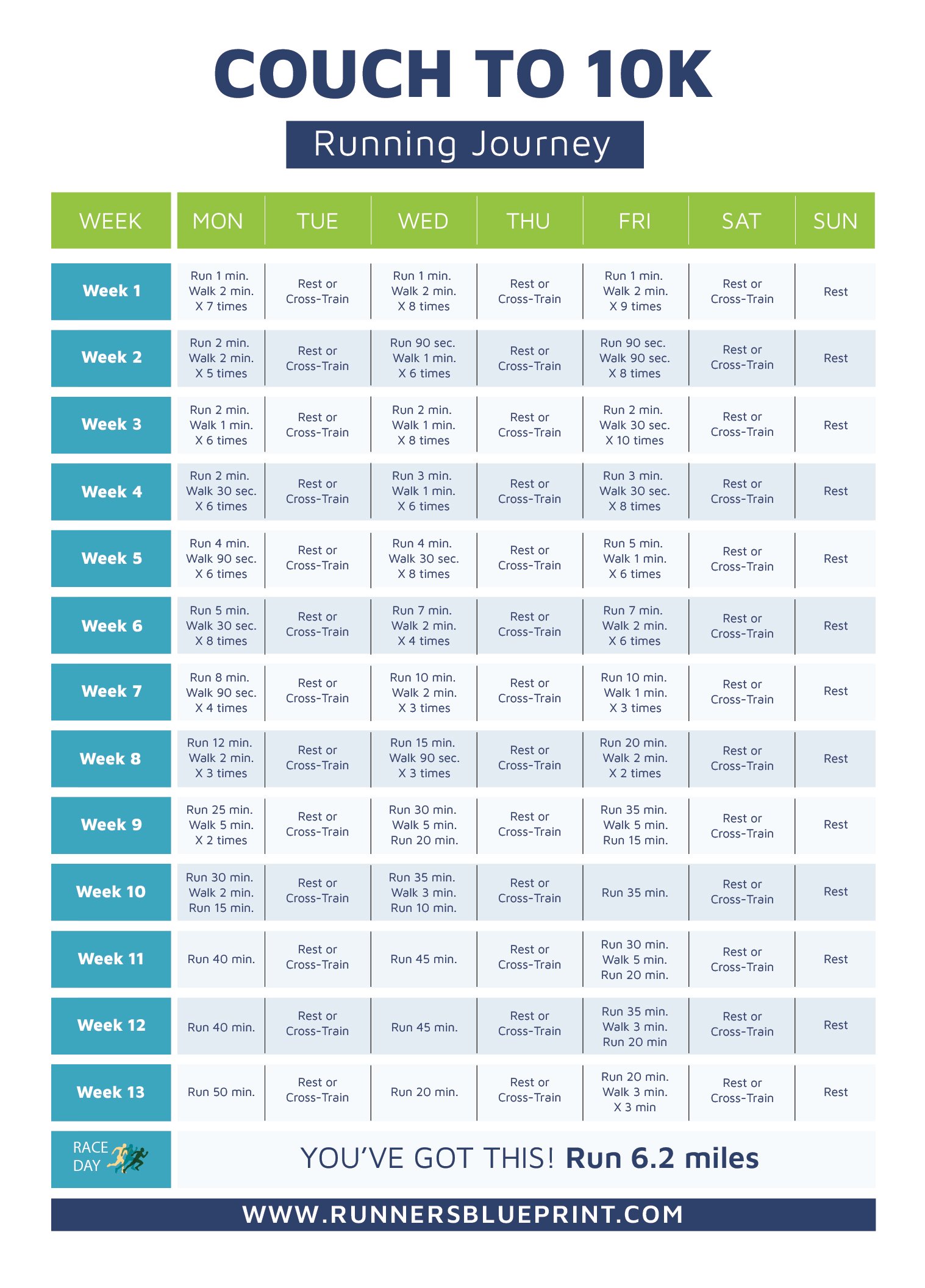
Week-By-Week Plan: Build with Flexibility

We can chart this plan out week-by-week with suggested run/walk intervals and mileage goals. But here’s the golden rule:

If a week feels too hard? Repeat it. There’s no shame in repeating Week 5 before moving to Week 6.

Training plans should fit your life, not the other way around. Miss a workout? Life happens. Just keep moving forward.


Life + Training: Make It Work for YOU

Busy parent? Older runner? New to exercise? 3 runs/week is plenty.

Already fit from another sport? You might bump quicker—but don’t skip steps.

This plan is adjustable. What matters most: consistency, patience, and staying uninjured.


Crossing the Finish Line

By the end, you’ll be doing ~60 minutes of running. You’ll have covered a 6-mile run. Race day might take 70–80 minutes—no big deal. Time doesn’t matter here.

You finished a 10K. That’s a win. Full stop.

Even better? You did it without trashing your knees, burning out, or quitting halfway. You built habits that stick. That’s what real runners do.


10K Under 80 Minutes: The Run-Walker’s Graduation Plan

So you’ve tackled a 5K (maybe with a mix of running and walking), and now you’re eyeing the 10K. Respect. This plan is for runners still building up the endurance to run the full distance—but want to finish strong, under that 1:20 mark.

Think of this as your “solidify the running” season. We’re bridging the gap between part-time runner and someone who can hold it together for a full 6.2 miles. Not with speed. With steady, honest effort.

Who This Is For:

  • You can run a little, maybe a lot—but not quite 10K non-stop yet.
  • You want to run most (if not all) of the 10K.
  • Your goal pace is around 12:50/mile.
  • You want to finish feeling in control, not crawling across the line like a wounded zombie.

How Long? Around 10–12 Weeks

If you just wrapped up Couch-to-5K, 10 weeks might be enough. Already jogging 2–3 miles a few days a week? You’re in a great spot. But giving yourself 12 weeks gives room for growth—and life’s little interruptions.


Weekly Mileage & Frequency

By mid-plan, you’ll be running 4 days a week, maybe 5 during peak weeks. We’re not chasing big mileage here—just consistent time on your feet.

  • Start: ~10 miles/week
  • Peak: ~22–25 miles/week

Example Mileage Progression:

  • Week 1: 4 runs – 3m, 2m, 3m, 4m long = 12 miles
  • Week 6: 4–5 runs – 4m, 3m + strides, 5m, 2m easy, 6m long = 18 miles
  • Week 10 (Peak): 5m w/ tempo, 4m easy, 3m shakeout, 8m long run = ~22 miles

Then we taper down the last 1–2 weeks so you show up race day rested, not wrecked.


Key Workouts: What You’ll Be Doing Each Week

Easy Runs: The Foundation

These make up the bulk of your week. Slow. Controlled. Conversational pace—think 13:00 to 15:00 per mile for most folks in this zone. Doesn’t matter if you’re jogging or still adding some walk breaks. You’ll gradually cut those out. The win here? Feeling smoother, stronger, and steady.

Long Runs: Stretch It Out

This is where the magic happens. We build you from 4 miles to 7 or 8 by peak week. Walk breaks are fine—especially for hills or hydration. Just keep moving forward. By the end, aim to run at least 6-7 miles straight (or close to it). These runs are slow on purpose—probably the slowest of the week. You’re building endurance, not racing your long run.

 The “Workout” Day: Light Speed, Big Confidence

Once a week, we throw in something a little spicy. Nothing wild. Just enough to remind your legs they can move.

Examples:

  • Tempo workout: 2 easy miles, then 1.5 miles at a “moderate hard” effort (aim for your hopeful 10K pace), then 0.5 mile to cool down.
  • Fartlek session: 4 × 2-minute pick-ups at a strong pace (11–12 min/mile effort), 2-min recovery walk/jog in between.
  • Intro Intervals: 4 × 400m fast (controlled effort), with full walk/jog rest between.

These teach your body to run a bit harder, but not all-out. They also help your brain learn pacing, so race day doesn’t feel like uncharted territory.

Strides & Drills: Smooth is Fast

After a couple easy runs, tack on 4–6 strides—20 seconds building up to fast, smooth running. Focus on posture and quick turnover. Maybe toss in a few fun drills like skips or butt kicks in your warm-up. Feels silly, but it improves form big-time.

Recovery & Rest: Don’t Skip This
  • 1–2 full rest days a week. That means nothing. No spinning, no HIIT. Just breathe.
  • One active recovery option: short shakeout jog (~2 miles) or a low-impact cross-train session (bike, swim, yoga).
  • After long runs? Recovery is crucial. Easy walk or cross-train the next day to keep things moving without pounding the legs.

Pacing Basics (Don’t Guess)

Here’s a cheat sheet so you’re not flying blind:

  • Easy pace: 13:00–15:00/mile. If you can’t talk, you’re going too fast.
  • Tempo pace: Around 13:00–13:30/mile. Just above comfortable. You can talk, but only in short phrases.
  • Fartlek/Intervals: Shoot for 11–12:00/mile or just a “strong but controlled” effort.
  • Long run pace: Chill. This can be 90–120 seconds per mile slower than your easy pace. Walk breaks welcome.

Cross-Training, Strength & Flexibility: The Bonus Fuel
  • Cross-training: Once a week. Walk, bike, swim, yoga—keep it low-impact.
  • Strength: 2×/week, 15–20 minutes. Focus on glutes, core, and form drills. Think squats, lunges, planks. If it burns a little, good.
  • Mobility: Stretch or foam roll after your runs—especially tight spots like hips, calves, and low back. Trust me, your future self will thank you.

Plan Structure Tip

Listen: if you miss a run or feel dead tired one day, don’t try to “make it up.” Just move forward. That’s part of training smart.


Sample Mid-Plan Week

Mon – Rest or light yoga
Tue – 4 miles easy + 4 strides
Wed – 3 miles with tempo: 1 easy, 1.5 tempo, 0.5 cool down
Thu – Rest or 2 miles easy jog
Fri – 3.5 miles easy + strength
Sat – Cross-train or optional 2-mile jog
Sun – 6.5 mile long run (run/walk as needed)


Final Push

By Week 8 or 9, you’re hitting long runs of 7–8 miles and adding one decent speed workout (like 6×400m with full recovery). After that? Taper time.

  • Week 10: Reduce volume 30%, keep intensity sharp
  • Race week: Drop volume by half, keep one short faster session early in the week to stay sharp


Intermediate 10K: Breaking 60 Minutes

Who’s This For?

You’ve been running for a bit. Maybe you’ve clocked a couple of 5Ks or even a slow 10K. Now you want to break that classic one-hour barrier.

This is where things get exciting. You’ll be running 4–5 days a week, building up to 25–30 miles per week. You’ll do workouts that make you sweat and rest days that make you stronger. It’s not easy—but if you’ve got consistency and some grit, you can do this.

🕒 Target pace: ~9:39/mile (6:00/km). That’s your magic number.

Training Block: ~12 Weeks

Twelve weeks gives you time to ramp up smartly and fit in the quality work you need. Some runners close to 60 minutes might only need 10 weeks. Others may want a longer ramp—closer to 16 weeks. But 12 is a sweet spot for most.

Mileage Build Example:

  • Week 1: 18 miles (4 runs: 4, 5, 3, 6 + cross + 1 rest)
  • Week 6: 25 miles (5 runs, including 7-miler and 20-min tempo)
  • Week 10 (Peak): 30 miles, with 8-mile long run and 2 key workouts
  • Week 11–12: Taper to ~20, then ~15 + race

Key Workouts (How You’ll Get Faster)

Long Runs: The Engine Builders

Build these up to 8–10 miles. If you can run 10 in training, 6.2 on race day won’t scare you.

Do them easy. That’s right—chill pace. Maybe toss in a moderate finish to simulate race effort on tired legs.

Threshold Runs: Where Speed Meets Stamina

Tempo runs are your friend. Start with 15–20 minutes at “comfortably hard” effort. Could be a 2-mile tempo sandwiched by warm-up and cool-down. Later, try cruise intervals like 4 x 1 mile at slightly slower than 10K pace with 1:00 jog rests.

This stuff trains your body to clear lactate better and hold faster paces longer. Gold.

VO₂ Max Intervals: Top-End Stuff

These make your 10K pace feel easier by pushing your ceiling higher. Think 5×800m at 5K pace with 2:00 jog rests. Or a ladder: 400–800–1200–800–400. Do these every other week—more isn’t better if you’re not recovering.

Speed & Form Work: Strides & Hills

Still doing strides (now ~100m), focusing on quick turnover and relaxed power. Add hill sprints once a week during base phase—6 x 10 seconds up a steep hill, full recovery walk down. These boost power and injury-proof your legs.

Race Pace Reps

About 3–4 weeks from race day, start dialing in that 9:30/mile rhythm. Try workouts like:

  • 3 x 1 mile at goal pace (2 min rest)
  • 2 x 2 miles at goal pace (3 min rest)

Feel the effort. Lock it in.


Recovery, Cross-Training & Strength

You need at least one full day off each week. Use it. Trust me—rest isn’t weakness, it’s how you cash in all the work.

Recovery runs: 2–4 miles at snail pace. These should leave you feeling better than when you started.

Cross-training: Optional, but helpful if your body can’t handle more miles. Easy cycling, pool running, elliptical—good options if your joints are cranky.

Strength Training: 2x a week, 20–30 minutes. Don’t overthink it:

  • Single-leg work: step-ups, single-leg squats.
  • Core: planks, bird-dogs, glute bridges.
  • Upper body: keep the arms strong—it helps with posture and drive.
  • If you’re experienced, add some heavier lifts: deadlifts, squats, 4–6 reps, 2–3 sets.
  • No access to weights? Do jump lunges, box jumps, and plyos instead.


Pacing Smarts for a Sub-60 10K

Look—if you’re aiming to break 60 minutes in a 10K, don’t get lured into thinking more is always better. More miles? Sure, up to a point. But if that mileage leaves you too beat up to hit your workouts, it’s hurting more than helping.

The 10K isn’t just a longer 5K or a shorter half. It’s its own beast—fast enough to sting, long enough to demand strategy. And it rewards runners who train with purpose, not just more volume.

Here’s how to pace your training without grinding yourself into the ground:


Easy Runs: Where the Magic Actually Happens

Yeah, I said it. Easy runs might not feel “sexy,” but they’re what build the engine. And for a sub-60 chaser, that’s probably in the 10:30–12:00/mile range. Don’t try to flex here.

Use the talk test or keep your heart rate around 65–75% max. If you can’t finish a sentence, you’re going too hard.

The 80/20 rule is gold: 80% easy, 20% spicy.

A lot of runners run their easy days too fast, then wonder why they can’t hit their workout paces. Chill on the easy days and you’ll actually be able to crush the hard ones.


Threshold / Tempo Runs: Where You Learn to Suffer Smoothly

Tempos are the “comfortably hard” effort—hard enough to make you focus, but not full send. Think around 9:45–10:00/mile for someone targeting a 9:39 race pace.

It’s the pace you could hold for about an hour—coincidence? I think not.

These runs raise your cruising speed, so don’t skip ‘em.


Intervals: Speed Work That Has a Point

This isn’t about running until you puke. It’s about teaching your legs to move fast with form.

  • 800m reps at ~4:30 each (about 9:00 pace)
  • 400s at ~2:00 (around 8:00 pace)

Don’t race these—run ‘em controlled and consistent. Think: “fast but relaxed.” Wild splits or sloppy form? That’s just junk speed.


Long Runs: Slow and Steady Builds the Beast

If your easy pace is 11:00, your long run pace might drift into the 11:30–12:00 range. Start chill, finish stronger—maybe even hit goal pace (9:39) in the last 2 miles once you’re deeper into training.

These are where mental grit and aerobic strength get built. Respect them.


Tune-Up Races: Dress Rehearsals That Hurt Good

Somewhere around week 8, throw in a 5K race. Use it to test your pacing and shake off the nerves.

If you can run 28–29 minutes, you’re on the right track. Treat it like a hard workout, not your Olympics.


Recovery: The Secret Sauce Nobody Talks About Enough

Progress isn’t just about the miles—it’s about absorbing them. That’s why every 3–4 weeks, cut volume and intensity by ~20%.

Down weeks aren’t lazy. They’re smart.

If you’re always grinding, your body won’t adapt—it’ll break down. So plan for:

  • Week 4 → cutback
  • Week 8 → another reset
  • Taper at the end

Recovery is training. Don’t skip it.


The Week-to-Week Plan (and How to Tweak It)

Here’s a basic structure that works:

  • Tuesday & Friday = Quality (intervals, tempo, hills)
  • Sunday = Long run
  • Other days = Easy, rest, or cross-train

Want 5 runs/week? Great. Can only manage 4? Still works—just prioritize:

  • One hard workout (tempo or intervals)
  • One long run
  • Easy runs to fill the rest

You can even sub a recovery day with cycling, swimming, or elliptical. That counts.


Race-Day Fueling (Yes, You Still Need It for a 10K)

If your long runs go past 60 minutes, bring fuel. One gel mid-run. That’s it. No need to overthink.

Start practicing pre-run breakfast now—maybe toast with PB or a banana 2 hours before. By race day, your stomach should be used to it.

Hot day? Hydrate ahead and take water when offered. Don’t wait ‘til you’re parched.

Bonus: Sub-50 10K Training (Advanced Runners)

This is for runners who’ve broken 25:00 in the 5K and want to start chasing podiums or age-group placements.

Sub-50 means sustaining ~8:00/mile pace for 6.2 miles. Not a jog in the park. It takes a mix of:

  • True speedwork (400s, 800s, cruise intervals)
  • Long tempo runs (20–30 min at threshold)
  • Smart recovery weeks
  • Mileage in the 30–45 mpw range, with some flirting with 50 if they’re marathon types

Most follow a 14-week plan:

  • Base (Weeks 1–4): 25 → 35 mpw
  • Peak (Weeks 8–10): Touch 40–45
  • Taper: Weeks 12–14, cut to 30 → 20

By this level, some runners add doubles or cross-training like a second job. But only if it supports your goal without blowing up your knees.

Here’s your blueprint.


Key Workouts – What You Need in Your Toolbox

Long Runs (10–12 Miles)

Yeah, you still need these. You don’t build endurance without going long. For a sub-50 runner, the long run might stretch up to 12 miles, and some days you’re not just cruising—you’re working.

  • Standard long run: 90 minutes to 2 hours at easy pace.
  • Spicy option: Finish with the last 2 miles at goal pace (8:00). It teaches you how to run strong when tired—exactly what you need to close hard in a race.
  • Tempo fusion: 8 miles easy + 2 miles tempo at the end = race simulation gold.

Key point: Long runs aren’t about pace. They’re about getting comfortable with time on feet. But don’t be afraid to test yourself occasionally.


Intervals (VO₂ Max)

Here’s where the gas pedal hits the floor. You want to run faster? You’ve got to train faster. These sessions raise your ceiling.

  • 5×1000m at 5K pace (~4:45 each if goal pace is 8:00/mi)
  • 6×800m at between 5K and 10K pace
  • 3×1600m at 10K pace (~8:00 each), short rests (2–3 mins)

Only one VO₂ workout per week (or 10 days). These are tough—don’t overdo them. This is your red zone work.


Threshold Runs (Tempo Work)

This is the bread and butter. Threshold runs raise your “floor” so you can run faster, longer, with less suffering. If intervals are the ceiling, tempo is the strong foundation.

  • Classic tempo: 20–25 mins at ~8:30 pace (comfortably hard)
  • Cruise intervals: 4×1 mile at ~8:00 with 1-min rest

Do one threshold workout most weeks, especially mid-cycle. These will teach your body to clear lactate and your brain to stay locked in.


Reps for Speed (Running Economy Work)

Short reps. Fast turnover. Pure leg speed. These sharpen your stride and improve efficiency.

  • 10×200m at mile pace (~45 sec each), full recovery jogs
  • 8×30 sec hill sprints (form over brute strength)

These show up early in your cycle for speed development or late as race sharpening. They don’t feel like much… until you realize your legs feel snappier at race pace.


Race Pace Workouts

You’ve got to feel goal pace. Your body needs to know what 8:00/mi feels like—relaxed, smooth, repeatable.

  • 3×2 miles at 8:00 with 3-min rest — brutal, but confidence-building
  • 4–5 miles continuous at goal pace — save this beast for late in training
  • Cutdown: 4K–3K–2K–1K at descending paces from 10K to 5K pace

These teach rhythm, focus, and grit. You’ll want to bail halfway. Don’t.


Doubles, Strength & Recovery Runs

At higher mileage, it’s smart to split some days:

  • 5 miles AM + 3 miles PM (easy)
  • Shakeouts the day after a brutal workout

Cross-training? Optional. If you’re healthy, running gets priority. But cycling or swimming can be solid on rest days if you’re cooked.

Strength work? Non-negotiable at this level.

  • 2x per week: Squats, deadlifts, lunges, planks
  • Keep it heavy (4–6 reps) if your form’s solid
  • Add plyos once a week if you’re ready

It’s about power now, not just staying upright. The stronger you are, the more efficient you’ll run.


Mobility & Prehab: The Details That Keep You Running

Mileage’s going up. Intensity’s higher. Weak links will get exposed.

  • Glute band walks
  • Ankle mobility drills
  • Hip strength work

Also: dynamic warmups before hard efforts. Leg swings, lunges, drills. Prime the system before you start the engine.


Block Breakdown – Building the Monster
Weeks 1–4: Foundation & Speed
  • Mileage builds
  • Hill sprints, strides, light fartleks
  • Introduce strength and mobility
Weeks 5–9: The Meat
  • VO₂ + tempo every week
  • Long runs stretch to 12 miles
  • Body gets tougher, mind gets sharper
Weeks 10–12: Sharpening
  • 10K pace workouts, tune-up 5K optional
  • Long run becomes maintenance (~8–10 mi)
  • Lock in pacing
Weeks 13–14: Taper
  • Back off volume, keep intensity light
  • You’re ready

 Pacing Guidelines
  • Easy Runs: 9:00–10:00/mi (don’t race recovery days!)
  • Long Runs: ~9:30–10:00/mi, maybe faster finish
  • Threshold/Tempo: ~8:20–8:30/mi
  • 10K Goal Pace: 8:00/mi
  • 5K Pace: ~7:40
  • Mile Reps: ~7:20
  • 200m Reps: ~6:00/mi pace (~45 sec)

 Reminder: Most runners go too hard on easy days and too easy on hard days. Don’t be that runner.


Race Strategy & Simulations

Don’t just train your legs—train your race brain.

  • Practice workouts at your race time (usually morning)
  • Do goal pace in workouts (3×2 miles at 8:00/mi is perfect)
  • Run even splits in workouts—learn not to blow up
  • Tune-up 5K in week 11? Great way to test speed and pacing control

Recovery & Lifestyle Stuff
  • At least one total rest day/week
  • Sleep and food matter—especially carbs
  • Foam roll. Warm up. Listen to niggles before they become injuries.
  • Use HR monitors to gauge recovery—if resting HR spikes, take a lighter day

Fueling? If your long run is over 75 minutes, bring a gel or drink mix. Your race might not need it, but it’s good practice.


The Result: A Legit Sub-50 10K Engine

By the end of this plan, you’ll be able to:

  • Run 7–8 miles at goal pace in training (maybe broken into chunks)
  • Knock out 12-mile long runs without fear
  • Cruise threshold workouts like it’s your job
  • Run fast 400s and smooth 1000s
  • Lock in that 8:00 pace without looking at your watch

You’ll also know suffering—and you’ll know how to keep going through it.

Sub-50? That’s yours. And maybe even sub-48 or a half marathon after that.

Chasing Sub-40 in the 10K: No BS, Just Work

Alright, so you’re chasing the big one: a 10K under 40 minutes. That’s 6:26 per mile. 4:00 per kilometer. No room for fluff.

This isn’t a casual jog. This is full-on performance mode. If you’re gunning for this, you probably already have some serious miles under your belt.

Maybe you ran track back in the day, maybe you’re grinding 40+ miles a week and dropping 5Ks in the 18–19 minute range. You’re not just running—you’re training.

Let’s break down what it takes to crack that 40 barrier—training, workouts, pacing, gear, everything. This is the competitive amateur level—close to local elite territory. And it demands a smart, no-shortcuts approach.


Timeline: 16 Weeks to Sub-40

At this level, gains don’t come overnight. You’ll need a 4-month cycle to build smart. That gives you time to stack volume, sharpen, and maybe toss in a tune-up race or two. Improvements are earned inch by inch here.


Mileage & Weekly Flow

You’re running 6–7 days a week—some might take a day off every other week. Mileage? Probably in the 50–70 miles/week range. Some runners hit sub-40 off 40 miles a week, but it’s rare. Most need volume.

A typical cycle might look like:

  • Base weeks: 50 → 60 → 65 → cutback at 50
  • Peak weeks: Hit 70 miles, maybe with doubles (easy AM jogs + PM workouts)
  • Taper: 50 miles → down to ~30 race week

Double runs help pack in volume without trashing your legs. Example: 5 miles in the morning, 6 in the evening—keeps you aerobically loaded without redlining.


Key Workouts That Get You There

Long Runs: 12–16 Miles

These build your staying power. Even if you’re training for 10K, going long gives you the aerobic foundation to hold 6:26 pace for 40 minutes without crumbling.

  • Pure 10K focus? 12 miles is solid.
  • Looking to move up later? Stretch to 16.
  • Want bonus points? Add quality to the end—finish last 3 miles at marathon pace.

Midweek 10-milers at a steady aerobic effort are gold too.

Threshold/Tempo Work

Bread and butter stuff. At least one threshold session per week.

  • Examples:
    • 4–5 miles continuous at threshold (~6:50–7:00 pace)
    • 6 x 1 mile @ threshold with 1-min rest
    • 8 miles @ marathon-ish pace (~7:15/mi) for endurance + strength

Threshold work raises your ceiling—it’s how you build that smooth, cruising engine that makes 6:26 feel sustainable.

VO₂ Max Intervals

Time to sharpen the blade. Speed sessions like:

  • 5 x 1000m @ ~5K pace (~6:00/mi) w/2–3 min jog
  • 3 x 1600m @ goal 10K pace (6:26/mi) w/2 min rest
  • 12 x 400m @ 5:40/mi pace (around 85 sec per rep)

These teach you how to suffer and still hit your splits. They’re also great for mental toughness—you’ll need that when 8K hits on race day.

Speed Reps (Strides, 200s, Hill Blasts)

These don’t feel “hard,” but they matter. They teach your legs to turn over fast and efficiently.

  • 10 x 200m @ mile pace (~40s) w/200m jog
  • Hill sprints: 10 x 10 seconds all out

These improve economy—think of them as lube for your running engine. Smoother = faster = longer.

Race Simulation Workouts

This is where we test the engine.

  • 3 x 2K @ goal pace (4:00/km) with 2-min rest
  • 2 x 3K @ goal pace with 3-min rest
  • 5K time trial mid-cycle (shoot for sub-19)

If you can hit those with control, you’re ready to make your move on race day.


Tune-Up Races & Test Days

Racing sharpens everything—form, mindset, pacing.

  • Early in the cycle: 5K or 2-mile race to check where your speed’s at
  • Week 12-ish: A rust-buster 10K to simulate race rhythm (not all-out)
  • Parkruns and track meets? Perfect stand-ins for hard workouts

 Doubles, Easy Runs & Recovery

Most sub-40 runners aren’t smashing every day. They live off easy mileage and smart recovery.

  • Double days: AM shakeout + PM quality
  • Easy runs: flush out soreness, build aerobic base
  • Rest: Optional weekly. Some go 14 days straight, then break. Just don’t ignore fatigue—listen to your body.

Strength, Plyos & Extras

You’re not just a runner—you’re an athlete. Treat your body like it.

  • Strength: 1–2x/week. Focus on weak links—hips, glutes, hamstrings. Can be bodyweight or heavier if you’re lifting in the off-season.
  • Plyos: Depth jumps, bounding, fast feet drills. One session a week can make your stride pop. Bonus: research shows this stuff actually helps running economy for well-trained runners.
  • Mobility: Daily dynamic warm-ups. Foam roll post-workout. Static stretch the problem areas (calves and hammies, especially after speed).

Cross-training? Mostly if you’re dinged up or swapping an easy run with cycling/swimming to save your joints.


Pacing Targets (Know Thy Zones)

You’ll want these dialed in:

  • Easy runs: ~7:30–9:00/mi (depends on your current fitness). Roughly 60–75% effort.
  • Long runs: ~60–90 seconds slower than race pace. Can progress near goal pace in last few miles.
  • Threshold: ~6:45–6:50/mi
  • 5K pace: ~6:00/mi
  • Speed reps (e.g., 200s): ~5:20/mi or faster
  • 400s: ~5:40/mi pace (85s reps)

Got power meters or HR zones? Use ‘em. But don’t let the tech run your brain. Know the feel. Know the grind.

💡 Pro tip: On big days, fuel like it’s race day—gel or carbs pre-workout, even a caffeine boost to mimic race effort. Train the gut too.


Race Day Strategy: Don’t Be a Hero at Mile 1

The number one reason people miss sub-40?

They go out too hot, then explode at 8K.

Train even pacing. Practice progression runs. Learn to start calm and close hard.

Use mental tools:

  • Break the race into two 5Ks.
  • Focus on your breathing, your form, your rhythm when it gets ugly.
  • Keep one mantra on standby: “Hold the line.”

Taper Like a Pro: Less Running, More Racing

Here’s the golden rule heading into race day: Don’t try to squeeze in last-minute fitness. That ship has sailed. Tapering is where you sharpen the sword, not forge a new one.

For a 10K, a two-week taper usually does the trick. In Week 1, cut volume by about 20%. In Race Week? Drop it by 50%. You’re not quitting training—you’re just trimming the fat.

You’ll still hit intensity, but with fewer reps. So if you normally knock out 5×1000m at threshold pace? Drop it to 3×1000. Keep the same effort—just less volume. And toss in a few strides here and there to keep your legs poppin’.

Also, now’s the time to be boring in the best way:

  • Sleep like it’s your job.
  • Eat slightly more carbs in the final 3 days.
  • Cut back on stress—ditch unnecessary commitments.
  • Say no to the late-night Netflix bender. This is your race week.

👉 Final tune-up tip: Do a dress rehearsal—race shoes, kit, warm-up, same time of day. Get familiar with how race day will feel.


Race Day Outcome: Sub-40 Is in Reach

If you’ve hit your workouts, tapered smart, and show up ready? You’re in sub-40 shape. A tune-up race or time trial that lands around 18:50 for the 5K? That’s a green light. It means you’re ready to flirt with a 39:XX 10K.

This isn’t just fitness—it’s mastery. When you break 40, you’re not just fast, you’re trained and tactical. And from here? The doors open to bigger goals: maybe a sub-90 half or a crack at BQ pace in the marathon down the line.

You’ve built a solid foundation. This isn’t random—you’ve earned every second.


Beyond Mastery: What’s Next?

Alright — you’re not just running 10Ks anymore. You’re owning them. You’ve learned the pacing, crushed the workouts, and stared down that 7K pain cave without flinching. So what now?

That’s the beauty of the 10K: once you’ve nailed it, your engine’s primed for whatever direction you want to go. Here’s how to ride that wave.


Option 1: Level Up to the Half — Without Losing Your Edge

You’ve got the speed, and your long runs are already brushing up against double digits. That means it’s prime time to take a shot at the half marathon. And no — you don’t have to become a slow plodder to do it.

In fact, that 10K sharpness? It’ll make your half marathon feel smooth… at least early on.

Here’s the plan:

  • Gradually build your long run — think 12 miles, then up to 14–15 over time.
  • Swap some 10K-style intervals for longer tempo runs at half marathon pace.
  • Keep sprinkling in strides and occasional short reps to stay snappy.

Pro Tip: Don’t ditch speedwork completely. I’ve seen runners “go long” and lose their zip because they forgot to keep turning over their legs. Every other week, hit a 10K pace workout to stay sharp.

Rough translation: If you’ve hit sub-50 in the 10K, you’ve got the chops for a 1:50–1:55 half (assuming your endurance is dialed in). But don’t get obsessed with the numbers — run your race, practice fueling, and pace smart.

Speaking of fueling: A half is long enough that you’ll want to train with gels or sports drink. Start practicing during your long runs — don’t let race day be a gut-check you didn’t prepare for.


Option 2: Go Shorter — Use That Strength to Smash Your 5K

Want to drop the hammer on your 5K time? Good. 10K fitness makes that possible — and painful in the best way.

See, by training for the 10K, you’ve been living just under 5K pace. That builds specific endurance and stamina. Drop back to 5K, and suddenly your body has the strength to hold near-max effort without blowing up halfway.

Tactical win: 5Ks feel shorter — mentally and physically — after racing 10Ks. You’ve developed pacing discipline and toughness. Now you get to suffer for just 20–30 minutes instead of an hour.

To fine-tune for the 5K:

  • Add more short, fast intervals (think 200–800m reps)
  • Slightly longer recovery between hard sessions
  • Keep a weekly tempo or longer rep day to hold onto strength

Bonus: That aerobic engine will even boost your mile time. You might not do full-on speed training, but don’t be surprised if your final lap finishes stronger thanks to that endurance base.

Strength = speed reserve. You don’t need to feel faster — you need to feel less tired running fast.


Option 3: Use the 10K as Your Fitness Barometer

You’ve mastered the 10K. Now you can use it.

Think of the 10K as a fitness litmus test. Mid-marathon cycle? Plug in a hard 10K race or time trial. Between training blocks? Jump into a local 10K instead of just doing another tempo.

Why it works:

  • It’s short enough to recover quickly
  • Long enough to show if your aerobic base is solid
  • Easy to plug into training without a full taper

Real-World Use Case: Can you run 10K in 45:00? You’re probably fit for a ~1:40 half. Prediction charts love the 10K for this reason — it bridges the short and the long.


Option 4: Go Wide – Trails, XC, Pacing, Experimenting

Maybe it’s not about chasing the next PR. Maybe it’s about exploring what else this body can do.

Try a trail 10K. If you thought road 10Ks were humbling, wait until you’re gasping up a muddy hill and tripping over tree roots. Trail 10Ks slow you down, toughen you up, and train your coordination and strength like nothing else.

Pace a race. Be the 50-minute pacer. Help someone else hit their goal. It’s one of the most satisfying ways to run a race — no pressure, just joy.

Get analytical. Now that you’ve got data — times, splits, heart rate, workouts — you can experiment. Try adding 10% to your weekly mileage. Swap a workout. Change recovery days. Use the 10K as your personal lab.

What if…

…you improve more off fewer miles?
…you handle back-to-back workout days better?
…you respond to hills more than intervals?

You’ll never know unless you test it — and the 10K is the perfect testing ground.

🧬 Some runners figure out their true strengths through this. Maybe you’re secretly built for the 5K. Or maybe, after experimenting, you realize you’re a marathoner in disguise.


Final Words – You Don’t Just Finish a 10K… You Own It

Crossing the finish line of a 10K is a win. No doubt. But owning the 10K? That’s something else entirely. That’s next-level. That’s when running stops being something you do and becomes part of who you are.

If you’ve stuck with this guide, trained smart, and pushed yourself through the process, then you’re not just another weekend warrior jogging for a medal. You’ve leveled up. You’re building mastery. And that changes everything.


This Ain’t Just About Running

Let’s be real—mastering the 10K isn’t about nailing one perfect race. It’s about understanding your body, your brain, and how the two work together. You’ve learned how to train with purpose, adjust on the fly, and grind through the tough days.

Maybe you found out you’re a grinder—steady engine, takes a while to warm up but can go forever. Or maybe you’re a speedster who had to wrestle with pacing and stamina. Either way, now you know your machine. You’ve tuned your engine. You’ve learned what fuels it, what breaks it, and how to fix it mid-run.

That’s not just running knowledge—that’s self-knowledge. That’s power.

Even elite runners are constantly fine-tuning. So are you now. Welcome to the club.


 From “Jogger” to “Athlete”

Think back to where you started. Maybe running was just cardio. A way to shed a few pounds. Something you “should probably do.”

Now? You’re thinking like an athlete. You plan. You pace. You look at splits and training cycles and how your body responds to different workouts. You made the jump from just exercising to training. That mental shift—right there—is a bigger win than any finish time.

Because when you start identifying as an athlete, your decisions start changing too. That second beer the night before a long run? Nah. You skip it. Sleeping in instead of training? Not today. That’s the mindset shift. That’s what turns finishers into racers.

And here’s the wild thing: that discipline leaks into other parts of your life. Suddenly you’re sharper at work. You handle stress better. You’re more patient, more resilient. You didn’t just build fitness—you built grit.


What’s Next?

That fire you feel right now? Bottle it. Take it with you. Whether you’re aiming for faster 10Ks, longer races, or just deeper enjoyment of the run—you’ve got the tools now. You’ve proven you can commit, push through tough patches, and come out stronger.

Mastery doesn’t have a finish line. It’s a mindset. A way of showing up, again and again, ready to get a little better every time.

So go out there. Run strong. Run smart. Run like it’s yours—because now, it is.

You don’t just finish the 10K. You own it.

How to Pace Yourself for a 10K Without Burning Out

Ever gone out way too hot in a 10K thinking, “This is my day,” only to hit 5K and feel like you’re dragging bricks behind you?

Yeah, same.

During one of my early 10K races, I flew off the line at 4:30/km—faster than my target pace—and I paid the price.

Legs cramped, breathing went off the rails, and not even halfway, I was in survival mode.

That day taught me something painful but important: pacing isn’t just a smart idea—it’s the entire game.

A 10K isn’t short enough to sprint, but it’s definitely not long enough to zone out and jog.

It’s that weird in-between distance where strategy matters just as much as fitness.

Nailing that balance? That’s what separates a breakthrough race from a mid-race breakdown.

Why Pacing Matters

Let’s get nerdy for a sec.

A 10K is usually run just around or slightly above your lactate threshold—the point where your body starts burning more fuel than it can clear efficiently.

Once you cross that threshold, you’re on borrowed time. The body starts to accumulate lactate, and if you’re not careful, fatigue hits like a freight train right in the middle of the race.

In plain English: push too hard early and you’re toast.

Your legs will tighten, your breathing turns into a wheeze-fest, and mentally you’ll want to pull the plug. But run it smart—start with some restraint—and you’ll actually finish stronger. That’s why holding back in the early kilometers isn’t cowardly; it’s a power move.

Pacing isn’t a gift—you can train it.

Let’s dive a little deeper…

Why 10K Isn’t a Sprint or a Jog—It’s Both

A 5K? You can muscle through it with raw speed and guts.

A half marathon? That’s a pacing chess match.

But a 10K? That’s a dance. One wrong move and your rhythm’s gone.

Most runners hit their 10K pace just above their lactate threshold.

It feels “comfortably hard”—but go just a few seconds too fast and that comfort turns into a full-blown meltdown.

And those first few kilometers? They’re sneaky.

With adrenaline kicking, the crowd cheering, and legs feeling fresh, it’s easy to fall for the trap.

The Burnout Wall

Most 10K runners hit the wall somewhere between 5K and 7K. You know the one—sudden leg burn, labored breathing, that voice in your head asking, “Why am I doing this?”

I’ve been there around 6.5K in nearly every 10K I’ve run. That’s the pain checkpoint. But here’s the thing: this is where most people crack. They didn’t pace it right, and now they’re in damage control.

Me? I remind myself that this is exactly what I trained for. This is where the smart pacing pays off. I still have a little in the tank while others are fading. I lean in, not away.

Here’s what’s going on under the hood: after 5K, you’re running mostly off anaerobic energy.

Lactate piles up. If your pace stays near threshold, your body can mostly keep up. If not, lactate floods your muscles—and your performance nosedives (MatthewBoydPhysio.com).

Don’t make that rookie mistake. Pacing isn’t about ego. It’s about control.

Let me simplify the science a little futher.

The Science (Made Simple)

At slower paces, your body burns fat using oxygen—clean and efficient. As you speed up, you burn more carbs and start producing lactate. That’s fine—until your pace tips over the edge.

That tipping point is the lactate threshold. For most runners, 10K pace sits just above it. That means you’re flirting with redline the entire race.

Go too fast early, and it’s like throwing gasoline on a fire.

You drown in lactate. Breathing spikes. Legs tighten. Performance plummets. Boyd’s research confirms this: stay close to threshold and 97% of your energy is aerobic. Blow past it, and the anaerobic engine takes over—and it doesn’t last long.

Start with a Target: What’s Your 10K Goal?

Don’t just wing it. Before race day, set your sights on a realistic finish time. Better yet—set three goals:

  • A Goal: Dream scenario. Everything clicks.
  • B Goal: Realistic target.
  • C Goal: Survive and finish proud.

This keeps you mentally flexible. If Plan A slips away mid-race, you’ve still got a mission.

As Sahil Bloom puts it, this tiered system keeps your head in the game even when the plan goes sideways. And let’s be honest—running rarely goes exactly as planned.

Note – If you’re a beginner, I’d recommend that you forget about this whole pace thing and instead follow my couch to 10K plan.

How to Find Your 10K Pace

A solid estimate? Use your most recent 5K time.

For example, if you ran a 20:00 5K, that roughly predicts a 42–43 minute 10K (around 4:15/km pace).

Or use a tempo run: if you can hold 4:30/km for 20 minutes, your 10K pace might sit closer to 4:20/km.

Not a numbers person? Use an online pace calculator (like McMillan’s) or a pace chart.

Here’s a basic breakdown:

Goal Time Pace/km Pace/mile
45:00 4:30 7:15
50:00 5:00 8:03
60:00 6:00 9:39

Whatever your number, burn it into your brain—and your legs. You want to feel the pace, not stare at your watch the whole way.

Pro tip: allow yourself a ±3–4 second buffer. If your goal is 5:00/km, don’t panic at 5:03.

Consistency matters more than perfection.

Plan Your Splits (and Know When to Adjust)

I like to either program my watch with split alerts or tape a mini pace chart on my wrist.

For example, if I’m chasing a 50-minute 10K, I should be at 3K around 15:00 and hit 5K near 25:00. That way, I can check in during the race without obsessing over every beep.

But pacing is more than math. It’s a feeling. You’ll know by 3K if you’re pushing too hard—or if you’ve got more to give.

Listen to that.

The 3-Part Game Plan for Your 10K: How I Break It Down

When I run a 10K, I don’t just wing it. I split the race into three phases.

Not because I’m fancy, but because pacing without a plan is like showing up to a gunfight with a spoon.

Here’s how I tackle it—and how I coach others to do the same.

Phase 1 (0–3K): Hold the Hell Back

This is where most runners blow it.

The start line feels electric. You’re pumped, adrenaline’s high, and the crowd takes off like it’s a 5K sprint. I’ve been there—legs itching to go, pace screaming faster than planned.

But here’s the move: resist. In these first 1–2K, I dial it down. I run around 5–10 seconds per K slower than my goal.

So if I’m aiming for 4:30/km pace, I’ll settle in around 4:35 to 4:40/km. Not because I can’t go faster—but because I want to finish strong.

I remind myself, “If it feels easy now, perfect. That’s how it’s supposed to feel.”

Honestly, my first kilometer often feels boring. But I’ve learned my lesson: start too hot and you’ll crash and burn later.

Think of this as putting energy in the bank. You’ll need it later.

Phase 2 (4–8K): Settle Into the Pain Cave

Now it’s time to level up.

By the 3–4K mark, I usually find my groove. I start creeping toward goal pace—not hammering, just settling in like I’m putting on an old pair of shoes.

For me, this is the meat of the race. It should feel “comfortably hard.” You’re breathing heavy but in control.

Cadence is on. Legs are moving. This is the grind—it’s not sexy, but it’s where the race is really run.

Here’s the gut check: if I’m gasping at 6K, I know I went out too fast. So I scan my effort: Are my shoulders loose? Is my stride smooth? Can I take a couple deep breaths and keep rolling?

Phase 3 (9–10K): Time to Bleed

This is where we find out what you’re made of.

At 8K, things should start hurting. Good. That means you’ve done it right. Now it’s time to go hunting.

I use what I call the “15-minute rule.”

Ask yourself: Can I hold this for 15 more minutes?

If yes—go. Every 200 to 400 meters, I add pressure. If I’ve got anything left, I’ll start pushing faster than goal pace—5 to 10 seconds faster per K.

Doesn’t matter what my watch says at this point. I’m all-in.

With 1K left, I start gearing up. 400m to go? I’m emptying the tank.

I focus on form—quick feet, arms driving, chest tall.

And passing people? That’s free fuel. Their pain is my momentum.

I’ll be honest: pulling off a negative split in the final 2K feels addictive. The first time I nailed it, I was high for hours. That final stretch isn’t just a sprint—it’s a statement.

The 4 Pacing Pitfalls That Wreck 10K Dreams

You can train hard and still mess up your race with dumb pacing.

Here are the four traps I’ve seen (and fallen into) more than once.

Going Out Like It’s a 5K

Biggest rookie mistake. Everyone sprints the start because they feel like a superhero. But if you fly in the first K, you’ll be crawling by 7K. I once watched a friend crush the first 5K in 18:30, then fade to 21:30 for the second half. Brutal. Don’t be that cautionary tale.

Start calm. Stick to your plan. Trust the pacing strategy—not your ego.

Ignoring the Course, Weather, or Chaos

Running a perfect pace is easy on paper. Add heat, hills, wind, or screaming crowds—and suddenly you’re 30 seconds too fast and cooked by halfway.

If the sun’s blasting, back off early. I always say: If it’s scorching out, the only goal is finishing with dignity. Don’t be stubborn—adjust as you go.

Being a GPS Zombie

I love my GPS watch—but I don’t worship it. They glitch. Especially under trees or around crowds. I’ve had mine misread splits by 20–30 seconds. Use it as a guide, not gospel.

More important: listen to your breathing, feel your legs. If your watch says 4:05/km but your lungs are on fire—you’re going too fast.

Not Practicing Race Pace in Training

This one’s huge. If you don’t train at race pace, how do you expect to hold it on race day?

You need workouts that hit that rhythm: tempo runs, intervals, goal-pace efforts. Otherwise, your legs will be confused, and you’ll either burn out early or never hit your goal pace.

According to McMillanRunning.com, goal-pace sessions are key to locking in your rhythm and improving endurance under pressure. And I’ve seen it firsthand—if I can nail 3–4×1 mile at race pace in training, I know I’m good to go.

Want to Pace Like a Pro? Train Like One

Confidence doesn’t come from race day magic—it comes from workouts that prep your brain and body for the real deal.

Here’s what I swear by:

Tempo Runs: Where the Real Work Happens

Think 20–30 minutes at “comfortably hard.” Tempo pace is usually just under your 10K race pace, so these runs build the exact stamina you need.

They train your body to clear lactic acid and keep moving. I run at least one tempo a week. It hurts—but it’s the kind of hurt that builds champions.

Race-Pace Intervals: Lock In That Rhythm

Want your body to recognize race pace like a second language? Do intervals at that pace.

Stuff like 5×1K or 6×800m at 10K goal pace. Jack Daniels calls these “cruise intervals,” and they’re gold. You get faster, smoother, and more confident with every rep.

I’ll sometimes throw in 3–4×1 mile sessions at race pace. If I feel smooth and strong there, I know I’m dialed in.

Long Runs with a Kick

Yes—even for a 10K, long runs matter. Building up to 90 minutes gives your legs serious durability.

Sometimes I’ll toss in strides or a fast finish. That teaches your body to hold form when you’re gassed—and that skill is priceless on race day.

Strength & Mobility: Don’t Skip the Basics

Strong runners pace better. Period.

I hit the gym 2–3 times a week for squats, lunges, core, and glute work. Add in hip mobility drills and my form holds up even when I’m dying in the last K.

Research backs this up—better strength = better running economy. Less energy wasted = faster splits.

Simulate Race Conditions

Train for what’s coming. If your race has hills, do hill workouts. If it’s hot, practice in heat.

Even little things help—eat what you’ll eat on race day, run at race time, wear the shoes you’ll race in. The more familiar it feels, the less room there is for panic or surprises.

Learn to Run by Feel (Not Just by Watch)

On race day, your body’s the real coach—not your GPS. Tune in. Listen close.

Breathing & The Talk Test:

If you can talk like you’re chatting on a coffee run, you’re going too easy. But if you’re gasping like a fish, it’s time to back off. That sweet spot is somewhere in between.

Studies back this up—when effort spikes, your breathing gets sharp, and talking becomes nearly impossible.

Personally, I use a one-line test mid-race. If I can whisper to myself things like “strong,” “steady,” or “keep going” without choking on the words, I know I’m sitting right at threshold. If I can’t even manage that, I’m redlining too early. That little check-in is gold—it’s your body’s built-in effort meter.

Heart Rate & Feel:

Sure, heart rate data is useful—especially if you’ve trained with it. Most runners hit threshold pace around their 10K effort.

If your watch starts flashing numbers way above that in the second kilometer, pull back. But me? I’ve learned to trust feel more than the screen.

If my breathing sounds like I’m doing mile repeats during a tempo effort, I’m pushing too hard.

And if I feel like I’ve got too much left in the tank at 5K? I know I’ve been sandbagging.

Golden rule: the first half of a 10K should feel strong but in control. Don’t try to break records in the first 2K—save the fire for the second half.

When Data Lies:

Let’s be real: GPS isn’t always honest. I’ve had it tell me I was 20 seconds ahead while my legs were falling apart. And in a crowded city or trail race? Good luck getting accurate splits.

RunnersConnect reminds us that even though GPS watches are better these days, they still glitch. Don’t let numbers mess with your head.

If the data says you’re cruising, but your body’s screaming, believe your body. That’s the truth teller.

Your watch? That’s a backup singer. You’re the lead.

How to Adjust Your Pacing on Race Day

Plans are great—until the gun goes off. Then the real race begins. Be ready to adjust.

Weather Throws Punches:

If it’s blazing hot, humid like a steam room, or the wind’s trying to slap you in the face—back off the pace. I’ve raced in Bali heat where just surviving meant slowing 10 seconds per km.

On the flip side, cold rain can give you permission to push a little.

Rule of thumb: adjust effort first, not time. Your body’s not a machine—it reacts to conditions.

Hills Change the Game:

Don’t fight the incline. Run hills by effort, not pace. If you try to hold 4:30/km going uphill, you’ll blow up.

Let the splits slow naturally.

Then, on the downhills, open up—but don’t fry your quads.

Play it smart. Use flats to make up time, but only if your breathing’s under control.

Excitement Is a Trap:

The crowd’s loud. The runners next to you are flying. Your legs feel fresh. That’s danger. Don’t take the bait.

I’ve seen too many runners toast themselves in the first 3K chasing someone else’s goal pace. That “elite-looking” group that passes you? You’ll probably reel half of them in at 8K.

Be patient. Let the race come to you.

Mid-Race Gut Check:

At 3K, run a system check. Breathing okay? Heart rate feels close to warm-up zone?

If things feel off—maybe breathing too hard or HR spiking—it’s better to lose 10 seconds now than 3 minutes later.

I follow one rule: if I think, “There’s no way I can hold this pace for 15 more minutes,” I slow down by 5 sec/km. You’ll thank yourself at the finish.

Ditch the Plan If You Must:

Sometimes, things fall apart mid-race. That’s okay.

If your A-Goal slips away, lock onto the B. If even that goes sideways, just make it to the finish strong.

I’ve had races where cramps knocked me off plan. In one brutal half, heat exhaustion hit me like a hammer—I threw the pace out and focused on one thing: Keep moving. Don’t quit. That was a win that day.

Bottom line: The best runners adapt. They bend, they don’t break. You don’t need a perfect race—just a strong finish and no regrets.

Mental Tricks for the Final 2K

8K in, and here comes the pain cave. But this is where you separate from the pack. Time to dig in.

Shrink the Distance:

Don’t tell yourself, “2 kilometers left.” That sounds like forever. Trick your brain. Pick landmarks.

“Get to that tree.” “Now that traffic cone.” I break the last stretch into 10 mental chunks. Every time I pass one, I feel stronger. Progress feeds progress.

Steal more of my mental tricks here.

Mantras Work:

I’ve tried every self-talk phrase under the sun. My go-to? “Relax and roll.” Or “Deep breath. Push.”

Simple cues re-center you. Don’t think about the entire race. Just focus on the next breath, the next stride.

Science says this works—and trust me, so do my battle-tested legs (see trailrunnermag.com).

Pass to Stay Alive:

When the hurt kicks in, shift the focus outward. Find someone ahead of you and tell yourself: “On their shoulder.” Then pass them. That little win is fuel.

One time, I passed a runner at 9.5K. His face said, “I’m done.” Mine said, “I’ve got one more gear.” That moment? Pure magic.

10K Pacing FAQs (Let’s Get Real)

What’s a solid pace for a beginner in a 10K?

Forget speed for a second—your first goal is simple: finish strong, not fried.

Most beginners fall somewhere around 6:00–7:00 minutes per km (roughly 10:00–11:00 min/mile), but it depends on your current shape.

A recent breakdown from Coopah.com found the average 10K finish time is about 58:30 for men and 1:09:40 for women—which works out to roughly 5:51/km and 6:58/km pace.

If you’re anywhere near that range, you’re doing great.

Here’s my rule: run at a pace where you can still talk. Not recite poetry—but a quick sentence. That means you’re in control.

For your first race, aim for a finish between 60 and 70 minutes. That’s a strong start, no matter what your watch says.

Should I go out fast or save it for the end?

Easy answer: finish strong.

The smart move—especially for a 10K—is the negative split. That means running the second half faster than the first.

Runna.com backs this up big time: easing in and turning up the heat mid-race leads to better results.

Think about it—if you empty the tank in the first few km, you’ll be crawling by the last stretch. But if you hold back a bit, then crank it up once you’re warmed up, you’ll pass runners like they’re standing still.

I’ve coached dozens through this exact plan—it works.

How do I know if I’m going too fast in the beginning?

Your body’s smarter than your GPS. If you’re wheezing, gasping, and mentally counting every painful breath, slow the hell down.

A quick gut-check I like: try saying something simple like “This feels okay” in your head. If your brain screams “SHUT UP,” that’s your red flag.

Another test? Check your first split. If it’s way ahead of your goal pace, pull it back before you pay for it later.

Remember the old talk test: if you can’t spit out a short phrase, you’re working too hard. Trust me—I’ve bonked at mile two before. Never again.

Can I walk during a 10K and still run a solid race?

Absolutely. Walk breaks aren’t a weakness—they’re a smart tool. A bunch of beginners use the run/walk method, and it works.

Even 30 to 60 seconds of walking can reset your legs and stop cramps before they show up.

Jeff Galloway’s method (run 3 min, walk 1 min, repeat) is a crowd favorite. What matters is consistency.

If you’re walking with purpose and jumping back into a strong run, you’re golden. Keep your posture tall when walking, and don’t wait so long that your legs tighten.

Walking smart beats crawling to the finish any day.

What’s the one pacing question you wish someone answered before your first 10K?

Let me know below—I want to hear your story.

Final Word: Run Smart. Run Strong

That’s it—my full playbook for 10K pacing. But here’s the thing: your perfect pace isn’t found on a chart. It’s built on practice. On trust.

On not freaking out when you feel good early. Or giving up when the pain hits late.

You’ve got to earn your splits. And when you do, they’ll tell you everything.

If this helped, pass it on. Know someone training for their first 10K or chasing a PR? Share this or tag them.

And tell me: what was the hardest pacing lesson you ever learned?

Post your splits, your story, your questions—I’ll be in the comments. Let’s learn from each other.

Now go run like someone who knows what they’re doing.

Couch to 10K Plan: Easy 12-Week Beginner Training Guide

You’ve finished your first 5K—nice work! I remember that feeling, crossing the line knowing you’ve just nailed 3.1 miles. It was a big moment, and I couldn’t wait to take on something bigger. Next up?

The 10K. I was nervous, no doubt. How was I going to double that distance? But here’s the deal: you don’t need to change what’s working. Just build on it.

I took my Couch to 5K plan and made it work for a 10K.

And it worked. It’ll work for you, too. Just keep the same steady approach and push a bit further.

You’ve already done the hardest part—getting started. Now, let’s focus on that next 6.2 miles.

Let’s get to it.

Understanding the 10K Distance

Alright, let’s break it down: What’s a 10K? It’s 6.2 miles.

Now, that might sound like a lot at first, but trust me, you’ve got this.

Here’s how I thought about it when I first started:

  • Imagine 50 laps around a standard indoor track.
  • Or 91 football field lengths (including end zones).
  • Or 26.25 climbs of the Empire State Building.

Doesn’t sound so bad, right? Breaking it down like that helped me mentally.

Instead of thinking about 6.2 miles, I’d focus on one lap at a time. That’s what made it feel doable. If you break it up into smaller chunks, the whole thing feels less intimidating.

how far is a 10K

Who’s Ready for a 10K?

The 10K is a sweet spot. It’s long enough to challenge you, but not so long that it feels impossible. If you’ve been running 5Ks regularly, it’s a perfect next step.

But don’t jump in without building a solid base. If you’re just starting, don’t rush into 10K training right away. I’d recommend that beginners spend a few weeks walking first — up to an hour at a time — before starting any real running.

Now, here’s where you need to listen to your body: if you’re feeling pain or dizziness, stop. You don’t want to push through anything that’s going to set you back. Progress at a pace that feels right.

Trust me, it’s okay to slow down if you’re not feeling it. Listen to what your body’s telling you, and build from there.

Setting Realistic Goals and Pacing

Let’s talk about time goals.

For reference, elite runners finish a 10K in under 30 minutes.

But, for most of us, that’s not the goal. Average time for a guy? Around 55 minutes.

For a woman? Around 1:03. But here’s the secret: this isn’t about being fast. It’s about building your endurance.

If you’re looking to estimate your 10K time, just double your 5K time and add a little bit for fatigue. So, if you run a 5K in 30 minutes, your 10K might be somewhere around 1:03–1:05. It’s not an exact science, but it’ll give you a starting point.

But don’t stress over times — focus on your pace. Instead of asking, “What’s my time?” ask yourself, “How long can I keep running at a steady pace?” That’s the real goal here.

Here’s how your pace impacts your 10K finish time:
10K in miles -

The 12-Week Timeline: Why Patience Pays Off

So, why 12 weeks? Seems like a long time, right?

But trust me, it’s the sweet spot for beginners who’ve already got a bit of fitness under their belt (like, you know, walking daily).

Most coaches will tell you that training for a 10K takes a few months. If you’ve been running for a bit, 12 weeks is usually enough to get you race-ready.

If you’re starting from scratch, no worries. Some people recommend doing 6–8 weeks of walk/run first to get your body used to the movements before diving into the real training. Once you’re there, another 12 weeks will do the trick.

The key is to build slowly. Let your muscles, bones, and joints adjust at their own pace. If you rush it, you’re begging for an injury. The rule of thumb?

Increase your mileage by no more than 10–15% each week. Don’t try to push harder every week. Let your body catch up by sticking with the same mileage for a couple of weeks.

Training Intensity: The Talk Test and Heart Rate

Here’s the thing—your runs should NOT feel like a race every time. Most of the time, you should be running at an easy, conversational pace.

Use the talk test:

Can you hold a conversation or sing short bursts? If you’re gasping for air, slow down. If you can’t chat, this isn’t sustainable. So, aim for a level of effort where you’re cruising along at a 5 or 6 out of 10.

Another way to look at it? Heart rate. Try to stay at around 65–75% of your max heart rate. This is Zone 2, or your aerobic zone. It’s an easy jog pace where you could run forever.

Trust me, keeping this pace on your easy days will pay off big time. I was amazed at how my body adapted when I stuck to this zone.

If you push too hard on every run, you’re going to burn out fast. Instead, save the tough sessions (like tempo runs or strides) for specific days. Most of your runs should be easy. Why? They help build a solid aerobic base so you can run further without breaking down.

In practice, I kept my breathing steady and made sure I wasn’t gasping for air. Some days, I’d even run while talking to a friend or listening to a podcast. That kept it chill and fun.

Cross-Training and Strength Work

Look, if all you do is run, you’re missing out.

Cross-training helps reduce the risk of injury—I’ve seen it firsthand. When you mix it up and move in different ways, you strengthen muscles you might not use as much while running.

For even better recovery and reduced muscle soreness after training, many runners incorporate cold therapy solutions like those offered by Polar Dive USA to help speed up healing and improve overall performance.

But don’t skip strength training. Runners rely heavily on their legs and core, so building strength in key areas is a game-changer. Focus on the glutes, hamstrings, quads, and calves.

I swear by bodyweight exercises like squats, lunges, calf raises, glute bridges, and planks. These moves build the “engine” of my run. After just a few weeks, I could feel a huge difference in my legs and knees.

Even just one good set of strength exercises can change everything. After a couple weeks of squats and lunges, I felt stronger, my knees felt better, and I was faster. If you’re new to strength training, start simple.

Squats and step-ups work your quads and glutes, calf raises hit the calves, and planks build your core and hamstrings. Strength helps prevent injury and keeps you from overtraining, especially as you start adding speed into the mix.

Make sure you’re doing at least two strength or cross-training workouts per week. But don’t go overboard—give your muscles time to recover between workouts. Active recovery counts too, like an easy bike ride or even yoga.

Embracing the Run/Walk Method

If you’re just starting out—or slowly building your mileage—consider the run/walk method. This strategy was popularized by Jeff Galloway back in 1974 when he discovered that adding planned walking breaks helped beginners finish 5Ks and 10Ks without crashing or getting injured.

The coolest part? It worked. His runners finished the race injury-free after just 10 weeks of run/walk training (jeffgalloway.com).

I’ve been there. In my early days, I kept it simple: run for 1 minute, then walk for 1 minute. Repeat. That first month was tough, but it kept me from feeling like I was about to pass out.

If you push yourself too hard, too fast, you’re gonna burn out. Mixing in those walks? It helps your body recover, keeps your heart rate from getting too high, and keeps you from losing focus.

Here’s the deal: you alternate between running and walking in intervals—like 60 seconds running, then 30 seconds walking. It gives your legs a break without stopping altogether.

As time goes on, you’ll gradually extend the run portion—2 minutes running, 1 minute walking, then 3:1, then 4:1. This is interval training for a race—it saves your legs for the long run.

Rest and Recovery: Non-Negotiable

Your training plan needs rest. Period. Rest days are built-in recovery—they’re not a cop-out. I learned this the hard way. I used to skip my rest days, and, no surprise, I ended up burned out or injured.

Rest isn’t a luxury. It’s part of the process. At least one full rest day a week is key. For most beginners, two easy days a week work even better.

Take it easy on those days—do some light stretching or nothing structured. I used to schedule Thursdays and Sundays as my rest days. Even if I felt fine, I stuck to it. No excuses.

Quick Tip: If you’re feeling extra sore, sluggish, or mentally wiped, don’t ignore it. Take an extra day off. Getting to the start line healthy is more important than any single workout.

Your 12-Week Couch-to-10K Training Plan

Here’s a simple 12-week plan. It includes 3 run/walk workouts, 2 cross-training or strength days, and 2 rest days every week. The run/walk days gradually increase your running time, while cross-training keeps your body strong. Modify it based on your schedule, but aim to hit each type of workout.

Week 1 – Getting Started

I’ll never forget my first week of running. I was nervous, doubting myself—but I just kept it slow. For this week, we’re doing run/walk intervals. Try running for 1 minute, then walking for 2 minutes. Repeat that for 6-8 rounds. Total time? About 20-25 minutes.

  • Runs (3× this week): Run 1 minute, walk 2 minutes for about 20-25 minutes.
  • Cross-training (2× this week): Light cycling, swimming, or yoga. Changing up your cardio will keep you fresh and prevent burnout.
  • Rest (2 days): Full rest. Seriously, rest is just as important as running. It’s about recovery and letting your body rebuild stronger.

Mindset: You’re probably asking, “Can I really do this?” I had the same doubts, trust me. But I kept showing up, even when it was tough. It’s all about taking it one run at a time. Before you know it, you’ll see the progress. Keep at it.

Week 2 – Building the Habit

Okay, you made it through Week 1. Now, we’re gonna build on that. This week, we’ll run for 1.5 minutes, then walk for 1.5 minutes. Do that for 6-7 rounds, which will give you about 25-30 minutes total.

  • Runs (3× this week): Run 1.5 minutes, walk 1.5 minutes for 25-30 minutes.
  • Cross-training (2×): More swimming, cycling, or strength training. Strengthening your legs and core will help you as you increase your mileage.
  • Rest (2 days): Full rest. No skipping it.

Mindset: It might feel a bit harder as you up the running time, but that’s part of the deal. The first time I ran 2 minutes straight felt like a huge win. You’ll get there, too. Just keep going one step at a time.

Week 3 – Finding Your Stride

By Week 3, your body is starting to groove with running. It’s like your body is finally getting the rhythm, and you’re feeling stronger. This week, we’ll do 2 minutes of running, followed by 2 minutes of walking for 6-7 rounds, for a total of about 28–30 minutes.

Trust me, you’ll start feeling like you’re picking up steam.

  • Runs (3×): 2 minutes running, 2 minutes walking for about 28–30 minutes.
  • Cross-training (2×): Keep up with your cross-training but add in some strength work. When I started building up my mileage, strengthening my glutes, hamstrings, and core made a world of difference.
  • Rest (2 days): Take two full rest days. If you’re feeling sore, don’t hesitate to take an extra rest day. The goal is to listen to your body and not push too hard, too soon.

Mindset: Here’s the deal: it’s easy to get caught up in comparing yourself to others or worrying about how far you have to go. But listen, you’re doing great! You’re already further along than you realize. Stick to the plan, keep showing up, and celebrate the small wins.

Week 4 – Stepping Up

You’re on the right track! You’ve built a solid foundation, and now we’re stepping it up. This week, try doing a longer run of 8–10 minutes non-stop. For the other runs, do 3-minute runs and 2-minute walks for 25–30 minutes. The key is to get comfortable pushing just a little bit further.

  • Runs (3×): One long run of 8–10 minutes, and two shorter runs with 3:2 intervals for around 25–30 minutes.
  • Cross-training (2×): Keep strengthening those legs and core. Squats, lunges, planks — all solid stuff to keep your form sharp.
  • Rest (2 days): Full rest. Let your body catch up with the increased effort.

Mindset: I remember when I was nervous about running for 10 minutes straight. But here’s the thing — it wasn’t as bad as I thought. You’ll feel the same. Focus on one interval at a time and enjoy watching yourself progress.

Week 5 – Momentum

You’re about to hit that “I can do this!” feeling. This week, let’s aim for a 25–30-minute long run. For the other two runs, try 4-minute runs with a 1-minute walk for about 30 minutes. You’re going to feel more confident and capable.

  • Runs (3×): One long run of 25–30 minutes (~3 miles). Two shorter runs with 4:1 intervals for about 30 minutes.
  • Cross-training (2×): Keep your cross-training easy but active. Swimming, cycling, or a lighter strength workout will help you stay in shape without overdoing it.
  • Rest (2 days): Rest up! If you feel sore, take extra time to recover. It’s better to rest than to risk injury.

Mindset: You’ve been putting in the work, and now it’s showing. You’re making real progress. I remember when running 3 miles felt like a huge challenge, and now here you are, getting closer and closer to your goal. Keep pushing.

Week 6 – Halfway Challenge

You’ve made it halfway — congrats! This week, you’re going to crush your first long run of 4–5 miles (40–50 minutes). Don’t stress if it feels tough; just keep it steady, find a pace you’re comfortable with, and know your body is getting stronger each step.

  • Runs (3×): One long run of 4–5 miles (40–50 minutes). Two shorter runs with 5:1 intervals (~30 minutes).
  • Cross-training (2×): Keep doing strength work. It’s all about keeping those legs strong as you build your distance.
  • Rest (2 days): Full rest. Hydrate, stretch, and get some good sleep to help with recovery.

Mindset: You’ve already put in the work to get here, and this is a big milestone. You’re tougher than you think. Trust me, soon you’ll be looking at a 10K and thinking, “That’s nothing.”

Week 7 – Stepping Toward 10K

You’re getting so close now! Aim for a 5-mile long run (45 minutes) this week. For your other runs, stick with 4:1 or 5:1 intervals for 30 minutes. It’s all about building endurance and confidence.

  • Runs (3×): One long run of 5 miles (45 minutes). Two shorter runs with 4:1 or 5:1 intervals (~30 minutes).
  • Cross-training (2×): Add in core and leg strengthening to keep your form on point.
  • Rest (2 days): Full rest. Focus on recovery and let your body do its thing.

Mindset: I remember when I was feeling a bit nervous about running that 5-mile mark. But once you hit it, you’ll feel like a superhero. Stay positive — you’ve got this. Trust your body.

Week 8 – Final Build-Up

Alright, time to push for your longest run yet: 6 miles (60 minutes). For the other runs, do 5:1 intervals for about 30 minutes. This is your last big training week before you taper, so let’s make it count.

  • Runs (3×): One long run of 6 miles (60 minutes). Two shorter runs with 5:1 intervals (~30 minutes).
  • Cross-training (2×): Strength and flexibility work — yoga’s a great addition for keeping your body loose and limber.
  • Rest (2 days): Full rest. Make sure you’re well-rested and ready for the final push.

Mindset: This week’s a big one. I know it’s intimidating, but remember: you’ve earned this. You’ve been building endurance, and now, it’s time to push your limits. You’ve got what it takes. Let’s crush this.

Week 9 – Taper and Tune-Up

It’s time to scale back a bit and let your body recover. This week, keep your runs easy — just 15–20 minutes — and do light cross-training to stay fresh. You’ve done the work; now it’s time to let your muscles recover for race day.

  • Runs (2–3×): Two easy runs (15–20 minutes). One short, steady run (20 minutes).
  • Cross-training (1×): Keep it light with swimming or yoga.
  • Rest (3×): Full rest.

Mindset: The finish line is so close now. Take it easy this week, and remember: you’ve done all the hard work. It’s normal to feel a mix of nerves and excitement — just enjoy the ride.

Week 10 – Race Week / Celebration

It’s here — race week! Keep your runs light (10–15 minutes) to stay loose, then get ready for race day. You’ve trained hard, and now it’s time to trust that training and take on the challenge.

  • Race Day: Start slow. Trust your training and focus on your pace. When you cross that finish line, take a moment to soak it all in — you’ve earned it.

Weekly Breakdown:

You’ve got all your runs, cross-training, and rest days laid out for you. Stick to the plan, adjust as needed, and keep showing up. This is how you build the strength and endurance to crush that 10K.

10K in miles

Congratulations!
By Week 12, you’ll have built the endurance to rock that 10K! Keep showing up, stay focused, and keep pushing yourself. You’ve got this!

Here are some useful links on the history of the 10K and some interesting facts.

Note – If this 10K plan is too much for you, try my couch to 8K schedule instead.

FAQ: Couch to 10K Training

Q1: How long does it take to go from couch to 10K?

Most Couch to 10K programs take 8 to 12 weeks, depending on your starting fitness and consistency.

Q2: Does Couch to 10K really work?

Yes—Couch to 10K plans are designed to build endurance gradually, helping beginners run a 10K safely and confidently.

Q3: How many days a week should I train?
Most plans recommend 3 to 4 days of running per week, with rest or cross-training days in between.

Q4: What if I miss a day or can’t finish a workout?

It’s okay—just pick up where you left off or repeat the missed workout before moving on. The key is to stay consistent and patient with your progress.

Q5: Can I walk part of the 10K?

Absolutely! Walking breaks are common, especially for beginners, and they help you manage your energy.

Q6: Should I add strength training to my Couch to 10K plan?

Yes—strength training helps prevent injuries and improves overall running performance.

Q7: Do I need special shoes for Couch to 10K?

Invest in a pair of comfortable, supportive running shoes that fit well to reduce the risk of injury.

Q8: How fast should I run during training?

Run at a conversational pace, where you can talk without gasping. Speed comes naturally as fitness improves.

Q9: What if I feel pain while running?

Stop and assess—mild soreness is normal, but sharp pain might indicate an injury. When in doubt, rest and consult a professional.

Why Run-Walk Is the Smart Way to Train for Your First 10K

Let’s be honest: running 6.2 miles straight can feel like a mountain when you’re just starting out.

You’re not lazy for thinking that—it’s normal to be intimidated.

Heck, I’ve worked with runners who stared at a 10K on the calendar and immediately started negotiating with themselves.

But here’s what most beginners don’t know: you don’t have to run the whole thing to call yourself a runner.

That’s where the Run-Walk Method comes in—and it’s a total game changer.

The run-walk approach breaks the distance into manageable chunks.

You run for a bit, walk for a bit, then repeat.

Think of it like interval breathing for your legs.

Those walk breaks? They aren’t cheating.

They’re strategic resets—a chance to breathe, recover, and stay in the game without burning out or breaking down.

Why Run-Walk Works So Damn Well

Let’s start with the injury factor.

Jeff Galloway—an Olympic runner and the guy who popularized this method—tested it on 22 beginner runners.

All 22 finished a 5K or 10K in 10 weeks.

Zero injuries.

That’s unheard of in traditional training, where beginner injuries are almost expected.

Usually, at least a couple runners end up limping to the sidelines with shin splints, knee pain, or a pulled something-or-other.

By easing the load with walk breaks, you dodge the “too much, too soon” trap that wrecks so many new runners.

Instead of pushing through fatigue and risking injury, you finish your workouts feeling strong—and wanting to do it again.

That’s the secret sauce right there.

The Real Mindset Shift

Here’s something I tell every beginner:

“The finish line doesn’t care how many walk breaks you took.”

It only cares that you showed up and kept moving forward.

Run-walk isn’t Plan B. For beginners? It’s the smartest Plan A. And frankly, even experienced runners use it during hot races, long runs, or ultras. Why? Because it works.

So if you’re worried about being “too slow” or “not a real runner,” drop that baggage now. You are a runner. Walk breaks don’t take that away—they help make it happen.

What’s a 10K, Anyway?

Let’s break it down:

  • A 10K = 10 kilometers = 2 miles
  • That’s 25 laps around a standard track, or about 12,000–15,000 steps
  • It’s double a 5K, and half of a half marathon (13.1 miles)

A lot of new runners graduate to a 10K after finishing a 5K and thinking, “What’s next?” It’s the perfect middle ground.

Long enough to be a real challenge, but not so long that you’re spending half your weekend doing long runs.

And bonus—it doesn’t eat up your life like marathon training can. You can train smart for a 10K and still have energy for your family, job, and, you know, sleep.

How Popular Is the 10K?

It’s a crowd favorite:

  • In the U.S., 10Ks make up around 9% of all race registrations
  • That’s 65 million 10K finishers in 2018 alone
  • Globally? Over 8 million people tackled a 10K that same year

Sure, 5Ks get most of the spotlight (about 49% of race entries), but 10Ks are where a lot of runners build real endurance and test what they’re made of.

Think of it this way: a solid 10K run takes about 55–65 minutes for most everyday runners.

That’s a legit workout. And if you’ve got dreams of running a half or full marathon one day? The 10K is your training ground.

Even competitive runners love it—it blends speed and endurance in a way that tests both your lungs and your grit.

For context, the world record is 26:24. That’s under 4.5 minutes per mile. Wild, right?

But don’t compare yourself to elites. Whether you run a 10K in an hour or walk-jog it in 90 minutes, finishing a 10K is a big deal.

How Long Does It Take to Walk (or Run-Walk) a 10K?

One of the first things people ask when they sign up for a 10K is: How long is this gonna take me?

And the truth is — it depends. Are you walking it? Doing run-walk intervals? Jogging the whole thing?

Either way, I’ll break it down for you.

But here’s the bottom line: your first 10K isn’t about the clock — it’s about crossing that finish line in one piece, with your head high.

Let’s walk (or run-walk) through a few real scenarios:

Walking the Whole 10K

If you’re planning to walk it from start to finish — great! That’s still 6.2 miles of work, and your legs are gonna feel it.

  • Brisk Walk (15 min/mile) = ~1 hour 30 minutes
  • Casual Stroll (20 min/mile) = ~2 hours

So if you’re walking, expect somewhere between 90 minutes and 2 hours.

Most charity runs and fun runs are cool with that. Some races have a 90-minute time limit, but plenty are flexible.

Just check beforehand.

Run-Walk: The Beginner Sweet Spot

Mixing running and walking? You’re already ahead of the game.

This method’s perfect for building endurance without blowing up halfway through.

Most new run-walkers finish in 70 to 90 minutes.

Here’s what that might look like:

  • 1 min run / 1 min walk intervals = ~85–90 minutes
  • 2 min run / 1 min walk or similar = ~70–75 minutes

One beginner told me she finished her first 10K in 79 minutes with intervals.

Ankles sore, knees barking — but she finished. That’s the win.

Another new runner? Finished in 65 minutes with some walking, and now she’s dropping sub-50s. Proof that we all start somewhere.

Average Continuous Runner

If you’re running the whole thing at a steady effort, average 10K finish times are around:

  • Men: ~55 minutes
  • Women: ~1:03

That’s roughly 9–10 min/mile pace. But don’t stress if you’re slower — most first-timers are!

If you’re running closer to:

  • 11–12 min/mile = 1:08 to 1:15
  • Couch-to-10K grads = 1:10 to 1:20, totally normal

Your finish time is your time. You can work on speed later. Right now, focus on completing the distance, strong and steady.

Fast Runners (Don’t Worry About Them Yet)

If you’re reading this as a beginner, don’t lose sleep over people finishing in:

  • 45–50 mins (7–8 min/mile)

That’s great for them, but irrelevant for you. You’re building your base now. Your “fast” will come.

The Real Goal? Finish With a Smile

Forget the average finish time. Your first 10K is about building your base, building confidence, and proving you can go the distance. Time will take care of itself.

As I always like to say: “Your first race isn’t a performance — it’s a starting point.”

Use it as a benchmark. Learn from it. Grow from it.

The Big Picture: Your 10K in 12 Weeks — The Run-Walk Plan

Now let’s zoom out and talk about the actual training plan.

This 12-week program is designed for beginners and comeback runners who want to cross that 10K finish line feeling strong, not shattered.

We’re not rushing. We’re building.

Here’s how it works:

The Weekly Setup

  • 3 Run-Walk Sessions Per Week
    That’s it. You’ll do short intervals of running and walking. For example: Run 2 minutes, Walk 1 minute — repeated for 20–30 minutes at first. We build from there.
  • No Back-to-Back Run Days
    You’ll always have at least a day between runs to recover. For example: Run on Monday, Wednesday, and Saturday. This rule alone prevents a lot of rookie injuries.
  • Cross-Training (XT) on Off Days
    On non-running days, you can walk, bike, swim, or do yoga. Anything low-impact. Or, if you’re tired? Rest. Your body gets stronger during

Gradual Progression = Fewer Aches, More Wins

In Week 1, you might only run for a total of 8–10 minutes.

That’s by design.

We start with short intervals and plenty of walking. It gives your body a chance to adapt.

Every 1–2 weeks, the run time goes up, or the walk time shrinks a bit.

By the last few weeks, you’ll be running multiple minutes at a time with short walk breaks — just like you might on race day.

We’re not rushing distance. We’re building confidence.

Sessions Stay Manageable

  • Week 1: ~20–30 minutes
  • Final Weeks: ~50–60 minutes

The goal? Finish every workout thinking: “I could’ve done a little more.” That’s what keeps you coming back and making progress without burning out.

Listen to Your Body (Not the Calendar)

This plan gives you structure, but you can flex it.

Example:

If Week 3 calls for “2 min run / 1 min walk” repeats but 2 minutes feels too long?

Scale it back to 90 seconds and extend the walk. You’ll still get the training effect.

Too busy to run on Wednesday? Shift to Tuesday or Thursday. What matters is not running two days in a row, not what day of the week it is.

Mindset Shift: You’re Not Just Training Your Legs

You’re training your brain. Your lungs. Your motivation muscle.

In 12 weeks, you’ll likely boost your VO₂ max by 15–20%, build stronger joints, and feel legit proud of what you’re doing. That’s not just physical change — that’s life change.

Week 4 – Honing the 2–3 Minute Runs

This week’s all about dialing in the short-run, short-walk rhythm. You’re not quite running non-stop yet, but you’re getting damn close. These workouts will build your breath control, mental confidence, and ability to recover quickly on the go.

Session I (Mon)

Run 2 min, Walk 30 sec – Repeat 10x

👉 25 min of intervals (~35 min total with warm-up/cooldown)

We’re repeating last Saturday’s effort to lock in that 4:1 ratio (2 minutes run, 30 seconds walk). This pattern is deceptively simple—and ridiculously effective.

A lot of beginners say once they can handle 2-minute chunks with short breaks, running a full 5K no longer feels like a fantasy.

So don’t underestimate this one.

Focus: Settle into each 2-min run like it’s your zone. Keep that breathing steady and smooth. Your lungs are learning to recover fast.

Session II (Wed)

Run 3 min, Walk 1 min – Repeat 6x

24 min intervals (~34 min total)

Time to level up: 3-minute run segments. That’s 18 minutes of actual running, folks. Pace it wisely—you should always feel like you could do one more minute.

If 3 minutes feels tough, remember you started this thing running for just 60 seconds. You’ve come a long way in a short time.

Bring water if needed, especially if it’s hot out. And don’t hammer the first 90 seconds of each interval—ease in, finish strong.

Session III (Sat)

Run 3 min, Walk 30 sec – Repeat 8x

28 min intervals (~40 min total)

This one’s spicy. Only 30-second walks between each 3-minute run—so you’re barely catching your breath before you’re rolling again.

Strategy: First half of every interval = find rhythm. Last 30–60 seconds = give it a little push.

By the end of this session, you’re covering close to 4 miles. Think about that: A month ago, that probably felt out of reach. Now you’re doing it.

Week 5 – Pushing the Envelope (Gently)

This week we stretch those intervals further. You’re now training like someone who’s seriously building endurance—not just “getting started.”

Session I (Mon)

Run 4 min, Walk 90 sec – Repeat 6x

27 min intervals (~40 min total)

You’re now doing nearly half a mile at a time before walking. It’s a great setup for learning good form and even pacing.

Don’t explode out of the gate.

Think long strides, relaxed shoulders, and soft footfalls.

Run like you’re going to be doing this for the next 10 years—not just the next 10 minutes.

Session II (Wed)

Run 4 min, Walk 30 sec – Repeat 8x

👉 36 min intervals (~46 min total)

Now you’re running 32 of those 36 minutes. That’s basically a 5K with breathers built in.

Tip: Use each walk break as a quick reset. Shoulders back? Breathing deep? Quick sip of water? Yes, yes, and yes.

Mentally, this one can feel long. Music, podcast, running buddy—whatever helps you stay present, use it. This is where grit gets built.

Session III (Sat)

Run 5 min, Walk 1 min – Repeat 6x

36 min intervals (~45–50 min total)

Welcome to 5-minute runs—the longest intervals so far. This is what I call a “chunky run.” You’re now in that real-run zone, and if you can hold these reps, a full mile non-stop is 100% within reach.

Break it mentally: “Just get to the next walk break.” One chunk at a time. That’s how we build endurance—and confidence.

This session likely takes you past the 5-mile mark. Take a minute to realize: you’re not just building fitness—you’re turning into a runner.

Week 6 – Leveling Up Your Endurance

This is your biggest training week so far. But don’t freak out. You’ve got the strength—now you’re just testing the engine a little more.

Session I (Mon)

Run 5 min, Walk 30 sec – Repeat 8x

44 min intervals (~54 min with warm/cool)

You’re running 40 minutes out of 44. That’s nearly full-run territory.

After this one, treat your recovery seriously. Foam roll. Stretch.

Epsom salt bath. Snack with protein + carbs. You’re earning it now.

Bonus tip: If your run is nearing an hour, have a banana or a few sips of sports drink before. Fuel = better effort = less nausea or crash.

Session II (Wed)

Run 7 min, Walk 2 min – Repeat 4x

36 min intervals (~45 total)

This session’s a bit of a “reset” in total volume, but don’t be fooled—7 minutes straight is no joke.

You’re now running almost a mile per repeat. These reps mimic race day efforts (run to the next water stop, then reset).

That 2-min walk? Use it. Recover fully, check form, shake out tension.

Bonus: This is a great workout to test gear—shoes, shorts, watch, hydration—for longer runs ahead.

Session III (Sat)

Run 7 min, Walk 1 min – Repeat 6x

48 min intervals (~58–60 min total)

This one’s a beast. You’re running 42 of 48 minutes with minimal rest. That’s practically continuous running with a tiny sip of recovery in between.

This could be your first 5+ mile day. You’ve earned it.

And yes—expect some soreness the next day. Hips, quads, calves… they’re all adapting. That’s good stress. Just make Sunday a full recovery day.

Stretch. Walk. Hydrate. Rest like a pro.

Week 7: Pushing Past Your Comfort Zone

Alright, Week 7. This is where it stops being “easy improvement” and starts being about mental grit.

Your legs have the fitness—but your brain needs to catch up. Let’s go.

Session I (Mon): Run 8 min, Walk 90 sec – Repeat 4x

Interval time: 38 min / Total time: ~48 min

You’re stepping up to 8-minute runs now. And trust me, around minute 6, your mind might start whining. That’s normal.

Here’s the trick: Break it up.

Tell yourself it’s two 4-minute chunks. Or heck, 8 one-minute chunks. Count them down. Dedicate each to someone or something. Use mantras. Remind yourself: A few weeks ago, 2 minutes felt like Everest. Now you’re stringing together 32 minutes of running.

That’s growth. That’s progress. Own it.

Session II (Wed): Run 10 min, Walk 2 min – Repeat 3x

Interval time: 36 min / Total time: ~46 min

This one’s sneaky—it feels like a breather, but you’re running 30 full minutes. With those 2-minute walks, it’s smooth sailing. Treat it like a “preview” of running a full 5K with a couple pit stops.

Key focus: form. Keep that chest up, shoulders loose, stride easy. If you’re thinking about race day? Good. Now’s also the time to practice fueling. Try a gel or sip some sports drink halfway through. Train your gut before race day surprises you.

Session III (Sat): Run 10 min, Walk 1 min – Repeat 3x

Interval time: 33 min / Total time: ~45 min

Don’t let the numbers fool you—this session is a full-on effort. You’ll run 30 out of 33 minutes. That’s basically a 5K with two short breathers.

Try negative splits today. Run each 10-minute segment just a hair faster. This teaches pacing: start calm, finish strong.

Congrats—you made it to the end of Week 7. The hardest work is mostly behind you. Seriously.

Week 8: Peak Training Week – Time to Simulate the Real Deal

You’re at peak fitness now. We’re sharpening the blade. Nothing left but to lock it in and simulate the run.

Session I (Mon): Run 12 min, Walk 2 min – Repeat 3x

Interval time: 42 min / Total time: ~52 min

Twelve-minute runs now. Think of each one like its own mile. Three clean efforts. Steady. Smooth. No panic. If you’ve ever walked through a water station in a race, this setup mimics that vibe perfectly.

Pro tip: The first few minutes after each walk? They might suck. That’s normal. You’ll warm back up and hit your stride.

Session II (Wed): Run 15 min, Walk 90 sec – Repeat 3x

Interval time: 49.5 min / Total time: ~60 min

This is your biggest volume day. You’ll run 45 minutes total with just three short breaks. If you can do this, you can finish a 10K, no question.

Session III (Sat): Run 20 min, Walk 1 min – Repeat 2x

Total time: 42 min / With warm-up: ~50 min

This is your dress rehearsal. It’s a 10K simulation run, plain and simple.

If you’re feeling great, stretch the second run to 22 or 25 minutes. That might put you right at race distance. But even if you stick to the plan, this run proves you’ve got it.

Use this one to:

  • Practice your race pacing
  • Test your fuel at the 20-min mark
  • Figure out your walk strategy (like “walk the aid station,” etc.)
  • Try out your race gear

By now, your body knows what it’s doing. Trust it.

Week 9: Taper + Confidence Boost

We’re dialing things back slightly now. You’re not building anymore—you’re sharpening. The race is near. You’re ready. Now we just stay loose and stay smart.

Session I (Mon): Run 25 min, Walk 2 min, Run 25 min

Total time: 54 min

Two solid blocks of 25-minute running with a 2-minute walk in between. This is mental confidence work. You’re basically running a full 10K time, just split down the middle.

Don’t hammer it. This isn’t the day to “prove” anything. Just run steady and relaxed. Save the fire for race day.

Session II (Wed): Run 30 min, Walk 2 min, Run 20 min

Total run time: ~52 min

Think of this like two halves of a race: 4 miles + 2 miles with a short break.

You could even stretch that second block a few minutes if you want to hit a full 10K. But you don’t need to. Your fitness is already locked in.

This is your final “big run.” After this, taper hard. Let the fitness sink in.

Session III (Sat): Run 35 min, Walk 3 min, Run 15 min

Run time: 50–53 min

This one’s more of a “keep-the-legs-moving” run. If you’ve got a 5K tune-up race in mind? Go for it and treat it like a fun speed test.

If not, this combo keeps you sharp without overloading. Honestly, by now you’ll probably notice you’re running faster at the same effort. That’s the training effect kicking in.

Week 10: Taper (or Keep Sharpening)

Alright, week 10 — you’re in the final stretch. Whether your race is this weekend or a couple of weeks out, the goal now is to stay loose, not smash PRs in training. No hero workouts here. Just keeping the legs fresh and the confidence high.

Session I (Mon):

Run 30 min, Walk 2 min, Run 15 min

This is just movement maintenance. Keep it easy. If race day’s around the corner, don’t push — just cruise. No need to be a rockstar today. Save that for the start line.

Session II (Wed):

Run 35 min, Walk 3 min, Run 10 min

You might notice your legs feel snappy or extra peppy this week — that’s taper magic. Let it feel good, but don’t go full throttle. Stay relaxed and smooth.

Session III (Sat):

Run 45 min nonstop (if you’re ready)

If you’re not racing yet, this is your dress rehearsal — a chance to test the endurance you’ve built.

Go for a solid, easy-paced 4–5 miles. If you still prefer the run-walk strategy, no problem — try 40 run / 5 walk or something similar.

Keep the effort conversational. No time trials. Just proving to yourself you’ve got the stamina in the tank.

Week 11: Dial It Back (Taper Time)

If you’re racing next week, this week is all about tuning down the volume without letting your engine cool off completely.

Session I (Mon):

Run 40 min easy

You can run continuous if your body feels good, or stick to the run-walk. Either way, the point is to maintain rhythm, not build fitness. Fatigue is the enemy this week.

Session II (Wed):

Run 45 min easy — include 15–20 min at a slightly brisker tempo

Not race pace. Just a light “pick-me-up” section to remind your legs what turnover feels like. Use this session to test final details — socks, nutrition, pace feel. Don’t overdo it.

Session III (Sat):

30 min shakeout

Out-and-back style — 15 minutes out, 15 back. Include a few 30-second strides at race pace near the end just to wake the legs up. You should finish feeling springy, not toasted.

🧠 Reminder: Taper can feel weird. You may feel sluggish, hyper, or randomly sore — totally normal. Trust the process.

Week 12: RACE WEEK

Now’s the time to stay cool, stay rested, and not do anything dumb.

Monday:

Rest, or super easy 20 min jog

Listen to your body. If anything’s barking at you, skip it. Fitness won’t improve now, but you can still mess things up with a wrong move.

Wednesday:

20–30 min jog with 4×100m light strides

Just enough to stay sharp. Strides = smooth, controlled pickups. Not sprints. Hydrate well and prioritize sleep starting NOW.

Friday:

Rest or 15 min shakeout with 2–3 strides

If you’re getting taper nerves, shake them off lightly. If you’re tired or something’s sore, rest completely. At this point, less is more.

Saturday (Day Before Race):

Rest, or super short 10-minute jog

Only if you’re feeling stir-crazy. Mostly, focus on logistics — pin your bib, lay out your gear, plan your route to the start line. Don’t stress tomorrow over something dumb like forgotten socks.

Race Day (Week 12 or 13)

You trained for this. Now go get it.

Here’s your game plan:

  • Start conservative — let the adrenaline roll, but don’t chase it. Stick to your practiced run-walk rhythm.
  • Take your walk breaks early, even if you feel like you don’t need them. They’re there to save you later. That’s not weakness — that’s strategy.
  • At the halfway mark, do a mental check: feeling strong? Good. Maybe increase the run intervals slightly. Feeling average? Stick to the plan and grind it out.

Race-Day Peace Starts Before You Lace Up

Confidence isn’t magic—it comes from being prepared.

  • Pick up your race packet early.
  • Lay out your gear the night before.
  • Pin your bib. Charge your watch.
  • Plan how you’ll get to the start. Be early.

If you know the course, use that knowledge: “Mile 2 has a hill, but mile 3 gives it back on the downhill.” If you don’t? Just focus on the mile you’re in. That’s all you need.

Fueling? For a 10K, water might be enough, but if you take gels, know when you’ll use them. No guesswork.

And have a pacing plan:

“I’ll hold X pace for the first half, then check how I feel. If I’ve got gas left, I’ll pick it up.”
Plans = peace of mind. Just stay flexible. If it’s hotter than expected or your legs feel different, adjust. That’s smart racing.

What Happens After Matters, Too

This one’s underrated: decide how you’ll treat yourself post-race—before you even run it.

Because here’s the truth: Some races go sideways. You might miss your time goal. You might walk more than you wanted. That doesn’t make it a failure.

Instead, say this now:

“Whatever happens, I’m going to treat myself with respect. I’m out here doing something hard. That’s already a win.”

Ask yourself this: If your friend had a rough 10K, would you trash them for it? Nope. You’d say, “You finished. You showed up. That’s huge.”

Give yourself that same grace. Self-compassion takes pressure off—and weirdly, that often makes you race better. You run freer.

Your first 10K is just the beginning. If you’re feeling that itch to do more, here are a few ways runners take the next step:

  • Chasing speed: Want to go faster? Aim for a sub-60 10K or a 30-minute 5K. Set a benchmark and work toward shaving off those seconds.
  • Going longer: Eyeing a half marathon? You’re already halfway there. Build on what you’ve learned—how to train, recover, listen to your body.
  • Trying new adventures: Trail races, triathlons, obstacle courses. Mix it up. Running opens doors to other challenges.
  • Helping others: Become a running mentor. Coach a couch-to-5K group. Pace a race. There’s power in passing it on.
  • Stacking up goals: Many runners use the 10K as a launchpad. According to Running USA, a large chunk of first-time half marathoners started with a 5K or 10K. And more than half a million Americans run a marathon each year—many after years of gradually building up.

You don’t have to level up.

Plenty of runners stay in the 10K zone and love it. But if the idea of longer distances or new races gets your heart pumping a little faster?

Go for it. You’ve already proven you can handle a training cycle. A marathon is just a longer version of that same process.

Final Words

You followed the plan. You trusted the process. You took the walk breaks when you needed them. And now? You’re a runner.

Whenever life throws you a goal that feels too big, too far, too overwhelming — remember how you tackled this one:

  • Piece by piece
  • Step by step
  • With grit, patience, and smart pacing

Keep this mindset close. It’s not just for running — it’s for life.

Running 10K Every Day: Benefits, Risks, and How to Make It Work

So, you’re thinking about knocking out a 10K every day?

I respect that.

It’s a big swing.

You’ll build insane endurance, level up your mental game, and maybe even drop a few pounds along the way.

But let’s not sugarcoat it — running 6.2 miles every single day ain’t for the faint of heart.

You’re not in a cartoon. You’ve got knees, tendons, a job, maybe a life. That means if you’re gonna run a daily 10K, you need to play it smart.

Real smart.

I’ve coached runners who’ve pulled it off and come out stronger.

I’ve also seen runners flame out faster than a bad pair of discount shoes. This guide is here to help you land on the right side of that line.

Let’s break down the good, the bad, and how to actually make this work if you’re serious about it.

Quick Stats: What You’re Signing Up For

Here’s the lowdown, no fluff:

What You Need to Know The Real Numbers
Distance 10 kilometers (6.2 miles) every day
Time Commitment 45 to 75 minutes a day (depends on your pace)
Weekly Mileage ~70 km or ~44 miles
Calories Burned 600–700 per run (average-size person)
Fat Burn Potential Around 1+ pound a week, if your diet’s dialed in
Big Benefits Cardio fitness, endurance, calorie torching, mental reset
Real Risks Injury, burnout, plateaus, time squeeze
Good For Experienced runners with a solid base
Not Great For Total beginners or injury-prone runners

10K: What It Really Means

If you’re new to metric speak, 10K = 10,000 meters = 6.2 miles.

You’re talking:

  • 25 laps on a 400m track. (Spoiler: it gets boring fast.)
  • Around 12,000–15,000 steps depending on your stride.
  • Double a 5K, so if that’s your usual jam, this is a serious upgrade.

Most folks will clock it in about an hour give or take.

Long enough to matter, short enough to be doable — if you’re smart about it.

What Happens When You Run 10K Every Day?

Run a 10K every day and your aerobic engine gets turbocharged.

Your heart, lungs, and legs are doing reps on reps — you’ll notice better stamina, stronger pacing, and probably better sleep and mood too.

A lot of runners say it becomes their daily therapy — that hour is yours, and no one can take it.

You’ll torch calories. If your diet’s in check, that could mean serious fat loss over time.

And the consistency? That builds mental steel. You’re proving to yourself every day that you can show up.

The Red Flags

Now, the flip side — and it’s a big one.

Running this much, every day, can beat you up if you’re not careful.

No rest days = no natural recovery.

That means your risk for shin splints, runner’s knee, or worse (stress fractures, burnout) goes way up.

Doing the same run daily also means your body might hit a training plateau.

Without variation, your gains start stalling. And let’s not forget real life: carving out an hour a day for running?

That can get tricky with work, family, and, y’know, being a functioning human.

How to Survive (and Thrive) on a Daily 10K

If you’re set on doing this — and I mean really doing it — here’s how you stay upright:

1. Ease Into It

Don’t go from couch to 70K a week. Build your base first. I’m talking a few months of consistent 3–5 mile days, minimum, before going all in.

2. Run Most of It Easy

At least 80% of your 10Ks should feel chill — you should be able to hold a conversation. This isn’t about hitting race pace daily. Save speed for 1–2 days a week, max.

3. Mix It Up

Change routes. Hit trails one day, road the next. Treadmill if you’re beat up. Variety is how you stay sane — and injury-free.

4. Rotate Your Shoes

You’ll be logging 300+ miles a month. That means your shoes will get smoked fast. Have at least 2 pairs in rotation. Trust me on this one.

5. Listen to Your Body

Pain? Tightness? Energy crashes? That’s your body raising a flag. Don’t ignore it. If you need to, drop the pace or take a “just move” day — even a walk/jog mix counts more than a zero day.

How Long Does It Take to Run a 10K?

So you’re eyeing a 10K—or maybe you’re already in the daily grind of logging 6.2 miles and wondering how your time stacks up.

Here’s the truth: how long it takes comes down to your pace, plain and simple.

No magic. Just effort, training, and time on your feet.

I’ve had new runners ask me, “How long should a 10K take?”

My answer? Depends on your legs, lungs, and level of hustle.

But here’s a rough cheat sheet to keep you grounded:

Pace (per mile) Pace (per km) Estimated 10K Time
6:00 (blazing) ~3:45 ~38 mins – Competitive club runner pace
8:00 (solid) ~5:00 ~50 mins – Fit recreational runner
10:00 (casual) ~6:12 ~62 mins – Average runner
12:00 (slow jog) ~7:27 ~75 mins – Newer runner or walk/jog combo

Most everyday runners finish a 10K in the 45–70 minute range.

If you’re newer and cruising at 10–11 minutes per mile, expect around an hour or a little more. If you’re clocking sub-8s? You’re shaving that closer to the 45–50 minute mark.

Oh, and if you’re taking walk breaks (which, by the way, is 100% fine), your finish time might be closer to 80+ minutes—but hey, you’re still doing the work. That counts.

Is 10K a “Long Run”? Well… That Depends

Some folks hear “10K” and think big deal.

Others hear it and start praying for mercy.

So is it a long run?

That all depends on your weekly mileage.

Coaches (myself included) often say a “long run” should be about 20–30% of your total weekly volume.

So, if you’re running 6.2 miles daily, that’s about 43 miles/week. In that case? A 10K is just another day in the office.

It’s your baseline—not your big effort.

But…

  • If you only run 3–4 days a week and total 20 miles or less, then 10K might be your long run.
  • And if it takes you over an hour, that definitely qualifies as a long run by time-on-feet standards.

So don’t overthink it. If a 10K leaves you wiped, treat it like a long run: go easy, fuel up, and recover hard.

Here’s how I break it down:

  • Beginner running 15–25 miles/week? 10K is your long run.
  • Intermediate logging 40+? That’s your standard day.
  • Training for a marathon? 10K is your shakeout run.

Either way, if you’re doing it daily, your body’s getting used to that distance. Eventually, it becomes your new “easy day,” and you’ll need to stretch the long runs further if you want to keep improving.

How Many Calories Do You Burn Running a 10K?

Let’s talk burn. Running 10K a day? You’re torching some serious calories.

The general rule of thumb is about 100 calories per mile for the average adult.

So for 6.2 miles, you’re looking at roughly 620 calories—give or take.

Here’s a more dialed-in look based on body weight:

Weight Calories per Mile Estimated Calories for 10K
125 lbs 80–100 500–620
155 lbs 100–120 620–750
185 lbs 120–140+ 750–870

These numbers assume you’re running at a moderate effort.

Push harder? Burn a bit more. Go slower? It still adds up—just takes more time.

Here’s the wild part: if you’re running a daily 10K, that’s well over 4,000 calories burned per week just from running.

That’s more than the 3,500 calories in a pound of fat.

Final Lap Thoughts:

  • If 10K feels like a beast right now—don’t sweat it. Build up slow.
  • If you’re already doing it daily, know that’s some serious weekly volume. Respect the distance.
  • And if you’re chasing fat loss or faster times, running a daily 10K can be a powerful tool—but only if you use it smart.

The Perks of Running 10K Every Day 

Alright, let’s talk about the upsides—because there are some big ones.

If you’re knocking out a daily 10K, you’re going to notice changes.

And I’m not just talking about a better selfie in your running shoes.

Let me explain more…

You’re Building Monster Endurance

This is the no-brainer benefit. You do anything for 6 miles a day, every day, and your body’s gonna adapt.

Fast. A few weeks in, you’ll realize that running a 10K doesn’t knock the wind out of you anymore—it’s your warm-up.

Grocery bags feel lighter. Flights of stairs feel shorter. You chase your kids and don’t wheeze like an old radiator.

Why? Because your body becomes a stamina machine.

Your VO₂ max (your oxygen-processing superpower) can climb with this kind of consistent mileage.

You’re training those slow-twitch muscle fibers and toughening up tendons and joints with every single step.

Even better? When race day comes, you’ll feel rock solid. Tired legs still move.

You’ll be the runner people hate in races because you just. keep. going.

Oh—and that mental grit? It’s real. Showing up when you’re tired, sore, or just not feeling it builds a whole new level of toughness.

That kind of mental armor doesn’t stay on the track. It follows you into everything else in life.

You Become a Discipline Machine

Here’s one of those sneaky benefits. Running 10K daily forces you to show up for yourself—every damn day.

That means planning your mornings, prioritizing your time, and not giving in to excuses.

Soon, it’s not just something you do. It’s who you are. That consistency starts spilling into other stuff—diet gets cleaner, sleep improves, you show up sharper at work.

But hey—don’t get too starry-eyed just yet. Like anything in training, too much of a good thing can backfire.

Let’s flip the coin.

The Downsides of Running 10K Every Day 

Daily running might sound like a badge of honor, but there’s a dark side. And if you’re not careful, it’ll catch up to you.

Mental Burnout Is Real

Even the most hardcore runners hit mental walls.

When something has to happen every day, it can start to feel like a job.

If you find yourself dreading the run, stalling at the door, or lacing up feels like dragging a boulder uphill—that’s burnout knocking.

Running becomes a mental grind.

The joy fades. That’s your brain telling you to switch it up or step back.

How to fight it?

Change your routes.

Ditch the music some days, or make a new playlist.

Run with friends. Hell, run with your dog.

Keep it fresh, or it’ll start to feel like punishment.

Remember, training should fire you up—not drain you every time.

Overuse Injuries Are Lurking

Let’s be clear: 6 miles a day = a lot of pounding.

You’re hitting the pavement with the same joints, bones, and muscles—day in, day out.

No breaks.

That’s how overuse injuries creep in. Shin splints, IT band flare-ups, Achilles issues, plantar fasciitis—pick your poison.

Running is high impact.

And without proper rest, those micro-tears in your muscles and tendons don’t heal up fully. Eventually, something gives.

A big review study even found that runners clocking 40+ miles a week had significantly higher injury risk—2.2× higher for men, 3.4× for women.

So if your daily 10K starts pushing you into that territory, be cautious.

I’ve seen way too many runners train hard… only to get benched with a stress fracture.

You Might Stall Out

Here’s a plot twist: doing the same 10K every day might stop making you better.

Your body’s an efficiency machine.

Once it figures out your pace and distance, it stops adapting. You just maintain.

You might even burn fewer calories over time for the same run.

This is called the dreaded performance plateau. You’re not recovering enough to push harder, but not going hard enough to improve.

You’re stuck in the middle zone—too tired for real workouts, not resting enough to rebuild.

The result? Same pace. Same output. No progress. You become a one-speed runner.

Wanna get faster or go longer? You need variety: hard days, long runs, slow days, actual rest. If every run’s the same 10K slog, your fitness flatlines.

Time Ain’t Free

Here’s the last kicker—it takes time. A 10K can eat up 45 to 70 minutes of your day depending on your pace.

Add in warm-up, cool-down, maybe a shower (unless you want to be that person at work)… and suddenly it’s a 90-minute event.

Can you do it daily? Sure. But be honest with yourself. Is your schedule that flexible? Will you still run when your kid’s sick, you’ve got a deadline, or it’s snowing sideways?

That’s the lifestyle side of streaking that doesn’t get enough attention.

Sample 10K Daily Running Schedule (With a Rest Day)

Let’s be honest: the idea of running 10K every single day sounds badass.

And it is. But if you also value your knees, sanity, and actual performance gains—you’re gonna want a rest day.

Good news? You can still average 10K a day and give your body some breathing room.

Here’s a sample schedule I’ve used with some of my more stubborn “run-every-day” types who finally realized rest isn’t weakness:

  • Monday: 8 miles (~13K) – Start the week strong.
  • Tuesday: 7 miles (~11K) – Dial it back a little.
  • Wednesday: REST – No running. Don’t negotiate this.
  • Thursday: 8 miles (~13K) – Back to solid mileage.
  • Friday:2 miles (10K) – Your standard effort.
  • Saturday: 8 miles (~13K) – Easy pace, good rhythm.
  • Sunday:2 miles (10K) – Cap the week or make this your rest day instead of Wednesday. Up to you.

That puts you right around 43–44 miles (~70K) for the week. Boom. You averaged 10K a day, and you still rested like a pro.

Want two rest days? Stack a couple of 9-mile runs earlier in the week and take both Wednesday and Sunday off.

Or toss in a 2-mile “active recovery” day instead of full rest if you’re streak-obsessed.

When 10K a Day Becomes Too Much: Red Flags You Shouldn’t Ignore

You’re tough. I get it. But running 10K daily comes with a price tag. If you’re not listening to your body, it’ll make damn sure you hear it eventually.

Here’s when to back off—no hero points for pushing through these signs.

1. Lingering Pain That Doesn’t Quit

Sore muscles? Fine. That sharp pain in your shin or knee that won’t go away? That’s trouble knocking.

  • Shin splints that worsen during the run?
  • Knee aching even when you’re sitting around?

Keep ignoring it, and you might be staring down a stress fracture or tendonitis. Don’t play that game.

2. You’re Tired All. The. Time.

We’re not talking “normal tired.” I mean dragging yourself out of bed, runs that feel like slogs, and legs made of cement even on easy days.

If even a rest day doesn’t reset the system, that’s your body screaming:

“Too much, too soon. Back the hell off.”

3. Slower Times, No Spark

You used to cruise 10K in 55 minutes. Now you’re fighting to hit 60, and everything feels like uphill sludge?

That’s not you getting lazy. That’s your body not recovering fast enough to keep up with your training.

Also, if your heart rate’s higher than normal, even at rest? That’s another red flag.

4. You’re Losing the Love

If you wake up dreading the run, hate every mile, or feel like it’s just a chore—it’s not just a mindset problem. It’s burnout.

You’re not weak for needing a break. You’re smart for noticing when your mind is waving the white flag.

5. Your Sleep’s Gone to Hell

Overtraining wrecks your sleep. Can’t fall asleep? Waking up constantly? Waking up tired?

That’s not just stress. That’s your nervous system on overdrive, and it needs a reset.

6. Getting Sick or Healing Slow

Run down? Always catching colds? Blisters taking forever to heal?

If you’re breaking down instead of building up, your immune system is saying,

“Pick rest, or I’ll pick it for you.”

Frequently Asked Questions About Running 10K Every Day

Q: Is running 10K every day safe?

A: It can be—if you build into it the right way. Plenty of folks do it and stay healthy. But the key is gradual buildup, smart recovery, and listening to your body. If you’ve been running consistently and know your limits, you might be good to go. But if you’re coming off the couch or injury? Pump the brakes.
No ego miles. No hero runs. Respect the grind and ramp up smartly. As I always say: running 10K daily doesn’t break you—running it stupidly does.

Q: What are the actual benefits of running a daily 10K?

A: Oh, where do I start? You’ll get:

  • Better cardio health
  • Higher endurance
  • Calories torched (bye-bye stubborn weight)
  • Mental gains—like confidence, grit, and mood boosts
  • Discipline built from showing up daily

And let’s be honest: when running becomes part of your identity, you stop negotiating with yourself every morning. You just run.

Q: How do I avoid blowing up or getting injured doing this?

A: Here’s your injury-prevention checklist:

  • Shoes: Good ones. Replace them every 300–500 miles. Don’t get cheap here.
  • Warm up: 5 minutes brisk walk + dynamic stretches = injury insurance.
  • Soft surfaces: Hit trails or grass when you can. Concrete every day is a joint-beater.
  • Slow the heck down: Easy pace 90% of the time.
  • Strength train 2–3x a week: Focus on glutes, core, and calves. Build your chassis.
  • Foam roll like a champ. Stretch tight spots. Hydrate. Eat well.
  • Every 4–6 weeks: Do a “cut-back” week. Reduce mileage, recharge.
  • Most important: LISTEN to pain. Real pain = red flag. Don’t tough-guy it through.

Q: When does this actually start feeling easier?

A: Most folks feel the shift somewhere around weeks 3 to 6.
Week 1? Your legs are mad. Week 2? You’re questioning your life choices. But if you stick with it? Week 4 or so, things start clicking. Your breathing evens out. Your stride feels smoother. That’s your engine adapting.
By week 6, a daily 10K might feel… dare I say, normal? Stick it out—but build up slowly so your joints don’t throw a tantrum.

Q: Should I still strength train while doing daily 10Ks?

A: Absolutely. Look—running every day will wear you down if you’re not reinforcing your frame.
Hit strength work 2–3x a week. Keep it simple: planks, lunges, squats, calf raises, bridges, clamshells.
Think of it this way: the stronger your muscles, the less your joints have to suffer.
Pro tip: don’t do heavy leg days before your long runs. You’ll regret it.

Q: No rest days? That seems crazy.

A: I hear you. Technically, if you’re doing 10K daily, you’re skipping rest days.
But here’s the trick: build in active recovery. Run super easy once or twice a week—maybe even cut the run to 1–2 miles and jog like a sloth.
Still, most runners (myself included) thrive with 1 true rest day a week. Body recharges. Mind resets. You come back fresher.
Can’t bring yourself to skip a day? Fine. Just make that “run” gentle enough to feel like a moving nap.

Q: I’m new to running—can I start with 10K a day?

A: Not unless you want to meet Dr. Tendinitis.
If you’re new, build slow. Start with 3 runs a week. Do run/walk intervals. Then bump to 4 runs. Then maybe 5.
When you’re comfortably running 30–40 km per week, then you can think about making it daily.
You’ve got time. Don’t rush it. I’d rather see you running steady for years than injured in 3 weeks because you went full send too early.

Q: What should I eat before and after?

A: Fuel matters—a lot.

Before:

  • Morning run? Maybe nothing, or grab a banana, a granola bar, or some toast.
  • Afternoon/evening? Make sure earlier meals had solid carbs—rice, oats, fruit.
  • Water is your friend. Especially in the heat.

After:

  • Refuel with carbs + protein.
  • Chocolate milk, protein shake and fruit, Greek yogurt, cereal with milk—keep it simple but balanced.
  • Get 15–25g protein in.
  • Rehydrate again. If you’re a heavy sweater, throw in some electrolytes.

Eat enough. Don’t try to diet and streak hard at the same time—you’ll crash.

Q: How do I know if it’s too much?

A: Red flags:

  • Chronic soreness that doesn’t fade
  • Your motivation tanks
  • Sleep or appetite goes off
  • You’re always tired, moody, or injured
  • You dread your runs

If that’s you? Ease up. Scale to 5 days a week. Or drop the mileage.
There’s no trophy for running through burnout. Streaking should make you stronger, not grind you into the pavement.

Q: How do I get from zero to running 10K every day?

A: Here’s a simple path:

  1. Start with a Couch to 5K plan. Get consistent.
  2. Run 2–3x a week for a while. Add a “long run” once a week.
  3. Bump up to 4–5 days. Some shorter, one longer.
  4. Slowly increase total weekly mileage. Don’t jump more than 10% week to week.
  5. Once 5–6 days/week feels solid, sprinkle in a 7th day.
  6. Use walk breaks if needed. There’s no shame in building smart.

Take 2–3 months to level up. No rush. We’re building a runner here—not a firework that flames out fast.

Final Thoughts: Run the 10K, But Run It Smart

Running a daily 10K is tough.

Let’s not sugarcoat it. You’ll question yourself.

You’ll wake up stiff.

You’ll run in rain and heat and chaos.

But if you do it smart, this routine can reshape your life—mentally and physically.

Just remember this: Consistency is awesome. Longevity is better.

If you’re breaking yourself just to keep a streak alive, you’re missing the point.

You’re not some anime character. You’re flesh and bone. So train smart, rest when needed, and listen to the signals your body sends.

Running daily 10Ks can make you stronger. More focused. Proud. But only if you approach it with patience and a little humility. You’ll learn to run through discomfort, to stay steady when motivation dips, and to celebrate showing up—especially on the hard days.

Whether you decide to run 10K every day or build toward it slowly, remember this:

Every step counts.

Every run tells your body, “Hey, I’m still in the game.”

So lace up, respect the run, and enjoy the ride.

– Coach Dack