Lose 100 Pounds Safely – The Fast Track Guide That Works

Picture stepping on the scale and seeing a number that’s 100 pounds lighter. Yeah, that might feel like looking up at a mountain summit when you’re still at the bottom.

But here’s the truth—I’ve been there. I got into running in my 20s because I needed to drop weight, not to win medals.

How much I needed to lose weight? Around 40 pounds – not 100 pounds – but the process is relatively the same.

And over the past few years, I’ve coached folks who’ve lost 100+ pounds without starving themselves or living in the gym.

So let me be straight with you: This isn’t going to be quick. And it sure as hell won’t be easy.

Anyone promising some 6-week miracle plan? They’re selling you hot air.

But with a solid plan, the right headspace, and some grit—you can absolutely do this.

In this guide, I’ll lay out the exact game plan: realistic timelines, no-nonsense nutrition, how to move your body without breaking it, and the mindset shifts that carry you through the rough patches. I’ll also share real stories from people who made it happen.

This isn’t theory. It’s road-tested stuff.

By the end, you’ll have a clear roadmap. And more importantly, you’ll believe you can take that first real step.

How to Drop 100 Pounds (Safely)

Want the short version? Here it is:

You’re shooting to lose 1–2 pounds a week, which is the steady pace backed by experts (yep, even Healthline says so). That’s about a year or more to hit the 100-pound mark.

No crash diets. No punishing bootcamps. Just real changes that stick.

Here’s your checklist:

  • Create a Calorie Deficit. Eat fewer calories than you burn. Period. No magic. Track your food with an app or notebook—whatever works. You’d be shocked how much junk sneaks in. Cut soda. Ditch mindless snacking. It adds up fast.

  • Eat Like You Want to Feel Good. Go heavy on protein, fiber, and real food. Chicken, fish, veggies, eggs, oats. Keep treats around, but treat them like, well, treats—not a food group. You don’t have to starve. You just need to fuel like you give a damn.

  • Move More (But Start Small). You don’t need to run marathons on Day One. Just walk. Ten minutes. Then 20. Build up to 150 minutes of cardio a week (brisk walks, cycling, whatever). Toss in strength training twice a week so you keep your muscle. And do stuff you actually like—or you won’t stick with it.

  • Set Up Your Environment. Stock your kitchen with stuff that helps you, not sabotages you. Prep meals. Keep protein snacks handy. Log your wins—how your clothes fit, how you feel—not just your weight.

  • Stay Accountable (Even When It Sucks). Track progress in 10-pound chunks. Celebrate wins. Join a group, find a coach, text a friend. You will hit plateaus. You will screw up. The ones who make it? They keep showing up.

Bottom line? Losing 100 pounds the “right” way is the fast way. Fad diets just bounce you around. This plan helps you build habits that stick—so when the weight’s gone, it stays gone.

What’s more?

Weight loss isn’t a straight line. You might drop 8 pounds in one month, then just 2 the next. That’s fine. The key is to zoom out. Trends matter more than weeks.

Let’s get to the practical stuff.

1. Start With a Goal and a Mindset That Doesn’t Suck

Here’s where it all starts—not in the gym, not in your fridge—in your head.

You want to lose 100 pounds? Great. Now accept that it’s gonna take time. That’s not defeat—it’s strategy.

You’re not trying to win a 6-week contest. You’re building a new life.

So set a goal. And then break it down. 100 pounds? That’s a big number.

Start with 5. Then 10. That first 10 might take 4–6 weeks. And before you know it, you’ve already lost 25 pounds.

When I first started, I remember hitting 12 pounds down and thinking, “I can actually do this.” That belief is rocket fuel.

Also—don’t underestimate visualizing. Imagine the wins: walking without pain, playing with your kids without needing to sit down, not sweating through your shirt during errands. It’s not about a number on a scale—it’s how your life changes.

Expect slip-ups. Expect setbacks. One of my clients, Jason, lost 120 pounds—but it took him 3 years. He gained back 10 once during the holidays. But instead of quitting, he dusted himself off and kept going.

That’s what separates success from start-overs: not giving up when it’s hard.

And here’s your tough-love dose: If you’re still hoping for a shortcut, you’re not ready. But if you’re willing to change—day by day—you can get there.

You’re not broken. You don’t need perfect. You just need consistent.

2. Clean Up Your Diet

Let’s be honest—if you want to lose 100 pounds, the food side of the equation is everything.

You can’t outrun a bad diet, no matter how many miles you put in.

But here’s the thing: you don’t need to go on some miserable crash diet or ban every food you love to get there.

I’ve coached people who tried cutting entire food groups, living off shakes, or going “zero carbs.”

Sure, the weight comes off fast… but so does your sanity.

On keto? Check out this clean ketogenic food list.

Start with a Calorie Deficit — But Be Smart About It

Yeah, the science is simple: to lose weight, you’ve got to eat fewer calories than you burn.

But don’t get tunnel vision chasing some trendy “magic diet.” Focus on real food and reasonable portions. That’s where the win is.

Portion Awareness Is a Game-Changer

You don’t need to count every crumb for the rest of your life—but for a few weeks? Absolutely. I’ve been there myself—thinking I was “eating healthy” until I logged it. Surprise: I was eating way more than I thought.

Use a free app or just write stuff down in a notebook. Doesn’t matter how—just track it. Research backs this up: folks who log their meals tend to lose more weight . Aim for a steady calorie deficit—usually 500 to 1000 calories under your maintenance. That’s about 1–2 pounds per week.

Make Protein Your Wingman

Want to stay full, protect your muscle, and burn more fat? Then protein has to be a priority.

Add some to every meal—chicken, eggs, fish, Greek yogurt, beans, tofu, protein shakes—whatever works. High-protein diets are proven to cut hunger and help with fat loss, especially around the belly.

Plus, it helps preserve muscle while you’re dropping pounds, which keeps your metabolism from crashing.

Pile On the Veggies (and a Bit of Fruit)

Veggies matter for fat loss—low in calories, high in volume, packed with fiber. That’s the trifecta. They fill you up without weighing you down.

Try making half your plate non-starchy veggies—spinach, broccoli, peppers, cauliflower. Roast ’em with garlic and olive oil, throw in herbs. Seriously—this can convert even the veggie haters.

Fruit’s great too. Whole fruit has fiber, so it won’t spike your blood sugar the way juice or candy does. Just don’t go overboard.

Fiber = Your Secret Weapon

Fiber slows digestion, keeps you full, and stabilizes blood sugar. That means fewer cravings and less overeating. Whole grains, beans, nuts, veggies—they all work.

Instead of white bread or rice, swap in oatmeal, quinoa, or whole grain options.

And healthy fats? Don’t fear them. A bit of avocado, olive oil, or nuts goes a long way in keeping you satisfied.

A solid meal = protein + fiber + healthy fat. That combo destroys cravings better than any diet book ever could.

Cut Back the Junk (Without Going Cold Turkey)

Refined carbs—white bread, sugary cereal, soda—they’re calorie bombs with zero staying power. They’re the classic diet mistake.

You eat, and you’re hungry again 20 minutes later. They mess with your blood sugar and make it harder to burn fat.

Benji’s turning point was ditching liquid calories. He stopped drinking soda, started drinking water, and made smarter drink choices. That shift alone carved out a big calorie deficit over time.

You don’t need to swear off sweets forever. Just save them for when they’re really worth it.

Want something sweet? Try a square of dark chocolate instead of a whole donut. Small swaps = big wins.

Moderation > Deprivation

Here’s a truth bomb: if you say you’ll never eat pizza or ice cream again until you lose 100 pounds, guess what’s going to be on your mind all day?

Deprivation leads to obsession, and obsession leads to quitting.

Instead, learn to work your favorites into the plan. Love pizza? Have two slices and a big salad, not the whole pie. Burgers? Go with turkey or lean beef, skip the cheese, ditch the fries—or just eat half and enjoy it.

That’s the point: you need a diet you can live with. Otherwise, it won’t last.

Plan Ahead

If your plan is “I’ll just eat something later,” then later usually means pizza or chips.

Don’t wing it—build a weekly plan.

On Sundays, I prep a few basics: grilled chicken, hard-boiled eggs, chopped veggies. That way, when I’m hungry, the healthy stuff is ready.

You don’t have to be a kitchen wizard. If you find a few go-to meals that you like, repeat them.

My personal staples? Oatmeal and berries in the morning. Chicken, rice, and veggies for lunch. I don’t get bored—I get results.

Audit Your Pantry

If your kitchen’s loaded with chips, cookies, and soda, you’re not weak for grabbing them—you’re human. So set yourself up to win. Clean out the junk.

If it’s not there, you won’t eat it. That simple.

I’ve told clients to donate unopened snacks, toss the old candy, and start over. Then stock up with foods that help you stay on track—Greek yogurt, cut-up veggies, nuts (just a handful, not the whole bag), whole grain crackers.

Easy swaps, big difference.

3. Start Moving: Make Exercise Your Sidekick 

Let’s get one thing straight—nutrition does most of the heavy lifting when it comes to dropping serious pounds.

But if you want to speed things up, feel better, and actually like the body you’re building? You’ve gotta move.

That doesn’t mean signing up for a military-style bootcamp or running 10Ks tomorrow. I’m not about that punishment mentality.

You don’t need to destroy yourself to get results. In fact, the best exercise plan is one that feels doable and keeps you coming back.

Start with Low-Impact Cardio

If your joints are grumpy or your fitness is at ground zero, forget about HIIT. Just walk.

I’ve coached folks who started by walking to the end of their driveway and back—and that was enough at first. One of my clients was over 300 lbs when she started. Her first “workouts” were walking around the block and doing dishes.

A few months later, she was down over 30 pounds—no 400-meter sprints required.

Start with 10 minutes if that’s all you can handle. Add a few minutes each week. Work toward 30 minutes a day, and if you can, shoot for 45–60 minutes as you get fitter.

You can break it into chunks—two 20-minute walks count. Don’t overthink it. Just keep it consistent.

If walking hurts, try water workouts or hop on a stationary bike. The goal isn’t to crush yourself—it’s to move regularly.

Hit the 150-Minute Mark 

According to general health guidelines, aiming for 150 minutes of moderate activity per week is a solid goal. That’s 30 minutes a day, 5 days a week.

Totally doable.

And if you ever work your way up to 300 minutes a week? Even better.

What counts? Anything that gets your heart rate up but still lets you talk in short sentences: brisk walks, dancing, swimming, even yard work.

I always say this to new clients: A 20-minute walk five days a week beats a one-time, all-out 2-hour session that leaves you too sore to move for a week.

Don’t chase hero workouts. Build a habit.

Do What You Like 

Hate the treadmill? Skip it. There’s no rule saying you have to suffer to lose weight. Try stuff until you find what sticks.

One reader told me she dropped 50+ pounds after falling in love with Zumba and yoga. Before that, exercise felt like punishment. Now it’s her therapy.

Like nature? Go hike. Like music? Dance around your kitchen. Even if you’re flailing like a newborn deer, you’re still burning calories.

The key is finding movement that makes you smile. That joy keeps you going when motivation fades.

Step It Up Gradually

As you lose weight and get fitter, what once felt like Everest will feel like a warm-up. That’s your sign to push a bit more. Maybe you jog for a few minutes during your walk. Maybe you ride a little faster.

Progress isn’t about perfection—it’s about effort over time.

But don’t be a hero. If you feel pain—not soreness, but sharp pain—or if you’re gasping like a fish out of water, ease off. This is a long game. Your body needs time to adjust. You’re building strength, lung power, and endurance, and that takes time.

I’ve seen so many people go too hard too fast, get injured, and quit. That’s not your story. Take it slow, and you’ll go far.

Add Strength Training When You’re Ready

Cardio’s great—but if you want a turbo boost? Strength training. It helps you keep muscle while you lose fat, and that means your metabolism stays higher.

Translation: you’ll burn more calories even when you’re watching Netflix.

No need to lift like a bodybuilder. Start with bodyweight stuff—chair squats, wall push-ups, resistance bands. Aim for 2–3 sessions a week. Once you feel confident, bump up the weight or reps.

And no—lifting won’t make you bulky. That’s a myth. Especially if you’re in a calorie deficit, you’ll just get leaner and tighter.

Promise.

If you’re unsure where to begin, a session or two with a trainer can help. Or follow beginner-friendly workouts from trustworthy sites. Just make sure you’re working all your major muscle groups each week—legs, core, chest, back, and arms.

Move More All Day 

Not every movement needs to be a “workout.”

There’s something called NEAT—Non-Exercise Activity Thermogenesis.

Fancy term, but all it means is the calories you burn doing normal stuff: walking, fidgeting, cleaning, climbing stairs.

These little actions stack up. Walk instead of drive. Pace while you’re on the phone. Play with your dog. March in place during commercials. Set a timer and stand up every hour. Here’s your guide to walking 10,000 steps a day.

It’s not about burning 1,000 calories at once—it’s about never going hours stuck in one position.

I tell clients: being consistently active throughout the day matters just as much as your gym time.

Movement is movement. Use it.

Progress Takes Time

You might feel clumsy and breathless at first. That’s okay. Everyone starts somewhere.

Give it a few weeks and you’ll notice things getting easier. Your body is way more adaptable than you think. Treat it right and it’ll surprise you.

4. Track Your Progress (Beyond Just the Scale)

Let’s get one thing straight: if you don’t track it, you can’t fix it.

That’s not just some cheesy quote—it’s a truth I’ve seen play out with every client I’ve coached, and in my own journey too.

Now, I’m not saying you need to obsess over every single number, but if you’re gunning for something big—like dropping 100 pounds—then you need feedback. Real feedback. Not just “I feel kinda lighter today.”

Let’s talk about how to actually track progress in ways that matter—not just what the scale tells you.

Step on the Scale—But Don’t Let It Own You

Some folks swear by daily weigh-ins. Others check once a week. My advice? Do what keeps your head in the game without messing with it.

If you weigh in daily, cool—just understand that your weight is going to swing a bit.

Sodium, hormones, water retention… even a big meal the night before can throw things off.

That doesn’t mean you failed. What matters is the trend over time. If the line is generally headed down, you’re doing the work.

Research backs this up too—frequent weighing has been shown to help people stay aware and consistent with their efforts (Healthline even reported this based on several studies).

But if the scale ruins your mood, step back. Weigh once a week instead.

Just don’t ignore it out of fear—because that number is information, not judgment.

Measure the Body That’s Changing

You ever feel like the scale’s frozen—but your pants suddenly fit better? That’s why measurements matter.

I tell my clients to break out the measuring tape once a month. Hit the key spots—waist, hips, chest, arms, thighs, neck.

Trust me, you’ll be shocked by the changes that don’t show up on the scale. You might only lose 2 pounds in a month, but drop 2 inches off your waist.

That’s fat loss, baby. That’s progress.

So write it down. Celebrate that smaller belt notch like it’s a gold medal.

Take the Dang Photos

Look, I hated this one at first too. I didn’t want to see myself shirtless when I was out of shape. But now? I wish I had more of those early pics.

Take photos. Front, side, back. Every 4 weeks or so. Wear something that shows your shape. No need to share it with anyone—just keep it for you.

Because the mirror lies when change is slow. But photos? They tell the truth. One day you’ll look back and go, “Whoa. I did that.”

Track Health Wins—Not Just Weight

The scale’s just one piece. There’s stuff happening under the hood, too. Blood pressure dropping. Blood sugar getting better. Cholesterol improving.

I had one client who didn’t care much about the number on the scale—but the day he got off his meds? That was a celebration.

And don’t sleep on the smaller wins. You feel more energetic. You sleep better. You can jog up stairs without gasping like a fish. That’s real progress.

If you’re having a rough week, remind yourself: “Okay, I didn’t lose weight—but I walked the dog without needing a break. A month ago that would’ve wrecked me.” Write that stuff down.

Use a Journal or an App (Your Choice)

Whether it’s pen-and-paper or an app like MyFitnessPal, LoseIt, or Cronometer—log your journey.

Even just jotting your weight, meals, and mood each day builds awareness.

I can’t tell you how many people start eating better just because they don’t want to log those three donuts. It’s a sneaky accountability trick that works.

Celebrate the Non-Scale Wins (NSVs)

Let’s be real—some of the best milestones don’t show up in numbers.

You fit in that airplane seat comfortably. You ran your first nonstop mile. Your kid said, “Wow, you’re faster than me now!”

That’s the kind of stuff you hold onto when the scale’s being stubborn.

One of my clients kept their old pair of 4XL pants just to step into once in a while and laugh at how far they’d come. Another taped an old photo to the fridge—not to shame themselves, but to say, “Never again.”

Whatever works for you—do it. Celebrate those wins like they’re trophies, because they are.

Quick Warning: Don’t Obsess Over Every Hour

Here’s where people go sideways—checking their weight three times a day, wrapping measuring tape around their wrist at midnight…

Don’t do that. Stick to a routine: daily or weekly weigh-ins, monthly measurements, and maybe a photo check-in once a month. Then move on with your day.

Live the plan. Let the data catch up.

Here’s a guide on how to measure your body fat.

5. Build a Support System and Stay Accountable

Let’s be real—dropping 100 pounds isn’t something you should try to tackle alone.

This isn’t just about food and workouts. This is about having people in your corner when your brain’s screaming, “Screw it, let’s quit.”

Having support is like wearing good running shoes—on the hard days, it can be the only thing keeping you from breaking down.

Tell Your People (Even If It Feels Weird)

I know, it can feel awkward to say, “Hey, I’m trying to lose 100 pounds.” Especially if you’ve tried before.

But telling close friends or family can turn them into your personal hype squad.

When I first told my girlfriend I was cutting out soda—she didn’t laugh or roll her eyes. She stopped stocking the fridge with it and joined me for walks instead.

That made a difference.

If you’ve got someone like that in your life—hold onto them. Tell them what you need: maybe it’s not bringing junk food home, maybe it’s checking in once a week.

Don’t expect everyone to jump in, though. Some folks won’t get it. That’s okay. Focus on the ones who do.

Get a Buddy or Group

There’s something powerful about knowing someone else is grinding with you. Maybe it’s a coworker, someone from your gym, or a new friend you meet on a Reddit thread.

If they’re trying to lose weight too, you can keep each other in check.

You can swap progress updates, complain about cravings, celebrate wins. Even a quick text—“I hit my step goal today”—can fire up motivation.

No in-person buddy? No problem.

Online communities like /r/loseit on Reddit are full of people who’ve lost 100+ pounds and share both the highs and the screw-ups. I’ve lurked there for years—it’s raw, honest, and helpful.

And sometimes, strangers on the internet are more supportive than people we know. Use what works.

Structured Programs (If That’s Your Jam)

Some people thrive with rules and routine. If that’s you, look into things like Weight Watchers or TOPS. They’re not magic pills, but the regular check-ins and built-in community can give you a serious boost.

Hiring a coach is another solid move—someone to design a plan and keep you on it. It’s not cheap, but if you’ve got the cash, having a coach who gets your body and your mindset can make a massive difference.

I’ve coached folks through massive weight loss before, and having that weekly accountability? Game-changer.

 Use Your Tech as Backup

Even if you don’t have a buddy or coach, you’ve got a secret weapon in your pocket: your phone.

Apps like MyFitnessPal or HabitShare let you track streaks—steps, meals, workouts. Seeing a 30-day streak is oddly satisfying.

Fitness watches, smart scales, step counters—they all help you visualize progress.

And yeah, some apps let you bet real money on your goals. If betting $20 means you’ll stay out of the cookie jar, why not?

Think of your phone as your digital coach. No judgment, just gentle nudges.

Watch Out for Saboteurs

Now for the hard truth: not everyone wants to see you succeed.

Sometimes it’s subtle—“C’mon, just skip the gym tonight” or “You’ve been so good, treat yourself.” Other times, it’s straight-up jealousy.

I’ve seen this in real life. A friend loses 40 pounds, and suddenly her coworkers act distant. People project their insecurities.

You’ve got to hold your ground.

It’s okay to say, “This is important to me. Please don’t push me to eat stuff I’m trying to avoid.”

And yeah, you might need to take space from certain people for a while—especially if they’re constantly dragging you off course.

One guy told me after his 100-pound loss, “There are people I just can’t be around if I want to stay healthy.” That’s real.

Social Media: Use It, Don’t Let It Use You

Creating an anonymous Instagram or TikTok just to document your journey? Do it.

I’ve seen people post daily check-ins, progress pics, even short workout clips—and the encouragement they get back is wild.

But don’t fall into the trap of comparing your Day 3 to someone’s Day 300. Social media’s a highlight reel.

Use it as fuel, not as proof you’re not doing enough.

Celebrate the Small Wins

5 pounds down? Celebrate it.

New PR on your walk pace? Hell yes.

Pants feel looser? Do a little dance.

Tell your crew. Post about it. Treat yourself—just not with food. Buy new shoes. Go for a massage.

I’ve seen folks make jars with 100 beads—one for every pound they plan to lose. Every time they drop a pound, they move one bead to a second jar.

It’s visual. It’s satisfying. It works.

You’re building something big, and every step matters.

6. How to Power Through Plateaus Without Quitting on Yourself

Let’s not sugarcoat it—losing 100 pounds isn’t some straight, easy trail. It’s full of potholes. You’ll hit plateaus. You’ll slip up. You’ll question everything.

But that doesn’t mean you’re failing. It just means you’re on the path.

Plateaus Happen. Don’t Panic.

Here’s the deal: even when you’re doing everything right—eating clean, moving more, staying on track—your weight might still stall.

That’s called a plateau. It’s not a sign you’re broken. It’s biology.

Your body’s smart. Drop a bunch of weight, and your metabolism naturally slows down a bit because there’s less of you to carry around. It’s like your body goes, “Alright, let’s conserve energy.”

I’ve coached folks who hit a wall halfway through their journey. Sometimes it’s 3 weeks with no change. Then out of nowhere—bam—five pounds gone. It’s what some call a “whoosh.” Your body holds water, adjusts, then finally lets go.

So, if the scale’s frozen, here’s your play:

  • Check your habits. Have your portions crept up?
  • Getting enough protein?
  • Maybe toss in 10 more minutes of movement or try something new.

Sometimes you don’t need to overhaul everything. A small shift can restart progress.

Just don’t jump to crash diets out of fear. That’s panic, not progress.

“Trust the process. Stay consistent. Make one smart tweak. Keep going.”

When You Slip, Bounce Back Like a Pro

Look, life’s gonna throw you curveballs—holidays, stress, birthdays, random Netflix-and-pizza nights. You might overeat. Skip workouts. Gain a few pounds back.

The danger isn’t the slip-up. It’s the reaction.

Most people spiral. They say, “Screw it, I blew it,” and fall completely off the wagon. That’s what you can’t afford.

Here’s what you do instead: you catch yourself. Right away.

Had a blowout dinner? Cool. Acknowledge it. Chug a big glass of water. Maybe go for a walk to clear your head.

And then? Next meal—clean slate. No starvation. No punishment workouts. Just normal, sane choices.

That’s what real long-term success looks like. You recover fast and don’t let shame steer the wheel.

Stop With the All-Or-Nothing BS

You ate a donut. So what? Doesn’t mean you now need to eat the whole box.

This kind of perfectionist thinking—“I ruined the day”—kills more progress than the donut ever will. Eat it. Enjoy it. Move on.

Progress is about patterns, not perfection. Some days, you’re gonna nail your goals. Other days, 50% is the best you can do.

That’s still better than zero. Keep stacking good days, and you’ll get there.

Celebrate the Wins You Can’t Weigh

When the scale isn’t moving, you’ve got to zoom out. Look at other victories:

  • Are your clothes looser?
  • Can you walk longer without gasping?
  • Are you sleeping better? Less joint pain? More energy?

One of my clients hit a plateau and decided to train for a 5K just to stay focused. Guess what? The weight started dropping again—and she got addicted to running in the process.

Weight loss isn’t just physical. It’s mental, emotional, even spiritual. Recognize all the growth, not just what the scale tells you.

Reconnect With Your “Why” When Doubt Creeps In

It’ll happen. You’ll think, “Why am I even doing this? It’s taking forever.”

Those thoughts are normal—but they’re not facts.

When that self-doubt hits, you’ve got to anchor yourself.

Why did you start this journey?

  • Is it to live longer for your kids?
  • Fit in plane seats comfortably?
  • Feel strong in your own skin?

Write it down. Stick it on your fridge. Keep it in your phone notes. Whatever it takes—make your why visible and unshakable.

Personally, I’ve pulled strength from others’ stories more times than I can count. Reading about someone who lost 80, 100, 150 pounds—it reminds you this is possible.

You just need to keep showing up.

Every Setback Is a Lesson—If You’re Willing to Learn

Let’s say you went on vacation, hit the buffet too hard, and came home 5 pounds up. That’s not failure—it’s feedback.

Lesson? Maybe next time plan a hike, pack some protein snacks, or decide in advance how many desserts you’ll actually enjoy without going off the rails.

Or maybe you stress-ate a tub of ice cream after a rough workday. That tells you food is your coping tool. Cool—now what’s another tool you can use? Walks, music, journaling, venting to a friend?

If you treat setbacks like teachers, not enemies, you’ll get stronger every time.

Don’t Be Afraid to Ask for Backup

Sometimes willpower isn’t enough—and that’s okay.

If emotional eating or mental health is getting in the way, a good therapist can work wonders. Same with a dietitian if you’re stuck and unsure what’s going wrong.

There’s no shame in needing help. Your weight loss journey is part of your health journey.

And health is a team sport.

“I’ve sent runners to PTs, nutritionists, therapists. Why? Because getting help is a sign of strength, not weakness.”

7. Stay Fired Up with Milestones, Rewards & Real Growth

Let’s be real — staying motivated for a journey this big? It’s not about being pumped 24/7. No one is.

That kind of fire fades if you don’t keep stoking it. What you need is a system that keeps lighting the match — day after day, mile after mile.

This part isn’t just about dropping weight. It’s about building mental muscle too.

Break It Down & Celebrate the Wins

You’re not just losing 100 pounds. You’re stacking small victories until they add up to something massive.

Set milestones that feel real to you. Maybe every 10 pounds. Maybe hitting a weight that starts with a “1” instead of a “2”. Whatever gives you that little extra push.

And when you hit one? Don’t just say “cool” and move on. Reward yourself.

Not with food — with something that reminds you you’re crushing it.

  • A new pair of shoes at 20 pounds down
  • A solo getaway or spa day at 50
  • A new bike or a badass photoshoot at 80

Even the little things count — a new book, a bubble bath, a movie night with a healthier snack stashed in your bag.

Doesn’t have to cost much. It just has to say: “Look how far I’ve come.”

Momentum is built on celebration. Don’t wait until the finish line to feel proud.

Write It Out 

Grab a notebook, a doc, anything. Journaling your struggles, wins, and everything in between gives your brain proof that you’re making moves.

Write letters to your future self. Or from your future self.

Sounds weird? Maybe. But it works. I’ve done it with clients — they come back weeks later saying that letter snapped them out of a slump.

Borrow Fire from Others

Don’t isolate.

Go watch a weight loss doc, scroll through some transformation stories, join a community.

You’ll find people who’ve lost 100, 150, 200 pounds. They’ve been where you are. And they found their way out.

I read about a guy who lost 100 pounds by hiking. First summit he reached? He broke down in tears. I still think about that story. Grit like that is contagious.

Ask yourself: What’s your version of that summit moment?

See It, Feel It, Own It

Picture you — not the old version, not the “trying” version — but the one who made it.

  • What do you look like?
  • How do you move?
  • What can you do that you couldn’t before?

Can you chase your kids around the park without gasping for air? Walk into any store and grab whatever fits — not just what hides?

Maybe it’s the moment you cross the finish line of your first 5K.

Visualize that version of you every damn day.

Not just reaching the goal, but living in that new reality. The one where this isn’t some temporary challenge — it’s just who you are now.

Ride the Emotional Rollercoaster

This isn’t just about body fat. You’re shedding old habits, old mindsets, sometimes even old identities.

You’ve been “the big guy” or “the big girl” for years. What happens when that label doesn’t fit anymore?

That’s not always easy.

There will be emotional highs — the day someone compliments you, the day your jeans fall off your hips — and there will be low points too.

That’s all part of the process.

Therapy helps some people. Talking to a friend. Journaling. Meditating. Do what helps you feel the feels without getting stuck in them.

Losing weight might change your body. But growing through it? That’s what changes your life.

Switch It Up, Keep It Fresh

What fires you up in month one might bore you to death in month ten.

Stay flexible. Get curious. Sign up for a 5K. Join a walking challenge. Try a recipe you’d never normally cook. Track your steps and aim for new highs.

If things feel stale, shake them up.

I once had a client who hated the gym. So we swapped in trail hiking — and that lit her up like nothing else. Boom, consistency unlocked.

Keep looking for what makes this lifestyle feel alive, not like a grind.

Don’t Just Praise the Scale

Maybe you didn’t drop a pound this week.

But…

  • You walked instead of stress eating
  • You cut your soda habit in half
  • You ran up the stairs without gasping

Those wins matter. That’s real growth.

Start thinking of yourself differently:

I’m someone who takes care of my body. I’m active. I don’t give up.

That shift in identity? That’s the engine that gets you to your goal — and helps you stay there.

Go Back to the Start

Why did you start this?

Maybe it was a scary doctor visit. Maybe an embarrassing photo. Or a moment when you realized, “I don’t want to feel like this anymore.”

Keep that moment close. Not to shame yourself, but to remind you what you’re walking away from.

Some folks tape a “before” photo on their fridge. Others keep a list of reasons and reread it every time the drive starts to dip.

Use what hits you hardest.

Progress Fuels Progress

Once the pounds start dropping… once your jeans fit better… once someone says, “You look different,” — that’s when motivation stops being something you chase.

It becomes something you ride.

But those first few weeks? That’s the battle zone. You might not see much progress. You’re tired. Sore. Maybe cranky.

Push through that fog. That’s when your brain starts rewiring itself to believe: “I can actually do this.”

I’ve seen it over and over as a coach. Someone loses 20 or 30 pounds and suddenly? They walk different. They speak different. They know they’ll hit -100. That belief is gold.


Final Words

Look — you’re not just dropping 100 pounds.

You’re gaining confidence, discipline, strength, and clarity.

You’re becoming someone who doesn’t quit.

That person you imagined? They’re waiting for you up the mountain. They’re waving. Telling you, “Come on — the view’s worth it.”

So keep moving. Keep climbing.

Every healthy meal, every workout, every hard decision — it’s a step closer.

VO2 Max: What It Is & How to Improve Your Fitness Level

Ever wish you had a single number that told you exactly how fit you are?

That’s VO2 Max. It’s like a fitness report card, giving you a snapshot of how well your body uses oxygen when you’re pushing your limits.

VO2 Max stands for maximal oxygen uptake—it’s the amount of oxygen your body can use per minute per kilogram of body weight during intense exercise.

Think of it like the horsepower of your engine: the higher it is, the harder you can push yourself.

The first time I came across VO2Max was years ago. I had just finished a run, chatting with some friends, and one asked, “Do you know your VO2 Max?”

Honestly, I had no clue. I dove deep into Google searches, lab tests, fitness trackers, and training tweaks to figure it out.

But over time, I realized something: V02 Max is helpful, but it’s not everything. It’s one piece of the puzzle, not the whole picture.

Lately, I’ve been noticing a lot of beginner runners getting caught up in the hype around VO2 Max—obsessing over numbers before even focusing on the basics. The truth is, if you’re new to running, there are more important things to tackle first—like building consistency and form.

So please, remember the basics and that V02 max is just one model.

Let’s get to it now.

In this guide, I’ll break down this important fitness metric, how it works, and share a few personal stories. I’ll also give you tips on how to improve it, but don’t get too hung up on the numbers just yet.

Let’s dive into the real work that matters in your training

What is VO2 Max and How It Works
 
VO2 Max is basically a measure of how fit you are. The higher the number, the better your endurance and health.
 
Harvard Health says VO2Max is an “objective way to tell how fit you are.”
 
The best part? Higher VO2 Max numbers are linked to a lower risk of heart disease and longer life.

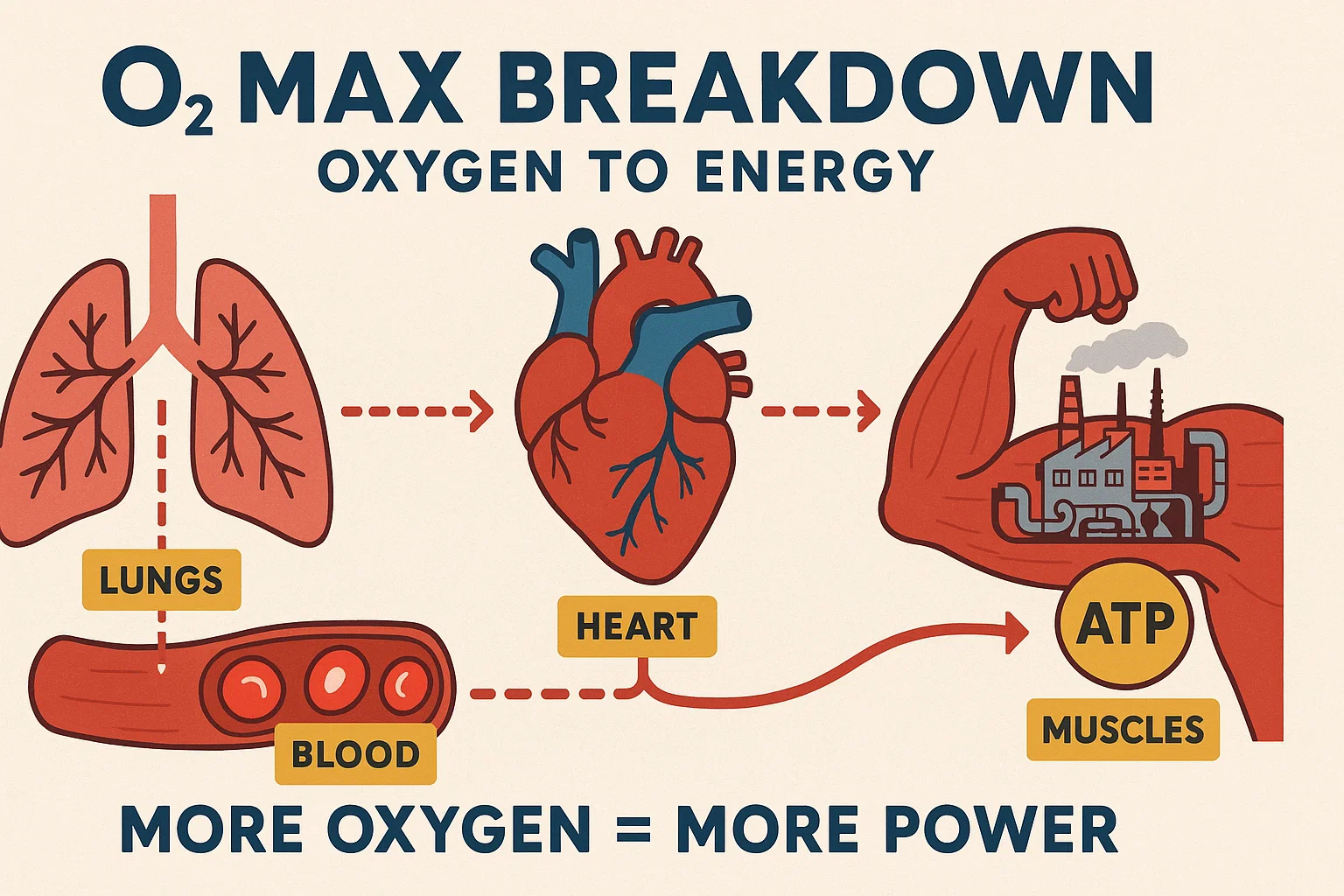
Physically, here’s how it works: you breathe in oxygen, your lungs send it to your blood, and then your heart pumps that oxygen-rich blood to your muscles. Your muscles use that oxygen to create ATP – the energy your muscles need to work. V02 Max measures how well your body can deliver and use oxygen when you’re going full throttle.

You’ll usually see VO2 Max numbers in mL/kg/min (milliliters of oxygen per kilogram of body weight per minute).

So, if your VO2 Max is 50, it means your body can use 50 mL of oxygen per kilogram per minute when you’re pushing hard. The higher the number, the better your body can keep up with the demands of exercise.

Explaining VO2Max to Beginners

Let’s break it down into simpler terms:

  1. Your body is a factory – it needs oxygen to produce energy for exercise. VO2 Max is how much oxygen it can process in one minute when you’re running at full speed.
  2. Bigger lungs, stronger heart = better VO2 Max – The bigger your lungs and heart, the more oxygen you can take in and use. So, someone with a higher VO2 Max can get more oxygen to their muscles.
  3. Everyday analogy: Think about climbing stairs. If you’ve got a higher VO2 Max, you can climb two flights without breaking a sweat. Someone with a lower VO2 Max might huff and puff after just one. It’s all about the power of your “oxygen engine.”
  4. VO2 Max is just one piece of the puzzle: It’s a measure of aerobic fitness, but it’s not the whole story. A coach might say, “It’s like knowing how big your fuel tank is, but you also need to know how well your engine runs on that fuel and how fast you can use it.”

If you’re new to running, here’s the bottom line: V02 Max tells you how much oxygen your body can use when you’re working hard. Think of it like your car’s fuel intake – the bigger it is, the more fuel you can burn per minute. In running terms, the more oxygen you can take in and use, the faster and farther you can go.

But remember, VO2 Max is just one factor. How efficiently you use that fuel (your running economy) and how long you can keep going (your lactate threshold) matter, too..

My Own Take

When I first got curious about VO2 Max, I decided to take the plunge and book a lab test.

I walked into the local university’s exercise lab, strapped on a mask, and got on a treadmill.

The scientist gradually cranked up the speed and incline until I was gasping for air – it felt like I was in some sci-fi movie. But in the end, I saw my number: 52 mL/kg/min. Not bad for a 26-year-old runner who wasn’t exactly gunning for elite status.

A few years later, I grabbed a GPS watch that estimated my VO2 Max.

At first, I thought, “There’s no way this watch can measure VO2.” Turns out, these devices can’t actually measure oxygen intake – they estimate it using your heart rate and pace. I found that my watch often showed slightly higher numbers than my lab test, but it still gave me a sense of progress. 

After adding in some HIIT workouts and cycling, I saw my VO2 Max improve.

After 12 weeks of doing 800m repeats and spin classes, my lab-tested VO2 Max went up by 6%.

Research backs this up – high-intensity interval training can boost VO2 Max, even for people who are already pretty fit.

But when I took a break from training (hello, holiday laziness!), I saw my numbers drop. That’s the thing with VO2 Max – it’s a reflection of your consistency.

What Affects V02 Max?

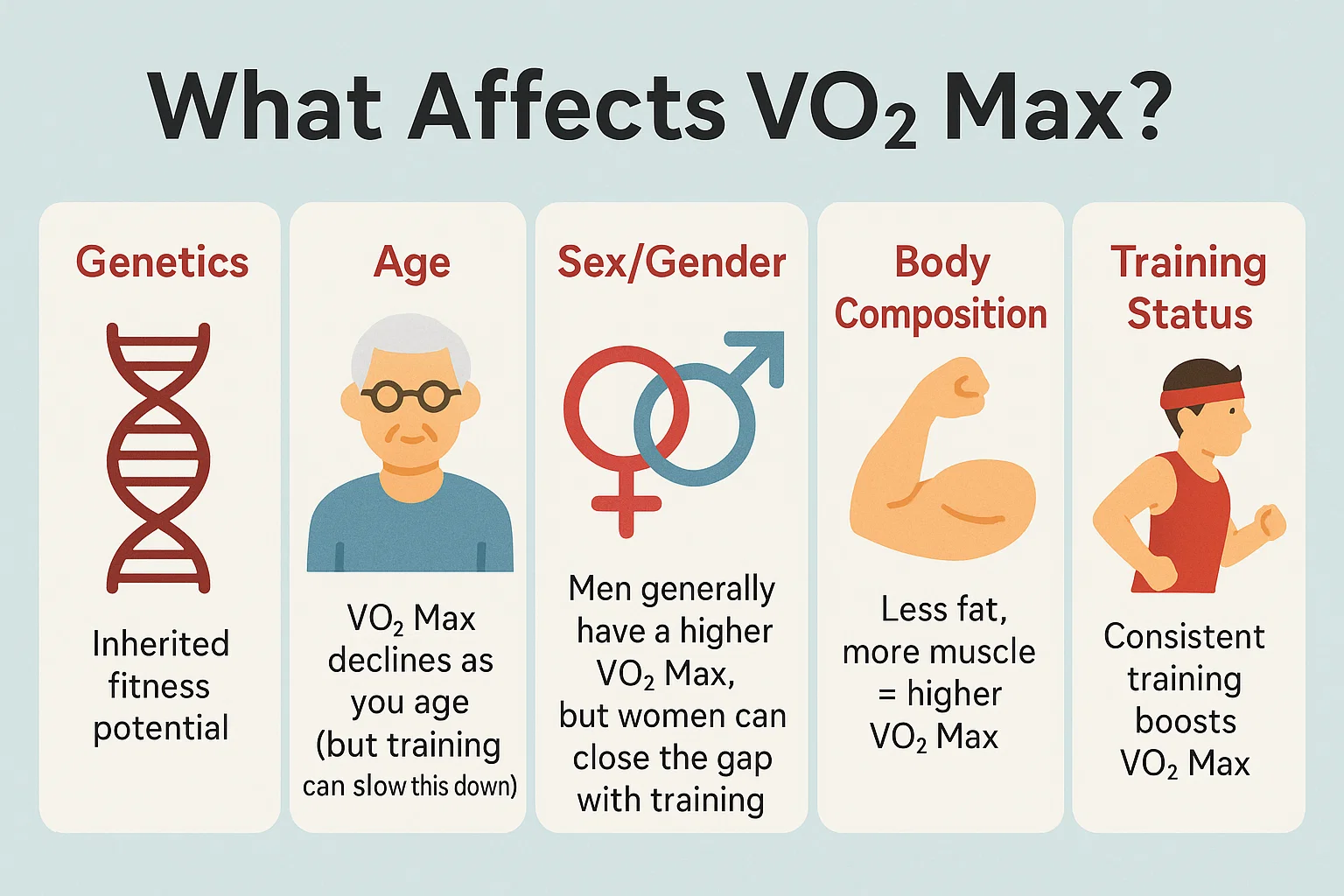
There are a few things that affect your VO2 Max. Some you’ve got no control over, and some you can definitely work on with time. Here’s the lowdown:

  • Genetics: Yeah, some of this is in the genes. If your family’s packed with athletes, you might have a natural advantage. But even if you didn’t inherit superhuman VO2 Max genes, don’t sweat it. You can still improve with the right training. I didn’t exactly have the natural build of an elite runner, but with consistent effort, I’ve seen my VO2Max improve.
  • Age: As we get older, VO2 Max starts to dip. A healthy 20-year-old might be sitting around 40-50 ml/kg/min, but by the time you hit your 70s, you’re looking at 20-30. Not ideal, but the good news is that staying active can slow that decline a lot. The key? Don’t let age be an excuse. Keep working, and you’ll be in better shape than most people your age.
  • Sex/Gender: On average, women have a VO2 Max about 15-30% lower than men. This is because of differences in body fat, muscle mass, and hemoglobin. But guess what? If you’re a female athlete with the right training, you can close that gap to about 10%. So ladies, don’t let the numbers scare you—focus on your training.
  • Body Composition: Since VO2 Max is measured per kilogram of body weight, carrying extra weight (especially fat) will lower your score. The good news? If you drop unnecessary weight (while keeping muscle), you’ll naturally boost your VO2 Max. Even Harvard Health backs this up—losing fat can help increase your VO2.
  • Training Status: This one’s in your control. Regular training, especially high-intensity stuff, will raise your VO2 Max. Beginners often see huge improvements, but don’t get down if you’re a veteran runner—those small gains are still worth celebrating. It’s about consistency.
  • Altitude: Training or living in the mountains can help you build up red blood cells, which can improve your VO2 Max. But heads up: when you’re up there, your VO2 Max will temporarily drop because of the thinner air. It’s all about the long haul.
  • Health and Diet: Got a health issue like anemia or a lung condition? That can lower your VO2 Max. But a healthy lifestyle—good sleep, eating well, and avoiding smoking—can help you keep it up. It’s all about those solid habits.
  • Day-to-Day Variation: Your VO2 Max might shift a little depending on things like how tired you are or if you’re dehydrated, but those changes won’t be huge. It’s all about consistency over time.

What affect vo2 max

VO2Max and Your Running Performance

So, how does VO2 Max actually affect your running? It’s important, but it’s not the whole picture. Think of endurance like a three-legged stool:

  1. VO2 Max (how much oxygen you can use)
  2. Lactate threshold (how fast you can go before lactic acid builds up)
  3. Running economy (how efficiently you use oxygen)

All three are key. VO2 Max is important because it’s the size of your engine. But once your engine’s decent, you need to work on the other stuff—lactate threshold and economy.

If you want to run faster, it’s not all about pushing that VO2 Max higher and higher.

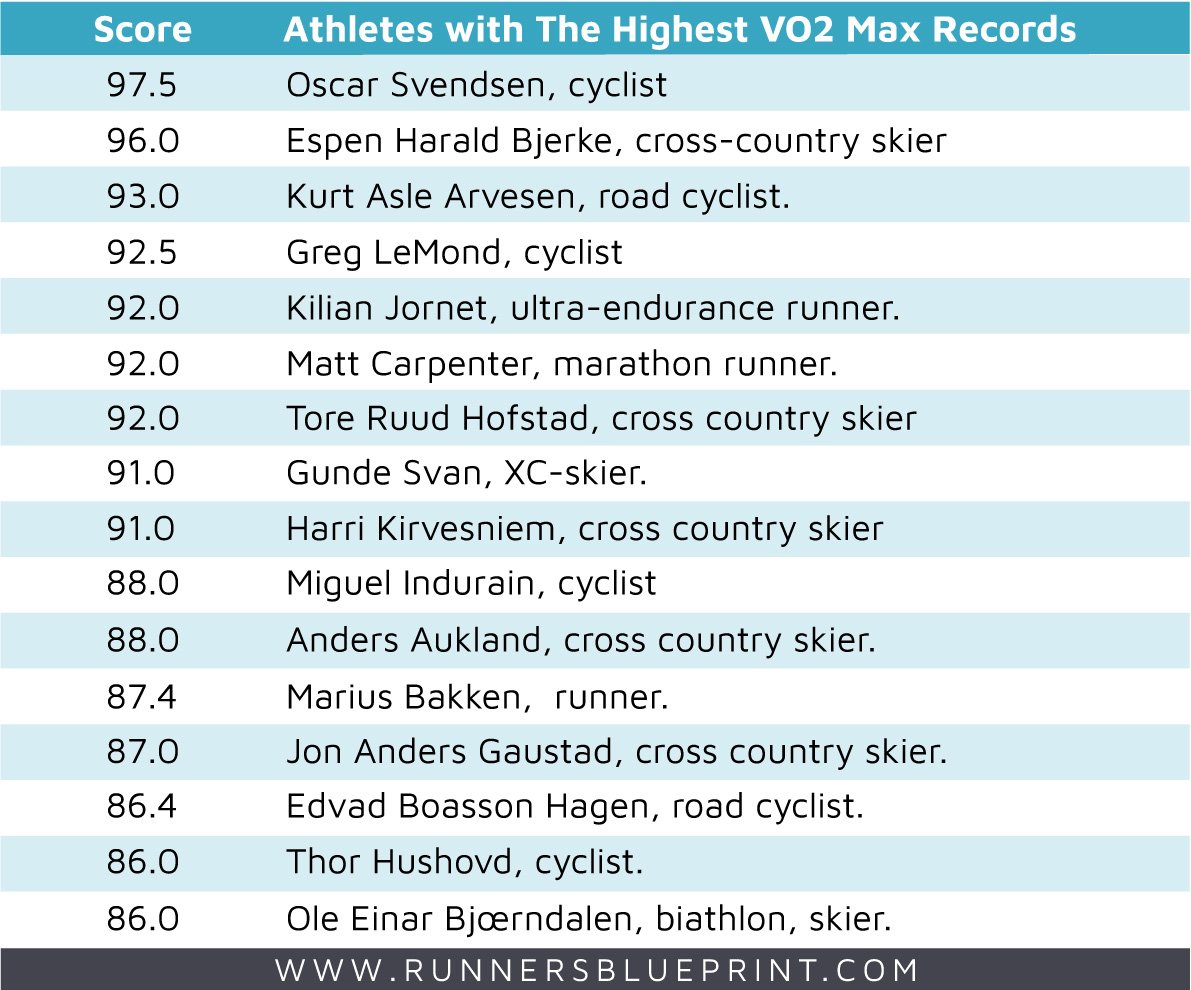
Take this: Runner A has a VO2 Max of 60, and Runner B has 50. All else equal, Runner A can go faster for the same effort. Elite runners usually have VO2 Maxes in the 70s or 80s, sometimes even higher. The world record-holders? We’re talking numbers like 96 for men and 79 for women. That’s nearly double what the average person has.

But once you’ve built up a decent VO2 Max, it’s about honing those other aspects—your lactate threshold and running economy. That’s why some of the fastest runners focus on tempo runs, long runs, and strength work. Don’t just focus on VO2Max; mix it all up.

VO2 Max in the Real World: What’s ‘Normal’ For You?

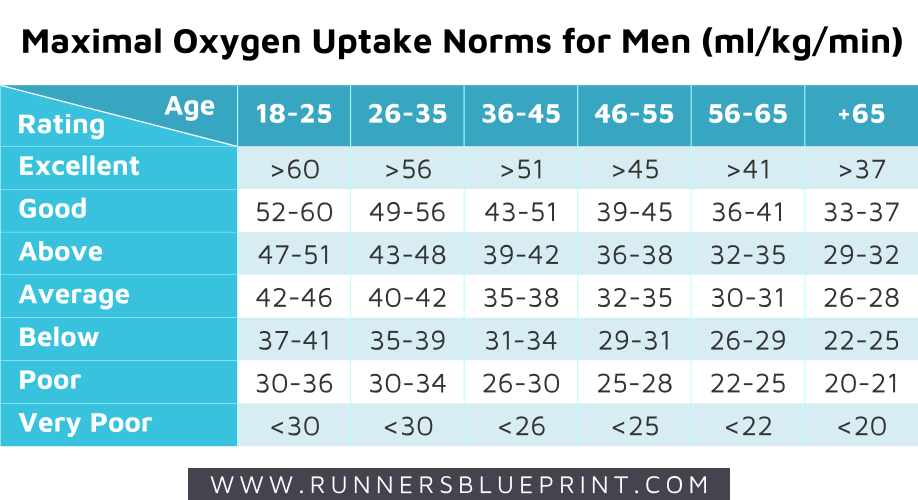
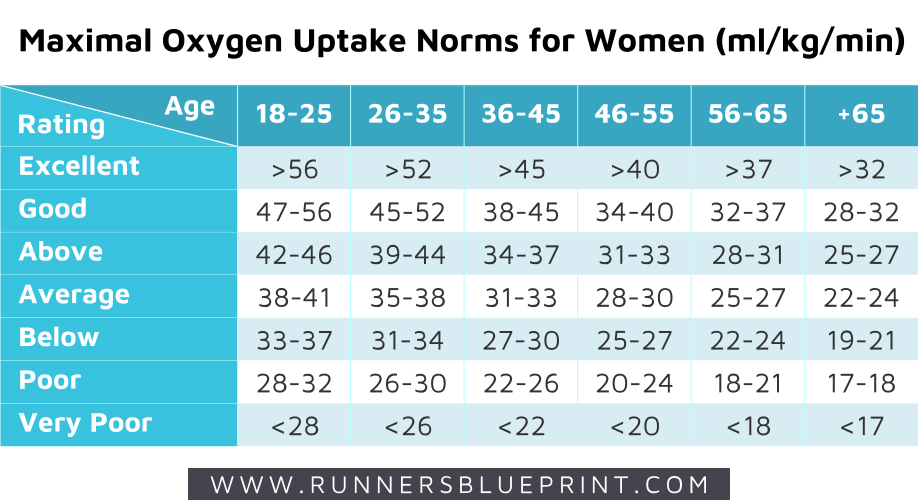
VO2 Max is a great fitness gauge, but it’s not a perfect one-size-fits-all measurement. For example, a well-trained 30-year-old guy might sit at about 50 ml/kg/min, while a top high school runner might have something in the high 60s. If you’re in your 60s, don’t worry. If you’re staying active, you might still have a VO2 Max in the 20s or 30s.

In short races (like a 5K or 10K), VO2 Max matters a lot. For marathons, it’s still important, but your lactate threshold is key. Your ability to sustain a pace over time is what separates good runners from great ones. VO2 Max will give you a solid foundation, but it’s what you do with that oxygen that counts.

VO2 max charts

VO2 max chart

The Bottom Line: VO2 Max is Key, but It’s Not Everything

VO2 Max is one of the most important factors for endurance athletes, but it’s not the only factor. You can train to improve your VO2 Max, but don’t forget about tempo runs, long runs, and strength training. It’s the combination of all these that will get you faster and more efficient.

So, don’t worry too much about your number on paper. Keep putting in the work, and your V02 Max will improve. Keep pushing, and you’ll keep improving.

How to Measure VO2Max (Lab and DIY)

So, you’re curious about how to measure VO2 Max? It’s a great question! There are two main ways to do it: the gold-standard lab test and a few DIY methods you can try on your own. Let’s break it down, starting with the lab.

Lab Testing (Gold Standard)

In a sports science lab, they measure VO2 Max directly. They slap a heart rate monitor on you and fit you with a tight mask that collects every breath.

Sounds a little sci-fi, right? You’ll run on a treadmill or ride a stationary bike while the intensity slowly increases until you’re completely gassed (usually in 10–20 minutes) (health.harvard.edu).

The mask tracks the oxygen you inhale and the carbon dioxide you exhale. When your oxygen consumption levels off, bingo—that’s your VO2 Max. This method is solid because it directly measures how much oxygen your body is using.

But here’s the catch: these lab tests aren’t cheap. They can run anywhere from $50 to $200, and they’re not something most recreational runners are doing every weekend. But if you ever find yourself in a sports physiology study or exercise medicine clinic, you could get a test done.

Field and DIY Tests

If the lab route isn’t in the cards for you, don’t sweat it—there are plenty of DIY options that’ll give you a decent estimate.

Cooper 12-Minute Run Test:

The deal is simple: run as far as you can in 12 minutes. Once you’re done, plug your distance into this formula:

V02 Max ≈ (distance in meters – 504.9) ÷ 44.73 (brianmac.co.uk).

For example, if you ran 2400 meters, it works out like this: (2400–504.9)/44.73 ≈ 42.4 ml/kg/min. Easy enough, right?

Cooper VO2 max

One-Mile Walk/Run Test:

Walk or run a mile as fast as you can, then immediately take your heart rate. Plug your time, heart rate, weight, and age into an online calculator. Harvard Health has a good one for estimating V02 Max.

Rockport (1-Mile) Walk Test:

Walk a mile as fast as you can, and measure your finish time and heart rate. Then, you can use the Rockport formula or an online tool to get your VO2 Max estimate.

Beep Test:

This is the “20-meter multistage fitness test” (yeah, the bleep test). You run back and forth to timed beeps. Your final level reached gives a rough idea of your VO2 Max.

Maximal Heart Rate Estimates:

Use the classic formula (220 – age) or get a little more advanced with ACSM’s tables. Combine that with your fastest pace for a quick VO2 Max guess.

Fitness Trackers/Apps:

Devices like Garmin, Fitbit, and Apple Watch use your heart rate at different paces to estimate your VO2 Max. They apply some algorithms and give you a ballpark figure.

These DIY methods aren’t as exact as a lab test, but they’ll get you close. Just make sure you keep your testing conditions consistent—flat course, well-rested, same shoes. And if you’re using a tracker, watch how your VO2Max trends over time. If it’s creeping up over a few weeks, you’re definitely improving!

Still want more V02 Max tests?

There are many methods for estimating VO2’max scores and different types of V02 max charts.

Maybe you heard a similar term but different methods.

Here are some of the most reliable ones.

These should be suitable for any fitness and lifestyle—even if you can’t walk:

How to Improve (Increase) Your VO2’Max Through Training

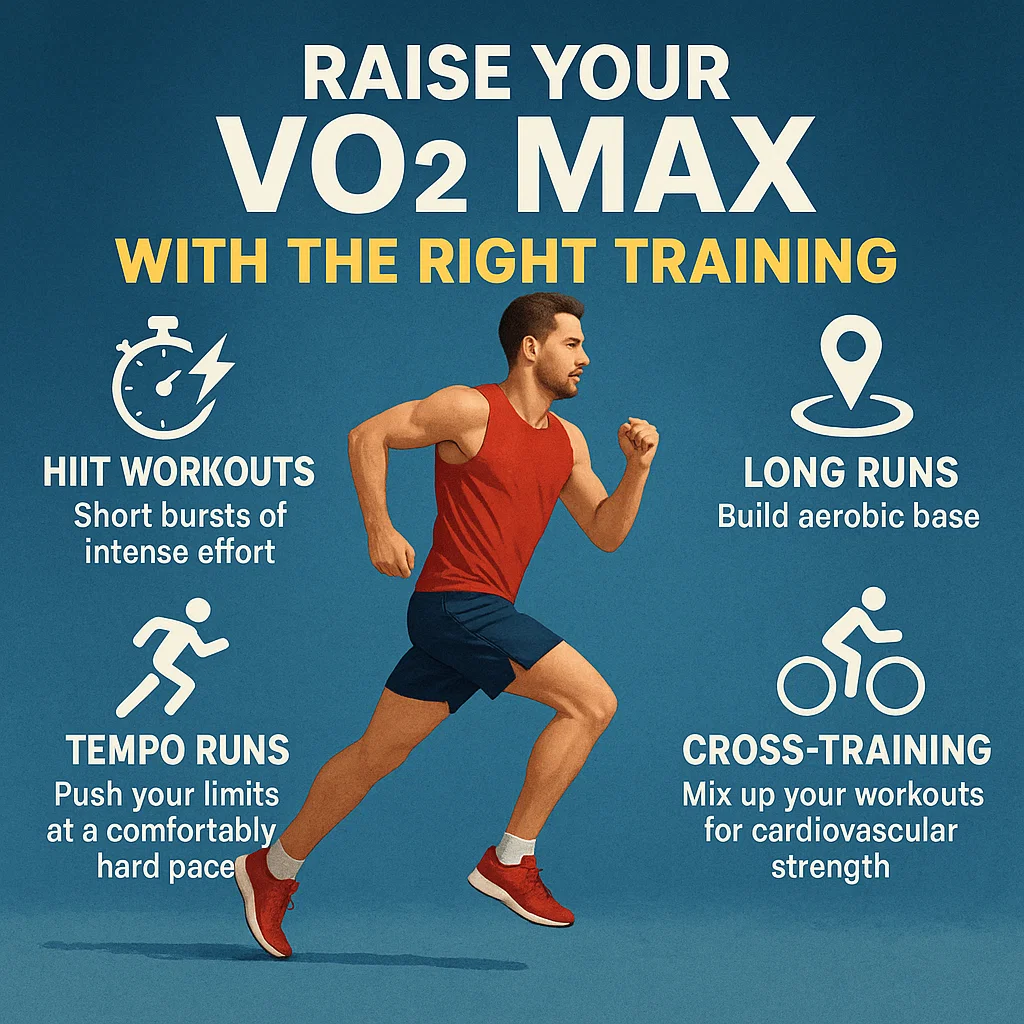
Alright, so now that you’ve got a VO2 Max number, let’s talk about how to raise it. If you want a higher VO2 Max, you’ve got to challenge your aerobic system. You need to push your body, and with the right training, it will adapt by improving your heart, lungs, and muscles. Here’s what works for me:

High-Intensity Interval Training (HIIT):

This is by far the most effective way to raise your VO2 Max. Short bursts of near-all-out effort push your system to its limits. For example, try 800-meter repeats or 3–5 minute hard efforts at max intensity. Harvard Health even says “HIIT is a fast and effective way to increase VO2 max, even if you’re already very active”. Aim for 2–3 interval sessions per week.

Long VO2 Max Intervals (Track Workouts):

Try this: 3 minutes at 90–95% effort, followed by 2 minutes easy jog. Repeat that 4 times for a 20-minute workout. This forces your heart and muscles to use more oxygen. It’s tough, but it’s a great workout.

Tempo Runs:

This is running at about 85–90% of your max effort—what I call a comfortably hard pace. For instance, run at this pace for 20 minutes, and you’ll see a nice improvement in how your muscles use oxygen.

Steady-State Aerobic Runs:

Don’t neglect the long, easy runs. These build your aerobic base. Think 60–90 minutes at an easy pace. This improves capillary density and mitochondrial function, indirectly supporting VO2.

Cross-Training:

Mix it up! If you’re always running, add cycling, swimming, or rowing. These activities challenge your cardiovascular system in new ways, helping boost VO2 Max.

Personal Experience:

For me, variety was key. I’ve gone through phases where I did hill sprints (20–30 second all-out efforts uphill) twice a week, and then there were times I focused on steady miles at a moderate pace. I always saw gains, but the biggest jumps in VO2 came from pushing hard. Interval training was a game-changer.

After a few weeks of HIIT, my body started to crave those high-intensity efforts. I remember one spring when I did 5×1000m intervals twice a week. My legs felt like they were spring-loaded, and my VO2 Max jumped by 5 points in 8 weeks.

There’s no magic trick—just a mix of consistent effort and pushing your limits. Every coach, no matter how many studies they quote, will tell you the same: push near your max capacity to see V02 improvements.

And don’t forget rest—overtraining can totally stall your progress.

Sample HIIT Workout:

  1. Warm up with an easy 10-minute jog.
  2. Then do 4 repeats of:
    • 3 minutes at near-all-out effort
    • 2 minutes easy recovery jog
  3. Cool down with 10 minutes of easy jogging.

This 20-minute workout hits your system hard and gets results (rei.com).

VO2 Max for Runners: Recreational vs Elite

So, let’s get this out there—VO2 Max is a big deal, but it’s not the only deal, especially for those of us who aren’t trying to land a spot on Team USA.

Recreational Runners: The Sweet Spot for Improvement

If you’re not trying to break world records (and let’s face it, most of us aren’t), don’t stress about having a VO2 Max like a pro runner. The great news? If you’re just starting out or you’re moderately trained, you’ve got a ton of room to grow.

In fact, untrained folks can see a 15-20% increase in their VO2 Max with a solid training block. That means, if your starting number is 40, with consistent effort, you could push it to 46-48. For a 30-year-old, that jump could take you from average to above-average. That’s a big win, right?

Top Athletes: Tiny Gains, Big Focus

For elite runners, they’re already at the top of the game with their VO2Max. We’re talking numbers in the 80s and 90s (ml/kg/min). Think of legends like Oskar Svendsen (cycling) with a VO2 of 97.5 and Bjørn Dæhlie (cross-country skiing) at 96.0. For women, Joan Benoit Samuelson’s 78.6 is something to marvel at.

These athletes are already pushing the limits, so every little increase in VO2 is harder to come by. They work obsessively on these tiny gains because when you’re already at the top, every edge counts.

But here’s the kicker: they’re not obsessing over the number—they’re focusing on getting stronger, faster, and better with every step.

Take a look at thee scores:

v02 max chart

VO2 Max FAQs: Your Personal Running Game-Changer

Q: Why is my VO2 Max important?

A: VO2 Max is one of the key ways we measure how fit we are. The higher it is, the better you can perform—whether that’s running a faster 5K or pushing through a long race. It’s also tied to overall health—lower risk of heart disease, better endurance, and more. Basically, the higher your VO2 Max, the more “fit” you are. Keep that in mind when you’re out on your runs—it’s a big piece of the puzzle.

Q: Can I increase my VO2 Max if I’m older?

A: Absolutely. VO2 Max drops with age, sure, but that doesn’t mean it’s a lost cause. Staying active—especially with HIIT—can slow that decline. In fact, studies show that even folks in their 50s and 60s can still boost their VO2 Max. You might not hit those teenage numbers, but you’ll definitely feel the benefits in how you perform and how you feel. The key is consistency and staying active, no matter what age you are. Trust me, you’ve still got a lot of power in those legs.

Q: How often should I test my VO2 Max?

A: There’s no strict rule. If you’re really trying to track your progress closely, lab tests might happen every 3-6 months. But for most of us, using a fitness watch to check in weekly or monthly is enough to see trends. Personally, I liked checking mine seasonally to see how I was doing. Just don’t overdo it—your numbers might fluctuate a little from day to day. It’s normal.

Q: What if I lose weight? Does my VO2 Max change?

A: Yep, it does. Since VO2 Max is relative to body weight, losing fat can make it look better, as long as your oxygen uptake stays the same. If you shed some weight, your body has less to move around, so your VO2 Max goes up. But hey, don’t just focus on the number—how you feel is what matters most. Weight loss can definitely help, though.

Q: I don’t run much—do I need to worry about VO2 Max?

A: You don’t need to obsess over it, but it definitely matters if you’re doing any cardio—running, biking, swimming, hiking, whatever. VO2 Max is all about how efficiently your body uses oxygen during exercise, and if you’re active, it’s going to help you do all those things with less struggle. Don’t stress if you don’t track your VO2, but just know that staying active and improving it can make your workouts feel easier.

Q: Should I only focus on VO2 Max training?

A: Nah, don’t get stuck just trying to chase that number. While intervals can help, a balanced approach is the way to go. Mix in some easy runs, tempo work, and even strength training. That’s what’ll make you a better all-around runner. I learned this firsthand—when I switched to adding longer tempo runs to my training, my race times got faster, even though my VO2 plateaued. So, focus on variety, not just VO2 Max.

Q: How accurate are VO2 Max estimates on my watch?

A: They’re estimates, not perfect. Devices like the Garmin or Apple Watch usually have a 5-10% margin of error. For instance, if your real VO2 Max is 50, your watch might show 52 or 48. But honestly, that doesn’t matter too much as long as you’re consistent with the same device and setup. What matters is the trend over time—don’t sweat the small fluctuations. It’s a solid way to track progress.

Q: Can altitude training boost my VO2 Max?

A: Altitude training can help by increasing your red blood cell count, which can boost your VO2 Max once you get back to sea level. But here’s the thing—training at altitude is tough, especially at first. It’s usually something advanced athletes do. For most of us, regular training at home is enough. So, don’t stress if you can’t get to the mountains—keep working hard where you are.

Final Thoughts:

VO2 Max is a useful tool, but it’s just one part of the fitness puzzle. It’s all about how efficiently your body uses oxygen during exercise, and you can use it to train smarter and run stronger.

But here’s the thing: don’t become obsessed with the number. Use it as a gauge for progress, but don’t let it define your running journey. If it’s going up, awesome. If it stalls, take a step back and adjust your training or focus on recovery.

And above all, remember why you’re running in the first place. It’s not just about numbers or stats—it’s about enjoying the process and improving yourself over time.

Whether you’re chasing a PR or just out for a fun run with friends, let the joy of running drive you. So next time you’re pushing through a hard workout, know you’re making gains, whether you’re aware of it or not. Keep learning about your body, keep pushing forward, and most importantly—have fun with it!

Good luck, and may your VO2 Max rise along with your smile as you cross that finish line!

Further Reading on VO2 Max

To deepen your understanding of VO2 max and its importance for runners, here are some reputable organizations and studies that provide valuable insights:

  • American College of Sports Medicine (ACSM): The ACSM is a leading authority on sports medicine and exercise science. Their comprehensive guidelines on exercise testing and prescription emphasize the significance of VO2 max for athletic performance. You can explore their resources on VO2 max in their position stand, available at the ACSM website.
  • Journal of Sports Science and Medicine: This peer-reviewed journal features a range of studies that delve into the effects of VO2 max on performance. For instance, the article titled “The Relationship Between VO2 Max and Running Performance” discusses how VO2 max levels correlate with various race performances.
  • British Journal of Sports Medicine: This journal regularly publishes research on exercise physiology and training methods. A notable study, “How to Measure and Improve Your VO2 Max”, provides insights into measuring VO2 max and training strategies to enhance it.
  • Mayo Clinic: The Mayo Clinic offers accessible information on VO2 max and its implications for cardiovascular health. Their article on “Exercise and Heart Health” discusses the role of aerobic exercise and VO2 max in maintaining heart health.
  • Runner’s World: This popular resource provides articles specifically focused on running and performance metrics, including VO2 max. Check out their article, “How to Boost Your VO2 Max” for practical tips and insights.


How Extra Pounds Slow You Down (and What to Do About It)

If you’ve ever wondered, “Does weight actually mess with your pace?” — the answer is a loud yes.

But it’s not just a doom-and-gloom story of “lose weight or lose speed.”

There’s more to it. There’s strategy, there’s progress, and yep — there’s science to back it up.

Let’s break it down in real terms.

No fluff.

Just what actually matters when it comes to weight, running pace, and feeling lighter on your feet.

The Real Cost of Carrying Extra Weight

Running’s like driving uphill with a loaded trunk — the heavier you are, the harder your body has to work to move forward.

Some classic research nailed this down.

In one study, runners who carried added weight slowed down by about 1.4 seconds per mile for every extra pound.

Another lab study flipped the script — they lightened runners with pulleys and saw a gain of 2.4 seconds per mile for every pound lost .

Do the math: drop 10–20 pounds?

That’s potentially 20–50 seconds faster per mile. That’s not a tweak — that’s a whole new race day.

I’ve seen it happen first-hand.

One runner I coached dropped about 13 pounds and cut over a minute off his 6-mile loop. From 10:30 to 9:20 per mile. That kind of change doesn’t just show up on the stopwatch — it shows up in confidence too.

Your Body’s Energy Budget

Most people don’t realize this, but nearly 75% of your energy while running goes into just keeping your body up off the ground.

Not sprinting forward.

Not pacing smart.

Just… not faceplanting.

The other 25% actually moves you forward.

So if your body’s carrying more weight than it needs, it’s spending most of its gas on survival, not speed.

Weight Messes With Your Form

Here’s something most people don’t think about: extra weight messes with your stride.

It’s not just about huffing and puffing more. Extra pounds throw off your whole running form.

You lean more.

You strike harder.

You shorten your stride without meaning to.

I’ve trained with a weighted vest a few times just to simulate effort. Let me tell you — just 5 kilos strapped to my chest made me feel like I was slogging through sand. Everything changed: my posture, my stride, even my breathing.

Coach tip?

On heavier days, shorten your stride. Go for quick, light steps instead of big bounds. Trust me — your knees will thank you later.

Joints Take the Hit Too

Every step when you’re carrying extra weight is like a mini assault on your joints. That adds up fast.

One of my runners once told me, “I didn’t know plantar fasciitis could go away until I leaned out a bit.” Sometimes it’s not the shoes. It’s the load.

On the flip side, even losing 5% of your body weight can make hill repeats feel less like torture and more like a challenge you can actually finish. But quick warning — crash diets don’t fix anything. We’ll get into that in a bit.

What the Science Says (And Why It Matters)

This whole weight-speed thing isn’t just in our heads. It’s in the data.

That old-school study I mentioned?

The one where runners wore added weights? Yep — 1.4 seconds per mile slower per pound. A more recent one “lightened” runners using pulleys and clocked 2.4 seconds per mile faster per pound lost.

Why?

Because running is basically hopping against gravity, over and over. And the more you weigh, the more fuel your body has to burn just to lift itself.

Here’s something wild: adding 4 lbs to your waist raises your energy cost by 4%.

But adding that same weight to your ankles? That jacks energy cost up by 24%. Where your weight sits matters too.

And one more thing: not all weight loss is equal.

Losing muscle can backfire. Muscle helps generate force. Fat, on the other hand, is just along for the ride. So the goal is fat loss — not just any weight loss.

How Much Faster Can You Run If You Drop 20 Pounds?

This is one of those questions I get all the time:

“If I lose 20 pounds, will I get faster?”

Short answer? Most likely—yes.

But how much faster? That depends.

There’s no perfect formula, but the rough estimate backed by research is this: 1–2 seconds per mile per pound lost. So, 20 pounds could shave 20 to 40 seconds off each mile.

Let’s break that down.

  • A study once crunched the numbers to about 4 seconds per mile per pound. That’s roughly 28 seconds faster per mile if you lose 20 pounds.
  • Another report pushed it to 4 seconds per mile per pound—meaning a potential gain of 48 seconds per mile.

So yeah, it adds up fast. Especially across longer races.

Don’t get me wrong. I’m not saying that dropping to zero pounds will make you run at the speed of sound. But extra pounds matter. And they matter a lot. Just keep in mind that if you drop too low, performance tanks.

Lose too much weight, and you’re not just shedding fat—you’re shedding power.

Rules of Thumb That Actually Work

If you’re into quick-and-dirty ways to set goals, here are two simple tools runners and coaches have used for years:

1. The “1% Rule”

Drop 1% of your body weight, and your pace improves by about 1%. So if you weigh 150 lbs and lose 1.5 lbs, expect about a 1% boost in speed. Nothing magic—just physics.

2. The “2-Second Rule”

Lose 1 pound, run 1 to 2 seconds faster per mile. A lot of runners swear by the 2-second estimate. Over a marathon, that’s about a minute faster per pound.

But again, these are just ballpark numbers. They only apply if the weight lost is mostly fat, and your training stays steady.

If you’re cutting calories so hard that your workouts suffer or you start losing muscle, those speed gains might vanish.

So here’s the bottom line: Use these rules to set expectations, not to obsess over numbers. They’re guides, not gospel.

Fat vs. Muscle: It’s Not the Same

Let’s clear this up—not all weight is created equal.

  • Muscle is your engine. It weighs more, but it helps you run stronger and handle hills, sprints, and long miles.
  • Fat? That’s just cargo. It slows you down and offers zero return on effort.

I had a sprinter friend who bulked up in the winter. Crushed it in the gym.

But on the track? His times got worse. Once he cut the fat—not the muscle—his speed came back.

If you’re lifting weights and eating enough protein while dropping fat, you’ll run leaner, stronger, and more efficient. That’s the sweet spot.

Running Isn’t Just Math

Let’s be real for a second.

Anyone can write down “lose 20 lbs” in a notebook. But executing that goal while still training hard? That’s where most runners hit the wall—usually around week 3 of some crash diet they found online.

Focus on Performance First

All the best runners I’ve coached?

They trained smart, fueled right, and didn’t obsess over the scale.

Their bodies leaned out as a result of consistent effort, not restriction.

A coach once said, “Do the training, eat well, and the right weight will find you.” And that’s been true in my experience too.

Eat to Run—Don’t Starve to Shrink

If you’re upping the mileage or adding speedwork, your body needs fuel.

Yes, you want to drop fat—but cutting too many calories will leave you flat, slow, and frustrated.

Think real food: lean protein, colorful veggies, solid carbs. You’re not just feeding your stomach—you’re charging your battery.

Training Beats Dieting—Every Time

Let’s not forget: speed comes from smart workouts—long runs, tempos, intervals, strength.

Dropping weight can help, but it’s not the whole puzzle.

I always tell my athletes: “You can’t out-diet bad training.”

Find Your Racing Weight

Everyone’s got a personal best weight—not the lowest weight, but the strongest one.

One runner I worked with said, “My coach warned me if I drop below 136 lbs (I’m 5’9”), I lose power. I feel best at 140.” That’s what you’re looking for—the weight where you feel fast, healthy, and in control.

Don’t chase someone else’s number.

Genetics matter.

Instead, track how you feel and perform at different weights. Let that guide you—not the bathroom scale.

Practical Tips: Committing to Your Ideal Race Weight

Let’s bring it home with a few action steps. These are not about starving yourself; they’re about smart, sustainable choices that naturally tune your weight for speed:

  • Set Process Goals, Not Just a Number: For example, commit to 4 runs a week or to adding one speed session. Let these activities help balance your weight over time.
  • Strength Train Regularly: At least twice a week. Muscle boosts your metabolism and power. Strong runners handle weight changes better.
  • Watch the Fuel, Not Just Fat: Quality matters. If you do cut calories, do it slowly (250–500 kcal/day deficit), and focus on protein and veggies. Avoid empty carbs and sugars.
  • Be Patient: Safe fat loss is about 0.5–1% of body weight per week. Faster often means muscle loss.
  • Use Tools Wisely: A running calculator or watch can estimate effect of weight on pace, but don’t get obsessed. Use them for motivation, not stress.
  • Listen to Your Body: Slower recovery, increased injuries, constant fatigue? These can be signs you’re losing more than fat. Adjust food or training accordingly.
  • Remember Recovery: More sleep, better hydration, and stress management help your body adapt and recover, making weight goals more attainable.

Conclusion: Embrace Your Journey

Extra weight on your frame is only one factor in a complex equation.

The good news is, it’s one you can work on with training and smart nutrition.

I’ve seen runners shave minutes off marathons after dialing in their weight and their workouts. But I’ve also seen runners crash from overdoing it.

Here’s the truth I want you to take away: Don’t let the scale be the boss of you. Use it as feedback.

Train hard, fuel well, and your body will find its racing groove.

I challenge you to commit to finding your ideal race weight – not by obsessing on pounds, but by building a strong, well-fueled body that wants to stay lean.

Check in on your weight every few weeks, but base your decisions on how you feel and perform, not just a number.

Keep running with heart; the speed will follow.

Why Run-Walk Is the Smart Way to Train for Your First 10K

Let’s be honest: running 6.2 miles straight can feel like a mountain when you’re just starting out.

You’re not lazy for thinking that—it’s normal to be intimidated.

Heck, I’ve worked with runners who stared at a 10K on the calendar and immediately started negotiating with themselves.

But here’s what most beginners don’t know: you don’t have to run the whole thing to call yourself a runner.

That’s where the Run-Walk Method comes in—and it’s a total game changer.

The run-walk approach breaks the distance into manageable chunks.

You run for a bit, walk for a bit, then repeat.

Think of it like interval breathing for your legs.

Those walk breaks? They aren’t cheating.

They’re strategic resets—a chance to breathe, recover, and stay in the game without burning out or breaking down.

Why Run-Walk Works So Damn Well

Let’s start with the injury factor.

Jeff Galloway—an Olympic runner and the guy who popularized this method—tested it on 22 beginner runners.

All 22 finished a 5K or 10K in 10 weeks.

Zero injuries.

That’s unheard of in traditional training, where beginner injuries are almost expected.

Usually, at least a couple runners end up limping to the sidelines with shin splints, knee pain, or a pulled something-or-other.

By easing the load with walk breaks, you dodge the “too much, too soon” trap that wrecks so many new runners.

Instead of pushing through fatigue and risking injury, you finish your workouts feeling strong—and wanting to do it again.

That’s the secret sauce right there.

The Real Mindset Shift

Here’s something I tell every beginner:

“The finish line doesn’t care how many walk breaks you took.”

It only cares that you showed up and kept moving forward.

Run-walk isn’t Plan B. For beginners? It’s the smartest Plan A. And frankly, even experienced runners use it during hot races, long runs, or ultras. Why? Because it works.

So if you’re worried about being “too slow” or “not a real runner,” drop that baggage now. You are a runner. Walk breaks don’t take that away—they help make it happen.

What’s a 10K, Anyway?

Let’s break it down:

  • A 10K = 10 kilometers = 2 miles
  • That’s 25 laps around a standard track, or about 12,000–15,000 steps
  • It’s double a 5K, and half of a half marathon (13.1 miles)

A lot of new runners graduate to a 10K after finishing a 5K and thinking, “What’s next?” It’s the perfect middle ground.

Long enough to be a real challenge, but not so long that you’re spending half your weekend doing long runs.

And bonus—it doesn’t eat up your life like marathon training can. You can train smart for a 10K and still have energy for your family, job, and, you know, sleep.

How Popular Is the 10K?

It’s a crowd favorite:

  • In the U.S., 10Ks make up around 9% of all race registrations
  • That’s 65 million 10K finishers in 2018 alone
  • Globally? Over 8 million people tackled a 10K that same year

Sure, 5Ks get most of the spotlight (about 49% of race entries), but 10Ks are where a lot of runners build real endurance and test what they’re made of.

Think of it this way: a solid 10K run takes about 55–65 minutes for most everyday runners.

That’s a legit workout. And if you’ve got dreams of running a half or full marathon one day? The 10K is your training ground.

Even competitive runners love it—it blends speed and endurance in a way that tests both your lungs and your grit.

For context, the world record is 26:24. That’s under 4.5 minutes per mile. Wild, right?

But don’t compare yourself to elites. Whether you run a 10K in an hour or walk-jog it in 90 minutes, finishing a 10K is a big deal.

How Long Does It Take to Walk (or Run-Walk) a 10K?

One of the first things people ask when they sign up for a 10K is: How long is this gonna take me?

And the truth is — it depends. Are you walking it? Doing run-walk intervals? Jogging the whole thing?

Either way, I’ll break it down for you.

But here’s the bottom line: your first 10K isn’t about the clock — it’s about crossing that finish line in one piece, with your head high.

Let’s walk (or run-walk) through a few real scenarios:

Walking the Whole 10K

If you’re planning to walk it from start to finish — great! That’s still 6.2 miles of work, and your legs are gonna feel it.

  • Brisk Walk (15 min/mile) = ~1 hour 30 minutes
  • Casual Stroll (20 min/mile) = ~2 hours

So if you’re walking, expect somewhere between 90 minutes and 2 hours.

Most charity runs and fun runs are cool with that. Some races have a 90-minute time limit, but plenty are flexible.

Just check beforehand.

Run-Walk: The Beginner Sweet Spot

Mixing running and walking? You’re already ahead of the game.

This method’s perfect for building endurance without blowing up halfway through.

Most new run-walkers finish in 70 to 90 minutes.

Here’s what that might look like:

  • 1 min run / 1 min walk intervals = ~85–90 minutes
  • 2 min run / 1 min walk or similar = ~70–75 minutes

One beginner told me she finished her first 10K in 79 minutes with intervals.

Ankles sore, knees barking — but she finished. That’s the win.

Another new runner? Finished in 65 minutes with some walking, and now she’s dropping sub-50s. Proof that we all start somewhere.

Average Continuous Runner

If you’re running the whole thing at a steady effort, average 10K finish times are around:

  • Men: ~55 minutes
  • Women: ~1:03

That’s roughly 9–10 min/mile pace. But don’t stress if you’re slower — most first-timers are!

If you’re running closer to:

  • 11–12 min/mile = 1:08 to 1:15
  • Couch-to-10K grads = 1:10 to 1:20, totally normal

Your finish time is your time. You can work on speed later. Right now, focus on completing the distance, strong and steady.

Fast Runners (Don’t Worry About Them Yet)

If you’re reading this as a beginner, don’t lose sleep over people finishing in:

  • 45–50 mins (7–8 min/mile)

That’s great for them, but irrelevant for you. You’re building your base now. Your “fast” will come.

The Real Goal? Finish With a Smile

Forget the average finish time. Your first 10K is about building your base, building confidence, and proving you can go the distance. Time will take care of itself.

As I always like to say: “Your first race isn’t a performance — it’s a starting point.”

Use it as a benchmark. Learn from it. Grow from it.

The Big Picture: Your 10K in 12 Weeks — The Run-Walk Plan

Now let’s zoom out and talk about the actual training plan.

This 12-week program is designed for beginners and comeback runners who want to cross that 10K finish line feeling strong, not shattered.

We’re not rushing. We’re building.

Here’s how it works:

The Weekly Setup

  • 3 Run-Walk Sessions Per Week
    That’s it. You’ll do short intervals of running and walking. For example: Run 2 minutes, Walk 1 minute — repeated for 20–30 minutes at first. We build from there.
  • No Back-to-Back Run Days
    You’ll always have at least a day between runs to recover. For example: Run on Monday, Wednesday, and Saturday. This rule alone prevents a lot of rookie injuries.
  • Cross-Training (XT) on Off Days
    On non-running days, you can walk, bike, swim, or do yoga. Anything low-impact. Or, if you’re tired? Rest. Your body gets stronger during

Gradual Progression = Fewer Aches, More Wins

In Week 1, you might only run for a total of 8–10 minutes.

That’s by design.

We start with short intervals and plenty of walking. It gives your body a chance to adapt.

Every 1–2 weeks, the run time goes up, or the walk time shrinks a bit.

By the last few weeks, you’ll be running multiple minutes at a time with short walk breaks — just like you might on race day.

We’re not rushing distance. We’re building confidence.

Sessions Stay Manageable

  • Week 1: ~20–30 minutes
  • Final Weeks: ~50–60 minutes

The goal? Finish every workout thinking: “I could’ve done a little more.” That’s what keeps you coming back and making progress without burning out.

Listen to Your Body (Not the Calendar)

This plan gives you structure, but you can flex it.

Example:

If Week 3 calls for “2 min run / 1 min walk” repeats but 2 minutes feels too long?

Scale it back to 90 seconds and extend the walk. You’ll still get the training effect.

Too busy to run on Wednesday? Shift to Tuesday or Thursday. What matters is not running two days in a row, not what day of the week it is.

Mindset Shift: You’re Not Just Training Your Legs

You’re training your brain. Your lungs. Your motivation muscle.

In 12 weeks, you’ll likely boost your VO₂ max by 15–20%, build stronger joints, and feel legit proud of what you’re doing. That’s not just physical change — that’s life change.

Week 4 – Honing the 2–3 Minute Runs

This week’s all about dialing in the short-run, short-walk rhythm. You’re not quite running non-stop yet, but you’re getting damn close. These workouts will build your breath control, mental confidence, and ability to recover quickly on the go.

Session I (Mon)

Run 2 min, Walk 30 sec – Repeat 10x

👉 25 min of intervals (~35 min total with warm-up/cooldown)

We’re repeating last Saturday’s effort to lock in that 4:1 ratio (2 minutes run, 30 seconds walk). This pattern is deceptively simple—and ridiculously effective.

A lot of beginners say once they can handle 2-minute chunks with short breaks, running a full 5K no longer feels like a fantasy.

So don’t underestimate this one.

Focus: Settle into each 2-min run like it’s your zone. Keep that breathing steady and smooth. Your lungs are learning to recover fast.

Session II (Wed)

Run 3 min, Walk 1 min – Repeat 6x

24 min intervals (~34 min total)

Time to level up: 3-minute run segments. That’s 18 minutes of actual running, folks. Pace it wisely—you should always feel like you could do one more minute.

If 3 minutes feels tough, remember you started this thing running for just 60 seconds. You’ve come a long way in a short time.

Bring water if needed, especially if it’s hot out. And don’t hammer the first 90 seconds of each interval—ease in, finish strong.

Session III (Sat)

Run 3 min, Walk 30 sec – Repeat 8x

28 min intervals (~40 min total)

This one’s spicy. Only 30-second walks between each 3-minute run—so you’re barely catching your breath before you’re rolling again.

Strategy: First half of every interval = find rhythm. Last 30–60 seconds = give it a little push.

By the end of this session, you’re covering close to 4 miles. Think about that: A month ago, that probably felt out of reach. Now you’re doing it.

Week 5 – Pushing the Envelope (Gently)

This week we stretch those intervals further. You’re now training like someone who’s seriously building endurance—not just “getting started.”

Session I (Mon)

Run 4 min, Walk 90 sec – Repeat 6x

27 min intervals (~40 min total)

You’re now doing nearly half a mile at a time before walking. It’s a great setup for learning good form and even pacing.

Don’t explode out of the gate.

Think long strides, relaxed shoulders, and soft footfalls.

Run like you’re going to be doing this for the next 10 years—not just the next 10 minutes.

Session II (Wed)

Run 4 min, Walk 30 sec – Repeat 8x

👉 36 min intervals (~46 min total)

Now you’re running 32 of those 36 minutes. That’s basically a 5K with breathers built in.

Tip: Use each walk break as a quick reset. Shoulders back? Breathing deep? Quick sip of water? Yes, yes, and yes.

Mentally, this one can feel long. Music, podcast, running buddy—whatever helps you stay present, use it. This is where grit gets built.

Session III (Sat)

Run 5 min, Walk 1 min – Repeat 6x

36 min intervals (~45–50 min total)

Welcome to 5-minute runs—the longest intervals so far. This is what I call a “chunky run.” You’re now in that real-run zone, and if you can hold these reps, a full mile non-stop is 100% within reach.

Break it mentally: “Just get to the next walk break.” One chunk at a time. That’s how we build endurance—and confidence.

This session likely takes you past the 5-mile mark. Take a minute to realize: you’re not just building fitness—you’re turning into a runner.

Week 6 – Leveling Up Your Endurance

This is your biggest training week so far. But don’t freak out. You’ve got the strength—now you’re just testing the engine a little more.

Session I (Mon)

Run 5 min, Walk 30 sec – Repeat 8x

44 min intervals (~54 min with warm/cool)

You’re running 40 minutes out of 44. That’s nearly full-run territory.

After this one, treat your recovery seriously. Foam roll. Stretch.

Epsom salt bath. Snack with protein + carbs. You’re earning it now.

Bonus tip: If your run is nearing an hour, have a banana or a few sips of sports drink before. Fuel = better effort = less nausea or crash.

Session II (Wed)

Run 7 min, Walk 2 min – Repeat 4x

36 min intervals (~45 total)

This session’s a bit of a “reset” in total volume, but don’t be fooled—7 minutes straight is no joke.

You’re now running almost a mile per repeat. These reps mimic race day efforts (run to the next water stop, then reset).

That 2-min walk? Use it. Recover fully, check form, shake out tension.

Bonus: This is a great workout to test gear—shoes, shorts, watch, hydration—for longer runs ahead.

Session III (Sat)

Run 7 min, Walk 1 min – Repeat 6x

48 min intervals (~58–60 min total)

This one’s a beast. You’re running 42 of 48 minutes with minimal rest. That’s practically continuous running with a tiny sip of recovery in between.

This could be your first 5+ mile day. You’ve earned it.

And yes—expect some soreness the next day. Hips, quads, calves… they’re all adapting. That’s good stress. Just make Sunday a full recovery day.

Stretch. Walk. Hydrate. Rest like a pro.

Week 7: Pushing Past Your Comfort Zone

Alright, Week 7. This is where it stops being “easy improvement” and starts being about mental grit.

Your legs have the fitness—but your brain needs to catch up. Let’s go.

Session I (Mon): Run 8 min, Walk 90 sec – Repeat 4x

Interval time: 38 min / Total time: ~48 min

You’re stepping up to 8-minute runs now. And trust me, around minute 6, your mind might start whining. That’s normal.

Here’s the trick: Break it up.

Tell yourself it’s two 4-minute chunks. Or heck, 8 one-minute chunks. Count them down. Dedicate each to someone or something. Use mantras. Remind yourself: A few weeks ago, 2 minutes felt like Everest. Now you’re stringing together 32 minutes of running.

That’s growth. That’s progress. Own it.

Session II (Wed): Run 10 min, Walk 2 min – Repeat 3x

Interval time: 36 min / Total time: ~46 min

This one’s sneaky—it feels like a breather, but you’re running 30 full minutes. With those 2-minute walks, it’s smooth sailing. Treat it like a “preview” of running a full 5K with a couple pit stops.

Key focus: form. Keep that chest up, shoulders loose, stride easy. If you’re thinking about race day? Good. Now’s also the time to practice fueling. Try a gel or sip some sports drink halfway through. Train your gut before race day surprises you.

Session III (Sat): Run 10 min, Walk 1 min – Repeat 3x

Interval time: 33 min / Total time: ~45 min

Don’t let the numbers fool you—this session is a full-on effort. You’ll run 30 out of 33 minutes. That’s basically a 5K with two short breathers.

Try negative splits today. Run each 10-minute segment just a hair faster. This teaches pacing: start calm, finish strong.

Congrats—you made it to the end of Week 7. The hardest work is mostly behind you. Seriously.

Week 8: Peak Training Week – Time to Simulate the Real Deal

You’re at peak fitness now. We’re sharpening the blade. Nothing left but to lock it in and simulate the run.

Session I (Mon): Run 12 min, Walk 2 min – Repeat 3x

Interval time: 42 min / Total time: ~52 min

Twelve-minute runs now. Think of each one like its own mile. Three clean efforts. Steady. Smooth. No panic. If you’ve ever walked through a water station in a race, this setup mimics that vibe perfectly.

Pro tip: The first few minutes after each walk? They might suck. That’s normal. You’ll warm back up and hit your stride.

Session II (Wed): Run 15 min, Walk 90 sec – Repeat 3x

Interval time: 49.5 min / Total time: ~60 min

This is your biggest volume day. You’ll run 45 minutes total with just three short breaks. If you can do this, you can finish a 10K, no question.

Session III (Sat): Run 20 min, Walk 1 min – Repeat 2x

Total time: 42 min / With warm-up: ~50 min

This is your dress rehearsal. It’s a 10K simulation run, plain and simple.

If you’re feeling great, stretch the second run to 22 or 25 minutes. That might put you right at race distance. But even if you stick to the plan, this run proves you’ve got it.

Use this one to:

  • Practice your race pacing
  • Test your fuel at the 20-min mark
  • Figure out your walk strategy (like “walk the aid station,” etc.)
  • Try out your race gear

By now, your body knows what it’s doing. Trust it.

Week 9: Taper + Confidence Boost

We’re dialing things back slightly now. You’re not building anymore—you’re sharpening. The race is near. You’re ready. Now we just stay loose and stay smart.

Session I (Mon): Run 25 min, Walk 2 min, Run 25 min

Total time: 54 min

Two solid blocks of 25-minute running with a 2-minute walk in between. This is mental confidence work. You’re basically running a full 10K time, just split down the middle.

Don’t hammer it. This isn’t the day to “prove” anything. Just run steady and relaxed. Save the fire for race day.

Session II (Wed): Run 30 min, Walk 2 min, Run 20 min

Total run time: ~52 min

Think of this like two halves of a race: 4 miles + 2 miles with a short break.

You could even stretch that second block a few minutes if you want to hit a full 10K. But you don’t need to. Your fitness is already locked in.

This is your final “big run.” After this, taper hard. Let the fitness sink in.

Session III (Sat): Run 35 min, Walk 3 min, Run 15 min

Run time: 50–53 min

This one’s more of a “keep-the-legs-moving” run. If you’ve got a 5K tune-up race in mind? Go for it and treat it like a fun speed test.

If not, this combo keeps you sharp without overloading. Honestly, by now you’ll probably notice you’re running faster at the same effort. That’s the training effect kicking in.

Week 10: Taper (or Keep Sharpening)

Alright, week 10 — you’re in the final stretch. Whether your race is this weekend or a couple of weeks out, the goal now is to stay loose, not smash PRs in training. No hero workouts here. Just keeping the legs fresh and the confidence high.

Session I (Mon):

Run 30 min, Walk 2 min, Run 15 min

This is just movement maintenance. Keep it easy. If race day’s around the corner, don’t push — just cruise. No need to be a rockstar today. Save that for the start line.

Session II (Wed):

Run 35 min, Walk 3 min, Run 10 min

You might notice your legs feel snappy or extra peppy this week — that’s taper magic. Let it feel good, but don’t go full throttle. Stay relaxed and smooth.

Session III (Sat):

Run 45 min nonstop (if you’re ready)

If you’re not racing yet, this is your dress rehearsal — a chance to test the endurance you’ve built.

Go for a solid, easy-paced 4–5 miles. If you still prefer the run-walk strategy, no problem — try 40 run / 5 walk or something similar.

Keep the effort conversational. No time trials. Just proving to yourself you’ve got the stamina in the tank.

Week 11: Dial It Back (Taper Time)

If you’re racing next week, this week is all about tuning down the volume without letting your engine cool off completely.

Session I (Mon):

Run 40 min easy

You can run continuous if your body feels good, or stick to the run-walk. Either way, the point is to maintain rhythm, not build fitness. Fatigue is the enemy this week.

Session II (Wed):

Run 45 min easy — include 15–20 min at a slightly brisker tempo

Not race pace. Just a light “pick-me-up” section to remind your legs what turnover feels like. Use this session to test final details — socks, nutrition, pace feel. Don’t overdo it.

Session III (Sat):

30 min shakeout

Out-and-back style — 15 minutes out, 15 back. Include a few 30-second strides at race pace near the end just to wake the legs up. You should finish feeling springy, not toasted.

🧠 Reminder: Taper can feel weird. You may feel sluggish, hyper, or randomly sore — totally normal. Trust the process.

Week 12: RACE WEEK

Now’s the time to stay cool, stay rested, and not do anything dumb.

Monday:

Rest, or super easy 20 min jog

Listen to your body. If anything’s barking at you, skip it. Fitness won’t improve now, but you can still mess things up with a wrong move.

Wednesday:

20–30 min jog with 4×100m light strides

Just enough to stay sharp. Strides = smooth, controlled pickups. Not sprints. Hydrate well and prioritize sleep starting NOW.

Friday:

Rest or 15 min shakeout with 2–3 strides

If you’re getting taper nerves, shake them off lightly. If you’re tired or something’s sore, rest completely. At this point, less is more.

Saturday (Day Before Race):

Rest, or super short 10-minute jog

Only if you’re feeling stir-crazy. Mostly, focus on logistics — pin your bib, lay out your gear, plan your route to the start line. Don’t stress tomorrow over something dumb like forgotten socks.

Race Day (Week 12 or 13)

You trained for this. Now go get it.

Here’s your game plan:

  • Start conservative — let the adrenaline roll, but don’t chase it. Stick to your practiced run-walk rhythm.
  • Take your walk breaks early, even if you feel like you don’t need them. They’re there to save you later. That’s not weakness — that’s strategy.
  • At the halfway mark, do a mental check: feeling strong? Good. Maybe increase the run intervals slightly. Feeling average? Stick to the plan and grind it out.

Race-Day Peace Starts Before You Lace Up

Confidence isn’t magic—it comes from being prepared.

  • Pick up your race packet early.
  • Lay out your gear the night before.
  • Pin your bib. Charge your watch.
  • Plan how you’ll get to the start. Be early.

If you know the course, use that knowledge: “Mile 2 has a hill, but mile 3 gives it back on the downhill.” If you don’t? Just focus on the mile you’re in. That’s all you need.

Fueling? For a 10K, water might be enough, but if you take gels, know when you’ll use them. No guesswork.

And have a pacing plan:

“I’ll hold X pace for the first half, then check how I feel. If I’ve got gas left, I’ll pick it up.”
Plans = peace of mind. Just stay flexible. If it’s hotter than expected or your legs feel different, adjust. That’s smart racing.

What Happens After Matters, Too

This one’s underrated: decide how you’ll treat yourself post-race—before you even run it.

Because here’s the truth: Some races go sideways. You might miss your time goal. You might walk more than you wanted. That doesn’t make it a failure.

Instead, say this now:

“Whatever happens, I’m going to treat myself with respect. I’m out here doing something hard. That’s already a win.”

Ask yourself this: If your friend had a rough 10K, would you trash them for it? Nope. You’d say, “You finished. You showed up. That’s huge.”

Give yourself that same grace. Self-compassion takes pressure off—and weirdly, that often makes you race better. You run freer.

Your first 10K is just the beginning. If you’re feeling that itch to do more, here are a few ways runners take the next step:

  • Chasing speed: Want to go faster? Aim for a sub-60 10K or a 30-minute 5K. Set a benchmark and work toward shaving off those seconds.
  • Going longer: Eyeing a half marathon? You’re already halfway there. Build on what you’ve learned—how to train, recover, listen to your body.
  • Trying new adventures: Trail races, triathlons, obstacle courses. Mix it up. Running opens doors to other challenges.
  • Helping others: Become a running mentor. Coach a couch-to-5K group. Pace a race. There’s power in passing it on.
  • Stacking up goals: Many runners use the 10K as a launchpad. According to Running USA, a large chunk of first-time half marathoners started with a 5K or 10K. And more than half a million Americans run a marathon each year—many after years of gradually building up.

You don’t have to level up.

Plenty of runners stay in the 10K zone and love it. But if the idea of longer distances or new races gets your heart pumping a little faster?

Go for it. You’ve already proven you can handle a training cycle. A marathon is just a longer version of that same process.

Final Words

You followed the plan. You trusted the process. You took the walk breaks when you needed them. And now? You’re a runner.

Whenever life throws you a goal that feels too big, too far, too overwhelming — remember how you tackled this one:

  • Piece by piece
  • Step by step
  • With grit, patience, and smart pacing

Keep this mindset close. It’s not just for running — it’s for life.

Running with a Broken Toe: Can You Still Train or Should You Rest?

Can You Run with a Broken Toe?

Look, I get it.

Breaking a toe sounds like a minor hiccup in the grand scheme of running injuries.

It’s not your knee, it’s not your hamstring… it’s a toe, right?

Wrong.

You use that little sucker every step—for balance, push-off, and control.

So even a tiny crack can throw off your stride, jack up your mechanics, and start a chain reaction of pain up the leg.

Ignore it, and next thing you know you’ve got calf strain, hip issues, or worse.

I’ve seen runners try to “run through it” because hey—it’s just a toe. Don’t make that mistake.

Trust me: a broken toe can wreck your training block if you don’t deal with it right.

Let’s break this down and see whether you can still train—or if it’s time to chill and let it heal.

What Actually Counts as a Broken Toe?

A broken toe means you’ve cracked one of the bones (called phalanges) in your foot.

Each of the smaller toes has three bones.

The big toe? Two.

Now, this is different from a sprain. A sprain hits the soft tissue—ligaments, tendons. A fracture is in the bone itself.

Thing is, they feel really similar.

Both can swell up, both can bruise, both can hurt like hell when you put weight on them.

Even pros can’t always tell without an X-ray. So don’t feel bad if you’re unsure.

How to Tell If It’s Broken (Without a Scan)

Here’s what to look for:

  • Sudden, sharp pain after a specific event (stubbed it hard, dropped a dumbbell on it, etc.)
  • Swelling or black-and-blue bruising
  • Pain right on the bone, especially with pressure or walking
  • Crooked or bent toe (yep—get that checked ASAP)
  • You heard a crack or pop when it happened

Compare that to a sprain, which usually feels more like general tenderness, puffiness, and stiffness—not that sharp, deep bone pain.

Two Types of Broken Toes You Need to Know

Not all broken toes are created equal. Two distinctions:

1. Traumatic Fractures

These are the “ow, I stubbed it on the coffee table” kind. One big impact.

In running? That might be tripping on a root mid-trail or smashing your foot into a curb at mile 23.

You’ll usually know when it happens. Pain hits fast. Swelling shows up. Sometimes, you hear that dreaded snap. Could be a clean break or something like an avulsion fracture, where a piece of bone gets yanked off by a tendon.

If your toe suddenly looks crooked or bruises like crazy—yeah, you probably broke it.

2. Stress Fractures

These are sneaky. You don’t feel them right away. They build up over time—thanks to too many miles, not enough rest, crappy shoes, or upping intensity too fast.

At first it’s just a dull ache. Maybe you feel it after long runs. Then it creeps into your shorter runs. Then it sticks around while walking. That’s a red flag.

Stress fractures happen when your bones can’t keep up with the micro-damage from pounding pavement.

Think of it as the toe whispering, “Hey, slow down,” before it starts screaming.

💡If you feel toe pain that gets worse with every run and doesn’t go away with rest—don’t brush it off. That’s exactly how stress fractures sneak in and steal your race season.

Can You Run with a Broken Toe?

Here’s the deal: breaking a toe as a runner sucks—but it doesn’t always mean you’re benched.

Whether or not you can keep running depends on which toe you broke and how bad the break is.

Some toes are just along for the ride. Others are key players in every push-off. Let’s break it down, toe by toe.

Let me explain more…

Middle Toes (2nd, 3rd, 4th): The “Maybe” Zone

These guys aren’t as essential as the big toe when it comes to propulsion.

If you’ve broken one of them, there’s a chance—and I emphasize the word chance—you can keep running, but only under the right conditions.

The go-to trick here is buddy taping—wrapping the busted toe to the healthy one next to it to give it a little backup support.

Some runners swear by it. I stubbed my fourth toe hard last year just days before Batur Trail race in Bali, taped it up, and still run a decent event.

The pain was really bad on the downhill sections but overall manageable.

That’s lucky—but it also shows that running on a middle toe break can be done if it’s not too severe.

BUT—big warning here: the second you start limping, compensating, or feeling that toe scream louder each mile, you’ve crossed the line.

Don’t try to “tough guy” your way through it. All it takes is one altered stride to start a domino effect—ankle strain, knee pain, hip tightness… You know the drill.

The safe rule: If taping keeps things stable and you can jog without pain or limping, maybe keep the runs super short and easy. But if it hurts? Shut it down. No race is worth a broken gait.

The Little Toe: Small But Mighty (And a Lot Trickier)

Don’t underestimate your pinky toe. Yeah, it’s tiny—but it does more than you think.

It’s key for balance, especially during toe-off and cornering. Running without its help? Surprisingly awkward.

That’s the pinky for you—it might let you run, but it might completely shut things down.

The pain and loss of lateral stability can be brutal, especially if you’re dodging rocks or turning fast.

So what’s the move?

Try buddy taping, test it on a walk or slow jog, and listen hard to your body.

If it hurts like hell or you feel off-balance, back off.

You’re better off taking two weeks off now than wrecking your stride for the next six months.

Broken Big Toe? Don’t Even Think About Running

Let’s be blunt: if you’ve broken your big toe—a.k.a. your hallux—running is off the table.

That toe does more work than the other four combined when it comes to running.

I’m talking 80–85% of your push-off power going right through it.

It’s the toe that drives you forward, keeps you balanced, and takes a beating every single stride.

Try to run on a busted big toe? You’re gonna limp, hurt, and probably screw something else up while you compensate.

And here’s the kicker: according to my research, big toe breaks are treated way more conservatively than smaller toe injuries. That’s how important it is.

Docs might cast it. They’ll almost always boot it. Because if it heals wrong, you could end up with permanent issues—think arthritis in the joint or a wonky gait that lingers for years.

All Toe Breaks Are Not Equal: What to Consider

Not all broken toes mean instant shutdown—but if you’re even thinking about running with one, here’s what you need to assess (honestly):

1. Which Toe’s Busted?

  • Big toe = STOP. It’s a deal-breaker.
  • Middle toes = maybe. You might be able to do some light stuff if it’s not severe.
  • Pinky toe = depends. It plays less of a role in push-off, but if it throws off your gait, you’re still risking trouble.

2. How Bad’s the Break?

There’s a big difference between a tiny crack and a full-blown displaced fracture.

  • If your bone’s shattered or moved out of place, you’ll probably need a boot, maybe even surgery.
  • Mild swelling, dull pain, and no weird toe angle? Could be minor.
  • Throbbing, major bruising, or a toe that looks off? That’s serious—get an X-ray and stay off it.

And don’t fool yourself if you haven’t gotten it checked. Err on the side of caution. One runner said, “Once I saw how bruised it was, I knew I wasn’t jogging on that thing without regrets.”

3. What’s the Pain Telling You?

If the pain is dull and doesn’t change much while running, maybe there’s wiggle room. But sharp or increasing pain? That’s your body yelling “sit down.”

Don’t be the person who pops ibuprofen to power through. That might mask the pain, but it won’t stop the damage.

One experienced marathoner put it best: “You’re not helping your fitness if every step is delaying the bone from healing.”

4. Can You Move Naturally—Or Are You Limping?

Try this: walk briskly, hop on both feet, maybe a gentle jog in place.

Now ask:

  • Are you favoring the toe?
  • Is your foot rolling funny to avoid pain?
  • Are you landing differently?

Any change in your gait is a huge red flag. You might not feel it immediately, but compensating can mess with your whole kinetic chain. Suddenly your arch hurts, your ankle’s tight, or your knee’s flaring up.

One runner who pushed through a broken pinky toe said she ended up sidelined with hip tendinitis from the compensation. All because she didn’t want to skip a week of running. That “just a toe” injury turned into a month off.

Can You Run on a Broken Toe? Sure. Should You? Probably Not.

Let’s get one thing straight: if your toe is so swollen you can’t even get your running shoe on without wincing, that’s your body screaming, “Sit your butt down.”

Don’t be the runner who tries to “tough it out” and ends up limping through a race and six months of forced time off. That ain’t grit. That’s dumb.

Swollen Toe = Stay Home

Here’s the test: Can you slide your foot into a regular shoe and walk across the room without wincing or limping like a zombie?

If the answer is no, you’ve got no business running. Period.

Forcing a swollen, possibly broken toe into a tight shoe? That’s not only agonizing—it can cut off circulation and delay healing.

I’ve seen runners try to duct-tape a broken toe just to “get the miles in.” Don’t do that. Take a couple days off and test it again once the swelling starts to drop. If the shoe still feels like a vice grip, you’re not ready.

What the Doc Says Goes

Seen a doc? Got an X-ray? If your podiatrist says no running, don’t play games. I don’t care how close race day is. Let the bone start healing.

If the injury turns out to be minor—a bruise or tiny crack—you might get the green light to run “as tolerated.” But if you’re guessing based on vibes and Google? Dangerous territory.

Think Big Picture: Risk vs Reward

Ask yourself: Are you chasing your A-race that’s just days away? Or are you in the off-season trying to build base?

If this is your goal race and your toe’s only mildly fractured and taped, you might make it work.

But realize—you could finish that one race and then be out for months. You’re rolling the dice.

Unless your paycheck or personal pride rides on this race, the smart move is usually to back off.

A week off now can save your entire season. Trying to “hero” your way through pain just means you’ll be sidelined longer later. I’ve seen it too many times.

Remember: “Trying to run on a broken toe isn’t gritty — it’s reckless.”

How to Know If It’s Time to Shut It Down

Still unsure? Take two full rest days. No running. No pretending you’re “just walking fast.” Just ice, elevate, and chill.

After 48 hours, reassess:

  • Pain getting better? Might be a bruise.
  • Still sharp, deep pain? Probably a break.

And if you’re still guessing? Stop. Go see a doctor and get it X-rayed. Don’t gamble your next race on hope.

Broken Toe Recovery Game Plan: Let It Heal Right the First Time

So maybe you do have a fracture. That sucks—but now it’s time to lock in and treat it like an athlete.

Because what you do in these first few days matters.

Step 1: Stop Running. Immediately.

This one’s obvious, but I’ve seen too many runners try to “walk it off” or sneak in a short run “just to test it.” Don’t. Every step adds more stress to a fragile bone that’s begging for a break. Serious injuries shouldn’t be trifled with.

Sit down. Rest. Take weight off. Cancel the run. The faster you chill, the faster you’ll heal.

One mindset shift that helps?
“Every step I don’t take now is one less week off later.”

Step 2: Ice Like You Mean It

Swelling’s the enemy here, and icing is your weapon.

  • First 48 hours? Ice every couple of hours.
  • Wrap the cold pack or frozen peas in a towel.
  • Hit it for 10–15 minutes at a time, max 20.

One runner told me his post-injury routine was clockwork: every night, foot up on the couch, frozen peas on the toe, 15 minutes while watching TV. It didn’t feel great at first, but it worked.

The swelling dropped fast, and he slept better with less pain.

Be consistent with it. Just don’t over-ice. Give your skin breaks between sessions.

Coming Back After a Broken Toe: Don’t Rush the Return

You’ve been sidelined, watching others log miles while you ice and tape. Now your toe finally feels normal-ish, and you’re itching to lace up. Totally get it. But this part—the comeback—is where runners either return smart or land right back on the injury bench.

So the question is: When can you start running again after breaking a toe?

The Real Answer: It Depends (But Here’s the Playbook)

Healing time isn’t one-size-fits-all. It depends on how bad the break was, which toe took the hit, and how your body heals.

Minor fractures (like stress cracks or hairlines)

You might be back around 3–4 weeks if things go smoothly. If your pain’s totally gone in day-to-day life—no limp, no twinge when walking—you can maybe test out a short jog.

Just remember: pain-free walking comes before pain-free running. One runner with a broken pinky toe said he didn’t run until he could walk briskly and hop in place without discomfort. Smart move.

Moderate fractures (say, a couple toes at once or a more traumatic break)

You’re looking at 5–6 weeks, maybe longer if swelling lingers or stiffness hangs around. Some athletes bounce back faster, but that’s the exception—not the rule.

A few folks have jogged at 4 weeks with tape still on, but that’s not a green light for everyone. Be honest about your own pain and mobility.

Severe fractures (like a displaced break or anything involving the big toe)

This usually needs 6–8 weeks or more. If you were in a boot or cast, plan on even longer.

And here’s the kicker—just because the bone heals doesn’t mean you’re ready to run hard.

The joint might still be stiff.

The muscles might’ve gone soft.

Give yourself a couple weeks to walk, stretch, and rebuild strength before pounding pavement again.

And yes, your doc might want a follow-up X-ray to be sure things are solid.

Don’t skip it. If the bone’s not fully knit, you’re risking another setback just as you’re getting momentum.

Pain-Free Isn’t Optional – It’s the Bar

Healing is biological. You can’t force it. You can eat clean, load up on calcium and vitamin D, and avoid stuff that slows bone growth (like smoking)… but at the end of the day, your body’s on its own timeline.

One solid rule to follow:

If walking is pain-free (brisk pace, normal stride, maybe even light hopping)? You can consider a short jog.
If walking still hurts? You’re not ready.

A runner who broke his fourth toe waited the full six weeks. Once he hit that pain-free point, he jogged half a mile, super easy. No pain. Next run? One mile. He worked up slowly, and within a month, he was back to full training. That’s how you win the long game.

The Comeback Rulebook (For Your First Few Runs)

  • Start with time, not distance. Go out for 10–15 minutes of easy jogging. Not a tempo. Not a progression. Just a shakeout.
  • Run on flat, soft surfaces (grass or treadmill if possible). Save hills and trails for later.
  • Keep your ego in check. Even if your lungs feel ready, your toe might not be. You’re not behind—you’re rehabbing.
  • Watch your form. If your footstrike feels weird or off-balance, stop. That’s your body protecting itself—and telling you to slow down.
  • Check in afterward. Does your toe feel sore later that night or the next morning? If yes, scale back or rest another few days.

Rebuild Mileage Like You’ve Got a Brain

Let’s be real—you might feel ready to run far. Cardio-wise, you’re probably still solid from biking, pool running, or whatever cross-training you did.

But here’s the catch: your toe isn’t ready to take full mileage yet.

Treat your comeback like you’re retraining your foot from scratch:

  • Week 1: 5 miles total? Cool.
  • Week 2: 6 or 7.
  • Week 3: 8 or 9.

You get the idea. That 10–15% rule? It works. It’s not just some coach myth—it’s how bones readapt to pounding.

One way to cheat the system a little and still build back smart: run-walk. Run a mile, walk a minute. Rinse and repeat. Even if you can run straight through, throwing in walk breaks early on helps unload the toe.

Run Smooth, Build Foot Strength

This is your golden opportunity to dial in your form. Smooth cadence. No overstriding. Keep that landing soft and quick.

And don’t skip foot strength. Get weird with it—towel scrunches, marble pickups, toe curls. They seem silly, but they work.

Toe’s been resting? Now you’ve gotta wake those tiny muscles back up.

Even a few minutes a day of mobility drills (toe flexion, toe spreads, towel slides) can make a difference. A stronger foot = less chance of this injury showing up again down the line.

Patience: Your New Favorite Training Tool

Let me say it louder for the runners in the back:

Don’t try to “make up” for lost time.

I know you’re tempted. You’ve missed long runs. Maybe a race. But pushing too hard, too soon turns a short comeback into a long rehab.

One runner I know nailed it: a 3-week ramp-up after a 6-week layoff.

  • Week 1: Three short run-walks (~2 miles each)
  • Week 2: Every other day, up to 3 miles continuous
  • Week 3: Running 4–5 miles, added one light pickup to test speed
  • Week 4: Back to normal training

No drama. No re-injury. Just smart training.

Compare that to another runner who jumped into a 10-mile long run the moment the calendar said “six weeks post-injury.” Ended up with a re-fracture. Another month in the boot.

You’ve got one shot to heal it right. Don’t blow it.

FAQs – Running with a Broken Toe (And What Not to Do)

Can I Run with a Broken Pinky Toe?

Short answer: maybe, but tread carefully.

Some runners have pulled off short, easy runs with a broken pinky toe by buddy-taping it and wearing roomy shoes. But if you’re limping or changing your gait to get through it? Nope. Shut it down.

The pinky toe helps more than you think—balance, push-off, stabilizing your stride. If you’re running through pain, you’re not just risking that toe… you’re begging for a cascade of new problems.

Better move? Take a week or two off. Cross-train. Let it heal.

Will Running on a Broken Toe Make It Worse?

Yes. Almost always.

Every step pounds that fracture site. What starts as a hairline crack can turn into a full break, or worse, heal the wrong way (misaligned, non-union, long-term issues).

And let’s be real—running through pain doesn’t make you hardcore. It just makes your comeback longer.

Unless your doc gave you the green light for some gentle movement, assume that running will only drag out the healing. Let it rest now so you can get back to real training sooner.

Can I Tape a Broken Toe and Keep Training?

Taping, aka buddy-taping (wrapping the broken toe to its neighbor), can help stabilize things. It’s great for basic breaks—like a simple pinky toe fracture—and can reduce pain for walking or light movement.

Yes, you can train around it—but not through it.

Try this:

  • Ride the stationary bike
  • Do upper body work
  • Walk easy
  • Swim if you’re into it

But taping isn’t a magic fix. If it still hurts to run? Don’t run. And if taping makes it worse or cuts off circulation? Remove it and reassess.

If it’s the big toe or the break is severe? That’s probably a boot situation. Don’t mess around with that.

How long should I wait before running again?

Here’s the honest answer: until it’s healed and pain-free.

  • Mild break → maybe 3–4 weeks
  • Bad break (esp. big toe) → 6–8 weeks or longer

The golden rule: If you can’t walk normally, without pain, and push off your toe without wincing—you’re not ready.

Even when it starts feeling okay, start with short, easy jogs. If it talks back? Shut it down and give it more time.

⏳ Around 6 weeks is when most runners can start easing back, but always go by how it feels. If your doc gave you a timeline or wants an X-ray? Do it. Be patient now so you’re not sidelined later.

What if it’s just a stubbed or bruised toe?

Different beast, same rule: listen to your body.

If it’s just bruised and not broken, you might be able to run through it—if the pain is mild and you’re not limping. Tape it up, test it on an easy run, and see how it goes.

Still limping or getting worse after a few days? Don’t be a hero—it might be a small fracture pretending to be a bruise. Treat it like one just to be safe.

🏃‍♂️ Lots of runners train through black toenails or stubbed toes. Just skip the speedwork and keep it easy until things settle down.

Do I need physical therapy?

Most of the time? Nah. For a basic toe break, you’re probably fine with home rehab and some toe mobility drills (like towel scrunches or marble pickups).

But if:

  • You were in a boot for weeks…
  • Your big toe joint got stiff…
  • Your gait feels weird post-recovery…

Then yeah—one or two PT sessions can be clutch. A good physio will show you how to restore motion, strength, and mechanics. Especially important if it was a gnarly break or there was tendon damage too.

Think of PT like optional maintenance—it’s not mandatory for everyone, but if your body isn’t moving right, it’s worth the tune-up.

Will I be more likely to break it again?

Good news: once it heals, the bone is solid. In fact, bone usually heals stronger at the break site.

That said—if it healed crooked, stiff, or if the joint’s a little janky now, that might increase your risk of annoying stuff down the road. Not necessarily another break, but weird wear, jamming, or compensations that could cause trouble.

Just don’t assume you’re doomed. Many runners—marathoners, trail junkies, even ultrarunners—have broken toes and came back strong. Take care of it now, build foot strength, and wear good shoes. You’ll be just fine.

Final Thoughts: A Broken Toe Feels Like a Big Deal. But You’ve Got This.

Yeah, it’s small in size—but to a runner, a busted toe can feel like the end of the world. Suddenly you’re sitting still, staring at your shoes, wondering if you’ll ever lace up again.

You will.

But here’s what you don’t do: force it. Running on a broken toe—especially a big toe—is a fast track to a longer layoff. Don’t turn one month off into six because you wanted to feel “tough.”

💬 Like I tell my athletes:
“You’re not proving anything by running through sharp pain. You’re just delaying your comeback.”

Smart Recovery = Stronger Return

So here’s your checklist:

  • Rest the damn thing.
  • Ice, tape, elevate.
  • Protect it with the right shoes.
  • Cross-train smart (bike, pool, upper body strength).
  • Use this time to fix weak links.

One runner told me, “Resting is 51% of the training.” I’ll go further—recovery is what makes your next PR possible.

The Beginner’s Guide To Track Running

track running

Thinking about giving track running a shot but feeling awkward just looking at that red oval? I’ve been there.

I remember my first time stepping onto a track. I was a clueless newbie clutching a beat-up stopwatch, watching sprinters fly by in lane 1 like they were training for the Olympics.

My heart was racing, and not from running—I was terrified I’d screw something up. Wrong lane, wrong pace, maybe get lapped and humiliated.

I felt like an outsider.

But here’s the truth no one tells you: everyone starts out feeling that way. Every seasoned runner you see today once stood where you are—unsure, slow, and trying to figure it out.

And the track? It’s not just for elites. It’s actually one of the best places to level up your running. It’s a space where every step teaches you something—about pace, grit, form, and pushing past your limits.

So let me walk you through the basics. By the end of this, you’ll see the track not as some intimidating arena, but as a super useful tool for improving your speed and confidence.

So What Is a Running Track, Anyway?

Simple: it’s a 400-meter loop made for running. That red rubber surface? It’s not just for looks.

Most tracks are made of synthetic rubber or polyurethane, which gives a little bounce and cuts down the pounding on your joints. Way easier on the body than pavement.

Here’s the lowdown:

  • Lap Length: One full lap in the innermost lane is 400 meters. That’s roughly a quarter mile. So yeah, four laps = about a mile. Technically, it’s around 9 meters short of a true mile, but for training? Close enough.
  • Lane Math: The farther out you go, the longer each lap gets. Lane 8 can be 40–50 meters longer than lane 1. That’s why races use those funky staggered starts. So if you’re doing laps in lane 6, just know you’re running a little extra. It won’t ruin your training—but it’s good to be aware.
  • Consistent Surface: No hills. No curbs. No cars trying to murder you like they do on busy roads. The track is smooth, flat, and predictable. That consistency is gold when you’re working on pace, intervals, or just trying to get a solid session in.
  • Helpful Markings: All those lines and arrows? They’re actually useful. The straight section (called the “straightaway”) is 100 meters. The curve? Another 100. So if you run one straight + one curve, that’s 200m. Boom. Now you can do short intervals without needing a GPS watch or fancy tech.

Quick math: 4 laps = ~1 mile, 8 laps = ~2 miles, 12.5 laps = 5K. Write those numbers down and make the track your measuring tape.

“But Isn’t Running in Circles… Boring?”

I get it. On paper, it sounds dull.

But honestly? That repetition is what makes it powerful.

The track strips away distractions. No hills. No traffic. No weird terrain changes. Just you and your effort. It becomes a kind of mental dojo—a place where you can focus.

For me, the track became a training lab. I could test my speed, hold a steady pace, and measure exactly how I was improving. No more guessing.

No more vague “felt good” runs.

The numbers don’t lie.

Why Bother with Track Workouts?

I used to be a road-only guy. Track workouts sounded scary and intense. But after just a few weeks of doing intervals once a week, my endurance shot up, my pace dropped, and I felt faster and stronger.

Here’s why the track works:

1. You Know the Distance—Exactly

Forget GPS errors and guessing how far you’ve gone. On the track, one lap = 400 meters. No surprises.

That’s why it’s the perfect place for interval training. You can time your 200s, 400s, 800s, whatever—and know you’re running the right distance, every time.

Studies back this up. One research project found that runners who added interval sessions on the track (like 200m fast, 200m recovery) improved their VO₂ max, sprint times, and even dropped body fat—more than those doing just steady road runs.

I’ve seen it in my own coaching, too. Athletes who commit to a weekly track session make serious gains. It’s not magic—it’s consistency plus effort in a setting that gives you honest feedback.

2. Speed Happens Here

If your goal is to run faster, the track is your best friend.

That slight bounce in the track surface helps absorb impact and gives you a bit of return with each step. Add in the fact that you’re not dodging potholes or climbing hills, and you’ve got a space built for pure speed.

Even marathoners do track work. Why? Because pushing the pace on a flat surface teaches your legs and lungs how to move faster—and that strength translates to your long runs too.

3. Building Confidence, One Split at a Time

My first real track workout humbled the hell out of me. I thought, “400 meters? That’s one lap—how bad could it be?” Famous last words. By rep three, I was sucking wind and seriously questioning my life choices.

But week after week, something clicked. I hit my splits. I stopped dreading that burning lung feeling. I stopped panicking when lactic acid kicked in. And I started seeing progress—not just on paper, but in my head.

Track teaches you how to suffer smart. It forces you to face discomfort in a place where it’s safe to fail and grow. By the time race day rolls around, that pain zone won’t freak you out anymore. You’ve been there. You know it. You own it.?

4. A Change of Scenery

Let’s be honest—all tracks kinda look alike. But the training stimulus they give? Totally different beast from your usual jog route.

Running on the track forces you to get intentional. You’re not just “going for a run.” You’re doing 6×400 at 5K pace. Or 12×200 with 100m jog.

That structure gives your training purpose. And that variety keeps your body guessing—and your brain from checking out.

I like to use the track for sharp, focused work. Then I save my easy miles and long runs for the road or trails. That balance? It keeps you healthy, motivated, and less likely to burn out.

5. The Ultimate Feedback Loop

Want to actually see your progress? Use the track.

It’s called a track for a reason—because everything’s measured, controlled, and repeatable.

Four laps is a mile. No guessing. No Strava discrepancies.

If last month you were walking between intervals, and now you’re jogging your recoveries, that’s real growth. If your splits dropped from 2:10 to 2:00 per 400m, that’s proof you’re getting fitter.

I tell my runners to log every session. Even the ugly ones. Especially the ugly ones. It’s not about perfection—it’s about patterns. And the track shows those patterns better than any road loop ever will.

Track Etiquette 101 (Without Being That Guy)

Walking onto a track for the first time can feel like jumping onto a freeway. Everyone’s got their own pace, direction, and flow. But don’t stress—there are just a few simple things to keep in mind.

Passing Rules: Stay Predictable. Stay Chill.

On most tracks, we run counter-clockwise. That means if someone’s faster than you, they’ll usually pass on your right, swinging into lane 2 or 3 to go around.

Your job? Hold your line. No zig-zagging, no sudden lane changes. Stay steady and let the speedster do the work.

Sometimes you’ll hear someone shout “Track!” as they approach. That’s runner speak for “Heads up, I’m passing!”

It’s not rude—it’s actually helpful. You don’t have to move; just be aware and maybe hug the inside of your lane a little tighter so they can cruise past without drama.

Some runners might say “on your right” or “lane 1,” depending on where you are, but the vibe is the same.

When I started, I thought I had to jump out of the way every time I heard “Track!”—like it was a fire drill.

Nope. You just stay in your lane and let them do their thing. Truth is, most experienced runners won’t even bother yelling. They’ll just quietly pass and vanish down the stretch.

If you’re the one passing someone and they haven’t noticed you, a calm “excuse me” or “coming on your right” goes a long way. And if you’re getting passed a lot—don’t sweat it.

We’ve all been there. It’s like skiing: the faster person has to avoid the slower one, not the other way around.

Walkers & Side-by-Side Joggers: Please Use the Outer Lanes

Walking is totally cool at the track. I walk there for warm-ups and cooldowns all the time. But if you’re walking, especially with friends, stay in the outer lanes—lane 6, 7, or 8.

Same goes for group jogs or recovery shuffles. Don’t turn lane 1 into a social lounge.

I’ve seen full-blown brunch conversations happening mid-track, blocking 3–4 lanes like it’s a sidewalk café. Don’t do that. If you need to chat or take a breather, just step off the track. It’s basic respect.

My go-to? I warm up in lane 8 if the track’s busy. Keeps me out of the way, and I can still shake out the legs without playing dodgeball.

Every Track Has Its Own Vibe

At your local high school track, you might see everything from bootcamps to barefoot kids to folks doing TikTok dances in lane 5.

The etiquette there is usually chill, but safety still matters. Keep your head up, don’t blast music so loud you miss a warning, and definitely don’t bring your dog for a poop jog.

Now, if you’re training on a college or elite-level track, expect more structure.

Athletes there are often locked into strict intervals, and they’re moving.

Give them space. Read the room. And always check the posted rules—some tracks don’t allow public use during school hours or team practice. Others ban spikes, bikes, skateboards, or even water bottles on the surface.

If There’s a Team Workout Happening… Respect It

You’ll know it’s a team session if there’s a coach on the side barking splits and a bunch of runners moving like clockwork. In that case, be smart.

Don’t hog lane 1. If they need space, either wait it out, run in an outer lane, or do what I’ve done before—start your workout on the opposite side of the track to stay out of their way.

Once, I showed up to a local track to find a junior club doing repeats. I shifted to lane 2 and started my intervals on the backstretch. Zero issues.

They got their workout done. I got mine in. That’s how you share space without stepping on anyone’s groove.

Be a Good Human Out There

Smile. Nod. Give a wave. Help someone if they look lost. I once gave a quick lane-use tip to a beginner who kept drifting into lane 1 mid-warm-up. Just a kind nudge, nothing preachy. They thanked me and adjusted right away.

And if you’re the one who accidentally cuts someone off or jogs into lane 1 during someone’s rep? No biggie. Give a little wave and carry on. Happens to the best of us.

The Golden Rule: Don’t Be a Jerk

Track etiquette isn’t about being perfect. It’s about being respectful and aware. After a few sessions, it becomes second nature. I learned most of it just by watching others and asking questions.

So don’t stress over it. You already win points just by caring enough to learn this stuff. That puts you ahead of half the people out there.

Track Running Shoes & Gear: What You Actually Need 

When it comes to track workouts, people love to overcomplicate things. Flashy spikes, carbon plates, the whole works.

But here’s the truth: you don’t need high-tech gear to get faster. What you do need is consistency, effort, and shoes that don’t mess with your stride.

Your Regular Running Shoes Are Just Fine

Let’s get this out of the way—if you already own a pair of comfy, reliable running shoes, you’re good.

I did an entire year of weekly track workouts in my beat-up daily trainers and still knocked out personal bests.

Were they flashy? Nope.

But they worked. And that’s the point. Gear doesn’t fix bad form. Consistency does.

Spikes: Flashy, but Not Essential (Especially for Beginners)

Track spikes are great—for short-distance sprinters. We’re talking 100 to 400 meters. They’re super light and make you feel fast, but they hammer your calves and Achilles.

Most beginners? Not ready for that.

You’re better off building a solid base with regular shoes before even thinking about spikes. And heads up—not every track allows them, anyway. So, no need to rush.

Racing Flats or Lightweight Trainers: A Solid Middle Ground

Want something that feels faster but doesn’t wreck your legs?

Try a pair of racing flats. They’re light, responsive, and easier on the body than spikes. I’ve used mine for interval days when I want that “race day” feeling without going all-in on gear.

But honestly? Even this is optional. Your go-to trainers are still your best training partners.

Carbon-Plated Super Shoes: Cool Tech, But Tread Lightly

Super shoes like Vaporflys are built for straight-line speed, not tight curves. I’ve seen runners wobble like newborn deer trying to corner in them on the track. Plus, overusing them weakens your stabilizer muscles.

I tell my athletes: think of these shoes like espresso—great once in a while, but not something you want to depend on daily. Once a week, max.

Other Gear That’s Actually Useful:

  • Moisture-wicking clothes – Layers if it’s cold. Trust me, cotton turns into a wet sponge.
  • Water bottle – Most tracks don’t have fountains. Bring your own.
  • Watch or timer – For intervals, or just to get a sense of pace. Or run by feel. Either works.
  • Hat/sunglasses/sunscreen – Tracks can feel like frying pans under the sun.
  • Towel – You’ll need it. Enough said.

Coach Tip: Rotate your shoes. Save your “race-day” shoes for special sessions. Use your daily trainers for most of your mileage. It’s like cars—don’t drive a Ferrari through traffic every day. Save it for the open road.

Don’t Stretch Your Recovery Too Far

Let’s get real.

If you’re taking 5-minute breaks between 400m repeats, chances are you went out too hot… or you’re just not ready for that many reps yet. It happens. No shame in dialing it back.

Now, if your form is falling apart mid-workout?

That’s your cue to stop. I always tell my athletes—it’s better to cut one rep short than limp through it and risk injury. This isn’t about punishing yourself. It’s about training smart.

That said, try to stick to the recovery plan. Whether it’s a 200-meter walk or 2-minute jog, the goal is to start the next interval with a little fatigue in your legs.

That’s how you train your body to push when it’s tired—because that’s exactly what racing feels like.

Over time, you can make your workouts harder without even touching the pace. How? By shaving down your rest. Going from a 400m walk to a 200m jog between reps is a sneaky way to level up without going all out.

Cool Down or You’ll Regret It Tomorrow

Once the hard work’s done, don’t just crash into the car and call it a day.

You need to cool down. I’m talking 5 to 10 minutes of easy jogging—either a few slow laps or a chill run around the block.

Why? Because your body needs help winding down. That cooldown jog helps flush out the junk in your legs and sets the tone for better recovery. Skip it, and you’ll likely feel like trash the next day.

Personally, I like stretching later in the evening—foam rolling the calves, quads, hammies. Nothing fancy, just a few minutes while watching Netflix. It’s those little habits that help you stay consistent long term.

And honestly, there’s something peaceful about jogging slowly around the track as the sun sets, feeling that mix of exhaustion and pride. That’s the stuff that keeps you coming back.

Don’t Let the Track Burn You Out

Let me be clear: track work is spicy. You don’t need to do it every other day to get faster.

For beginners, once a week is plenty. Maybe even once every two weeks if you’re just getting started or coming off an injury. More than that, and you’re asking for trouble—fatigue, burnout, injury, you name it.

And here’s a warning: don’t turn the track into your everyday route.

Easy runs and long runs should live on the roads or trails. Doing slow miles on a track isn’t just boring—it messes with your body. Tracks only curve one way, and running endless laps that direction can cause weird muscle imbalances over time.

Trust me, I’ve seen it happen.

Stick to using the track for what it’s good at—controlled, focused speedwork. That way, it stays fresh and exciting instead of becoming another mental drag.

Start Small, Build Slowly

You wouldn’t show up to the gym after months off and try to deadlift your bodyweight on Day One.

Same rules apply here.

If it’s your first time on the track, keep it simple. Something like 4x200m strides or a few 1-minute pickups is more than enough. Feel it out.

One of the coaches put it best: don’t start with 8x400m. That’s a shortcut to fatigue and frustration. Begin with 3x400m and full rests. Nail that. Then build week by week—4 reps, then 5, and so on.

That’s progressive overload—adding just enough to challenge your body without wrecking it. Maybe you go from 8x200m with full rest to 8x200m with half the recovery. Small tweaks like that stack up over time.

Bottom line: listen to your body. Soreness in your calves and quads? That’s normal. Sharp pain or being totally wrecked the next day? Back off.

Beginner Track Workouts That Actually Work

When I first stepped onto a track, I felt like a complete impostor.

Everyone around me looked like they knew exactly what they were doing.

Me?

I was just trying to survive the warm-up without gasping like a dying fish. But the track taught me some lessons real fast—one repeat at a time.

These workouts below are beginner-friendly, but that doesn’t mean easy. They’ll wake up your legs, push your lungs, and sharpen your form. Let’s dive in.

🔹 400m Repeats – A Solid Start

Try 4 to 6 × 400m at a strong, steady pace. Between each one, jog or walk 400m to catch your breath. Think of it like this: run one lap at about 80–90% effort, then take a full lap to recover—just don’t stop moving.

This was my first “real” interval workout. I remember doing just four reps and feeling like I’d conquered Everest. But it works. It teaches your body to handle pace without burning out. Over time, you can stack more reps or shave down the recovery.

🔹 200m Repeats – Speed That Doesn’t Break You

Not ready for full laps? Go half: 6 to 8 × 200m fast, with 200m walking or slow jogging between.

One turn, one straight—short and sharp. These are great for working on form: relaxed shoulders, fast feet. I like to tell runners to aim for around their 800m or mile race pace—hard but controlled.

They’re over in 40–60 seconds for most beginners. Honestly, they’re kind of fun. Like sprinting back in middle school before we started overthinking everything.

🟢 Coach’s tip: Run the straights, recover on the curve, or jog back to the start if you’re not on a full loop. Either way, don’t skip the recovery—speed without form is a recipe for pulled hamstrings.

🔹 100m Strides – Small But Mighty

Perfect for beginners or recovery days. On a standard track, run the straightaway (100m) at around 85–90% effort, then walk the curve. Do this 8 to 10 times.

This isn’t about going full send—it’s about quick turnover, clean form, and fluid movement. I like using strides at the end of an easy run or as a short, sharp standalone workout when time is tight.

🔹 Ladder Workout – Up & Down the Pain Scale

A ladder workout adds variety and keeps your brain engaged. Try this set:

200m – 400m – 800m – 400m – 200m, with a slow 200m or 400m jog after each.

That 800m in the middle? That’s your test. It’ll sting. But once you clear it, the rest feels like a victory lap.

If you’re new to track stuff, skip the 800m the first few times. Do a 200-400-400-200 setup instead.

🔹 Mile Repeats – The Big League Session

This one’s for advanced beginners aiming at longer races (think 10K or half marathon). Classic workout:

2 or 3 × 1600m (4 laps) at a “comfortably hard” effort—roughly your 10K race pace or a pace you could hold for 30–40 minutes straight. Recover with 1–2 laps of easy jogging between.

I still use this workout during base building. It’s not sexy. But it works. It teaches you how to hold pace without falling apart.

🔹 Fartlek on the Track – No Watch Needed

Don’t want to stress about splits? Do a fartlek session.

Try this: alternate hard/easy every lap for 15–20 minutes. Or go:

1 lap fast, 1 lap easy, 2 laps fast, 1 lap easy, 1 lap fast.

No fancy math. No exact times. Just effort and movement. It’s a great way to get comfortable on the track without overthinking it.

My Final Track Wisdom

Alright, runner. Before you head off and tackle the oval, here’s some real talk from a coach who’s spent years sweating it out and coaching others to do the same.

1. Show Up More Than You Show Off

I’ve seen this play out too many times: someone crushes one monster track session and then ghosts the oval for a month.

That’s not how progress works.

Want to get faster? Show up.

Even once a week. Even when you’re tired. Even when your reps are ugly. Because showing up—consistently—is how those tiny gains stack up into something big. I’ll take a year of “solid” over one day of “heroic” any time.

2. Make It Suck Less by Making It Fun

Track isn’t just about pain—it can be weirdly fun.

Some days, hitting your target time feels like hitting a jackpot. Other days, you’ll laugh at how slow your legs feel.

Either way, enjoy it. Try workouts that fire you up—maybe it’s the grind of 800s or the thrill of fast 200s. Celebrate small wins, even if it’s just feeling stronger on rep 6 than rep 2. That stuff matters.

3. Recover Like You Mean It

You don’t grow stronger from workouts—you grow from recovering after them.

Let that sink in.

So after you beat yourself up on the track, respect the rest.

Easy days? Actually make them easy. Fuel up, sleep well, and don’t skimp on water. Think of recovery not as skipping work, but as part of the work. That’s where the real fitness happens.

4. Park Your Ego at the Gate

Track workouts are not a competition unless you’re in a race.

If someone blows past you—good for them. Let them go. You’ve got your own mission.

And if you’re the one passing, don’t be a jerk about it. We’re all trying to get better.

I’ve had sessions where I was the slowest runner out there and others where I led every rep.

Neither meant much—what mattered was that I gave it my best that day. Stay humble. Be kind. Cheer for someone else between reps—you never know who needs it.

5. Adjust When You Need To

Not every track day will be magic. Some days your legs just don’t show up.

That’s fine. Modify. Cut a rep. Slow the pace. Come back next week.

The track doesn’t care—it’ll be waiting.

And if you’re feeling beast mode and everything’s clicking? Go ahead and push a little harder on your last rep. Just don’t overdo it. Learning when to push and when to pull back? That’s what separates smart runners from injured ones.

6. Build That Track Grit

The oval teaches a kind of toughness you can’t fake. When you’re gasping through rep 9 and still line up for 10? That’s character.

That grit carries into race day—and life.

The track is brutal, but it’s honest. It shows you exactly where you’re at, and if you keep showing up, it’ll show you how far you’ve come.

Now it’s your turn:

What’s your go-to track workout?

Have you ever had a breakthrough on the oval—or a meltdown?

Drop a comment and let’s talk track war stories.

The clock’s waiting. Let’s see what you’ve got.

Compression Pants for Running: Do They Really Help?

I Used to Laugh at Compression Pants — Now I Live in Them

I’ll be honest: back in the day, I used to side-eye guys in compression tights.

I figured they were either trying to look like superheroes or just copying elite runners they saw on Instagram.

I remember thinking,

“Why would anyone squeeze into those things unless they were racing Kipchoge?”

But like a lot of things in running, experience changes you.

Over the years — especially coaching newer runners and getting humbled on trails in Bali — I’ve come to see compression gear differently.

I’ve watched beginners finally enjoy pain-free runs, trail runners stay protected from the elements, and marathoners bounce back faster post-race… all thanks to a good pair of tights.

So here’s the truth — from someone who used to laugh and now owns more pairs than he wants to admit.

Let’s break it down.

So, Do Compression Pants Actually Help?

Look — they won’t make you a speed demon overnight.

But they can make the miles feel smoother.

The science backs it up: compression helps reduce muscle vibration and can delay that deep ache that creeps in during longer runs (source: VU.edu.au).

They’re also champs at fighting off thigh chafing (if you know, you know), and they’re surprisingly good at keeping you warm when the temperature drops — something I learned the hard way running through the chilly highlands here in Indonesia.

But maybe the biggest perk?

Recovery.

According to VU research, wearing compression gear after a hard run can speed up muscle recovery, reduce soreness, and improve blood flow.

That’s not hype — that’s data. One 2023 study showed that runners who wore compression for four hours post-run recovered faster and believed in the gear more after feeling the results.

I’ve had days when I finished a long run, showered, and immediately slipped into my compression pants. Sometimes, I even sleep in them after races — not sexy, but hey, it works.

Why Runners Actually Wear Compression Tights (Beyond Looking Fast)

Let’s go beyond the ads and break down what these things really do for runners:

🔹 Chafing Prevention

This is the big one.

Compression fabric hugs your skin like a second layer, so there’s no thigh-on-thigh crime mid-run.

A fellow runner on Reddit said it best: “I wear compression shorts because my thighs like to kiss — and it’s not cute after mile 5.”

I’ve coached beginners who ditched cotton shorts and finally made it through long runs rash-free. That alone makes compression gear worth trying.

🔹 Muscle Support & Less Jiggle

Compression pants hold everything in — which means less bounce, less wasted energy, and more stability.

There’s a fancy term for it: muscle oscillation. But all you need to know is this: your legs feel more “together,” especially when you’re tired.

Some runners even describe it like wearing a hug or weighted blanket on your legs. I’ve felt it on trails — especially on rocky terrain — where the tightness gives me better balance and awareness of each step.

🔹 Better Blood Flow = Longer Lasting Legs

Good compression gear helps push blood back up to your heart.

That means more oxygen to your muscles and less build-up of the junk that causes soreness.

It’s not some miracle drug — but the benefits show up on those back-to-back training days, when your legs aren’t totally trashed.

🔹 Warm When It’s Cold (And Cool Enough When It’s Not)

In cold or windy weather, compression pants trap just enough heat to keep your legs warm without turning into a sweat swamp.

I’ve done some long chilly runs in the mountains, and my compression tights were the only reason I didn’t turn into an ice sculpture.

Even better, some fabrics breathe enough that you can wear them in warm-ish weather without overheating. They’re like a smart shell: warm when needed, cool when it counts.

🔹 Recovery Game-Changer

This one’s personal.

I’ve had marathon days where every muscle in my legs screamed “retire.” I’d pull on compression tights after the race, and by the next morning, I was moving like a human again — not a zombie.

Multiple studies agree: compression tights used after a tough session can improve circulation and reduce muscle soreness. It’s not magic — it’s smart blood flow.

🔹 Mental Edge

Don’t underestimate this part.

When I slide into compression gear before a big run, I feel ready.

It’s the same reason some people have “lucky” race socks — it’s not just about performance, it’s about mindset.

One Reddit runner said compression pants made them “feel powerful.” Another said they made their butt look great — and honestly, if something makes you feel good before a run, that’s a win.

I Used to Scoff at Tights Too—Until They Saved My Legs

Let’s be honest—compression tights don’t exactly scream “hardcore runner” at first glance.

I used to roll my eyes at them too. Thought they were just overpriced spandex for people who wanted to look fast instead of get fast.

Back in the day, I’d pull on some beat-up basketball shorts and call it a day.

A few of my buddies did the same. At one of the clubs I trained with, anyone rocking full-length tights got teased—called ‘posers’ or told to save it for the yoga studio.

There’s this weird macho myth floating around—like real runners shouldn’t care about gear comfort.

And I’ll admit, part of me thought compression pants were all hype. Just another gimmick claiming to shave off seconds, boost performance, yada yada.

But then came two wake-up calls:

  1. My inner thighs started getting wrecked from long runs. Bloody chafing. Every. Single. Time.
  2. I stumbled across a Reddit post from a runner who said compression tights helped his legs “feel less beat up” on trail runs. Not a sales pitch. Just a regular guy sharing what worked for him.

Then I started paying attention.

Another guy said his tights felt like “a hug” for his legs—and that it even improved his mood. A few of my trail friends told me they swear by compression gear for better stability and support over rough terrain.

It took me a while, but the seed was planted.

One cold morning, I finally gave in.

Slid on a pair of tights under my shorts, just to keep my knees from freezing.

And holy crap. No wind burn. No thigh burn. No friction. Just a smooth, solid run that left me feeling way fresher than usual.

Did I suddenly run faster?

Nah. But I recovered quicker, ran again sooner, and didn’t have to limp around for two days. That’s a win in my book.

Now? I’m that guy. The coach who recommends compression tights—right after proper shoes. Because if they save your skin and keep you training longer, why not?

And if you’re still on the fence, trust me—I’ve been there. But if one run in tights could mean no chafing, less soreness, and a more comfortable grind… why not give it a go?


Trail Running in Compression Tights: Like Armor for Your Legs

Now, if you’re hitting the trails, compression tights go from helpful to hell yes territory.

Picture this: you’re dodging rocks, ducking under branches, and charging through overgrown paths. Your shins are magnets for nettles, thorns, and all kinds of trail trash.

I’ve run enough jungle races in Indonesia to know that one bad scratch can mess with your whole stride.

But when I wear compression tights, they act like a barrier—like trail armor. No more bloody scratches, itchy skin, or bug bites all over my calves.

One UK runner summed it up perfectly: compression tights “keep you warm and protect you from nettle attacks.” I couldn’t agree more.

Support-wise? They’ve got your back there too.

When I’m bombing down technical descents or grinding out a long ultra, my legs take a beating.

Compression tights help reduce that muscle shake—especially in the quads and calves. Less vibration = less damage = faster recovery. Simple math.

Personally, I double up: compression leggings and compression socks. That combo helps my legs feel steady, especially on gnarly descents and river crossings.

And let’s talk weather.

Out on exposed ridges or up in the mountains, the sun and wind can mess you up. Instead of constantly reapplying sunscreen that sweats off in five minutes, I’ll sometimes throw on a pair of UV-protective compression tights. Some of the better brands advertise UPF 50+—basically sunblock in fabric form.

I’ve also been caught in monsoon-level downpours during trail races. While everything else was soaked and freezing, my tights at least kept my legs from going numb.

Quick tip: If you’re running through bug-heavy zones or poison ivy territory, tuck those tights into your socks. Might look goofy, but it works.

Do Compression Tights Help Prevent Injuries?

Short answer: They won’t fix bad form—but they can help support your stride when things get rough.

Some compression tights, like the ones from CW-X, have built-in support bands that act like a gentle brace for your knees.

I’ve coached a few runners with IT band issues who swear by these on tough trail runs. They say it’s like someone’s holding their knees together on every downhill.

Even basic compression gear can help you stay more aware of your form when you’re dead tired. That little squeeze around the legs is a reminder to engage your muscles and stay sharp.

If you’re new to trail running—or just want to stay out there longer without wrecking your legs—compression tights are worth a shot.

Just don’t cheap out.

Flimsy pairs will rip the second they meet a thorn bush. I’ve torn more than one cheap pair before I learned to invest in gear that can take a beating.

Fit & Sizing: The Muscular Runner’s Struggle is Real

If you’ve got tree-trunk quads or calves that don’t fit into skinny jeans, welcome to the club.

One thing I’ve learned after coaching hundreds of runners—especially the more muscular ones—is that compression tights are hit or miss if the sizing’s off.

Too loose and you lose the point. Too tight and it feels like you’re being vacuum-sealed.

I’ve had runners come to me frustrated—“How do I find tights that actually fit both my thighs and my waist?”

Totally fair.

Most brands size based on some imaginary runner with noodle legs and a flat butt. That’s not all of us.

Big Legs, Big Problems

If you’ve built your legs through years of soccer, cycling, or just happen to be genetically blessed (or cursed) with meaty quads, then you know the deal.

I remember one guy on Reddit joking, “My thighs are still too big,” when trying on compression shorts. Felt that.

Here’s what I tell runners with bulk: Look for brands that label their gear “athletic fit” or use 4-way stretch.

That extra give can save you from feeling like you’re stuffing a Thanksgiving turkey into lycra. Brands like CW-X actually recommend measuring both your waist and the thickest part of your thigh—finally, someone gets it.

Should You Size Up?

Tempting, I know.

But here’s the catch: size up too far and the gear loses its compression power. Then it’s just tight pajama pants.

A good pair of tights should hug your body, not strangle it.

Try squatting, high-knees, even a few strides in place when trying them on. If the waistband rolls down or the seams dig into your skin? Nope. Try again.

I once bought a pair that felt great until I ran in them—halfway through my tempo run, they were halfway down my butt. Lesson learned.

Fit Hacks for Muscular Runners

  • Drawstring waistbands help if you need to size up for your thighs but still want the tights to stay up.
  • Stick with running brands like Nike, 2XU, or Under Armour—they usually leave more room in the legs.
  • Avoid cheap knock-offs. I’ve seen runners get chafed raw from low-quality seams. One guy told me every off-brand tight he tried gave him thigh burn, but his Nike ones? No issues, ever.
  • Flat seams and smooth materials make a huge difference—especially for runners with thick legs that rub together.

What About Length?

Tall runners often get the short end (literally). I’ve had to go up a size just to avoid the ankle peekaboo.

Some brands offer “tall” lengths—worth hunting down. If not, try ¾-length tights—they hit below the knee and dodge that awkward mid-calf look.

On the flip side, shorter runners may find tights bunching at the ankle. No shame in rocking calf sleeves or even trimming them if needed.

Quick PSA: Ditch the Underwear

Please.

Compression tights are made to be worn commando.

That’s why they have that gusset built in—it’s there to reduce seams and prevent chafing. I’ve seen folks complain about discomfort, only to find out they were wearing boxer briefs underneath.

Just don’t.

If modesty’s a thing, throw a pair of shorts on top like most guys do.

Look, if your first pair of tights feels like medieval torture gear, don’t panic.

It’s trial and error.

Use sizing charts, read reviews, and listen to other runners built like you. When you find that perfect pair, you’ll know it. You’ll move better, feel supported—not squeezed—and most importantly, you won’t be thinking about your pants mid-run.

Do Compression Tights Really Work? Let’s Keep it Honest

I’ve been asked this a dozen times: “Do compression tights actually do anything, or are they just expensive yoga pants for runners?”

Let’s cut through the hype. I looked at the science, tested it myself, and here’s what really matters.

🔹 They Won’t Make You Faster… But They Might Keep You Running Stronger

Studies—including one from the Journal of Strength & Conditioning Research—show that compression tights won’t improve your VO₂ max, top-end speed, or race time.

So no, wearing tights won’t turn you into Kipchoge overnight. But—and this is key—they reduce muscle vibration when your foot strikes. That bounce your muscles take with every step? Compression limits it.

I notice it most on long runs. Less wobble = less post-run soreness. When I wear tights on 20K+ runs, I feel fresher the next day. That’s a win in my book.

🔹 Recovery is Where They Really Earn Their Keep

This is the sweet spot. Compression helps increase blood flow and reduce swelling, according to multiple studies. One even found runners who wore them for 4 hours post-run had less soreness and faster strength recovery.

I’ve done this after hill repeats, and the next morning, I’m not limping like a zombie. That recovery boost makes it easier to stay consistent—and that’s how you actually get better.

🔹 They Sharpen Your Awareness

There’s some science suggesting compression might improve proprioception—that fancy word for “knowing where your limbs are.” Basically, that snug squeeze helps you stay in tune with your form when you’re tired.

Late in a long run, when my mechanics start to wobble, the tight wrap on my thighs reminds me to straighten up and not shuffle.

🔹 And Yeah, They Boost Your Mindset Too

Let’s be real—half of running is mental. If tights make you feel like a serious athlete, that’s not placebo—it’s focus.

Wearing mine post-workout signals to my brain, “I’m in recovery mode now. Let’s bounce back stronger.” That kind of mindset keeps me sharp even when the legs are toast.

Features That Actually Matter (From a Runner Who’s Been There)

Not all compression tights are created equal—and trust me, I’ve had enough pairs ride down mid-run to know the difference.

So when you’re shopping for a new pair of compression jogging pants or tights, don’t just go by the brand or looks.

Here’s what actually matters, from one runner to another:

Compression Level: The Squeeze That Works With You

This is what you’re paying for. Some brands slap a number on it—like 15-25 mmHg—and others just call it “medium” or “firm.”

For running, that sweet spot is usually somewhere in that 15–25 mmHg range: snug enough to support, but not so tight it feels like your legs are in a blood pressure cuff.

Bonus if the tights are graduated compression (tighter near the ankle, looser as it goes up). That helps with blood flow. Most quality running tights do this by default, but it’s worth double-checking.

Real-world tip: I once ran a half in a pair of “fashion” tights that looked the part but gave me zero support. Lesson learned—compression matters, and flimsy tights are a waste of time (and chafe magnets).

Fabric & Breathability: Don’t Let Sweat Win

You want fabrics that work as hard as you do. Think moisture-wicking and quick-drying.

Most solid pairs are a nylon-spandex blend. If you train in heat like I do here in Bali, lightweight, breathable materials are your best friend—especially around sweat zones like behind the knees and lower back.

Running in the cold? Go for thermal tights with a brushed interior.

Also, high-quality fabric = durability.

Cheap tights thin out fast or tear on trails. Look for anti-odor or antimicrobial treatments too—because nobody wants to smell like a gym sock by mile five.

I used to buy whatever was on sale… until I ripped a hole sliding over a rock during a trail run.

Pay for durability upfront—it’s cheaper than a busted run and bloodied knees.

Waistband & Fit: The War Against Sag

A tight that fits well stays up, period. I swear by a wide waistband that hugs the midsection without cutting into it.

And a drawstring?

Absolute game-changer. Without it, you’re one sprint away from mooning traffic.

Check for flatlock seams, too—they cut down on chafing.

I had a pricey pair from 2XU with a drawstring that still slipped mid-run. The waistband looked great but didn’t hold. I spent most of the run yanking them back up.

Not fun. Always check reviews for fit complaints—if people mention “constant adjusting,” skip ‘em.

Pockets: Because We’ve All Got Stuff

These days, pockets are non-negotiable—especially if you run without a vest.

Some tights give you a tiny zipper pocket in the back waistband (barely fits a key), others add side thigh pockets that hold phones, gels, and even a soft flask if you jam it just right.

What I look for?

If I’m trail running, I want easy-access side pockets for snacks or my phone. I’ve even tried some women’s compression tights just because the pockets are better designed. No shame—go with what works.

If you’re the minimalist type, you might be okay with a key pocket. But if you’re logging long miles or hate running with a belt, aim for a pair with real storage.

Length & Cut: Know Your Preferences

You’ve got options: full-length, ¾ capris, and shorts.

Full-length gives you the most coverage and muscle support.

Capris free up the lower leg—great for warmer days or gym work.

Shorts are all about anti-chafe and thigh support, with less bulk.

Some folks even layer tights under running shorts for modesty or to get extra pockets. Totally fair game.

Also, pay attention to the cut—men’s, women’s, or unisex. Women’s tights often have higher waists and more shape in the hips; men’s might offer more room up front. Try different ones and don’t worry about the label—just find what fits you best.

Other Little Features That Make a Big Difference

  • Reflective strips: If you run at dawn or dusk, you need to be seen. Reflective logos or 360° detailing can save your life.
  • Ankle zippers: Old-school, but still awesome if you hate wrestling sweaty tights off post-run.
  • Reinforced panels: Extra knee or rear fabric? Great for trail runners or folks who want durability.
  • Crotch lining or dual-layer panels: Avoids the dreaded see-through squat test. (Please. We’ve all seen it happen.)
  • UV protection: If you run under strong sun, fabrics with a UPF rating are a great bonus.
  • Style and color: Black is classic, but if a loud pattern gets you fired up to run—go for it. I’ve got a neon pair I save for weekend group runs. They always start conversations, and honestly, they make me smile.

Bottom Line: Know What You Need

Before you buy, ask yourself:

  • Do I need pockets or not?
  • Is sliding down a dealbreaker?
  • What’s my climate like?
  • Will I use these mostly for trails or road?

A trail runner in rainy Oregon needs something different than a Florida road racer.

Once you find the pair that hits your sweet spot—stays up, supports well, fits your needs, doesn’t annoy you mid-run—don’t let go.

Black Toenails from Running: Causes, Treatment, and How I Learned to Keep My Feet Intact

black toenail from running

I’ll never forget the first time I lost a toenail.

It was after a long, sweaty 12-miler in the middle of summer.

I peeled off my sock and there it was: my big toenail, black as oil, throbbing like it had its own pulse.

Blood in the toe box.

Sock ruined.

Nail eventually fell off.

And here’s the kicker—I knew I should’ve trimmed my nails the night before. Big mistake.

But hey, I was tired.

Figured it could wait.

It couldn’t.

At the time, I weirdly wore it like a badge of honor. “I’m a real runner now,” I thought. Like a lost toenail was some war trophy.

Turns out, it was just a sign I was being careless.

Since then, I’ve heard the same story from all types of runners—weekend warriors, 5K newbies, ultra vets.

Let’s dive deeper into this annoying but not so dangerous running ailment.

What Is Runner’s Toe, Anyway?

Here’s the deal. That black nail? It’s basically a bruise under the toenail—called a subungual hematoma if you want the science.

Most runners call it “runner’s toe.”

It happens when your toe keeps banging against the front or top of your shoe, over and over.

Every footstrike adds up, and those little hits break tiny blood vessels under the nail.

The blood gets trapped. That’s the dark color you see—red, purple, black.

Imagine gently tapping your toenail with a hammer 10,000 times.

Eventually, it’s gonna protest.

Runner’s toe is super common if you’re doing long runs, downhill work, or trail miles where your foot’s shifting around a lot.

The big toe and second toe usually take the beating, especially if they’re the longest.

Good news: It’s usually not serious. Just ugly and annoying.

The nail might hurt for a bit, change colors like a bad bruise, maybe fall off. Then it grows back. Slowly.

But here’s the catch—if you ignore it and let bacteria sneak under that loose nail in a hot, sweaty shoe? Now we’re talking infection territory.

That’s where things can get nasty.

Most of the time, though, podiatrists will tell you it “looks worse than it is.”

And I agree—unless you let it fester. Then you’ve got problems.

Why Runners Get Black Toenails

Let’s cut the fluff and get into what’s actually causing your toe to turn into a horror movie scene.

1. Shoes That Don’t Fit Right

This is the big one. And 9 out of 10 times, it’s the reason your toe’s taking a beating.

Too tight? Your toes are getting slammed into the front of the shoe every time you land.

Too loose? Your foot slides forward and still smacks the front.

Either way—impact city.

When I got my first black nail, I realized I was wearing the same size in my running shoes as my casual sneakers.

Not a good idea.

Running shoes need room—your feet swell, your toes need wiggle space.

Rule of thumb (literally): you should have a thumb’s width of space between your longest toe and the front of the shoe.

And the toe box should be roomy enough that your toes aren’t pinched from the sides.

Oh, and don’t forget heel lockdown.

If the back of the shoe is loose, your whole foot shifts forward on every downhill. Boom—toe slam.

When I got into running, I used to suffer from constant blood blisters under my big toes, especially after a long run. But when I finally sized up a full shoe size and—no surprise—the problem disappeared.

Some brands are better for toe space too.

Altra, for example, is popular among trail and ultra folks because the foot-shaped toe box gives your toes room to breathe.

No more cramming them into a pointy wedge.

2. Dead Shoes That Should’ve Been Retired

Even if your shoes fit great when new, they don’t stay that way forever.

Old shoes lose their shape, cushioning, and internal structure.

That includes the toe bumper up front. If that gets crushed down, there’s less padding between your nail and the outside world.

If your shoe’s got 400+ miles on it, the fit might’ve changed just enough to start causing problems—especially on longer runs.

3. Downhills + Overstriding = Toenail Carnage

If you’ve ever finished a hilly race and peeled off your socks to find one of your toenails black or halfway gone… welcome to the club. Downhill running is one of the fastest ways to destroy your toenails.

Here’s why:

Every step downhill, gravity is doing its thing—sliding your foot forward in your shoe and jamming your toes into the front like battering rams.

And if your form breaks down and you start overstriding (landing too far out front), you’re basically hitting the brakes with every stride and driving your nails into the shoe over and over.

One podiatrist from Cleveland Clinic straight-up said runner’s toe is caused by your toenail “repeatedly and forcefully” hitting the shoe. And guess what ramps that up? Descents.

4. High Mileage = More Chances to Wreck Your Nails

You don’t need to be running mountains to mess up your toenails—sometimes, it’s just the sheer mileage that does it.

More miles = more steps = more mini toe-bashes.

A runner-doc once told me: “You probably won’t get black toenails running 10 miles a week. But start hitting 40, 50, 60 miles? It’s almost a rite of passage.”

Why? At higher mileage, your feet swell.

Your shoes stay moist.

Your toes take thousands more micro-hits.

That’s a recipe for bruised nails—especially if your shoes are even slightly tight or your socks don’t manage moisture well.

In fact, research shows that running 30–40+ miles per week increases your risk for various injuries.

The study didn’t zero in on toenails, but I can tell you from coaching experience: every marathon build-up, someone in the group starts complaining about a black nail.

It’s usually the first clue we need to check their footwear.

The warning sign: one or two black nails popping up after mileage spikes.

Not always a dealbreaker, but definitely a sign to check your shoes, socks, and stride.

5. Cotton Socks & Bad Shoes 

You could have perfect form and a smooth stride, but if your socks and shoes suck, your toes are still in trouble.

Let’s start with socks: if you’re still running in old-school cotton socks, we need to talk.

Cotton holds moisture like a sponge.

That wet environment softens skin and makes your feet slide more inside your shoe—add in the friction, and you’ve got a toe-pounding mess.

Plus, soggy feet = blisters = more toe trauma.

Go for moisture-wicking socks—synthetic blends or merino wool. These keep your feet dry and reduce slippage.

And don’t assume thicker is better. Thick socks in a snug shoe might crowd your toes even more.

Always test your race-day shoes with your race-day socks.

Now the shoes: worn-out midsoles, too-small toe boxes, or stiff non-running footwear are all red flags.

6. Long Toenails: The Silent Toe Killer

Let me be real with you—if you’re out here running with long toenails, you’re asking for it.

I’ve done it. And paid the price.

We’re talking black nails, bloody socks, and pain that makes every step feel like your toe’s in a vise.

When your toenails grow past the tip of your toe, they don’t just look gnarly—they become weapons.

Every step you take, that nail jams into the front of your shoe, and it doesn’t take long before your nail starts to lift, bleed underneath, and turn into a full-blown horror scene.

Here’s what I’ve learned: keep your toenails trimmed flush with the end of your toe. Not freakishly short, but short enough that your actual toe—not the nail—is taking the hit inside the shoe. That one little detail can save you from a whole world of pain.

And yeah, I know it sounds a little bougie, but nowadays I wear by regular pedicures —just to keep the nails in check. You don’t need to hit a spa, but grab those clippers once a week.

Straight across trim, no crazy curves at the corners (unless you like dealing with ingrown nails). And don’t forget to file any sharp bits. I’ve skipped a trim before a long run and ended up with a black nail overnight. Never again.

Oh—and bonus: clean, short nails mean fewer foot funk problems too. Fungal infections love long, dirty nails. Just sayin’.

Spotting Runner’s Toe Before It Gets Ugly

Black toenails don’t start out dramatic. It sneaks up on you.

One day your toe’s fine, the next it looks like a crime scene.

That Creepy Color Change

The first red flag? Discoloration.

I’m talking deep red, dark purple, greenish-black… not normal toe stuff.

This is blood pooling under the nail—what docs call a subungual hematoma. At first it might just look like a dark smudge. Then it grows. If you’ve ever had one, you know the dread.

The color won’t fade like a regular bruise because it’s stuck under the nail. And no, pressing on it won’t turn it white—it’s not on the skin surface. That’s one way to know it’s the real deal.

Now, if you see black or brown streaks in your nail and you haven’t whacked your toe or done a long run recently? Get it checked. It’s rare, but melanoma can show up in the nail.

But if you just finished a 10-miler and your toe turned black? Yeah, it’s almost always a running war wound.

That Nasty Pressure Throb

Sometimes you don’t even feel it during your run. But a few hours later? That nail starts to throb like it’s got its own pulse.

According to the American Osteopathic College of Dermatology, that pain is from blood pooling and creating pressure under the nail.

Tap it gently. If you wince? You’ve got a problem brewing under there.

Some runners can walk it off.

Others can barely get their shoe back on.

Pain peaks in the first 24–48 hours, then usually eases off—unless the pressure builds up so bad the nail lifts.

That’s when it gets gnarly.

Nail Lifting (AKA: The Gross Part)

If the damage is deep enough, your nail can start to lift off the bed.

It might not be right away—you’ll see signs over time. Like the edge of the nail separating, or a bubble forming underneath it.

WebMD says if there’s enough blood trapped under there, the whole nail might eventually fall off.

I’ve had this happen, and it’s both disgusting and weirdly satisfying (don’t judge). It usually takes a few weeks, once new nail starts growing underneath.

If you notice the black spot covers most of the nail, or you can wiggle the nail and it feels loose, don’t rip it off.

Seriously.

I know it’s tempting.

But tearing it can scar the nail bed—and the new nail might grow back thick, warped, or not at all.

Let it come off naturally, or ask a doc to trim it if it’s just barely hanging on.

Signs of Infection: When That Black Toenail Goes Rogue

So, you’ve got a black toenail. Welcome to the club.

Most of the time, it’s just gross-looking and annoying.

But sometimes? It turns into something a little more serious.

If bacteria sneak under the nail—especially if it’s partially lifted or you tried a DIY drain job with a safety pin and a prayer—you’re at risk of infection.

That’s when runner’s toe stops being a badge of honor and starts being a problem.

Here’s what to look out for:

  • Redness and swelling that gets worse, not better
  • Throbbing pain that cranks up a few days later
  • Warmth, ooze, or pus under or around the nail
  • That gross, sour-smelling funk (you’ll know it)
  • In bad cases? Fever or red streaks up your foot—rare, but serious

Can You Run with a Black Toenail?

Short answer: Yeah, usually.

Long answer: It depends on how bad it hurts.

If it’s just a little sore or ugly-looking but not really affecting your stride, you’re probably good to go.

Dr. Jordan Metzl (sports doc who’s seen it all) says, “If it doesn’t hurt too much, you should be fine to run.”

And I agree. I’ve run with more black toenails than I can count. A little tape, a thick sock, maybe a toe sleeve—and I’m out the door.

Pro tip: Trim the nail short so it doesn’t snag your sock. And if it’s tender? Pad it. I’ve even cut a hole in the top of an old shoe mid-race just to give my toe some breathing room. Ultra-runners do it all the time.

How to Treat a Black Toenail from Running

So you’ve got one. Now what?

When You Don’t Need a Doctor

  • Nail’s just dark? No biggie. It’ll fall off eventually, and a new one will grow.
  • Mild pain? Ice it, tape it, and carry on.

When to See a Doctor

Sometimes you gotta wave the white flag and let a pro step in:

  • Throbbing pain that won’t quit: If your toe feels like it’s pulsing with each heartbeat, it might need to be drained. That blood trapped under the nail is building pressure. Doctors do a quick drain (called trephination), and relief is almost instant.
  • Signs of infection: Red, hot, swollen, leaking pus? That’s serious. You’ll need antibiotics and maybe the nail removed.
  • Nail’s 75% black and ballooning: That much trapped blood usually means a doc should take a look. You might save the nail—or not—but the pain’s gotta go.
  • Not sure it’s just trauma: If you didn’t stub it or jam it during a long downhill and one random nail turns black, it’s worth letting a doctor rule out other stuff like fungal infection—or, rarely, something worse like melanoma.
  • If you have diabetes or circulatory issues: Any foot injury is a bigger deal. Don’t wait—get seen.

When you do see a doc, they’ll likely poke a tiny sterile hole to drain the blood. If the nail is dangling, they may remove it cleanly so a new one can grow in straight.

They might slap on an antibiotic ointment or give you pills if it’s infected. Quick, easy, and worth it if you’re in legit pain.

Home Treatment for Mild Black Toenails 

Let’s be real—if you’ve been running long enough, black toenails are almost a badge of honor. Ugly? Yeah. Painful? Sometimes. But scary? Usually not.

If the pain’s minor and the nail just looks bruised or a bit weird, good news: you probably don’t need to panic or hit the doc’s office.

Most mild cases are easy to treat from your own bathroom floor—just be smart and don’t rush it.

Here’s what to do:

Rest & Put Your Feet Up

Give that toe a break. Take a couple of days off from pounding pavement—especially if it hurts to walk.

Elevating your foot when you’re chilling can help kill the throbbing. Less blood rushing down = less pressure = less pain.

Ice It (But Don’t Go Overboard)

The first day or two, ice can be your best buddy.

Wrap some in a towel or use a cold can of soda (seriously, it works), and give that toe 15–20 minutes of chill time. Don’t slap ice directly on bare skin unless you want frostbite to go with your bruised nail.

Painkillers, If Needed

Ibuprofen’s great for knocking down swelling and pain. Acetaminophen works too if you’re just trying to dull the ache. Use whatever you’d take for a sore back or a headache—but follow the directions, yeah?

Keep It Clean & Dry

This isn’t the time for sweaty socks and dirty locker room floors.

Wash the foot daily, especially around the nail. If the nail’s lifted a bit, squirt some antiseptic (like iodine or alcohol) around the edges to keep the funk out. On your runs, cover it with a bandage, then let it air out after.

Don’t Torture the Nail More

Loose nail? Don’t yank it. Seriously. Trim off any bits that are totally unattached so they don’t snag, but let the rest ride.

Wear open-toe sandals or shoes with plenty of toe room—your foot deserves some breathing space right now.

Usually, the pain fades after a couple of days, and you’ll be fine to lace up again soon.

The nail might look gnarly for weeks (or months), but as long as there’s no pain or infection, you’re good to train again.

Just keep tabs on it. If something starts feeling worse instead of better, don’t tough-guy it—get it looked at.

DIY Drainage (AKA the Sketchy Part—Be Careful)

Alright, this next bit? It’s not for the faint of heart. Or anyone squeamish. But hey, runners are a gritty bunch.

Sometimes the pressure under a black toenail builds up like a balloon.

If you can’t get to a doc, and it’s really painful—like pulsing, can’t-sleep kind of pain—some runners drain it themselves. I’ve done it.

Others have too.

Doesn’t mean you should. Infection’s a real risk here. But if you’re gonna do it, here’s how to not completely screw it up:

  • Sterilize your weapon of choice. Needle, safety pin, unfolded paperclip—whatever you use, burn it till it’s red-hot or soak it in alcohol. If it’s not sterile, forget it.
  • Find the darkest spot. You’re going through the nail plate—not the skin below. That’s key. You want to pierce the area where the blood’s pooled.
  • Go slow. Use the heated paperclip to burn through the nail (yep, that’s a thing), or twist the needle slowly until… POP. Blood might start oozing out. Could be a little, could be a horror show. Either way, once the pressure’s gone, the relief is often instant.
  • Clean it up. Press gently to drain the rest, wipe with sterile gauze, then hit it with antiseptic. Bandage it and keep it wrapped for a few days. Change that dressing daily, and don’t ignore signs of infection (redness, pus, nasty smell).
  • Respect the aftermath. You just made a hole in your body, so treat it like one. Keep it clean, cover it up for runs, and don’t expect miracles. That nail’s probably still gonna fall off. You just gave it a head start.

And for the love of feet, don’t use a power drill. Someone once told me they tried that. Don’t be that guy.

What Happens Next? The Long Road to Normal (Sorta)

Once the pain’s under control and there’s no infection, your next question is probably: “What now?” Well, the ugly truth is… the nail’s probably toast.

Nail Fall-Off Timeline: 1–3 Weeks (Give or Take)

If the bruise under the nail was big, the connection at the base is likely shot.

Within a week or two, you’ll notice it loosening—maybe catches on socks, maybe starts to lift. Sometimes, a new nail starts growing underneath and slowly pushes the old one off.

I’ve had one take a month to finally pop. Another one bailed after two weeks. Everyone’s feet write their own story.

Rule of thumb: Don’t rip it. If it wants to leave, it’ll leave. Until then, keep it clean, tape it down during runs, and trim any snags.

But What If It Stays Put?

Lucky you.

If the bruise was small or shallow, the nail might not fall off at all—it’ll just grow out over time.

You’ll watch that black spot move up the nail month by month like some kind of slow-motion scar.

Eventually, you’ll clip it away and be done with it. Best-case scenario, honestly.

New Toenail? Don’t Hold Your Breath. 

Alright, real talk — toenails grow slower than a long run with dead legs. If you’ve ever lost a toenail (hi, marathon training), you already know: it’s not coming back anytime soon.

We’re talking 6 to 18 months for a full toenail regrowth.

Yeah, you read that right — a year or more for the big toe. Smaller toes are a bit quicker, but still slow.

Fingernails? 4 to 6 months.

Toes? Grab a snack. It’s a long ride.

I lost my big toenail after Mantra 166 Trail race in East Java, and it took close to 8-9 months before it looked like a toenail again — and not some zombie horror prop.

While your body’s working behind the scenes to rebuild it, you’ll notice some changes: the skin underneath (the nail bed) starts to thicken and toughen up.

That’s your body throwing down some natural armor.

When the nail starts growing back, it might be thinner, ridged, or even look a little off. Don’t panic — that’s normal. It strengthens up over a few trim cycles.

Sometimes It Grows Back… Funky

Let’s be honest — that new nail might look like it came back from war. It’s not always pretty. After trauma, it’s pretty common for the first regrowth to be:

  • Thicker
  • Bumpier
  • Curved weirdly

If you yanked the nail off too aggressively or wrecked the nail matrix (the growth zone), you might have a permanent ridge or odd shape.

Dr. Botek says tearing a nail can scar the nail bed, and yeah — the nail may never grow back exactly the same.

Been there. After one nasty subungual hematoma (that’s the gross blood blister under the nail), my toenail came back like it had armor plating. Stayed that way for a year, then finally chilled out.

Quick PSA: Keep the area clean while it’s regrowing. Fungal infections love damp, damaged nail beds — and they’ll leave your new nail thick, yellow, and gnarly.

Some of us just accept the gnarly. If your toenails look like they’ve been through combat, you’re not alone. Calluses under the nail, weird edges — they’re mostly cosmetic. If it bugs you, a doc can grind it down or treat for fungus. But if it’s not hurting? Just roll with it.

Dean Karnazes (yep, the ultrarunning legend) once said:

“Toenails are overrated.”

He’s not wrong.

No Toenail? You Can Still Run

This might surprise you — you don’t actually need a toenail to run. I’ve run plenty of miles with nothing on the big toe but tough skin. Once it doesn’t hurt, you’re good to go.

Some runners even have chronic toe issues and choose to get the nail removed permanently. Extreme? Maybe. But if that nail keeps falling off every race season, I get it.

Point is — don’t obsess. Your body knows what it’s doing. That new nail will grow in on its own schedule. All you’ve gotta do is protect it, keep your shoes dialed in, and be patient.

Final Word from Coach Dack: Black Toenails Ain’t a Badge

After pounding pavement for over 15 years — and losing more toenails than I care to admit — I’ve finally stopped treating black toenails like battle medals. Yeah, I used to think they meant I was tough. “Look at me, real runner stuff!” But truth is? They’re not a badge. They’re a signal. And usually, they’re your feet yelling, “Yo! Something’s off!”

Here’s the real talk: black toenails are preventable. And no, I’m not saying you’re soft if you get one. It happens. But don’t wear it like it’s something to celebrate either. Like I tell my runners all the time — pain isn’t proof of progress. It’s feedback. And if your nail turns purple and dies? That’s feedback you can’t ignore.

Maybe your shoes are too tight. Maybe you’re bombing down hills with sloppy form. Or maybe those toenails are long enough to carve a turkey. Whatever the reason, that little mess under your sock is a coachable moment.

What to Do Instead? Run Smart, Not Bloody

Want to keep your toenails? Cool — then here’s what you do:

  • Size up your shoes: You want enough toe room, especially for downhills.
  • Trim your nails: Don’t let ‘em dig in.
  • Sock game matters: Look for blister-free, sweat-wicking socks that don’t bunch.
  • Fix your downhill form: Lean slightly forward, keep your cadence up, and control the descent.

When you do that stuff right, your toenails stay pink and boring — just how we like ’em.

If You’ve Got One Now…

Got a black nail right now? First off — respect. You earned that gnarliness. It’ll fall off eventually, and yeah, it’ll look gross for a bit. But you’ll live. Just don’t let it happen again if you can help it. Learn from it. Adjust.

Use it as part of your runner war stories:
“Remember that race where my nail came off at mile 12 and I kept going?”

Classic. Just… aim for it to be the last time you tell that story firsthand.

Got a Toenail Tale? Let’s Hear It.

Look, runners are a strange and resilient tribe. If you’ve got a horror photo, a clever hack, or a toenail prevention trick that saved your soles — drop it in. I’ve heard everything from duct tape wraps to silicone toe caps and even DIY toenail rituals worthy of a garage horror movie.

We share this stuff not to brag about pain — but to stay in the game longer. Stronger. Smarter.

Wrap It Up: Keep the Toenails, Skip the Drama

I get it — losing a toenail can feel like part of the runner rite of passage. But the truth is, your best runs happen when your feet aren’t screaming at you. Trust me. It’s way more hardcore to line up healthy and ready than limping through with bandaged toes and bloodied socks.

Take care of your feet. Stay one step ahead. And remember, toenails might be overrated… but not having to explain your missing one every time you wear sandals? That’s the real win.

Keep running strong — and may your toenails stay boring as hell.

Do Compression Socks Work for Runners? Real Benefits, Science, & When to Use Them

how to choose Running Compression Socks

Compression socks: once just for post-surgery patients and long-haul flights, now they’re all over the starting line at races.

At first, I didn’t buy the hype either.

Tight socks that help you run? Sounded gimmicky.

But after seeing runner after runner swear by them—and finally giving them a try myself—I’ve gotta say, there’s something to it.

For me, I noticed a weirdly satisfying “lightness” in my legs after running in them.

Nothing dramatic, but definitely smoother, more supported.

And for some of my athletes, they’ve become a must-have, especially when the miles get long.

So what’s the deal? Are they magic? Snake oil? Something in between?

Let’s break it down—from how they work to what the science (and real runners) say.

What the Heck Are Compression Socks Anyway?

They’re not your everyday socks. Think of them as a performance wrap for your calves.

The pressure isn’t random—it’s graduated, meaning it squeezes hardest at your ankles and eases up as it moves up your leg.

Why does that matter? Because it helps your blood fight gravity.

Your heart is already working overtime on a run—compression socks give your circulation a little boost, pushing blood back toward your heart and keeping it from pooling in your lower legs.

Translation: better blood flow, more oxygen to your muscles, less junk like lactic acid hanging around.

The first time you wear compression socks, expect a snug fit—like your calves are getting a hug.

The Science (Yes, There’s Plenty)

I love a good anecdote, but when it comes to gear, I also want hard facts. So what does the science say?

Let’s start with one of the more popular studies. Published in the Journal of Strength and Conditioning Research, it looked at marathon runners split into two groups: one wore compression socks for 48 hours after a race; the other wore regular socks.

Two weeks later, both groups did a treadmill run to exhaustion. And the results?

  • Compression group ran longer than before the race (by 52 seconds on average).
  • Control group ran worse (down 62 seconds from their baseline).
  • Net gain? Nearly 2 minutes of performance difference, just from wearing compression socks during recovery.

That’s not small. That’s meaningful.

And it’s not a one-off. A 2017 meta-analysis from the British Journal of Sports Medicine found that compression gear helps reduce muscle swelling and speeds up post-run recovery.

Another study out of New Zealand echoed it—marathoners who used compression post-race felt less sore and bounced back faster.

The pattern here is clear: compression socks shine brightest in recovery.

They might not make you run faster on race day (we’ll get to that), but they sure help you show up strong the next day.

But Do They Help Performance During the Run?

Here’s where the science is a little murkier.

A 2025 systematic review looked at 28 trials involving 600 runners.

The verdict? Compression socks don’t significantly change your performance or physiology compared to regular socks.

In other words: they’re not hurting you, but they’re probably not turbo-charging you either.

That said, they still have their place. Plenty of runners feel less soreness during long efforts, or like their muscles are more stable—especially on tough terrain or long runs.

And here’s the key: if you feel better in them, you run better.

So whether the benefit is mental, physical, or somewhere in between, if it helps you show up and push harder—or recover faster afterward—it’s a win.

Compression Socks & Muscle Oscillation: Do They Really Help?

Ever feel your calves bounce around like a bowl of Jell-O after a downhill run?

That jiggling—also called muscle oscillation—might look harmless, but it adds up over miles.

Think of it as unnecessary movement that creates micro-damage and leaves you feeling sore the next day.

That’s where compression socks come in by helping reducing that vibration.

It holds the muscle fibers a little tighter, like a firm grip around your calves.

That means less jiggle, less trauma, and maybe fewer DOMS (delayed onset muscle soreness) the next day.

Here’s what the science says:

  • A German study found that compression socks helped runners perform longer at a higher anaerobic threshold. Why? Likely because reduced muscle vibration = better muscle efficiency = less fatigue.
  • At the Two Oceans Ultra Marathon in South Africa, researchers tracked runners in and out of compression gear. Those in compression socks had less muscle damage, recovered faster, and finished 12 minutes faster on average. That’s a big margin in a 56K race.
  • A study in the Journal of Sports Science had runners go hard in a 10K. Those wearing compression reported way less soreness the next day—only 2 out of 14 had sore legs with compression, compared to 13 out of 14 without.

Let that sink in. That’s a pretty big difference for just wearing a pair of tall socks.3

Do Compression Socks Make You Faster?

Okay, let’s talk performance. This is where the hype hits the wall a bit.

The Takeaway: Should You Use Them?

Here’s the real-world breakdown:

Benefit Backed by Science? Worth Trying?
Reduced soreness ✅ Strong evidence ✔️ Yes, especially after hard runs or races
Faster recovery ✅ Supported ✔️ Great for post-run use
Better in-run feel 🤷 Mixed, mostly anecdotal ✔️ If you like how they feel, use them
Improved race performance ❌ No consistent evidence ⚠️ Don’t expect magic—but small gains for some

What Compression Socks Can Do

They might not give you race-day magic, but here’s where compression gear earns its place in your kit:

1. Reduced Muscle Fatigue & Cramps

Compression helps reduce that constant muscle shaking that happens with every footstrike—especially in the calves and shins. Less vibration means less wasted energy and possibly fewer cramps late in a run.

A lot of runners say their calves feel better and more stable during long efforts with sleeves on. It’s not night-and-day, but if you’ve ever cramped up at mile 22, even a small improvement is worth it.

Think of compression as a low-key support brace. Not locking you down—just giving your muscles a gentle hug to hold things together.

2. Better Muscle Oxygenation

Compression can improve blood return to the heart. That means more oxygen-rich blood out to your muscles, and faster clearing of waste products like CO₂ and lactate.

The science shows small gains in oxygen saturation in active muscles. It won’t transform your 5K, but over long training blocks, better oxygen flow can help you push longer before fatigue sets in.

It’s like keeping the engine well-lubed instead of letting it sputter dry.

You might not “feel” it every step, but it adds up.

3. Less Swelling, Better Circulation

Ever finish a hot long run and look down at balloon ankles? That’s blood and lymphatic fluid pooling in your lower legs.

Compression keeps that in check.

  • Reduces post-run swelling
  • Helps prevent varicose and spider veins in the long haul
  • Keeps you from looking like you ran with one leg in a cast

If you’ve ever run a marathon or taken a long flight, you know how nasty swelling can get.

Compression socks are like circulatory insurance—they help fluids move where they’re supposed to.

4. Comfort That Actually Matters on the Long Run

Here’s something you don’t really appreciate until you’re deep in the pain cave of mile 16: small comfort upgrades make a big difference.

Compression socks? They’re one of those quiet game-changers.

The better ones have padding in the right spots—under the ball of the foot, around the arch.

No seams to rub, and they cling to your skin like a second layer.

That means fewer hotspots and no loose fabric bunching up to chafe you raw. I’ve had regular socks rub my ankle into hamburger on long runs… compression socks fixed that.

And if you’ve ever bombed downhill late in a race, you know that shaky, jelly-leg feeling. Compression can reduce that muscle vibration. Less jiggle = less soreness later.

5. No More Swamp Feet

Let’s talk about the gross stuff for a sec: sweaty feet, squishy shoes, and the blisters that follow.

That used to be me every long run in summer. Then I found socks that actually pull moisture away instead of holding it in like a sponge.

Most good compression socks use performance fabrics—nylon, merino blends, polyester—that breathe and wick.

Your sweat gets moved to the outside of the sock, where it evaporates. That means your skin stays drier, which is huge, because wet skin = blister city. Plus, dry feet stink less. Win-win.

Some brands even toss in antimicrobial coatings. I’ve worn the same pair on back-to-back long runs without my feet turning into petri dishes. If you’ve got sweaty feet or run in humid weather, this one’s a big deal.

6. Locked-In Legs & Better Balance

Proprioception sounds like a fancy science term—but here’s what it really means: knowing where your foot is when it’s about to hit the ground, especially when you’re tired.

Compression socks give your legs subtle feedback that helps with this.

Don’t take my word for it.

A 2022 study showed runners kept better ankle position sense after a half marathon when they wore compression socks versus regular ones. That’s big—especially when you’re bombing down trails or grinding out intervals on uneven grass.

What I’ve felt—and what runners I coach often say—is that it makes you feel more “dialed in.”

Your foot lands more solidly. Your ankle doesn’t flop around like a cooked noodle when you’re gassed.

That little extra awareness helps you stay upright, reduce rolled ankles, and keep your stride clean even when fatigue kicks in.

This, in turn, makes compression socks a part of any runner’s gear.

When Compression Socks Might Do More Harm Than Good

Alright, let’s get real—compression socks are solid for recovery, but they’re not for everyone or every situation.

I’ve seen too many runners throw them on thinking they’re magic, only to end up with more problems than benefits.

So here’s the no-fluff version of when to hold off.

Got Circulation Issues? Talk to a Doc First

If you’ve got any serious blood flow issues—like peripheral artery disease (PAD), advanced diabetes that messes with your arteries, or a history of deep vein thrombosis (DVT)—you need to hit pause before using compression socks.

Here’s the deal: compression gear works by helping blood return to the heart.

But if the problem is actually getting blood to your legs in the first place (like with PAD), squeezing your legs might make it worse.

The Journal of Vascular Surgery and others have pointed this out.

And with DVT, compression can help—but only if it’s the right kind and cleared by your doctor. This isn’t “just in case” territory—this is real medical stuff.

Also, if you’ve got issues like massive leg swelling from heart problems, open sores or infections on your legs, or nerve problems like peripheral neuropathy, compression socks can backfire fast.

They could hide symptoms or trap infections.

If this sounds like you, get the green light from a pro first.

Don’t Wear Them Like a Second Skin 24/7

Compression socks aren’t pajamas. They’re not meant to be glued to your legs all day, every day.

Wearing them too long—especially overnight—can trap moisture, cause itching, and lead to rashes or even fungal junk like athlete’s foot.

Your skin needs to breathe, just like you do at the end of a long hill repeat.

I usually wear them right after a hard workout or race for a few hours, max.

Then off they go. Recovery time? Awesome.

Marathon Netflix binge with them on for two days straight? Not so much.

And hey—don’t double up! I know it sounds like more pressure would mean better recovery, but trust me, more is not always better.

That extra squeeze can choke off circulation, not help it. It’s like overtraining—you think you’re being hardcore, but really you’re just digging a hole.

Ill-Fitting or Worn-Out Socks = Bad News

A bad fit can kill the whole benefit. If your socks leave a red ring on your calves so deep it looks like you got attacked by an elastic band, that’s a sign.

That tight upper cuff could be acting like a tourniquet—blocking blood flow instead of helping it.

And don’t get me started on old socks.

Compression gear wears out. After 30-ish uses, many brands start to lose their snap.

It’s like running shoes—once they break down, you’re not getting the support you think you are.

You might even cause new issues from bunching or uneven pressure.

Sensitive Skin? These Might Not Be Your Friend

If you’ve got eczema, skin allergies, or you break out just from looking at synthetic fabrics, compression socks might give you grief.

Constant pressure + sweaty runs = the perfect storm for rashes, itchiness, or worse.

Same goes for any open wounds or infections like cellulitis—don’t trap that under tight fabric. Bad idea.

Real Talk Conclusion

Compression socks aren’t miracle workers, but they’ve earned a place in the runner’s recovery toolbox.

Just don’t treat them like some golden ticket. They can help—if used right and if your body’s cool with it.

Personally, I’m a fan after hard sessions.

They help my legs feel lighter, my recovery smoother, and mentally—they give me that “I’m taking care of business” vibe.

But I’ve also seen the flip side—folks with circulation issues or skin problems end up worse off because they didn’t check first.

So don’t skip the basics. If you’ve got any health conditions, talk to your doc. If you’re healthy, still treat compression like a tool—not a crutch. And for the love of running, please don’t sleep in them unless your doctor says to.

How to Improve Your Running Cadence

do you want to improve running cadence?

Let’s talk cadence.

When I first heard “180 SPM,” I thought it was the holy grail.

Some guy on a podcast swore by it, and I figured if I could just hit that magic number—180 steps per minute—I’d turn into a speed demon and never get injured again.

Wrong.

Turns out, chasing that number without knowing why? Total rookie move.  So I’m writing this to save you from that mess.

We’re going to break down what cadence actually means, why it matters (sometimes), and how to tweak it without wrecking your form. I’ll throw in real-world coaching tips and my own training mistakes so you’re not flying blind.

By the end of this, you’ll know how to use cadence as a tool—not a rule. Because trust me, you don’t earn a sub-3 marathon just by upping your steps per minute. It takes more than that.

Let’s get to it.


What the Heck Is Cadence, Anyway?

Cadence is runner-speak for how many steps you take in a minute. That’s it. It’s often written as “SPM”—steps per minute.

So if you count 170 steps in 60 seconds, boom—your cadence is 170 SPM.

Now here’s where it gets interesting: cadence is tied to your running form. Not your speed, not your VO₂ max—just how efficiently you’re moving.

Most casual runners fall somewhere between 160 and 170 SPM during an easy run.

Elite runners? They’re usually around 180 or more, especially during races.

And sprinters? They go above 200 SPM, but that’s a whole different beast.

Your cadence isn’t carved in stone. It shifts based on your pace, terrain, fatigue, and even your build.

A tall runner with long legs might take fewer steps than someone shorter—because each of their strides naturally covers more ground.

But here’s the kicker: cadence doesn’t equal speed. You could take 180 tiny steps and still move like a turtle. Or run fast with 150 longer strides.

What really determines pace is stride length × cadence.

So yeah—cadence matters. But only when you use it right.


Why Cadence Can Make or Break Your Stride

Back when I first started coaching, I noticed something. A lot of runners struggling with overuse injuries or just running sloppy had one thing in common: they were overstriding.

You know the move—landing way out in front, heel-first, almost slamming on the brakes every step.

I used to run like that. Long strides, heavy landings, zero flow. My knees hated me for it.

One simple fix? Cadence.

When you take more steps per minute, your stride shortens naturally. Your feet land closer to your center of gravity—right under your body—not way out in front. That means smoother motion, less impact, and a better rhythm.

The first time I nudged my cadence up just a few notches, I felt the difference immediately. I wasn’t pounding the pavement anymore—I was gliding.

My knees stopped aching, my hips felt less beat up, and weirdly enough, I was running faster with less effort.

And guess what? Research backs it up.

According to studies published in the Journal of Orthopaedic & Sports Physical Therapy and elsewhere, a small increase in cadence—just 5 to 10%—can slash the pounding on your joints by a huge margin.

One study even showed that bumping step rate by 15% lowered joint stress significantly, especially in the knees and hips.

That’s big if you’re dealing with shin splints or patellofemoral pain.

So yeah—quicker steps, softer landings.

But here’s the part most runners miss…


Cadence Isn’t a Magic Fix

Let me say it straight: Cadence isn’t a shortcut to running like Kipchoge.

I’ve seen too many runners obsess over it—watching their watches like hawks, trying to hit 180 at all costs.

Here’s the truth.

Cadence is a tool. Not the answer.

If your form is off—say you’re slouching, running with weak glutes, or collapsing at the hips—cranking up cadence won’t solve those issues.

In fact, it can make things worse if you’re not ready. You might stop overstriding but start running like you’re late for the bathroom: short, choppy, and tight.

That’s why I always tell my athletes: fix your form first.

Focus on posture, core strength, foot strike, and rhythm. Once that base is solid, cadence becomes the fine-tuning knob.

If you’re brand new to running, don’t even worry about cadence yet. Just run.

Build consistency. Get stronger. Then, down the line, we can talk about steps per minute.

As one veteran coach said—“Cadence is dessert, not the main course.”

Quick Coach Takeaways:

  • Cadence = steps per minute. Not speed. Just rhythm.
  • Most runners sit around 160–170 SPM on easy runs.
  • Elite racers hit 180+, but that’s not your benchmark.
  • Bumping cadence by 5–10% can reduce impact and improve form.
  • Don’t force it. If it feels weird, fix your form first.
  • Cadence is a tool, not a rule. Use it wisely.

The 180 Cadence Myth

You’ve probably heard it too—“180 steps per minute is the gold standard.”

It’s plastered across running books, magazines, blog posts, and every other thread on Reddit.

At one point, I swallowed that idea whole. I thought if I wasn’t running at 180 SPM, I was doing something wrong—like my running form was broken.

So what did I do? I got obsessive.

Downloaded a metronome app set to 180 BPM, cranked it up every run, and tried to match my stride to every tick.

It felt like I was being chased by a drumline. My natural cadence was around 165 on easy runs, and pushing to 180 made me feel like I was sprinting in place—heart rate spiked, rhythm gone, and fun?

Completely sucked out of it.

Eventually, I hit pause and asked myself, “Why 180?”

Turns out, the whole 180 number came from a legit place—but it was misunderstood.

Coach Jack Daniels (no, not the whiskey guy) noticed during the 1984 Olympic Marathon that most elite runners were clocking around 180 steps per minute or higher.

But that was during a race. Peak effort. World-class speed.

Not your typical Saturday shuffle around the neighborhood.

Even elite runners don’t keep that cadence during warm-ups or recovery jogs. Their cadence dips just like ours when the pace slows.

So expecting every runner to force 180 SPM all the time? That’s like saying every basketball player needs to dunk.


Let’s Break It Down

180 isn’t a commandment—it’s an observation.

Daniels never said “everyone must run at 180.” He just recorded what elites were doing in race mode.

If you’re at 170, you’re not broken. Maybe you’ve got a longer stride that feels natural. Maybe you’re 6’2” and your legs cover more ground.

Or maybe you’re just cruising on an easy day.

Cadence follows speed. You slow down, cadence drops. That’s how the body works.

Even pros dip into the 160s or 170s on jogs. Forcing 180 on an easy run?

It’s like trying to sprint through mud. You’ll shuffle weirdly and burn out fast.

Body type and experience matter. A shorter runner might naturally turn over faster than a taller one at the same pace.

Your stride, flexibility, and even how strong your glutes are will impact your rhythm.

Some coaches say there’s no one-size-fits-all number—and I agree.

You’ll usually find your sweet spot somewhere between 170 and 185 during workouts.

For easy runs? It can be less, and that’s okay.


Real Talk from the Road

I’m not the only one who learned this the hard way. I read a Reddit post once where someone said the whole 180-cadence obsession has been “circle-jerked to death.”

Crude, yeah—but spot on. That runner bumped up from 155 to 170 and felt better. Still, he knew 180 wasn’t the magic number.

Another guy said focusing too much on cadence ruined his stride power. He was ticking off fast steps but not going anywhere.

That hit home. I’ve been there—taking so many quick steps I was basically running in place.

No drive, no strength.

It wasn’t until I backed off, focused on stronger push-offs, and worked my form that things started to click.


Find Your Natural Running Cadence

Look, before you try to “fix” anything in your running form, you need to know where you’re actually starting from.

One of the first things I ask my athletes is: What’s your cadence right now?

Not when you’re hammering 400s on the track—but when you’re cruising on an easy run. That’s your baseline. Your personal rhythm.


1. Count Your Steps on an Easy Run

Go out at your usual, relaxed pace—the one where you could hold a convo if you had to.

Once you’ve warmed up for 10 minutes, it’s time to count.

Here’s a simple trick: count every time your right foot hits the ground for one minute, then multiply by 2.

So if you hit 77 right-foot strikes in 60 seconds, your cadence is around 154 steps per minute (SPM).

Easy math.

Try it two or three times to be sure. That number gives you a starting point—your easy-run cadence.


2. Check It at Different Speeds

Cadence isn’t one fixed number—it shifts with your pace.

When I started running 5K intervals, my cadence shot up into the 180s, even though my easy pace was more like 165.

That’s totally normal.

Try this:

  • Warm up first.
  • Run 1 minute at your easy pace → count.
  • Then 1 minute at a moderate pace → count.
  • Then 1 minute at hard effort (like 5K pace) → count again.

Recover in between so you’re fresh.

What you’ll get is your cadence range—maybe something like 160 at easy pace, 170 at marathon pace, 178 at 5K pace.

That’s golden info.

Why it matters: You don’t want to compare your fast pace to your buddy’s recovery jog and think your cadence is “off.”

Apples to apples, always.

Also—your running watch probably tracks cadence already. But I still suggest doing it manually at least once.

There’s something powerful about feeling the rhythm instead of relying on a gadget.


3. What’s Your “Natural” Cadence?

After a few runs, you’ll start to notice a sweet spot—that cadence you settle into on most runs. That’s your natural cadence.

For a lot of runners, it’s somewhere between 160–170 SPM at easy pace.

If yours is lower—say 150s—and you tend to get injured or feel clunky when running, you might be overstriding.

But if your cadence is already 175 and you’re feeling great? No need to mess with it.

The goal isn’t to chase a magic number. It’s to understand where you are and see if a slight boost might help you run smoother and avoid injuries.


Terrain Tip

Try counting on different terrain too.

I’ve noticed my cadence naturally picks up on hills. Running up a climb in Ubud, I clocked 180 SPM on the way up, then dropped to 165 on the flats.

It’s not something I forced—my body just adjusted.

So next time you’re out on the trail or hitting a hill repeat, count.

You’ll learn a lot about how your stride changes without you even realizing it.

3. Take Smaller Steps

Here’s one of the best tweaks I’ve used myself and with my athletes: take smaller, quicker steps.

Forget trying to power through your runs by pushing harder. That’s not what bumps up your cadence.

If you’re running at the same speed, the easiest way to get more steps per minute is to shorten your stride a little.

I used to think this would slow me down, but it didn’t—it made my stride smoother, faster, and honestly, a lot more efficient.

Try this: imagine you’re running across a field of eggshells—you’ve gotta stay light, quick, and bounce off the ground before you crack one.

Or picture hot coals under your feet. You want to get your feet off the ground fast before they “burn.”

Those mental cues work. They help cut your ground contact time and tighten up your form without even thinking about it.

When I first tried it, I felt ridiculous—like I was shuffling around instead of running. But my watch didn’t lie. My pace held steady, my cadence jumped up, and everything felt smoother.

Less vertical bounce. More forward drive.

If you want proof, have someone film you or check your shadow during a low-sun run. You’ll probably notice you’re bouncing less—and that’s a good thing.

Want a quick drill? Try running in place. Pump your arms and keep your steps fast and light. Your feet should barely leave the ground.

Then, lean forward into a jog. That fast foot turnover? It’ll carry into your regular stride. I use this almost every time before a run—it only takes 15 seconds and works like a charm.

Your turn: Have you ever tried shortening your stride? What did it feel like for you?


4. Sync Your Steps to a Beat 

When I was trying to nail down a faster cadence, I turned to one old-school tool: the metronome. Yep, the same thing musicians use.

The tick-tick-tick might drive you nuts at first, but it’s super helpful when your brain needs to learn the rhythm.

You don’t even need a real metronome these days—there are apps (like RunCadence) and even built-in tools on watches like Garmin.

I set mine to 170 steps per minute and focused on syncing every foot strike with the beep. Not the most fun run ever, but wow—did it work.

After a few sessions, the rhythm got stuck in my head. That’s when I ditched the metronome and switched to music. Way more enjoyable.

There are playlists out there with songs set to 170–180 beats per minute. That’s the cadence sweet spot for a lot of runners.

I remember cruising through the rice fields in Bali, music in my ears, feet hitting the beat like a metronome of my own. It felt like flow state.

Just a heads-up: keep the volume low, especially if you’re running near traffic. No song is worth missing a honking scooter or a stray dog crossing.

Try this: What’s your go-to cadence song? Found any tracks around 170 BPM that keep your rhythm locked in?


5. Practice Quick Feet with Drills That Actually Work

If you want faster turnover, you’ve got to train your body to move that way. That’s where drills come in.

Here are a few I’ve used with runners at every level:

  • High Knees: Get those knees driving up fast. This wakes up your core, builds leg speed, and teaches quick ground contact.
  • Butt Kicks: Keep it snappy—your heels should flick up toward your glutes. Helps with the backside recovery part of your stride.
  • Quick Feet (Ankling): Take short, rapid steps while barely lifting your feet. It’s like tap dancing with your forefeet. You’ll feel your calves working overtime.

These drills are golden—especially when your legs feel sluggish or you’re struggling to find that quick cadence.

Here’s how I use them: After a 5–10 minute jog, I throw in two rounds of each drill over 20 meters. Doesn’t take long, but it primes your body for speed.

Over time, those quicker steps from the drill session spill into your regular stride.

But form matters. Don’t flop around like a cartoon. Stay tall—imagine a string pulling your head up. Engage your core. Keep your arms moving in rhythm.

In fact, arm swing is underrated. I’ve found that if I pump my arms a bit faster—without swinging wildly—my legs catch up naturally.

Try it. You’ll see.


6. Use Workouts That Train Faster Turnover

If you want a quicker cadence, you’ve got to train for it — plain and simple.

You can’t expect your legs to magically spin faster without practice. The good news? You don’t need to go full beast mode to get results.

Just sprinkle in the right kind of workouts that get your legs turning over faster without wrecking your body.

Here are two go-to moves I rely on: strides and gentle downhill running.

Strides

Strides are short, controlled sprints — about 100 meters or so.

You ease in from a jog, ramp up to about 85–90% of your top speed (fast but not flat-out), hold it for a few seconds, then coast down. Each one only takes 20–30 seconds.

What makes strides gold is they teach your legs what “fast” feels like — without burning you out.

When you’re moving at near-sprint pace, your cadence naturally shoots up to 180–200+ steps per minute. That’s the sweet spot where your body learns fast turnover.

Do this after an easy run, maybe 4 rounds. I love doing them barefoot on grass — feels springy and natural — but running shoes on a track or flat pavement work just fine.

Just make sure to rest a full minute or so between each rep. Walk it out or do a gentle jog.

The more often you hit strides, the more your nervous system adapts.

Over time, faster steps start feeling normal even at your regular pace.

Downhill Running (Be Careful Here)

Now this one comes with a warning label.

Downhill strides can help boost your cadence, but only if done with control.

A gentle downhill — I’m talking a 3–5% slope, not a steep hill that turns you into a human cannonball — can give you just enough gravity to speed things up.

When you run downhill, you’re forced to take shorter, quicker steps (unless you want to eat pavement). That’s exactly what we’re looking for.

But you have to stay focused: lean slightly forward, keep your core tight, and let your legs spin — don’t throw your feet out in front or you’ll end up jamming your joints and possibly getting hurt.

I had this one route with a soft decline — maybe a 20-second stretch. I’d hammer 5 reps down it, just focusing on that fast leg turnover.

It helped lock in that “fast feet” rhythm.

But again, if you’re nursing an injury or just starting out, skip this for now. The risk isn’t worth it unless your form is solid.


7. Be Patient 

Listen, I know it’s tempting to obsess over that cadence number on your watch. Been there.

But here’s the truth: this is a slow game. You don’t brute-force a new cadence overnight.

Changing your running form takes time. I tell my runners to treat cadence work like a good slow-cooked meal: don’t rush it.

You need a few weeks — 6 to 8 is a good window — before things start feeling natural.

Expect some mild soreness in your lower legs and calves at first. That’s normal. You’re using muscles in a slightly different way — quicker push-offs, more tension in the calves.

But pain? That’s not okay. If anything feels sharp or off, pull back. Form improvements should make you feel better, not broken.

Don’t turn your watch into a judge. Use cadence as a tool — not a rule.

As long as the trend is moving upward, and your running feels smoother, more efficient, and your body’s handling it well — you’re winning.


Final Takeaway 

If you’ve made it this far, you’ve got the full playbook:

  • What cadence is (and isn’t)

  • Why that 180 number isn’t gospel

  • How drills, music, strides, and form tweaks all come into play

  • And most importantly, how to actually make it stick

At the end of the day, you’re not just trying to jack up your step count.

You’re trying to build a better, more efficient stride — one that keeps you healthy and feeling good mile after mile.

So test this out. Next run, count your steps. Try a few one-minute bursts with quicker turnover.

Start small, stay curious, and see what your body gives you.


And hey — let’s hear it:

What’s your current cadence? What are you working on in your running form right now? Drop your thoughts, and let’s talk shop.