Is Running 2-3 Miles Every Day Good for Your Health?

Thinking about running every day?

It might sound tough, but what if I told you running just 2-3 miles each day can actually make you feel better and improve your health?

I know, the idea of running daily might seem hard, but it doesn’t have to be.

Running 2-3 miles a day is something almost anyone can do, and the benefits are huge—your body, mind, and mood will thank you.

Of course, you don’t want to overdo it. It’s easy to push yourself too hard in the beginning, but running every day is all about balance.

In this article, I’ll talk about why running 2-3 miles each day is great for your health, and I’ll also explain some of the challenges you might face.

Don’t worry—I’ll give you tips to help you keep going, stay healthy, and avoid burnout.

Let’s get to it please.


The Whole Package

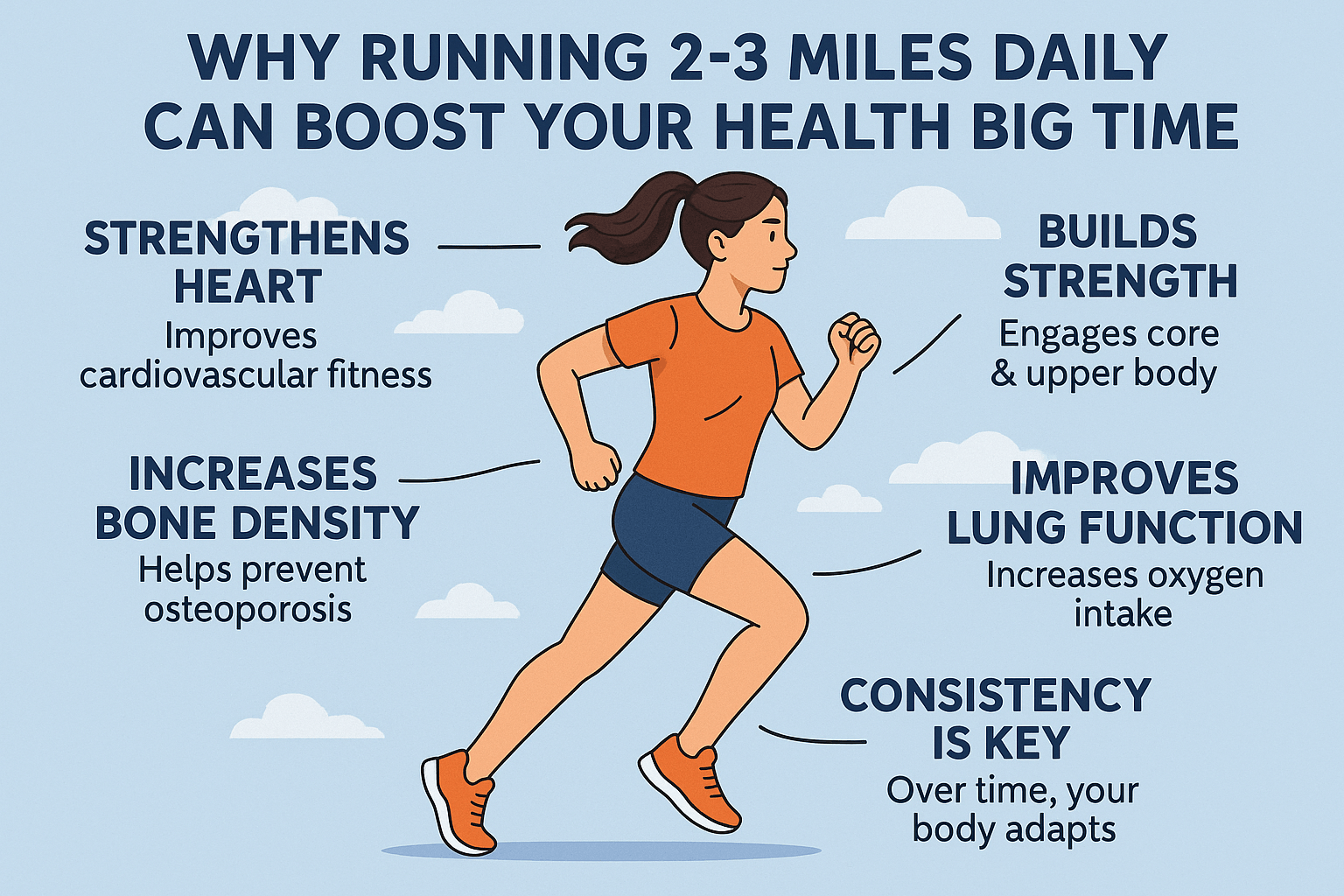
Running 2-3 miles a day isn’t just great for your heart—it works your whole body. It strengthens your legs, core, and even your arms. Running every day makes your lungs stronger, keeps your bones healthy, and boosts your heart.

You won’t run like a pro at first, but keep going, and your body will get better each time.


Weight Loss: Not Just a Bonus, But a Reality

If you want to lose weight, running 2-3 miles a day can help burn fat. A 30-minute run can burn 300-400 calories, depending on your pace and weight.

The real key?

Consistency.

The more you run, the more you stay in that fat-burning zone, which helps you burn more calories. Keep at it, and you’ll start to see the results!


Stress-Busting Power

Let’s be honest—we all deal with stress. But running? It can help a lot. Every run helps your body release endorphins, which are chemicals that make you feel happy and less stressed.

Some mornings, I don’t feel like running, but I put on my shoes anyway and just go.

By the end of the workout, I feel like a brand-new person.


Building Consistency and a Routine

The best part about running every day? It becomes part of your routine—no big deal. It becomes second nature—one less thing to think about, and that makes life easier.

Having a routine isn’t just for getting fit; it makes your life a little simpler. It’s a simple habit that can set you up for a great day, every day.


The Danger of Doing the Same Thing Every Day

Running 2-3 miles every day is awesome for building consistency, but don’t get stuck in a boring routine. Your body’s pretty clever—it gets used to things fast. If you keep running the same distance at the same speed, you’ll stop seeing progress.

The fix? Mix things up!

Try speed intervals: sprint for 30 seconds, then jog or walk for 90 seconds. Change your pace, try new routes, or add in some hills to challenge your legs.


Is It Right for You?

Running 2-3 miles every day isn’t for everyone, but for many runners, it’s a sweet spot. If you’re running a few days a week, try running every day next. But if you’re brand new to running, don’t jump in headfirst.

Start slow, listen to your body, and work your way up. You can also mix in some cross-training to keep things balanced and give your body a bit of a break. You can also check my couch to 5K plan.


Don’t Skip Rest Days

Alright, hear me out. I know you’re eager to run every day, but your body needs rest. Burnout is real, and you don’t want that. Your tendons and ligaments take longer to recover than your muscles, so they need time to adjust.

Skipping rest days? That’s a one-way ticket to injury. Give your body the time it needs to recover and come back stronger.


Conclusion

Running 2-3 miles every day is totally doable and comes with tons of benefits. Your heart will get stronger, you’ll burn fat, and your mind will be sharper.

But here’s the key: balance. Rest days, mixing up your runs, and proper recovery are just as important as the runs themselves. Don’t forget to listen to your body and give yourself credit for the work you’re putting in.

Every run gets you one step closer to becoming the runner you want to be.

So lace up, get out there, and enjoy the journey. It’s not about perfection—it’s about consistency.

Thank you for stopping by.

Creatine Monohydrate for Runners: Benefits, Myths, and How to Use It Right

Many people think creatine is only for bodybuilders and weightlifters. We’re here to tell you that’s not true.

As runners, we can get serious benefits from this supplement, too.

Let’s examine creatine monohydrate, its benefits for runners, and the proper use of it.

What Is Creatine and How Does It Work?

Creatine Monohydrate is a natural compound in our muscles and foods like meat and fish. Our bodies use it to make energy quickly during short, intense activities.

When we run fast or tackle hills, our muscles use a quick energy system called ATP-CP (adenosine triphosphate (ATP) and phosphocreatine (PC)). Creatine helps refill this system faster.

By taking creatine supplements, we increase the amount stored in our muscles, giving us more fuel for high-intensity efforts.

Creatine monohydrate is the most tested form, with the most research backing it up. That’s why it’s the go-to choice for most athletes.

How Creatine Benefits Runners

We’ve found several ways creatine helps our running:

Stronger Sprints and Intervals

  • Improves performance during speed workouts
  • Helps maintain power during the final sprint of a race
  • Makes hill repeats more effective

Better Recovery

  • Reduces muscle soreness after hard workouts
  • Allows for quality training on back-to-back days
  • Helps muscles repair faster between sessions

Strength Gains

  • Builds stronger leg muscles for better running form
  • Improves running economy (how efficiently we use energy)
  • Helps prevent injuries through increased muscle stability

Studies suggest that runners taking creatine are likely to experience improved performance during the final sprint of a race. The enhanced phosphocreatine stores can provide extra energy for that crucial finishing kick when you need to push through fatigue and maintain speed.

Common Myths About Creatine for Runners

Let’s clear up some confusion about creatine:

MythReality
“Creatine is only for bodybuilders.”Research shows benefits for endurance athletes, too
“It causes water weight that slows runners down.”Initial water retention is within muscles, not under skin; it doesn’t impact performance
“Creatine causes cramping.”Studies show no increase in cramping with proper hydration
“Women shouldn’t take creatine.”Benefits apply to all genders; no negative hormonal effects
“Creatine damages kidneys.”No evidence of kidney harm in healthy people taking recommended doses

The truth is that creatine is one of the most studied supplements, with a strong safety record when used correctly.

How to Use Creatine the Right Way

Using creatine effectively is pretty simple:

Dosage Options:

  1. Loading Method: Take 20g daily (split into 4 doses) for 5-7 days, then drop to 3-5g daily
  2. Gradual Method: Take 3-5g daily from the start (it takes longer to build up but causes less water retention)

Timing Tips:

  • Take it daily (timing doesn’t matter much)
  • Mixing with juice or a post-run smoothie may help absorption
  • Consistency matters more than exact timing

What to Expect:

  • Some people gain 2-4 pounds initially (muscle water retention)
  • Full benefits kick in after 2-4 weeks
  • Track your interval workouts to notice improvements

Practical Tips for Runner-Friendly Creatine Use

Here’s what we’ve learned about making creatine work for our running:

Choosing a Product:

  • Look for “creatine monohydrate” with no extra ingredients
  • Find products with third-party testing certifications
  • Powder forms are usually cheaper than pills or capsules

Smart Usage for Runners:

  • Consider timing your creatine cycle with speed-focused training blocks
  • You don’t need to “cycle off” creatine; continuous use is fine
  • If racing in a weight class, be aware of the initial water weight gain

Who Should Think Twice:

  • People with kidney disorders
  • Those with certain medical conditions
  • Always check with your doctor first if you have health concerns

Our Take: Is Creatine Worth It for Runners?

We think creatine is worth trying if:

  • You do speed work, intervals, or hill training
  • You’re looking for better recovery between hard workouts
  • You want an extra edge in the finishing kick of races
  • You’re trying to build strength for better running form

The research backs up creatine’s benefits, and it’s one of the more affordable supplements at about 10-30 cents per day.

Start with a small container to see how your body responds. Pay attention to how you feel during hard workouts and recovery days. Not every supplement works the same for everyone, but creatine has enough evidence behind it to deserve a spot in many runners’ nutrition plans.

If you want one supplement that improves your running performance, especially for speed work and recovery, creatine monohydrate is probably it.

Just keep in mind that no supplement replaces good training, proper nutrition, and adequate rest.

Remember: While this article provides general information about creatine for runners, everyone’s body is different. Get a proper consultation with your healthcare provider before starting any new supplement.

Biomechanics Deep Dive: How Individual Anatomy Affects Technique

Running might seem like this universal, instinctive movement—just put one foot in front of the other. Simple enough.

But what’s not simple is human anatomy: Every person’s physical dimensions are different to one degree or another. From hip structure to leg dominance, these subtle anatomical differences can significantly influence form, technique, and even injury risk.

Understanding how your anatomy affects how you run can help you train more effectively, run more efficiently, and avoid injury. Let’s take a look at how four key anatomical features—femur length, foot arch, and leg dominance—impact running form.

Hip Structure: The Pelvic Blueprint

The hips serve as the fulcrum for the key running movements. Their structure—including the orientation of the pelvis, the angle of the acetabulum (hip socket), and the width between the hips—plays a major role in stride mechanics.

For example, runners with wider hips (more common among females) may naturally have greater Q-angles (the angle formed between the quads and the patella tendon). This brings a greater risk of knee valgus (knees caving inward), which affects knee tracking and overall gait alignment.

To deal with this, some runners choose to externally rotate the feet or swing the legs wider to maintain balance and stability (doing so either consciously or unconsciously). However, this can reduce efficiency and contribute to overuse injuries.

Conversely, runners with narrow hips usually have a more direct and linear gait. This is more energy-efficient but might also increase stress on the hip flexors and lumbar spine, especially if lacking in mobility and strength.

Training considerations for different hip structures include strengthening stabilizing muscles (glutes, abductors) and focusing on mobility to allow for an efficient and safe range of motion.

Femur Length: Lever Mechanics in Motion

The length of your femur (thigh bone), relative to your torso and tibia (shin bone), significantly affects your stride pattern, cadence, and ground contact dynamics.

Longer femurs generally provide a greater range of motion and more potential for power generation. However, this also makes high cadence running (the average recommended being 180 steps/min) more challenging since a longer limb needs more time to swing. 

Runners with longer femurs may favor a longer stride and are more prone to heel striking, especially when fatigued. While this isn’t inherently bad, it does, however, require adequate strength and control to manage the impact effectively.

Meanwhile, shorter-femured runners will have a quicker turnover and perform midfoot or forefoot strike. This more compact form results in a higher cadence, which is somewhat more energy-efficient on average, especially over longer distances.

They often exhibit a higher cadence and more compact running form, which can be energy-efficient, especially over longer distances.

Regardless of your femur length, what’s important is finding a balance between stride length and cadence that aligns with the runner’s biomechanics. There is no one-size-fits-all advice for this; it needs video analysis and even coaching.

Foot Arch: The Foundation of Force Transfer

Foot structure, especially arch height, plays a critical role in shock absorption and propulsion. 

The good news is that high, low, or neutral arches can all be functional depending on muscular support and running style. However, there are considerations for each. 

Runners with higher foot arches (pes cavus) typically have a more rigid foot that doesn’t absorb shock as effectively. This stiffness results in increased loading on the bones and joints, which makes the runner more vulnerable to conditions like stress fractures or IT band syndrome. These runners often benefit from cushioned shoes. Exercises that increase foot mobility and strength in the calves and ankles are also highly recommended.

Flat-footed runners (pes planus) tend to have more flexible feet. But this comes at the cost of being more likely to suffer from overpronation—the excessive inward rolling of the foot—which can cause knee, hip, and lower back issues over time.  Footwear and orthotics with proper arch support are beneficial for them. For strength training, it’s important to correct imbalances by focusing on intrinsic foot muscles and the posterior tibialis.

Leg Dominance: Strength and Stability Disparities

Like handedness, most people have a dominant leg. This dominance affects stride symmetry, muscle recruitment patterns, and impact loading. The degree of dominance this leg has over the other also results in varying degrees of influence on the runner’s biomechanics. 

Dominant leg runners might unconsciously push off harder with the dominant leg. This can lead to asymmetrical strides as well as uneven wear on shoes or that leg’s joints. The dominant leg can also become more fatigued more quickly.

This, of course, affects running efficiency and therefore performance, especially during long-distance events. The imbalance can lead to overuse injuries like runner’s knee or hip bursitis if left unchecked.

To reveal strength and stability differences, perform simple tests like single-leg squats or hops. From there, you can do unilateral strength training—lunges, step-ups, and single-leg deadlifts—to correct these imbalances (often by strengthening the non-dominant leg).

The result is a more symmetrical and efficient gait. Remember, however, that dominance is natural and that even professional athletes often have minor asymmetries. The goal isn’t perfect symmetry (as that’s impossible), but rather sufficient and functional balance that reduces injury risk and enhances movement economy as much as possible. 

Embracing Individual Variation

In the age of the internet, where we can see other people’s running forms and all sorts of running advice, it’s easy to follow what works for elite athletes or follow generalized “ideal” form checklists. But what works for your favorite runner probably won’t work for you, and it might even lead to injury. 

It’s crucial to embrace your individual anatomy and run in a way that’s best for your body. If you have trouble determining what that is, personalized coaching can be a game-changer. If you can’t find a coach that works for you, try using a VPN with alternative email services to find one in nearby geographical areas. Many coaches offer virtual coaching nowadays.

Conclusion

Understanding biomechanics isn’t just for elite athletes or sports scientists. Every runner—no matter how casual a runner they are—can greatly benefit from understanding how their body works and should work.

In the end, you simply have to honor your body’s design. Train with it rather than against it, and you’ll be the best runner you can be.

How to Deal with Missing a Running Day: A Real Runner’s Guide to Staying on Track

Alright, so you missed a run. It happens to everyone. Life gets busy—work, family, or maybe your legs just didn’t want to move that day.

I get it. We’ve all been there.

But here’s the thing: lots of runners get worried when they miss a day, thinking they’ve ruined all their hard work.

Trust me, that’s not the case.

Missing one run doesn’t erase all the hard work you’ve done.

So before you stress out, let’s talk about how to stay calm, make a plan, and get back at it without losing your momentum.


Take a Chill Pill 

Listen, I’ve been there. You miss one run, and suddenly it feels like the whole plan is ruined.

But let me tell you something: missing a single workout is nothing in the grand scheme of your training.

Seriously, if you’ve been working hard, one missed run won’t change everything.

Actually, taking a break can be good for you.

If your legs are feeling ragged, taking a little time off might give your muscles a chance to recover and help you come back stronger for your next run.

I’ve had runs where I felt like I was running through molasses, and you know what?

I’m glad I took a break before pushing through. Sometimes, taking a short break helps you come back stronger.

Don’t stress over one missed workout—you’ll be fine!


Don’t Try to “Make It Up” 

Here’s a common mistake: trying to catch up by doing extra runs after missing one. That can lead to getting too tired and hurting yourself. I’ve seen so many runners push themselves way too hard after missing a workout, trying to catch up by overloading themselves—and that’s how you end up injured.

Instead, just keep going where you stopped last time.

Don’t try to run extra miles to make up for missing a run.

Trust me, take it slow and steady.

Keep your focus on the bigger picture: your long-term progress. It’s about showing up regularly, not rushing to catch up.


Assess the Situation 

Alright, so what did you miss?

Was it your long run, a fast workout, or just an easy jog?

If you missed a key workout—like a long run or a tempo run—you might need to rearrange your schedule a bit.

It’s no big deal, just shift things around to stay on track. But if it was just an easy jog, don’t worry about it.

For those long runs, don’t worry too much. You can move them to another day.

Life happens, and your body will actually appreciate the rest rather than pushing through a run when you’re not feeling it.

Just pick up where you stopped and keep moving forward.


Play the Long Game

Don’t get me wrong, I’m not saying you have to be perfect all the time. Running isn’t about being perfect every time—it’s about showing up, day in and day out, over the long term.

Every runner I’ve worked with has had problems, like missing runs, being sick, or life just getting busy.

That’s normal.

The long game is what counts.

Think about your progress over weeks and months, not just one day.

A missed run doesn’t change everything. And honestly? That extra rest might even work to your advantage, giving your body a chance to recover and come back stronger.


Adjust Your Plan

If you’ve missed more than one run, don’t sweat it. You don’t have to play catch-up.

It’s not about cramming in those missed miles—it’s about getting back into the routine and moving forward. Life happens. You’ve got to be flexible.

So, change your schedule a little. Add a few extra miles or move your long run to a day that works better for you.

Flexibility is key. Running is about staying consistent, not being perfect every time.

Keep moving forward, and don’t stress over the little bumps. You’ve got this!


Focus on Mental Toughness

Look, missing a run can mess with your head. You might start thinking you’ve failed.

Stop that right now.

Missing a workout doesn’t mean you’re out of the game—it just means you’re human.

Use it as a chance to reset mentally.

Be nice to yourself—that’s part of getting better. So, you missed a run? Don’t worry about it. It’s not a setback unless you let it be one.

Running should be something you enjoy, not a task. Keep your mindset right, and keep moving forward.


When In Doubt, Do Something

When you miss a run, don’t just sit there feeling sorry for yourself. Get moving.

Whether it’s a short jog, a fast walk, or just some light stretching, keep that consistency going.

It doesn’t have to be a full workout—just show up.

Even a quick, easy jog helps keep you in the right mindset and keeps your body moving.

Don’t let one missed run mess with you—get back at it and keep your momentum going.


The Specific Impact of Missing More Than Three Days

Okay, so you missed more than three days. I get it. You’re probably thinking you’ve messed up all your progress.

Again, and I hate to sound like a broken record, but let me tell you something: you haven’t.

If you’ve missed a chunk of training—like key long runs or speed sessions—it’s time to get a bit strategic.

Here’s the deal: don’t try to cram everything into one week. Gradually start running more as you feel ready.

You don’t have to make up for everything all at once.

Maybe replace about 50-75% of what you missed.

For example, if you missed a 12-mile run, don’t try to run 15 miles right away.

Add some extra distance to your next few runs, but don’t push your body too hard.

Remember, you’re easing back in, not sprinting your way back to fitness.


In Conclusion:

At the end of the day, it’s not about being perfect; it’s about getting back up and running again.

Life’s going to throw curveballs, and you’ll miss runs here and there.

But the most important thing is staying consistent.

Don’t let a missed workout define your journey—it’s all about showing up for yourself, day in and day out.

Every step you take—no matter how small—gets you closer to who you’re meant to be.

Thank you for stopping by.

David D.

When to Replace Your Running Shoes, Clothes, and Gear

If you’re anything like me, you’ve probably kept running shoes, clothes, and gear way past the point when you should’ve replaced them.

Maybe you didn’t want to spend the money, or you just didn’t realize how much worn-out gear can impact your runs.

Here’s the hard truth: running in old shoes or wearing gear that’s lost its support and elasticity doesn’t just make your runs uncomfortable—it can seriously hurt your performance and increase your risk of injury.

In this article, I’m going to walk you through the signs that it’s time to replace key running gear—from shoes and socks to sports bras, hats, and even your GPS watch.

I’ll share tips on how often to replace each item and why rotating gear can actually save you money and keep you running longer.

If you want to stay injury-free, feel comfortable, and get the most out of your training, knowing when to upgrade your gear is just as important as your workouts.


How Often Should You Replace Your Running Shoes?

Your shoes are the foundation of every great run. But even the best shoes wear out eventually. You’ve probably heard the rule: change your shoes every 300-500 miles.

That’s a good start, but it’s about more than just miles.

I’ve kept running in old shoes to save a few bucks, but that’s when injuries pop up.

So, how do you know when to let them go?

Here are the signs:

  • Thin spots
  • Visible holes
  • Too slippery
  • Making sounds
  • Loss of elasticity around toes/cuffs

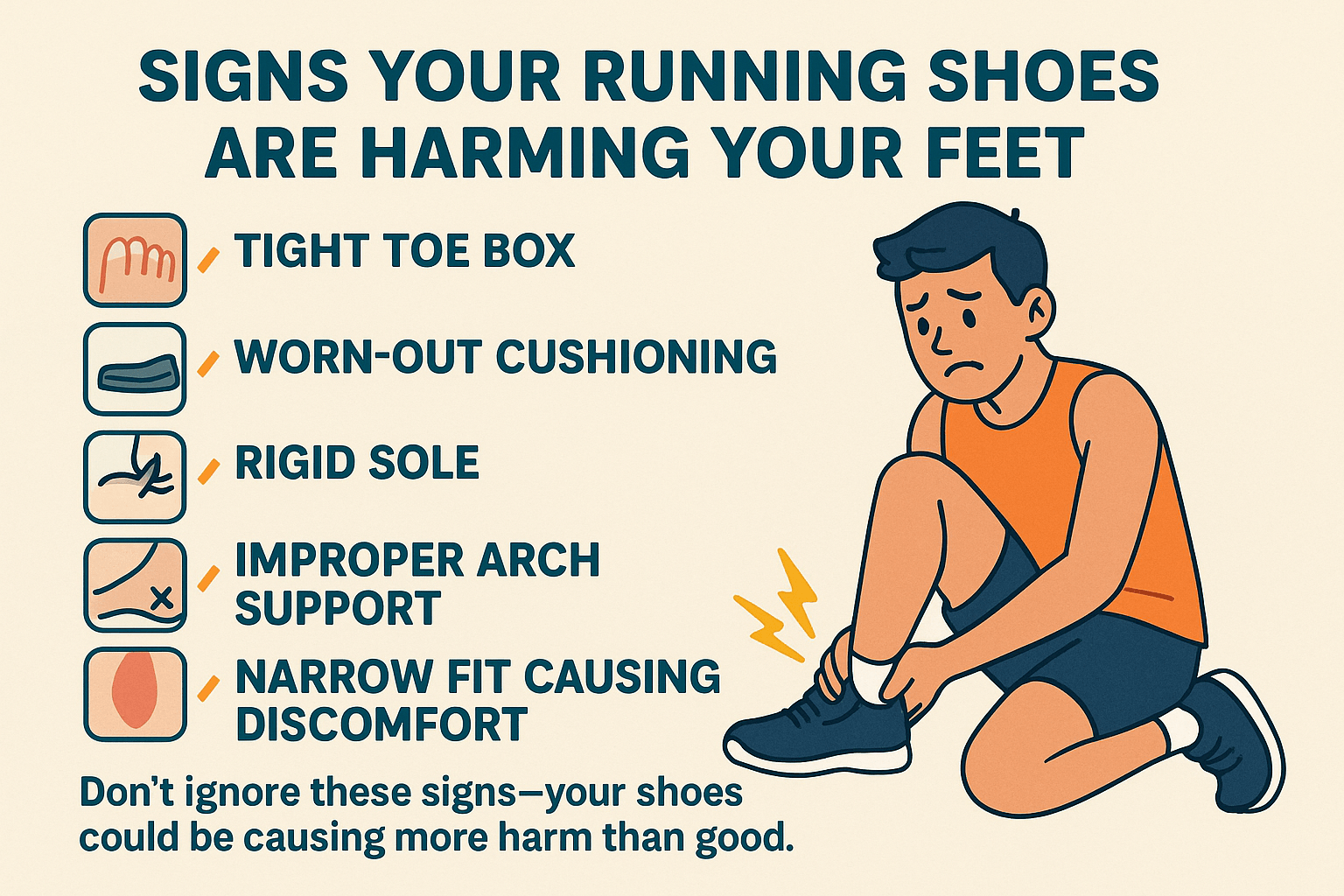
Don’t wait until it hurts—replace those shoes before they mess up your form and cause injury.


How Often Should You Replace Your Running Sports Bras?

Sports bras need to provide support. When the elastic stretches out or straps lose shape, it’s time to replace them.

On average, replace your sports bras every 6-12 months, depending on how often you wear them.

Of course, I’m no expert on the subject so please do your own research.


How Often Should You Replace Your Running Tops and Bottoms?

Moisture-wicking fabrics work wonders—when fresh. But if they lose elasticity or start thinning, they aren’t doing their job.

If stubborn smells stick or the fabric feels “sticky,” it’s time to let them go.


When to Replace Your Running Hat

I used to hang on to hats longer than I should’ve.

That favorite cap of mine had faded, was stained, and the brim drooped. Hats shield you from the sun, but once they lose shape or the fabric gets worn, it’s time to replace them.

And when the sweatband stretches or smells funky no matter how many washes? Let it go.


When to Replace Your Running Sunglasses

Sunglasses protect your eyes, but if they’ve seen too many miles, they might be doing more harm than good.
If the lenses are scratched, you’re compromising your vision. Clear, distortion-free lenses are essential for your run.

My advice? If they slip down your nose, it’s time to upgrade. Don’t wait for them to fall off mid-run.


When to Replace Your Running Gloves

Gloves keep your hands warm and comfy, but they have a shelf life. They take on sweat, dirt, and weather, so they wear out. Once the fabric isn’t as snug or warm, it’s time for a new pair.

Don’t wait for holes to form and leave your hands exposed to the cold.


When to Replace Your Running Watch or GPS Device

Your GPS watch tracks your runs and heart rate, but it needs replacing too.

Here’s what you need to pay attention to:  

  • Battery Life: If it’s struggling to hold a charge, it’s a sign it’s time to go.
  • Accuracy: If the readings are off—whether for distance or pace—it’s time to invest in a new device.

A GPS watch is your training partner, so don’t keep running blind.


When to Replace Your Running Socks

Socks might seem insignificant, but they play a big role in comfort. If you get blisters, it’s time for a replacement.

Signs They Need Replacing:

  • Thin spots
  • Visible holes
  • Loss of elasticity around toes/cuffs

Replace them every 6 months to avoid discomfort and injury.


How to Store Your Running Gear

Proper storage extends the life of your gear. Don’t toss everything in the laundry basket or leave shoes by the door.

Here’s what you need to do:

  • Shoes: Keep them in a cool, dry place. Moisture breaks them down faster.
  • Clothing: Hang running clothes to dry and store them in a dry area to preserve their elasticity.

Proper storage means your gear stays in better shape for longer.


Frequently Asked Questions About Running Gear Lifespan

1. How do I know if my running shoes are still providing the right support?

Press the midsole (cushy part) with your thumb. If it’s stiff or hard, replace them. Also, if you notice pain in your knees, hips, or back after running, it could be time for new shoes.

2. Can I extend the lifespan of my running shoes?

Yes! Rotating between two pairs helps extend their lifespan. Also, let them dry out fully after each run and store them in a cool, dry place.

3. How can I tell if my running gear is too tight or too loose?

If your gear feels tight or restricts movement, it’s time for new gear. Tight clothing can lead to chafing, while loose clothing can affect your performance.

4. How often should I replace my running socks if I have blisters?

If you’re getting blisters regularly, replace your socks. They lose elasticity and cushioning over time, which can lead to discomfort. Replace them every 6 months or sooner, depending on usage.

5. How long do running sunglasses typically last?

Running sunglasses last 1-3 years depending on usage. If the lenses get scratched or foggy, or the frames start slipping, it’s time for a new pair. Keep them in a protective case when not in use.

Here’s the full guide to proper running gear. On a budget? Check out this post.

Couch to Marathon: The Ultimate Training Plan & Guide

Going from couch potato to marathon finisher?

That’s no joke—it’s a massive leap.

But trust me, it’s also one of the most satisfying things you’ll ever do.

In today’s post, I’ll walk you through everything I wish I knew when I started:

  • How to train smart, not just hard
  • What all those running terms mean (like VO₂ max and lactate threshold)
  • What phases to expect (base → build → peak → taper)
  • How to dodge injuries and burnout
  • And so much more…

So if you’re staring at that 26.2-mile goal wondering, “Can I actually do this?”—you’re in the right place.

Let’s get to it.

What Is a Marathon, Anyway?

A marathon is 26.2 miles (or 42.2 kilometers).

To put that in perspective: you’d be running around a 400-meter track 105.5 times.

Yeah… brutal.

If you’re running at a 12-minute mile pace, you’re looking at about 5 hours and 15 minutes out there. Some folks move faster, others slower—there’s no magic number for your first marathon.

Your only real goal?

Cross that finish line strong and proud.

How Long Does Couch to Marathon Take?

 About 6 months.

Most true beginners need 24–30 weeks to train safely without wrecking their body.

That’s enough time to build up mileage, endurance, and mental grit without flirting with injury.

Now, I’ve seen exceptions.

Some people train for three months and crush it.

Others have been running for years and still DNF their first race. It all depends.

If you’ve already done a few 5Ks or maybe a 10K, you might squeeze your training into 4–5 months.

But here’s my coaching advice: don’t rush it. A little extra time is better than limping off the course halfway through.

And hey, this all assumes you’re healthy and not battling any major injuries.

If you’re completely new to fitness, start with a few weeks of walking or a couch-to-5K program.

You don’t need to leap straight into marathon mode.

Build a base first. That’s where the wins are made.

What should my weekly mileage be before starting a marathon plan?

Ideally, be running about 15–25 miles per week.

That means you can comfortably knock out a 5–6 mile run, even if you walk some of it.

Hal Higdon’s beginner plan kicks off with a 6-mile long run in Week 1.

If that sounds insane right now, no stress. Just spend a few extra weeks doing a couch to 5K or couch to10K plan to build up.

Already ran a 10K? Then progress to the couch to half marathon plan.

Think of it like this: the more miles you already have in your legs, the smoother the next few months will go—and the less likely you are to get sidelined by injury.

Don’t Skimp on Gear (Especially Shoes)

If you ignore everything else in this article, hear this: don’t cheap out on your shoes. They’re your most important weapon.

Running Shoes

Go to a running store.

Get fitted.

Find something with decent cushioning and support for distance.

Don’t run your marathon—or your long runs—in brand-new shoes.

I made that rookie mistake once. Slipped into a flashy new pair and thought I was golden.

By mile five, I was bleeding through my socks. Had to hobble home with angry blisters and a bruised ego.

Trust me, break your shoes in with at least 100 miles before race day. Better yet, rotate two pairs during training.

Socks

Get synthetic or wool-blend running socks. Seamless, moisture-wicking stuff.

Cotton socks are blister factories. Learned that the hard way on a humid Bali long run—looked like I ran through a meat grinder.

Clothes

Wear moisture-wicking shirts and shorts.

No cotton.

For women, a solid sports bra is non-negotiable.

Here in Bali, I live in feather-light running gear because the heat’s no joke. If you’re training somewhere cold, layer up with smart technical gear you can peel off as you warm u.

Hydration

Once your long runs creep past an hour, you’ll need water.

Whether it’s a handheld bottle, a waist belt, or a hydration vest—just find what works.

Don’t let dehydration sneak up and kill your run.

Other Essentials

  • Running hat + UV-blocking sunglasses
  • Waterproof jacket if you train in rainy weather
  • Anti-chafe balm (thighs, armpits, nipples—don’t wait until it’s too late)
  • GPS watch or app to track your runs

If you’re going to spend money on anything, make it shoes, socks, and anti-chafe balm.

That trio has saved me (and my runners) more times than I can count.

Marathon Training, Step by Step: What It Really Looks Like

So you’ve got the fire.

You’ve picked up your gear.

You’re ready to go.

But if you think marathon training is just “run a little more each week,” let’s hit pause right now.

Marathon prep is a process.

A grind.

A system that builds layer by layer, like stacking bricks. Without structure, it’s like building a house on sand—you’ll crash before you even get to the 10-mile mark.

Here’s how I walk my runners through the journey from couch to 26.2.

The 4 Phases of Marathon Training

I break marathon training into four blocks. Think of it like climbing a hill in stages—each part builds you up for the next.

1. Base Phase – Laying the Foundation

You start from wherever you are. Maybe you can barely run a mile without stopping.

That’s okay.

This phase gets you running regularly, gradually stretching your distance toward a solid 5K base.

You’re not chasing pace here—you’re just showing up, again and again.

2. Build Phase – Stacking the Miles

This is where things get serious.

We start adding more distance.

Long runs creep from 5K toward 10K and beyond.

You’ll also dip your toes into faster efforts—think strides or simple intervals—just enough to remind your legs they’ve got gears.

3. Peak Phase – Testing the Engine

This is the heavy lifting.

Mileage gets high. Long runs stretch to 15, 18, even 20 miles. You’re running tired.

Training on tired legs is gold—it makes race day feel lighter.

This part tests your head as much as your legs. You’ll want to quit. Don’t.

4. Taper Phase – Rest & Sharpen

The final 2–3 weeks.

You cut back on mileage so your body can heal up and absorb the work. It’s not slacking—it’s strategy.

Don’t let the taper freak you out. You’ll feel weird, maybe even sluggish. That’s your body gearing up for race day.

How Many Runs Per Week?

Aim for 3–4 runs a week. You don’t need to run daily—in fact, you shouldn’t. The sweet spot for beginners is usually:

  • Short run
  • Midweek run
  • Long run (usually on weekends)
  • Optional fourth easy run

Rest is part of training. So are cutback weeks. Don’t ignore them.

Long Runs: The Backbone of Your Plan

The long run is the main event. Do one every week.

It might start at just 3 miles with walk breaks—and that’s fine. What matters is showing up and slowly building the distance.

Add about a mile each week. Every few weeks, pull back (cutback week) to avoid overload.

Eventually, your longest run will top out around 18–20 miles.

And no, you’re not running those at race pace.

You go slow. You should be able to chat during these.

If you’re gasping, you’re going too hard. This is about time on your feet and building mental grit.

Easy Runs: Don’t Overthink These

Most of your weekly miles will be easy pace.

And I mean easy.

You should feel like you’re holding back. Forget pace. Easy runs build your engine and help recovery.

Roughly 80% of your runs should be easy. The 80/20 method—coined by coach Matt Fitzgerald—works.

It helps you stay consistent and keeps injuries at bay. I tell my athletes: “Easy is a feeling, not a number.” If it feels smooth, it’s working.

Walk-Run Works (Especially at the Start)

If you’re new to running, walk breaks are not cheating.

They’re smart.

One of the best ways to build endurance without injury is with a run-walk combo.

Start with something like “Run 1 minute, walk 2 minutes, repeat 10 times.” Gradually flip that ratio over the weeks until you’re running more than walking.

And hey—on race day, walk breaks might still be part of your strategy. The Jeff Galloway method is based on it. I’ve seen it help runners finish strong instead of crawling to the end.

Cross-Training & Rest Are Non-Negotiable

You’ll take 1–2 full rest days a week—no workouts, no guilt. Your body needs recovery just as much as it needs miles.

You’ll also cross-train 1–2 times per week. That means stuff like:

  • Cycling
  • Swimming
  • Brisk walking
  • Yoga or mobility work
  • Strength training (especially core and glutes)

Cross-training builds you up without the pounding of running. It also keeps things interesting.

Personally, I love yoga and short strength circuits on off days. Keeps me limber, resets my head, and protects me from injury.

The 10% Rule: Build Smart

The golden rule in marathon prep? Don’t get greedy with mileage.

Increase your weekly distance by no more than 10% each week.

So if you ran 15 miles total last week, your next week should be around 16–17, not 20.

Same goes for long runs—slow, steady gains.

Every 3–4 weeks, take a cutback week. Hold mileage steady or drop it slightly to let your body catch up. That’s where the real growth happens.

Phase 1: Base Building (Weeks 1–6)

Goal: Build a solid running habit and get your body used to moving for 3 miles without falling apart.

This first stretch isn’t about going fast or far. It’s about getting your legs to show up, even when your brain says, “Nah.”

Especially if you’re starting from the couch, expect to lean on the run/walk method for a bit—and that’s more than okay.

Here’s a sample of how I’d ease someone in during the first six weeks:

  • Week 1: Start with 1-minute jog, 2-minute walk. Repeat that 10 times. Boom—30 minutes done. Do that 3x/week. Long run? 1–2 miles, even if it’s mostly walking.
  • Week 2: Run/walk 3–4 times. Try to get that long run closer to 3 miles—running more if you’re up for it. Weekly mileage? Around 5–8 miles total.
  • Week 3: Run a little longer. Something like 2 min run / 1 min walk. Long run hits 4 miles.
  • Week 4 (Cutback): Step back a bit. Let your legs soak up what you’ve done. Maybe stick to a 3-mile long run.
  • Week 5: Aim for a few continuous runs—even if they’re short. Long run pushes to 5 miles.
  • Week 6: Less walking, more running. Try for a 6-mile long run, if it feels right.

If you can cover a 5K (3.1 miles) comfortably by the end of this phase—even if you still walk a little—you’re winning. Weekly mileage might land between 10 and 15 miles.

But don’t obsess over numbers.

This isn’t about stats yet—it’s about routine, momentum, and not quitting when your legs are screaming.

What’s Happening Behind the Scenes (Physiology Check):

This is where your aerobic system gets its first serious workout. You’re teaching your body to use oxygen better—to build a bigger engine.

Even if you’re not doing intervals, every run is nudging your VO₂ max higher (that’s just your body’s max oxygen delivery system, by the way).

According to Runner’s World, even easy runs help expand capillaries, boost mitochondria (your cells’ engines), and start laying down endurance foundations.

You’re also slowly lifting your lactate threshold—the pace at which your legs start burning and your body yells, “Nope.”

That means you’ll feel less wiped at the same pace over time. It’s happening without you even thinking about it.

Phase 2: Build Endurance (Weeks 7–12)

Goal: Go from 5K to 10K and beyond.

Start building mileage into the 15–25 weekly range, with a little sprinkle of speed.

By now, you’ve probably got a groove going. You’re not gasping after the first 10 minutes, and that 3-mile run doesn’t feel like Everest.

Now we’re going to push the envelope—gently.

The key word here is “progression.”

  • Week 7: Long run hits 6 miles (~10K). Toss in 2–3 shorter runs. Maybe try an easy fartlek—speed up for 30 seconds here and there to wake up those fast-twitch muscles.
  • Week 8: Long run goes to 7 miles. Weekly total might be 18–20 miles.
  • Week 9: Long run 8 miles. Add a simple tempo run: 3 miles total, with the middle mile at “comfortably hard” pace (think 10K race effort). These teach your body to handle fatigue without falling apart.
  • Week 10 (Cutback): Step back again. Long run drops to 6 miles. Let your body recover and bounce forward.
  • Week 11: Long run 9 miles. Weekly mileage passes 20.
  • Week 12: Long run hits 10 miles—double digits, baby! Try running 1–2 of those at goal marathon pace just to feel it.

At this stage, you’re probably running 10Ks and even 15Ks in training. That’s huge. It’s common to see your 5K pace drop noticeably too—more fitness, better efficiency, and confidence.

What’s Happening Under the Hood:

We’re getting more strategic here—adding tempo runs and speed play to start pushing that anaerobic threshold. That’s the point where your muscles flood with lactic acid.

According to Marathon Handbook, tempo runs help your body handle and clear lactate, so you can run faster for longer without blowing up.

Runner’s World also notes this is when you improve your running economy—how much oxygen your body uses to hold a certain pace.

More miles = better efficiency. You’ll burn less energy for the same result. That’s a quiet win that shows up later in your long races.

Phase 3: Peak Training – Welcome to the Grind (Weeks 13–20)

Goal: Stack your biggest mileage weeks, cap off with an 18–20 miler, sharpen your race pace legs, and finish feeling tired—but strong.

Not broken. Not overcooked. Just that deep fatigue that tells you: You’re getting ready.

This is the part where it gets real.

If Base Phase was the warm-up and Build was the hard work, then Peak Phase is the final exam before the marathon.

This is where you teach your body—and your brain—to go the distance. You’ve already built decent endurance.

Now you’re training for fatigue. For grit. For holding your pace when everything in your body is yelling slow down.

Here’s how these weeks usually play out for most first-timers:

Weeks 13–14: Climbing Higher

Your long runs go from 10 to 12, then 14 miles. Weekly mileage creeps into the low-30s.

Start mixing in Marathon Pace (MP) segments at the end of your long runs.

Example: On a 10-miler, run the last 2 miles at your goal marathon pace.

Trust me, it’s a humbling experience—but a necessary one. This simulates that “late-race fatigue” feeling. You’re not just building your legs here—you’re teaching your brain how to stay locked in when things get heavy.

Week 15: Cut Back and Catch Your Breath

Dial it down a bit—long run drops to 10 miles.

You’ve earned a down week. Let the body soak in the work you’ve done so far.

Some runners use this week to run a casual half marathon or do a solo time trial.

Not mandatory, but it’s a great way to test your race-day routine: fueling, pacing, shoes, even your playlist. Nothing fancy—just go out, run steady, and see what happens.

Weeks 16–17: Long and Lonely

You’re now logging 16- and 18-mile long runs. This is where a lot of runners hit a wall mentally.

Plan ahead—safe route, maybe a loop course so you can stash water and gels.

Bring a buddy for those last miles if you can. These runs will take over 3 hours – maybe even 4 – so slow it down and focus on fueling.

And please remember to take plenty of walking breaks during this long run.

I usually treat these like mini simulations: carry sports drink, take a gel every 45 minutes, and see what your stomach agrees with. Don’t try anything new on race day—learn now.

Week 18: The Big One

This is it—your 20-miler.

Not everyone hits 20, and that’s okay.

Some stop at 18. But mentally, 20 is a milestone.

Don’t feel like you have to run 26.2 in training—that’s a fast-track to injury.

Running 20 miles tired is more than enough prep for race day, especially since you’ll be tapering with fresh legs by then.

Most runners also hit their peak weekly mileage here—somewhere between 35–40 miles. That’s solid for your first time.

Week 19–20: The Taper Begins

Week 19: Pull back by about 20–25%. Long run drops to around 12–13 miles. Your body starts recovering.

Week 20: Drop it even more—half your peak mileage. Long run is only 8 miles, and it should feel easy.

Your legs start to feel lighter. You might even get a little antsy—that’s the taper magic.

Midweek Workouts? Optional, Not Required

If you’ve got the energy, you can throw in one faster session midweek—like mile repeats at 10K pace or a tempo run (4–6 miles at moderately hard effort).

But for most first-time marathoners, this isn’t essential.

Focus on the long runs. Easy mileage is your bread and butter. Endurance is what gets you to the finish line, not flashy intervals.

Fueling the Machine: Don’t Wait Until Race Day to Figure This Out

Once your long runs are over 90 minutes, fueling isn’t optional.

You need to start experimenting.

Most runners aim for 30–60 grams of carbs per hour during long efforts—via gels, chews, sports drinks, or real food (I’ve seen people eat rice balls and PB&Js mid-run).

Example: I usually take a gel every 45 minutes and chase it with water. I also carry an electrolyte drink with carbs and sodium, especially on humid days here in Bali. Figure out what works now, not when the stakes are high.

Pre-run meal? Keep it simple—some toast and peanut butter, or oatmeal 1–2 hours before.

Post-run? Don’t skip it. Within 30 minutes, get some protein and carbs in—like a protein shake or chocolate milk. Your body will thank you later.

The Science: Why Running on Tired Legs Works

This phase isn’t just about mileage—it’s about fatigue resistance.

There’s this concept called accumulated fatigue.

Basically, you’re running on legs that haven’t fully recovered from earlier in the week. It’s deliberate. It’s how you teach yourself to keep moving when your body’s begging to stop.

You might notice your heart rate’s higher on easy days. Or your pace is slower even though the effort feels the same. That’s part of the process.

According to studies published in the Journal of Strength & Conditioning Research, these long, slow efforts help your muscles become more efficient at using fat for fuel (huge for marathons), and they increase your glycogen storage.

You also see modest gains in lactate threshold and VO₂ max, but at this point, the real benefit is mental.

This is where you train your brain to deal with discomfort, boredom, doubt—all the stuff that shows up in the final 10K of a marathon.

This is where you earn the right to call yourself a marathoner-in-training.


Burnout Isn’t Weakness, It’s a Signal

Quick story: I coached a runner who was 3 weeks out from her marathon. She was grinding every day, but I could tell something was off. She finally said,

“Coach, I’m done. My legs hurt all the time. I don’t even want to run anymore.”

Classic training burnout.

We made a simple switch—swapped a run for a bike ride, added an extra rest day, and doubled down on sleep and fueling.

Within a week, she was smiling again. The bounce came back. She ran her marathon strong.

Moral of the story: Listen before your body screams. Fatigue is part of the game, but full-on dread? That’s a red flag.

If you’re feeling cooked, take a day off or cross-train. You won’t lose fitness. You might just save your race.

Phase 4: Taper Time (Weeks 21–24)

Goal: Shed the fatigue. Keep the fitness. Roll into race day fresh and ready to crush.

First off—congrats.

You survived the hardest part.

You did the long runs.

You earned this taper.

Now comes the weird part: slowing down. And yeah, it feels strange. Most runners hit this phase and panic like, “Wait, am I losing fitness?! I’m barely running!”

Breathe. That’s exactly what your body needs.

Here’s how taper usually plays out:

3 Weeks Out

  • Cut weekly mileage to about 70% of your peak.
  • Long run = ~12–13 miles.
  • No more beast-mode speedwork—just short strides if anything. Save the fire for race day.

2 Weeks Out

  • Drop to ~50% of peak.
  • Long run = ~8–10 miles.
  • You should start feeling fresher, less sore, more bouncy. That’s the point. Don’t chase last-minute gains.

Race Week

  • 2–3 short, easy jogs (2–4 miles).
  • Maybe a couple miles at marathon pace—but nothing that leaves you drained.
  • 2 days out: I like a 2-mile shakeout.
  • Day before: Some runners jog a mile. Others rest completely. Go with what helps you chill.

Take Care of the Small Stuff

Use this time to sharpen everything else:

  • Sleep more.
  • Eat well.
  • Carb up smart (especially in the last 3 days).
  • Avoid dumb injuriesnow isn’t the time to jump into a basketball game or rearrange your garage.
  • Got some aches? Try gentle stretching, foam rolling, or a sports massage. Let your body absorb the work.

Taper Madness Is Real

You might start overthinking, doubting your plan, or feeling antsy.

That’s normal.

Use that energy to mentally rehearse race day:

  • Picture hitting mile 20 and still having gas in the tank.
  • Go over your fueling plan.
  • Lay out your race gear.
  • Print your pace chart.

If you feel a little bored during taper… good. That means it’s working.

Marathon Week: Lock It In

Let’s walk through your final checklist:

Gear Rehearsal

Do a short run in your exact race-day kit.

Socks, shoes, shorts, everything. No surprises.

✅ Nutrition Strategy

Plan your dinner (carbs, not spicy), your breakfast (something you know works), and your race fuel.

I usually go: gel at miles 8, 14, and 20. You do you—but test it first.

Pacing Plan

If it’s your first marathon, just finishing is a win.

If you’ve got a goal, use a pace band or calculator—but also have a Plan B.

Hot day? Bad sleep?

Adjust. It’s smarter to run slightly slower and finish strong than blow up chasing a dream pace.

✅ Logistics

Sort your ride, alarm clock, gear layout, etc.

Race morning is way less stressful when you’ve got everything dialed in.

Race Day: Time to Cash In

You’ve trained for this.

You’ve sacrificed for this.

Now all that’s left is to show up and run your race.

The first 10 miles? You’ll feel invincible.

The halfway point? Still solid.

Then around mile 18 or 20—that wall hits.

Here’s where you dig deep.

Think back to all those long runs on tired legs.

Think about your “why.”

Use whatever you’ve got—crowd energy, your playlist, a friend’s voice in your head.

Take walk breaks if needed. They don’t make you weak. A 1-minute walk can save your race.

Final Mile Magic

When you see that finish line—lean into it.

Smile, cry, scream—whatever you feel, let it out.

Because you just joined the 1% who can say they’ve run a marathon.

Every sore muscle, early alarm, and soaked shirt was worth it.

Welcome to the club, marathoner.

The Real Finish Line

By the time you hit that start line, you won’t be the same person who signed up months ago.

You’ll have already fought through doubt, soreness, missed workouts, maybe even a few breakdowns. And you kept showing up. That’s the real win.

The race?

That’s just your victory lap — yeah, a long one at 26.2 miles — but by then, you’ll have earned it.

I’ve coached a lot of people through this journey, and one thing always holds true: when you cross that line, something clicks.

You realize it wasn’t just about the miles.

It was about proving to yourself that you could do something hard. Something most people won’t even try.

And maybe it’s not just about you. Maybe your grit fires up a friend, your kids, or someone scrolling past your post thinking, Damn. If they can do it, maybe I can too.

I’ll leave you with a quote I saw once on Reddit that stuck with me:

“No matter what your finish time is, you cleared 26.2 miles — and that is worth celebrating.”

Run it. Walk it. Crawl it.

Doesn’t matter. Once you cross that line, you’re a marathoner. Forever.

So go write your marathon story.

One mile at a time.

One foot in front of the other.

I’ll be rooting for you — loud and proud.

How to Avoid Burnout in Your First Month of Running

When I started running, burnout hit me like a brick wall. One week I was fired up, ready to crush it—and then suddenly, I was exhausted, sore, and seriously questioning why I even bothered.

If that sounds familiar, you’re not alone.

Over the years after, I learned that pacing myself, mixing things up, and listening to my body are the real keys to sticking with running.

In this article, I’ll share the tips that helped me push through that tough first month—and how you can avoid burning out too.

Ready to keep moving without feeling wiped out? Let’s get into it.

Slow Down

One of the biggest mistakes I made early on was doing way too much too fast.

Those first few weeks were rough—always tired, sore, and frustrated. I tried to run too much, too soon.

Here’s the deal: You don’t have to run like you’re in a race right away.

Trust me, you don’t want to burn out after just one week. You need to keep that spark alive for the long run.

It’s all about being consistent, not pushing too hard in the beginning.

My Best Advice:

  • Start with 2-3 easy runs a week.
  • Take walking breaks if you need them.
  • Keep it simple, no pressure.

It’s not about running the fastest. It’s about making running a regular part of your life.


Mix It Up

I used to run the same route over and over again. It felt like I was stuck in a loop—kind of like Groundhog Day, but with more sweat.

But then, one day, I found a cool new trail by the river. It was the best decision I ever made. Now, I can’t stop running there.

Here’s what you need to do:

  • Change it up! Try running in a new neighborhood or add some hills to your route.
  • A little variety will make running feel fresh again.

When you mix things up, running stops feeling like a chore and starts feeling like an adventure.


Cross-Train

Let me save you some trouble—running every day will wear you out. No doubt about it.

You’ll feel great after a couple of runs, but trust me, your legs are going to start complaining.

That’s where cross-training comes in.

Find something else to do—bike, swim, do yoga, or just go for a walk.

Your legs need a break, and trust me, those rest days are a must. Mix it up, and you’ll feel stronger when you get back out there.


Listen to Your Body—And Rest When You Need It

Running is a mental challenge, but it’s also a physical one. If you’re pushing too hard, you’re just asking for burnout.

I’ve been there—running when I should’ve been resting. It only led to injuries and more frustration.

Overtraining is real, and it’s like running on empty—you’ll just crash.

Your first month? The fatigue is real, but if you listen to your body and take breaks, you’ll handle it just fine.


Key Takeaways:

  • If you’re feeling wiped out, take a day off. Your body is trying to tell you something.
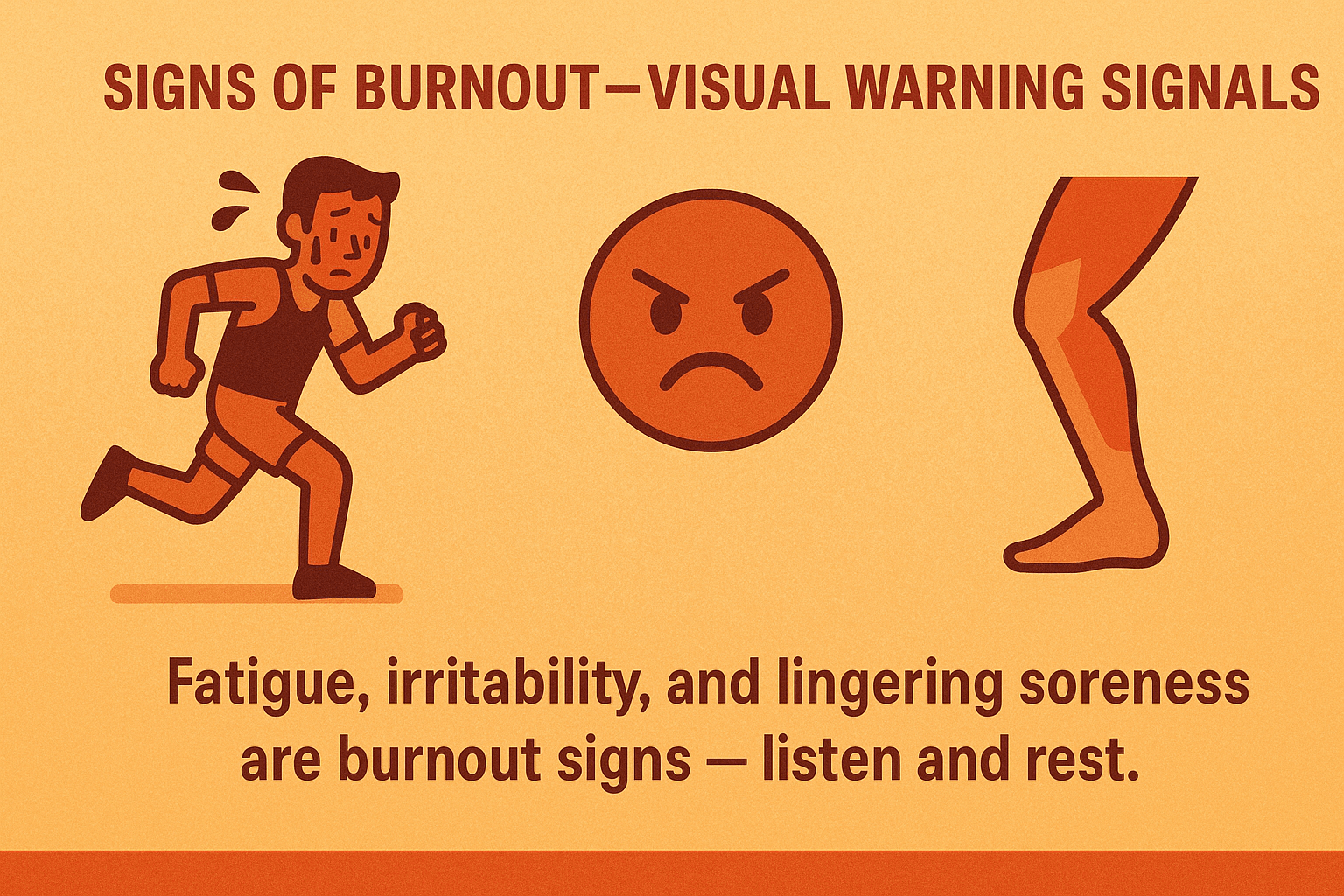
  • Watch out for signs like feeling cranky or sore that won’t go away.
  • If you’re sore, do something easy like walking or light cycling to recover.

Rest is key to staying strong. Don’t skip it if you want to keep running regularly.


Make It Fun—Or Don’t Do It At All

Here’s the truth—if running feels like a chore, you’re doing it wrong.

I’ve had plenty of runs where it felt like I was dragging a sled through mud. But when I stopped worrying about my time and just enjoyed running, that’s when it really clicked.

You’re not a robot—you’re a person. Find something fun about your run.

Maybe it’s a new route, a podcast, or a friend who’ll talk your ear off the whole time.

If it’s not fun, it’ll feel like torture, and that’s when burnout creeps in. 


Conclusion:

The first month? Yeah, it’s tough. But if you pace yourself, mix things up, listen to your body, and don’t expect to be perfect, you’ll not only make it through—you’ll actually enjoy it.

Forget about chasing speed or distance—just focus on consistency and having fun.

Stick with it, take care of your body, and soon running will feel as natural as breathing.

Trust me, you’ve got this.


FAQs

How can I avoid burnout in my first month of running?

  • Start slow, mix in cross-training, and listen to your body when it needs rest. Focus on being consistent instead of fast or distance-focused.

What are the best ways to recover after a tough run?

  • Rest, take it easy with walking or swimming, and get enough sleep and hydration to help your muscles recover.

How do I know if I’m pushing myself too hard while running?

  • If you’re always tired, sore for days, or getting irritable, it might mean you’re overdoing it. Take a rest day and pay attention to how your body feels.

How often should I take rest days during my first month of running?

  • Try for at least one or two rest days a week, depending on how your body feels. Recovery is key to getting stronger.

What should I eat before and after a run to prevent burnout?

  • Have a light snack before your run with carbs and protein. Afterward, make sure you eat a balanced meal with protein, carbs, and healthy fats to help you recover.

What Are Some Reasons Why People May Stop Running After a Few Months?

Starting to run is tough, and honestly, it’s easy to want to quit. I’ve been there—legs aching, out of breath, and wondering why I even started.

Most runners hit a wall at some point. Whether it’s pain, slow progress, or life getting in the way, quitting feels tempting.

But here’s the truth: every runner faces these challenges.

What matters is how you push through.

In this article, I’m breaking down the real reasons runners quit—and more importantly, how you can avoid those traps and keep moving forward.


1. It Hurts Like Hell 

Look, I’m not here to sugarcoat things. Running is painful when you start.

It’s like your legs are screaming, your lungs are on fire, and your knees are practically begging, “Why are you doing this to me?!”

I remember those first couple of weeks—everything was sore, I could barely breathe, and I seriously thought I’d never make it through a run.

But here’s the deal: that pain? It’s your body adapting. Your muscles are learning how to do this, and yeah, it’s uncomfortable at first. But they’ll toughen up.

Soon enough, those early struggles won’t feel as intense, and it’ll get easier.

Don’t stop just because it hurts. The real magic happens when you push through that discomfort. Keep going—you’re building strength, and every step forward is a step closer to making running feel like second nature.


2. You’re Not Losing Weight 

I get it—you’ve been hitting the pavement, working your butt off, but that damn scale just won’t budge.

When you’re running and not seeing the results on the scale, it’s easy to think, “Why bother?”

But hear me out—running burns calories, sure, but it’s only part of the equation.

If you’re burning 300-400 calories on a run but then digging into a massive post-run burrito, your math might be a little off.

Here’s the fix: add some strength training into the mix. Building muscle helps you burn more calories—muscle burns more calories than fat, even when you’re not running. Trust me, you’ll start seeing those changes soon enough.

It’s all about consistency. Keep showing up, stay focused, and keep your eye on the prize. The results will come.


3. Life Gets in the Way

Let’s be real: life gets busy. Work, family, Netflix—you name it. Some days, your running shoes just sit there, collecting dust.

I’ve been there. It’s easy to let running slide when you’ve got a million other things going on.

Here’s my advice: treat running like brushing your teeth. Make it non-negotiable. You don’t skip brushing your teeth, right? So don’t skip your run either.

Even if you only have time for a short one, just squeeze it in. It’s about sticking to the routine, not the distance. Make it a habit, and soon enough, it’ll be something you do without thinking.

Here’s how to make running a habit.


4. Injuries 

No one plans on getting injured, but it happens. I’ve been sidelined with knee pain, and let me tell you, it messes with your head.

You start wondering, “Is this even worth it?” But here’s the truth: most running injuries are preventable.

The key is paying attention to your form, getting the right shoes, and not overdoing it in the beginning.

I’ve learned the hard way—cutting back when you feel a tweak or discomfort can save you from being sidelined for months.

Listen to your body. If you need rest, take it. A little recovery now means you can keep running longer without the risk of bigger injuries down the road.


5. Boredom Kills Motivation

Running the same route day after day?

Yeah, that’s a surefire way to hit burnout.

Trust me, I’ve been there, running the same loop over and over until I just couldn’t stand it anymore.

The solution? Change things up! Try new routes, explore different environments, or even sign up for a race or join a running group.

It’s amazing how much fresher a run can feel when you switch things up. Your brain—and your body—will thank you. Keep it interesting, and you’ll stay motivated longer.


6. It’s Not What You Expected

You start running thinking you’re going to feel like a superhero, but instead, you’re winded, sore, and definitely not running marathons right off the bat.

It’s like signing up for a race and realizing you’re stuck on the starting line.

Let’s get one thing straight: running isn’t about instant results. It’s a slow build, and you’re in it for the long haul.

Don’t get discouraged by your pace or the lack of those immediate “feel-good” moments.

It takes time, and that’s okay. Consistency is the secret sauce. Stick with it, and those moments will come.


7. You’re Running for the Wrong Reasons

Listen, medals and finish lines are great, but if your only goal is to grab a shiny 5K medal, you might hit a motivational wall after the race.

Running isn’t just about the “bling” or the end goal—it’s about how it makes you feel, your health, your mind, and the way it challenges you.

If you’re just running to check off boxes, it’s easy to fall off track.

Find your deeper reason for running—whether it’s stress relief, building strength, or just doing something for yourself.

When you hit those tough moments, that deeper reason will keep you coming back for more.


Conclusion

The truth? Every runner has hit that wall, wondering if they should quit.

But the ones who succeed are the ones who get back up and keep moving forward.

Don’t let the tough days make you question your whole journey.

Every run, no matter how tough, is progress.

And hey, one bad run doesn’t define you.

Every mile you show up for, every step you take, gets you closer to who you’re becoming.

Keep going.

How Long Does It Take To Walk 5 Miles? Average Time & Tips

Walking’s one of the easiest ways to stay fit, and a 5-mile walk is a great goal – whether you’re an old pro or just lacing up for the first time.

For me, walking isn’t just exercise.

It’s my time to hit reset, clear my head, and enjoy the simple rhythm of it all.

Whether I’m strolling through Bali’s busy streets or hiking a quiet trail, it’s a must-do part of my day.

BUT…

How Long Does it Actually Take to Walk 5 Miles?

Well, that depends on a few things, like your pace, fitness level, and the terrain.

But generally, you can expect anywhere between 75 minutes and 2 hours.

That’s a pretty wide range, but don’t sweat it – we’re all built differently, and walking’s about enjoying the journey, not stressing about the time.

Let’s break it down.

My Approach to Walking 5 Miles

When I head out for a 5-mile walk, it’s never about hitting a specific pace or target time.

Honestly, I’ve learned to take in the experience.

Some days, I just take it slow – especially when my legs are sore or I need to recover.

Other days, I pick up the pace, especially when I’m on a trail and feel that extra challenge.

The beauty of walking? It’s not about speed. It’s all about moving, taking in the sights, and soaking up the vibe, whether I’m cruising through Bali’s streets or hitting a nature trail.

On flat roads, I slow it down and let my mind wander. But when I’m on a trail, I push it a bit faster to feel the challenge, always listening to my body. If it feels too hard, I back off and enjoy the moment. It’s all about balance.

5 miles is too much? Try 3 Miles instead.

Walking Speed Matters: How Fast Are You Moving?

On average, most adults walk around 3 miles per hour. So, at that pace, you’re looking at about 1 hour 40 minutes for 5 miles. But don’t expect that to be true for everyone.

  • Brisk Walkers: If you’re moving at 4 mph (think a faster-paced walk), you’ll knock out 5 miles in about 1 hour and 15 minutes.
  • Easy Walkers: If you’re strolling along at 2.5 mph, 5 miles could take you around 2 hours.

Age and Gender Impact

Walking speed also depends on age and gender. As we get older, our pace tends to slow down, and men usually walk faster than women.

For example, research shows that men in their 20s average about 3.4 mph, while women in their 20s average around 3.0 mph.

By the time we hit our 70s, those speeds drop to about 2.8 mph for men and 2.5 mph for women.

But hey, that doesn’t mean older adults can’t walk faster – it’s all about individual fitness and how much effort you’re putting in. So if you’re over 65, expect your time for 5 miles to be closer to 2 hours, but that’s totally fine. Everyone’s journey is different.

Curious about average 5K times? Check my post.

Terrain and Fitness Level Matter

Other factors that affect your walking time include terrain, incline, and your fitness level. Walking uphill or over rough terrain? It might slow you down, but it turns the walk into a legit workout.

If you’re on flat, smooth ground, you’re good to go at a faster pace. Your fitness level matters too – if you’re in good shape, you’ll cruise at a faster pace with ease.

Calories Burned Walking 5 Miles

Walking is a killer way to burn calories. For me, every 5-mile walk isn’t just about getting in some movement – it’s about torching calories and staying on top of my fitness.

How many calories you burn depends on your weight, how fast you’re walking, and your fitness level.

Here’s the deal:

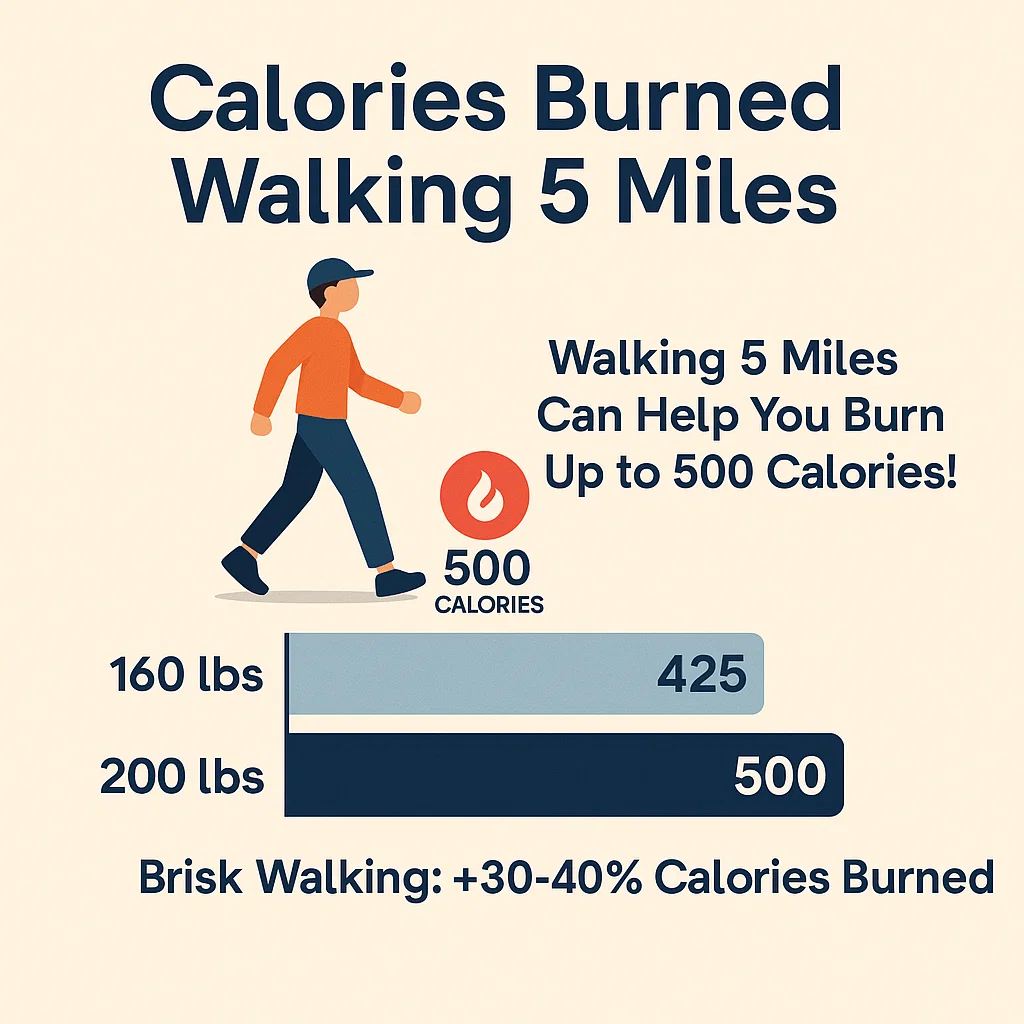
  • At a moderate pace, someone who weighs 160 lbs can burn about 425 calories during a 5-mile walk.
  • At a brisk pace, that number jumps to about 455 calories.
  • For heavier folks, it’s even more – a 200-pound person might burn closer to 500 calories, and at a brisk pace, that could go up to 568.

When I walk on a trail or in nature, I like to add a few hills to boost the calorie burn. Going uphill can burn up to 50% more calories, so if you want to make your walk a little tougher, just add a hill or two.

Pro Tip

When I’m walking in nature, I try to add an incline or some hills. It turns a casual walk into a workout without feeling like I’m pushing too hard. Plus, it’s more fun! The challenge makes it feel less like exercise and more like an adventure.

Health Benefits of Walking 5 Miles:

Walking – it’s one of the simplest and most powerful ways to boost your health, and I can personally vouch for how much it helps, not just physically but mentally, too. Let’s break down the key benefits, and why I swear by it:

Stronger Heart and Lungs. Walking regularly does wonders for your heart and lungs. It’s not just about burning calories. For me, it’s about keeping my heart and lungs strong. Walking helps drop your blood pressure, improve cholesterol, and lower your chances of heart disease. I’ve felt the difference in my own body – my heart feels stronger, and I can handle more.

Mood Boost. A quick 20-30 minute walk can get those endorphins flowing, and trust me, it’ll lift your mood instantly. Walking isn’t just a way to get in shape – it’s a way to feel better mentally. I’ve especially noticed this when I walk in nature, like around Bali’s rice terraces. That connection to nature helps me clear my mind and puts me at ease.

Stress Reduction. Walking is a great way to ease stress and get better sleep. After a tough day, I’ll lace up and go for a walk, and it makes all the difference. It’s a great way to wrap up the day, leaving the tension behind and stepping into relaxation.

The Actual Research:

Now, this isn’t just my word for it – there’s real research behind it. Check this out:

  • A study from Harvard shows that brisk walking, around 3 mph for about 3 hours a week (roughly 9-10 miles), cuts your risk of heart disease by 30-40%. That’s powerful stuff. I’ve seen the results firsthand – and they’re not just for the pros, they’re for anyone who gets out there and moves.
  • Walking also helps regulate blood pressure and cholesterol, which keeps your heart in check. It’s clear this simple activity is a game-changer for your heart health, according to this research.
  • On the mental health side, even a short walk can lead to an instant mood boost. Your brain gets more blood flow, and those endorphins kick in. A big study of 100,000 people found that the more steps you take, the less likely you are to feel down. Even small movements can have a huge impact.
  • Even a little movement goes a long way for your mental health. Trust me, every step counts. As Dr. Karmel Choi, a Harvard psychologist, said, “Even small amounts of movement can add up to support better mental health.” So, don’t worry if you can’t get out there for hours at a time – short walks add up.

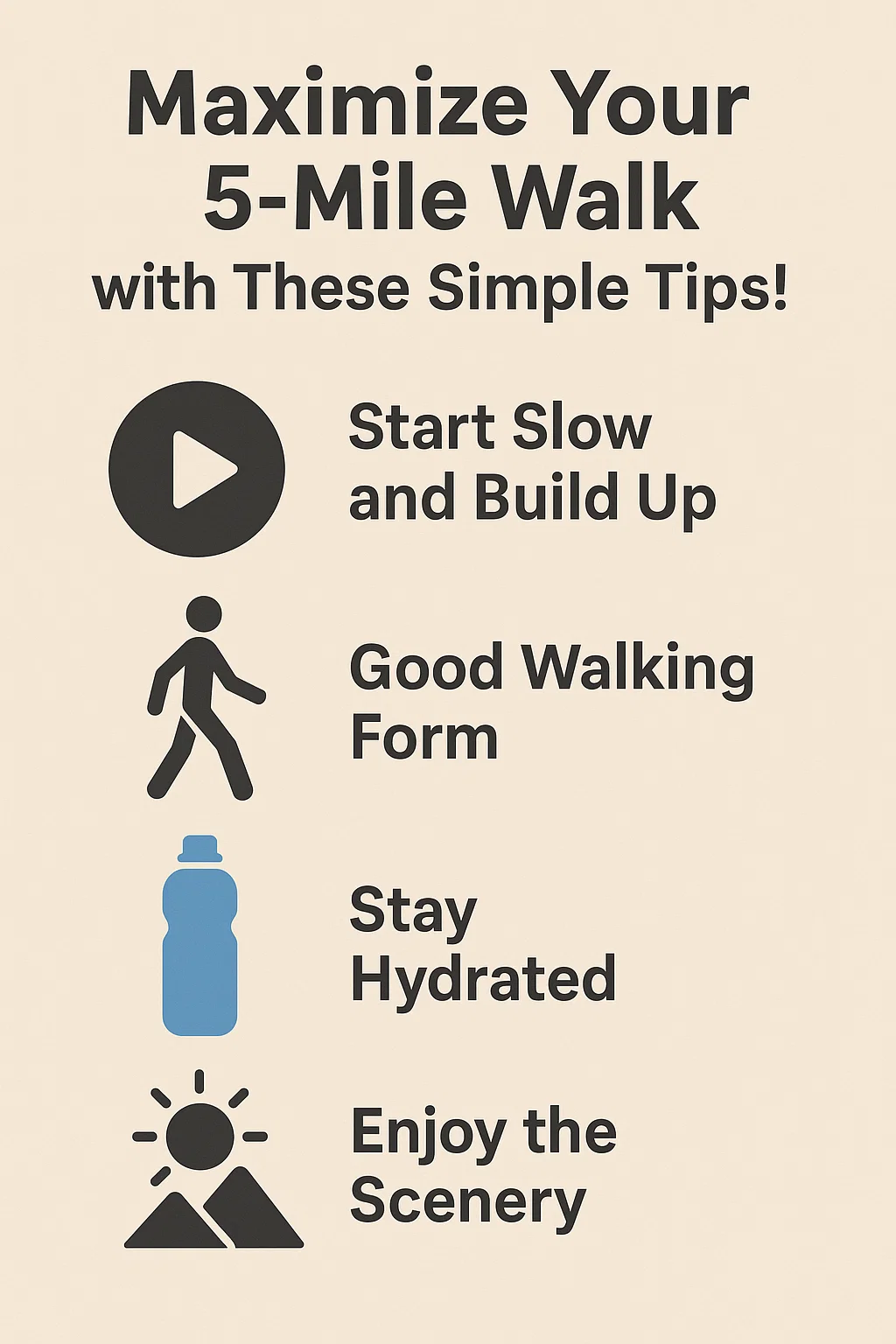
Tips for Walking 5 Miles (Form, Stamina & Motivation):

Walking 5 miles? It’s not a race, so don’t stress it. Here are some tips I’ve learned to make your walk more enjoyable and effective:

Start Slow and Build Up:

I didn’t jump straight into 5 miles. If you’re starting out, take it easy. Start with shorter walks and work your way up. There’s no rush. It’s all about consistency, not speed.

Use Good Walking Form:

Stand tall, shoulders loose, and let your arms swing naturally. Simple stuff, but it makes all the difference. If you walk with good form, you’ll feel better and avoid those annoying aches.

Stay Hydrated:

Trust me, dehydration will leave you feeling wiped out. I’ve learned that the hard way. If you’re walking for more than an hour, carry water to stay hydrated. It’ll keep you feeling good and energized.

Enjoy the Scenery:

Whether it’s a sunset or the sound of the waves, I enjoy the walk a lot more when I stop worrying about time or how far I’ve gone. Let go of any pressure to finish fast or hit a certain distance. Sometimes, it’s more about the journey.

Listen to Your Body:

Walking’s about listening to your body – knowing when to go for it and when to chill. Some days, I’m feeling strong and push myself. Other days, I’m a bit slower, and that’s okay.

Set Goals

Completing a five-mile walk is not only a physical challenge, but also a test of willpower. To motivate yourself better, some small souvenirs can help you, such as custom keychains. 

You can incorporate your goals, achievements, and some motivational slogans into the design of the keychains. Every time you achieve a goal, you can get such a keychain as a reward, which will not only make you feel more accomplished but also motivate you to continue to move forward on the road to health in the future. 

Click on Enamel Keychains to add motivation to your health goals!


average 5 miles walk time

The Bottom Line:

Walking 5 miles is a solid workout, even if you’re just getting started. Depending on your pace, it’ll take you anywhere from about an hour and a quarter to two hours, but trust me – every minute is worth it. You’ll burn some calories, strengthen your heart, and feel better every time you hit the pavement.

As one expert from the American Heart Association said, “It’s amazing what walking can do for the body, including cardiovascular health and brain health.

So, lace up those shoes, pick a route you enjoy, and forget about the clock. Whether it takes 75 minutes or 120 minutes, remember, you’re getting in better shape than anyone sitting on the couch.

FAQ: Walking 5 Miles

Q1: How long does it take to walk 5 miles?

Most people take 75 to 100 minutes to walk 5 miles at a moderate pace.

Q2: What factors affect walking speed?

Age, fitness level, terrain, weather, footwear, and even motivation can impact your pace.

Q3: How can I walk faster or longer?

Gradually increase distance, add intervals of brisk walking, and build endurance through consistent training and strength work.

Q4: Is walking 5 miles a day good exercise?

Yes! Walking 5 miles daily improves cardiovascular health, calorie burn, mood, and overall fitness.

Q5: How many calories does walking 5 miles burn?

Walking 5 miles can burn 250 to 500 calories, depending on weight, pace, and terrain.

Q6: Should I stretch after walking 5 miles?

Yes—stretching helps improve flexibility, reduce muscle tightness, and aid recovery.

Q7: Can walking 5 miles a day help with weight loss?

Absolutely! Combined with a healthy diet, walking 5 miles a day can support a sustainable weight-loss plan.

Q8: Is it okay to walk 5 miles every day?

For most people, yes—if you build up gradually and listen to your body, daily 5-mile walks can be safe and effective.

Q9: What should I wear for a 5-mile walk?

Wear comfortable, supportive shoes, moisture-wicking clothes, and consider weather-appropriate gear like hats or rain jackets.

Q10: How can I stay motivated to walk 5 miles every day?

Set goals, track progress, find a walking buddy, listen to music or podcasts, and vary your route to keep things interesting.

Further Reading on Walking and Fitness:

If you want to dive deeper into the benefits of walking and its impact on your health, here are a few studies and articles you can check out. They’ll give you even more insight into how walking can improve your life.

  1. American Heart Association (AHA): The AHA provides guidelines on physical activity, emphasizing the importance of walking for cardiovascular health. Check out their article on “Walking: A Simple Way to Get Active” for tips on how to incorporate walking into your daily routine.
  2. Centers for Disease Control and Prevention (CDC): The CDC has extensive resources on physical activity and its impact on health. Their page on “Physical Activity Basics” includes information on the benefits of walking and how much activity is recommended for different age groups.
  3. Harvard Health Publishing: For research-backed insights into the health benefits of walking, Harvard Health offers a comprehensive article titled “Walking for Health” that discusses how walking can improve cardiovascular fitness, mood, and overall well-being.
  4. National Institutes of Health (NIH): The NIH provides a wealth of information on exercise and fitness research. Their publication on “The Benefits of Walking” outlines the physical and mental health benefits of regular walking, backed by scientific studies.
  5. American College of Sports Medicine (ACSM): The ACSM is a leading authority on exercise science and sports medicine. Their position statement on “Exercise for Weight Management” discusses the role of physical activity, including walking, in weight management and overall fitness.


Curved Treadmills: Benefits, How to Use Them & Top Picks for Your Home Gym

The first time I hopped on a curved treadmill, I thought, “No big deal—I run 30+ miles a week. This’ll be fun.”

Ten minutes later, I was drenched, legs smoked, and wondering who swapped my lungs for sandbags.

It was humbling.

There was no motor carrying me along.

No speed button. Just me, my legs, and this brutal arc of a machine daring me to keep up.

That’s the beauty of curved treadmills—they force you to work for every step.

And once I caught my breath, I realized how effective (and addictive) that challenge could be.

Studies back it up: running on a curved, manual treadmill cranks up the effort by 25–30% compared to motorized ones.

And yeah, your body feels every bit of it.

So if you’re considering bringing one into your home gym—or just want to learn how to use it without getting flung off the back—this guide is for you.

What Is a Curved Treadmill?

Think of a curved treadmill as a manual treadmill with no motor and no mercy.

The running deck is U-shaped—curved like a shallow bowl.

There’s no plug, no console that controls your pace.

You move the belt with your legs. You run, it moves. You ease off, it slows. Simple as that.

The curve itself isn’t just for show—it actually does two big things:

  • Forces a more natural stride (you’ll feel yourself landing more midfoot/forefoot, not heel-slamming like on a flat treadmill).
  • Cranks up the intensity. Even a slow jog feels like an incline.

What’s more?

There’s no top speed limit.

If you’ve got the horsepower, you can go all-out without waiting for a motor to catch up. (Fun fact: some pro sprinters have hit 24+ mph on these things.)

Why It’s Tough (and Why That’s a Good Thing)

You’ll feel it immediately: a curved treadmill is always uphill, and there’s no hiding behind a pace setting.

It forces good form and punishes laziness.

You’ll likely:

  • Burn more calories per mile
  • Improve your running mechanics
  • Engage your posterior chain (glutes + hammies) more
  • Build better cardio in less time

It’s like doing a long hill repeat—without needing a hill.

How to Use a Curved Treadmill

If you’re new to these beasts, don’t jump on and sprint your heart out.

Here’s the step-by-step playbook:

Start Slow – Walk Before You Run

Hop on, grip the rails, and ease into a walk or shuffle. At first, the belt might feel like it’s glued down—just lean in and let your stride slowly build momentum.

Don’t go full send out the gate. Warm up. Or you’ll be gasping in 90 seconds.

Find Your Position

Your spot on the belt controls everything:

  • Too far forward? You’ll accidentally speed the belt up.
  • Too far back? It’ll slow or stop.
  • The sweet spot? Dead center of the curve.

Think of your body like a throttle.

Want to speed up? Lean slightly forward.

Want to slow? Ease back an inch.

It’ll feel weird at first—like learning how to ride a bike—but give it a few sessions, and it’ll click.

Lock In Your Posture

Form matters more here than on a regular treadmill training:

  • Eyes up, not down
  • Core tight
  • Shoulders relaxed
  • Lean slightly forward from the ankles, not the waist

Let the curve do some of the work. If you hunch or flail, you’ll feel it fast—probably in your lower back or balance.

Use Short, Quick Strides

Forget long, loping steps. Curved treadmills reward fast turnover and proper foot strike.

  • Short, snappy strides = smoother belt movement
  • Aim for midfoot or forefoot strikes under your hips
  • Think: light feet, fast cadence

Try to “pull” the belt backward with each step rather than pushing off. That mental cue can help you keep your feet under control.

🏁 Pro tip: Curved treadmills naturally improve cadence and stride mechanics.

You’ll carry that back to road running without even trying.

How to Run on a Curved Treadmill 

Now you know how to use the machine? Let’s get to how to actually run on it.

Let me be honest with you.

Curved treadmills aren’t your average gym toy. They’re self-powered, unforgiving, and brutally effective—if you use them right.

If you’re new to the game, expect a learning curve (literally).

But once you get the feel, these machines can sharpen your stride, crank up your cardio, and turn your glutes into steel.

Stay Loose and Centered

Here’s the deal: your first time on a curved treadmill might feel weird. Like you’re running uphill in molasses. That’s normal.

The biggest mistake? Stiffening up.

  • Don’t death-grip the handrails.
  • Don’t lock your arms or shoulders.
  • And for the love of your knees, don’t panic when the belt speeds up.

Let your body relax.

If it’s too fast, drift backward.

Too slow? Lean slightly forward.

The treadmill reacts to your body position—not buttons—so stay calm and learn how to ride that sweet spot.

Know How to Stop (Without Faceplanting)

Curved treadmills don’t have a “Stop” button. You’re the motor—and the brake.

To stop, gradually move back on the belt and let it slow.

If you’re smoked or off-balance, grab the rails and step off onto the side platforms.

Don’t be a hero. This isn’t the time to practice parkour. Grab, step, reset.

It Feels Weird at First. Stick With It.

Every runner I know who stuck with the curved treadmill for more than a few sessions ended up loving it. But yeah—it’ll humble you at first.

You’ll feel like your legs are stuck in mud.

You’ll breathe harder than you thought possible.

But once you figure out the balance and rhythm, the belt flows with you.

And the fitness payoff? Massive.

Curved Treadmill Form & Strategy

Once you’re past the awkward phase, it’s time to run like you mean it.

Here’s what I recommend to get the most out of this machine.

1. Use Real Running Form

Forget the shuffle you use on the gym treadmill. This thing won’t let you cheat.

  • Run tall but lean slightly forward—from your ankles, not your hips
  • Midfoot or forefoot strike—the curve rewards it
  • Quick cadence, active arms, high knees—treat it like you’re doing track work

A track athlete told me it’s the closest thing to outdoor running indoors—because it forces you to run right.

No lazy strides, no bouncing, no belt carrying you along.

2. Fire Up Your Glutes (And Hamstrings, And Calves…)

This machine makes you work.

You have to pull the belt back with every step.

That means your posterior chain—glutes, hammies, calves—is on full blast.

If you’ve only trained on flat motorized belts, this will feel like a different sport.

And that’s a good thing.

  • Push down and back
  • Drive your stride like you’re powering a sled
  • Engage your core and keep your torso stable

It’s why your heart rate spikes faster. You’re recruiting more muscle, burning more energy, and building real power.

3. Ditch the Pace Obsession

Almost everyone is slower on a curved treadmill. Don’t freak out.

  • Your perceived effort (RPE) is what counts
  • Most runners are 30–60 seconds per mile slower on the curved belt
  • That doesn’t mean you’re less fit—it means you’re working harder

I’ve had athletes think their treadmill was broken because their normal 8:00 pace felt like a sprint.

It’s not broken—you’re just earning it now.

Here’s how to adjust:

  • Reduce total time or distance by ~20%
  • Focus on intervals, not pace targets
  • Use heart rate or effort to guide training

4. Use It for Intervals and Tempos

This is where the curved treadmill shines. No buttons, no lag—you just run.

Want to sprint? Lean in and go.

Want to recover? Back off.

That makes it ideal for:

  • Sprints: explode, float, repeat
  • Fartleks: random effort surges
  • Tempo work: steady grind, high effort

It’s like outdoor fartlek training—without worrying about traffic or terrain.

Many athletes even use curved treadmills to simulate hill workouts, since the constant resistance builds leg strength like a mild incline would.

Should You Buy a Curved Treadmill?

Let’s cut to it: curved treadmills are badass—but they’re not for everyone. They’re hard, expensive, and a little brutal on the ego the first time you try one. But if you’ve got the right goals, they can be a game-changing tool.

Let me break it down for you:

You’re All About High-Intensity Training

If you thrive on sprints, HIIT, or getting absolutely wrecked in 20 minutes, a curved treadmill will meet you there.

It’s self-powered. There’s no “set speed” to lean on.

The harder you run, the faster it goes.

Stop moving? It stops. Perfect for interval training, CrossFit, Hyrox, or any workout that mixes cardio with strength.

You Want to Fix Your Running Form

Curved treadmills punish bad form.

Heel-strike or overstride? You’ll feel it immediately.

They naturally encourage:

  • Midfoot strike
  • Forward lean
  • Quicker cadence

If you’re looking to refine your mechanics, it’s like having a form coach under your feet.

Trail runners and forefoot strikers especially love the natural rhythm it reinforces.

You’re Building the Ultimate Home Gym (and Have the Budget)

Let’s be real—these things are not cheap. Expect $3,500–$6,000+ for a quality model.

But if it’s within reach and you’re serious about long-term fitness, it’s a high-durability investment.

No motor, no plug-in, barely any moving parts = fewer things to break.

Bonus: if you’re a coach or trainer, clients will love it. It stands out and opens up unique training options.

You Want an Eco-Friendly, No-Frills Option

No electricity.

No buzzing motor.

Just you and the belt.

Some off-grid runners buy them specifically to stay in shape during winter while sticking to their values.

It’s literally a self-sustaining training solution.

You Do Circuit or Functional Training

Ever tried a circuit where you run 400m, hop off for kettlebells, then jump back on?

With a traditional treadmill, you’re stuck waiting for it to speed up.

A curved treadmill fixes that:

  • Starts when you move
  • Stops when you stop
  • Perfect for circuit training, CrossFit WODs, or Hyrox

When a Curved Treadmill Might Not Be Right for You

As much as I love what a curved treadmill can do, it’s not for everyone.

In fact, there are a few very real reasons you might want to pass—or just stick with the one at your gym instead of buying your own.

Here’s when it might be smarter to hit pause:

1. You’re Focused on Long, Steady Endurance Runs

If your training sweet spot is 60–90 minutes of easy running—especially in aerobic zones—a curved treadmill is probably the wrong tool.

These machines are built for intensity, intervals, and form work—not long, steady efforts.

Trying to do your weekly long run on one? You’ll either fry your legs or your patience.

For base mileage and zone 2 training, you’re better off outside or on a standard treadmill with cruise control.

2. You’re on a Budget (or Just a Casual Runner)

Look—these things aren’t cheap. Many curved treadmills run $3,000–$5,000+.

If you’re not serious about using it on a regular basis—or you’re just trying to stay active without breaking the bank—it probably makes more sense to:

  • Stick with the gym’s equipment
  • Buy a solid $1,000 motorized treadmill
  • Or split your cash across a full home gym setup

Ask yourself: Will I use this thing regularly for years? If not, save the space and the cash.

3. You’re Dealing with Lower-Leg Injuries

If you’ve got Achilles issues, tight calves, plantar fasciitis, or recent calf strains—be careful.

Curved treadmills put more load on your posterior chain, especially the lower leg.

That can be a good thing for training… once you’re healthy.

But if you’re still in rehab mode, skip it for now.

You don’t want your recovery derailed by a well-intentioned sprint session on a self-propelled torture arc.

4. You Avoid Indoor Running Like the Plague

If you’re the kind of runner who braves rain, snow, and sleet just to stay outside? Be honest with yourself.

Some folks buy a fancy treadmill thinking they’ll use it “on bad days,” but end up ignoring it 350 days a year. That’s an expensive clothes rack.

That said, some outdoor diehards find that curved treadmills are the only indoor running they can tolerate—because it feels more like real running. You decide which camp you’re in.

5. You’re Tight on Space

These things are tanks. Heavy, non-folding, often 300+ pounds.

If you live in a small apartment or 5th-floor walkup with no elevator, delivering and storing one of these isn’t just inconvenient—it’s nearly impossible.

If space is a concern, opt for something lighter and more portable—or just take your runs outside.

Final Thoughts: Once You Try It, Running Will Never Feel the Same

Let’s be clear—running on a curved treadmill is a gut check. It’s not for passive miles or zone-out jogs while binging a Netflix doc. It’s for real work. Full-body engagement. Legs, lungs, and brain firing together.

The first time you try it, it might crush you. That’s part of the draw.

But give it a few sessions and you’ll feel stronger, more efficient, and probably never look at a motorized treadmill the same way again.

I don’t use mine for every run—but when I want a session that forces me to show up, stay focused, and push my limits? I get on the curve.